


A high yield checking account can help you earn interest on money you already keep available for everyday spending, bills and short-term expenses. Unlike a traditional checking account that may pay little or no interest, a high yield checking account can offer a much higher annual percentage yield (APY).
But there is an important catch: the checking account with the highest advertised APY is not necessarily the best account for you.
Some accounts offer exceptionally high rates only on the first few thousand dollars. Others require direct deposit, a certain number of debit-card purchases, electronic statements or other monthly activity. Some have no major requirements but offer a lower rate on a much larger balance.
For that reason, this guide looks beyond the headline APY. We compare the rate, balance limits, qualification requirements, fees and potential earnings so you can decide which type of high-yield checking account fits the way you actually manage money.
Rate note:
Checking account APYs and qualification requirements can change. The rates discussed below were checked against available institution disclosures in September 2026. Always confirm the current rate and terms directly with the financial institution before opening an account.
Want to estimate your potential earnings? Use our high-yield checking account calculator to see how much interest you could earn based on your balance, APY and eligible balance limit.
Best High-Yield Checking Accounts at a Glance
Rates and terms verified: September 2026. APYs shown are subject to change, and some advertised rates require customers to meet monthly qualification requirements. Always check the institution’s current disclosure before opening an account.
| Account | Advertised APY | Balance for Top APY | Key Requirements | Best For |
|---|---|---|---|---|
| AmeriCU High Rate Checking | Up to 7.00% | Up to $10,000 | 12 debit signature swipes, eStatements and qualifying loan for 7% | Highest advertised APY |
| Genisys Genius High Yield Checking | 6.75% | Up to $7,500 | 10 debit purchases of $5+ and eStatements | Very high yield on a smaller balance |
| Chartway High-Yield Checking | 5.00% | Up to $15,000 | 15 debit purchases, $500 direct deposit and eStatements | Strong yield up to $15,000 |
| Connexus Xtraordinary Checking | 4.50% | Up to $25,000 | $500 direct/ACH deposit plus debit activity and eStatements | Larger balances |
| Lake Michigan CU Max Checking | 4.00% | Up to $15,000 | Deposit, debit purchases, banking logins and eStatements | High yield with ATM access |
| Presidential Advantage Checking | 3.75% | Up to $25,000 | Electronic deposit and withdrawal requirements | Larger balances |
| Primis Premium Checking | 3.70% | No account maximum | No major qualification hoops | Simplicity and no cap |
| HOPE Rewards Checking | 5.12% | Up to $10,000 | 12 debit transactions and digital banking activity | Eligible regional members |
Important: These accounts are not directly interchangeable. Some require credit-union membership, some have geographic or eligibility restrictions, and the highest APY may apply only when specific monthly conditions are met.
How We Chose These Accounts
We evaluated these accounts based on more than the advertised APY. Our comparison considers the rate available on eligible balances, balance caps, monthly qualification requirements, fees, minimum opening deposits, ATM access, account accessibility and applicable deposit insurance. Because checking-account rates and requirements can change, readers should verify current terms directly with the financial institution before opening an account.
Want an easier way to compare high-yield checking accounts?
The headline APY is only part of the story. Our free 2026 High-Yield Checking Account Checklist helps you compare the details that can affect your real-world earnings, including APYs, balance caps, qualification requirements, fees and account activity.
Get the Free 2026 Checklist →
https://eezypost.kit.com/high-yield-checking-checklist
Free EEZYPOST Money Brief. Practical banking information. No spam. Unsubscribe anytime.
What Is a High Yield Checking Account and How Does It Work?
A high yield checking account is an interest-bearing checking account designed to pay a higher rate than many conventional checking accounts.
The account still functions primarily as a checking account. Depending on the institution, you may receive a debit card, online and mobile banking, bill pay, direct deposit, ATM access and other everyday banking features.
The difference is that your checking balance can earn interest or dividends.
The amount you earn is generally expressed as an annual percentage yield, or APY. APY accounts for the effect of compounding, making it more useful for comparing deposit accounts than the stated interest rate alone.
However, high-yield checking accounts often come with conditions.
For example, an account might advertise a 6% or 7% APY but require you to:
- Make a certain number of debit-card purchases each month
- Receive a qualifying direct deposit
- Maintain electronic statements
- Log into online or mobile banking
- Keep your balance below a specified limit
- Meet other account activity requirements
If you don’t meet the requirements, you may receive a much lower rate.
That means the qualification rules are just as important as the APY.
Best High-Yield Checking Accounts in 2026
1. AmeriCU High Rate Checking: Highest Advertised APY
AmeriCU’s High Rate Checking stands out because its current rate table lists 7.00% APY on balances up to $10,000 when the qualifications and qualifying loan requirement are met. The institution also lists a 6.00% APY tier when the qualifying loan condition is not met.
To qualify for the highest advertised rate, AmeriCU says customers must:
- Make at least 12 debit signature swipes during the monthly statement cycle
- Enroll in eStatements
- Have at least a $5,000 qualifying loan in good standing, excluding credit cards and student loans
There is no minimum balance required to open the account.
Why we like it
A 7.00% APY is exceptionally high for a checking account.
A $10,000 balance earning 7.00% for a full year would produce approximately $700 in interest, before considering changes in the rate, balance or qualification status.
The catch
The loan requirement makes this account very different from a checking account that anyone can qualify for simply by using a debit card.
If you would not otherwise want or qualify for a $5,000 loan, don’t take on debt simply to obtain a higher checking-account yield.
Best for: Consumers who already qualify for AmeriCU’s requirements and can comfortably satisfy the loan condition.
2. Genisys Genius High Yield Checking: Very High APY on a Smaller Balance
Genisys currently lists 6.75% APY for Genius High Yield Checking, effective September 2, 2026. The rate applies to qualifying balances, with balances above $7,500 earning 0.05% APY.
To earn the advertised APY, customers must enroll in eStatements and use their Genisys debit Mastercard at least 10 times per month for purchases of $5 or more. ATM transactions don’t count.
Why it stands out
The rate is extremely competitive.
At a $7,500 balance, 6.75% APY would represent approximately:
$7,500 × 6.75% = $506.25
in annual interest under a simple full-year illustration.
The catch
The balance cap matters.
If you have $25,000 sitting in checking, you should not assume that 6.75% applies to the entire amount.
This is exactly why our comparison focuses on the amount that actually earns the headline rate, rather than the APY alone.
Best for: Consumers with a relatively small checking balance who can comfortably meet the monthly debit-card requirements.
3. Chartway High-Yield Checking: Strong Yield Up to $15,000
Chartway currently lists 5.00% APY on balances up to $15,000, with the rate effective September 1, 2026. Balances above $15,000 receive a much lower rate.
The account’s qualification requirements include:
- At least 15 debit-card purchases each month
- At least $500 in direct deposits during the monthly cycle
- Enrollment in eStatements
Chartway also says the account has no monthly fee.
Potential earnings
At the $15,000 top-rate balance:
$15,000 × 5.00% = approximately $750 per year
assuming the qualifying APY remains unchanged and the account remains qualified.
The catch
You have to actively use the account.
If you don’t naturally make at least 15 qualifying debit purchases every month or cannot meet the direct-deposit requirement, the advertised rate may not be realistic for you.
Best for: Consumers who regularly use a checking account and can comfortably meet the monthly requirements.
4. Connexus Xtraordinary Checking: Best for Larger Balances
Connexus Xtraordinary Checking is particularly interesting because it combines a competitive rate with a relatively large balance cap.
The current account page advertises up to 4.50% APY on balances up to $25,000.
To earn the high yield, Connexus says customers must:
- Make 15 debit-card purchases or reach $500 in debit-card spending by month-end
- Subscribe to eStatements
- Make at least a $500 direct deposit or ACH deposit from a non-Connexus account
Connexus also lists no monthly fee for Xtraordinary Checking.
Why the $25,000 cap matters
Consider someone keeping $25,000 in checking.
At 4.50%:
$25,000 × 4.50% = approximately $1,125 per year
That can be more total interest than a checking account advertising 6% or 7% if the higher-rate account applies its APY only to a much smaller balance.
Best use case
This account makes particular sense for consumers who maintain a relatively large checking balance and don’t mind completing monthly qualification requirements.
Best for: Larger checking balances where the consumer can meet the monthly requirements.
5. Lake Michigan Credit Union Max Checking: Strong Rate Plus ATM Access
Lake Michigan Credit Union’s Max Checking currently advertises 4.00% APY on balances up to $15,000. The institution says there is no monthly fee and no minimum balance requirement.
The account’s monthly qualification requirements include:
- Direct deposit or ACH deposit
- At least 10 posted debit or credit-card purchases
- At least four online or mobile banking logins
- eStatements
The credit union also provides access to more than 55,000 ATMs through its network and advertises up to $10 per month in reimbursement for certain non-network ATM fees.
Potential earnings
At $15,000:
$15,000 × 4.00% = approximately $600 per year
The rate is lower than some headline offers, but the overall account package may be attractive to someone who values ATM access as well as interest.
Best for: Consumers who want a competitive checking yield and broad ATM access.
6. Presidential Advantage Checking: Up to $25,000
Presidential Bank’s Advantage Checking currently lists 3.75% APY on balances up to $25,000 and 2.75% APY on higher balances. The account requires a $500 minimum opening deposit.
The bank notes that the account is interest-bearing and that rates can change. It also says deposit and withdrawal requirements are waived during the first month the account is in the product.
Potential earnings
At $25,000 and 3.75%:
$25,000 × 3.75% = approximately $937.50 per year
That makes it another interesting option for people who want to keep a larger amount in checking.
Best for: Consumers looking for a higher-yield checking option with a $25,000 top-rate tier.
7. Primis Premium Checking: Best for No Major Qualification Hoops
Primis Premium Checking takes a different approach.
The bank currently advertises 3.70% APY with no minimums and no major qualification hoops, along with a $1 minimum opening deposit. Primis also advertises no overdraft fees and free nationwide ATM use.
The account has no account maximum and no cap on interest earnings, according to Primis.
Why this matters
Suppose you have $25,000 available.
At 3.70%:
$25,000 × 3.70% = approximately $925 per year
That’s slightly less than a 4.50% account on the same balance, but Primis’s simpler structure may be more attractive to someone who doesn’t want to track monthly debit purchases or direct-deposit conditions.
Best for: Consumers who value simplicity and an uncapped balance more than the highest possible APY.
8. HOPE Rewards Checking: Strong Rate for Eligible Members
HOPE Rewards Checking currently advertises up to 5.12% APY, with no monthly service charge and no minimum balance requirement.
The higher rate applies to balances up to $10,000 when the monthly requirements are met.
Those requirements include:
- 12 debit-card transactions that post and clear
- At least one login to HOPE digital banking each month
Without the qualifying activity, the account earns a substantially lower base rate.
Potential earnings
At $10,000 and 5.12%:
$10,000 × 5.12% = approximately $512 per year
The catch
HOPE has membership eligibility requirements, so this shouldn’t automatically be presented as a universally available nationwide option.
Best for: Consumers who are eligible for HOPE membership and can meet the monthly activity requirements.
How Much Can You Actually Earn With a High-Yield Checking Account?
The easiest way to understand these accounts is to stop looking at APY in isolation.
Imagine three accounts:
- Account A: 7.00% APY up to $10,000
- Account B: 5.00% APY up to $15,000
- Account C: 4.50% APY up to $25,000
At first glance, Account A looks like the obvious winner.
But the answer changes with your balance.
If you have $5,000
At 7.00%:
Approximately $350/year
At 5.00%:
Approximately $250/year
At 4.50%:
Approximately $225/year
The 7% account wins on pure yield if you can qualify.
If you have $10,000
At 7.00%:
Approximately $700/year
At 5.00%:
Approximately $500/year
At 4.50%:
Approximately $450/year
The highest APY still wins.
If you have $15,000
Now the balance caps become more important.
A 7% account that pays the headline rate only on the first $10,000 doesn’t produce 7% on the full $15,000.
By contrast, a 5% account paying its top rate through $15,000 could produce approximately:
$15,000 × 5% = $750/year
The exact result depends on how the institution treats balances above the top tier.
If you have $25,000
A 4.50% account that pays its top rate on the full $25,000 could generate approximately:
$1,125/year
That’s why Connexus’s $25,000 high-yield tier is so significant.
If you’re working toward a specific savings target, our 12-month plan for saving $10,000 breaks the goal into monthly, weekly and daily amounts.
The lesson
The best APY and the best total earnings are not always the same thing.
Always check:
- The APY
- The balance eligible for that APY
- The rate above the cap
- The qualification requirements
High APY Isn’t Everything: The Requirements Matter

High-yield checking accounts often use monthly requirements to make their highest rates available.
This isn’t necessarily bad. But you need to determine whether the requirements fit naturally into your financial routine.
Direct Deposit Requirements
Some accounts require a qualifying direct deposit every month.
This can work well if your paycheck or government benefit already goes directly into your checking account.
But if you receive irregular income, use multiple bank accounts or don’t have traditional payroll direct deposit, the requirement may be inconvenient.
Look for accounts that accept alternatives such as ACH deposits when available.
Connexus, for example, says its $500 monthly deposit requirement can be satisfied through direct deposit or an ACH deposit from a non-Connexus account.
Debit-Card Purchase Requirements
Reward-style checking accounts commonly require a certain number of debit transactions.
That can be easy if you already use your debit card for everyday purchases.
But don’t buy things you don’t need simply to earn interest.
If an account requires 15 purchases every month and you normally make only two, the account may not be a good fit.
Online Banking Requirements
Some accounts require you to log in to online or mobile banking each month.
That is generally easy to satisfy, but it is still something to understand before opening the account.
E-Statements
Electronic statements are another common requirement.
If you already use digital banking, this may not be an issue.
What Happens If You Miss the Requirements?
This is one of the most important questions to ask before opening a high-yield checking account.
The answer varies by institution.
Some accounts drop to a very low base APY.
Others may stop paying interest for that qualification period.
For example, Quontic says its High Interest Checking account earns 1.10% APY when the required debit transactions are completed, but the APY falls to 0.01% if the qualifying activity isn’t fulfilled.
That is a dramatic difference.
So don’t evaluate:
1.10% APY
without also reading:
What happens when I don’t qualify?
The same principle applies to accounts with much higher advertised rates.
Balance Caps Can Completely Change the Comparison
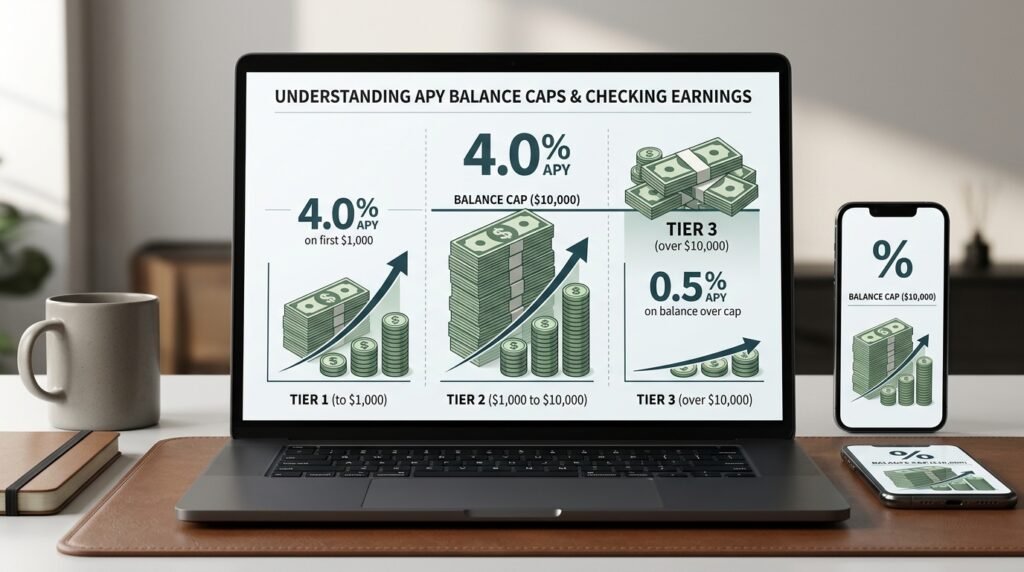
A balance cap is the maximum amount of money eligible for a particular APY tier.
Consider:
Account A
7% APY up to $10,000
Account B
4.5% APY up to $25,000
If you have $5,000, Account A may be more attractive.
If you have $25,000, Account B could produce more total interest depending on what Account A pays above its cap.
This is why EEZYPOST evaluates APY and balance eligibility together.
Before you choose a high-yield checking account, check the details—not just the rate.
Our free 2026 High-Yield Checking Account Checklist gives you a simple 10-point framework for comparing APYs, eligible balances, qualification rules, fees and other account terms.
Get Your Free Checking Account Checklist →
https://eezypost.kit.com/high-yield-checking-checklist
Free from EEZYPOST. Use it to compare accounts before you open one.
A headline rate without its applicable balance tier is incomplete information.
High-Yield Checking vs. Traditional Checking
| Feature | High-Yield Checking | Traditional Checking |
|---|---|---|
| Interest | Often higher | Often low or none |
| Debit card | Usually | Usually |
| Bill pay | Usually | Usually |
| Direct deposit | Usually | Usually |
| APY requirements | May apply | Often fewer |
| Balance caps | Common in reward accounts | Less relevant |
| Best use | Spending + earning interest | Everyday banking simplicity |
A traditional checking account can still be perfectly reasonable.
If your balance is usually very small, the difference in interest may not justify switching.
But if you routinely keep several thousand dollars in checking, earning interest on that balance can become meaningful.
If you’re still deciding between the two account types, our guide to savings vs. checking accounts explains the major differences in purpose, interest, accessibility and everyday use.
High-Yield Checking vs. High-Yield Savings
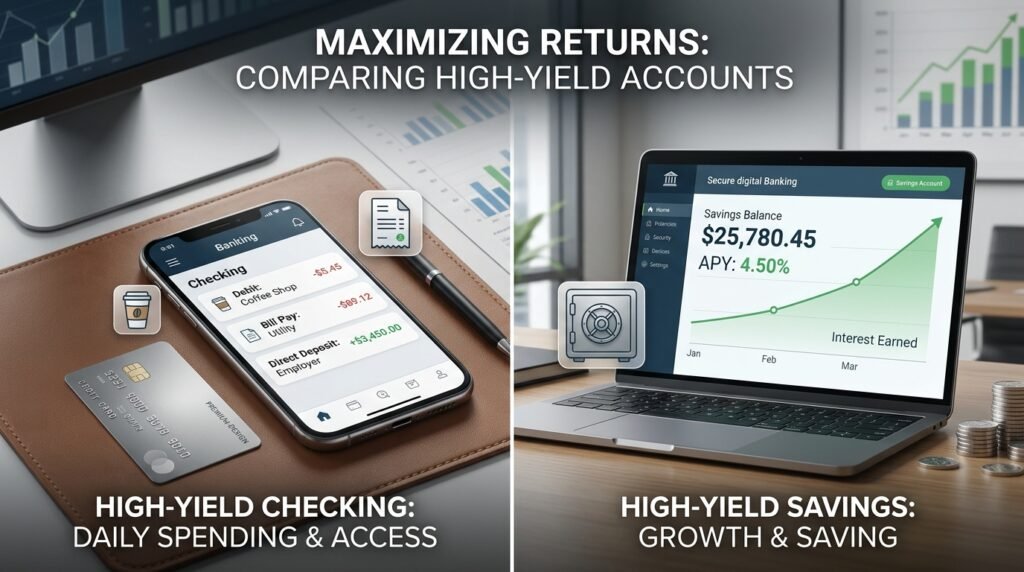
This is one of the most important decisions for consumers.
High-Yield Checking
Better suited for money you:
- Use for bills
- Spend regularly
- Need to access through a debit card
- Keep available for everyday expenses
High-Yield Savings
Better suited for money you:
- Don’t need for daily spending
- Are building for emergencies
- Want to separate from spending money
- Plan to leave untouched for longer periods
The right answer can also be both.
If you’re primarily looking for a place to keep money you don’t need for everyday spending, compare the best high-yield savings accounts before deciding where to keep your cash.
For example, someone might keep one or two months of normal expenses in a high-yield checking account and maintain a separate emergency fund in a high-yield savings account.
The best setup depends on spending habits, account rates, withdrawal rules and how much effort you’re willing to put into managing multiple accounts.
If you’re also building an emergency fund, see our guide on how much money you should have in savings to help determine how much cash should remain readily available.
High-Yield Checking vs. Money Market Accounts
Money market deposit accounts can also earn interest while providing relatively easy access to funds.
The differences depend on the specific institution.
A high-yield checking account may be preferable if you want:
- Frequent debit-card use
- Everyday bill payments
- Checking features
- Direct deposit
- Broad transaction access
A money market account may make more sense if your primary objective is earning interest on cash that you don’t spend regularly.
Always compare the actual APY, fees, minimums and transaction rules rather than relying on the account name.
Are High-Yield Checking Accounts Worth It?
For many consumers, yes.
But not every high-yield checking account is worth the effort.
Consider two people.
Person A
Keeps $8,000 in checking, receives a regular paycheck by direct deposit and already uses a debit card several times a week.
A reward checking account could make sense because the qualification requirements fit naturally into the person’s existing behavior.
Person B
Keeps $1,000 in checking, rarely uses a debit card and doesn’t receive direct deposits.
A complicated reward checking account may not be worth the hassle.
The difference in interest could be relatively small, while the account requires monthly tracking.
The practical rule
Choose the account whose requirements you can meet naturally.
Don’t change your spending habits just to chase a headline APY.
Who Should Consider a High-Yield Checking Account?
A high-yield checking account may be worth considering if you:
- Regularly keep a meaningful cash balance in checking
- Want your spending money to earn interest
- Receive qualifying direct deposits
- Frequently use a debit card
- Are comfortable using online or mobile banking
- Don’t mind meeting monthly requirements
- Want easy access to your money
It may be particularly attractive for consumers who otherwise leave several thousand dollars sitting in a traditional checking account earning almost nothing.
Who May Be Better Off With Another Type of Account?
A different account could make more sense if:
- You rarely keep money in checking
- You cannot meet the monthly requirements
- You don’t want to track transactions
- You want a simple account with minimal conditions
- Most of your money is intended for long-term savings
- You need extensive branch access
- You prefer keeping spending and savings separate
In these situations, a traditional checking account combined with a high-yield savings account could be simpler.
How We Evaluated These High-Yield Checking Accounts
We did not rank accounts solely by advertised APY.
Our evaluation considers:
1. APY and potential earnings
A higher APY can be valuable, but only when it applies to a meaningful balance.
2. Balance limits
We look at how much money can actually earn the headline rate.
3. Qualification requirements
Direct deposit, debit transactions, account logins and other requirements can materially change the value of an account.
4. Fees
A monthly maintenance fee can reduce or eliminate the benefit of earning interest.
5. Minimum opening deposit
An account shouldn’t be considered equally accessible if it requires a large initial deposit.
6. ATM access
ATM availability and reimbursement can matter for people who use cash regularly.
7. Account accessibility
Some credit unions have membership or geographic eligibility requirements.
8. Insurance
We look for applicable FDIC or NCUA insurance.
9. Practical usability
Interest is only one part of a checking account. Consumers also need access to their money, payment features, digital banking and reasonable account terms.
EEZYPOST’s Key Takeaway: Don’t Chase the Biggest APY
The biggest APY number is useful as a starting point, not as the final answer.
For example:
- AmeriCU advertises up to 7.00% APY, but its highest rate has specific qualification requirements and applies to the first $10,000.
- Genisys advertises 6.75% APY, but the headline rate applies only up to $7,500 and requires monthly debit activity.
- Chartway offers 5.00% APY up to $15,000 with monthly requirements.
- Connexus offers up to 4.50% APY on $25,000 with its qualification requirements.
- Primis offers 3.70% APY with no account maximum and no major qualification hoops.
There is no single winner for every consumer.
The best account depends on your balance, your habits and how much effort you’re willing to put into meeting the requirements.
How to Open a High-Yield Checking Account
Once you’ve selected an account, the process is generally straightforward.
Step 1: Check eligibility
Confirm whether the bank or credit union is available in your state and whether you meet any membership requirements.
If you’re considering an account that has additional eligibility or lending requirements, understanding your credit profile can also be useful. See our guide to what is a good credit score for an overview of current FICO score ranges.
Step 2: Read the current rate disclosure
Don’t rely solely on an advertisement.
Check:
- Current APY
- Balance tiers
- Qualification rules
- Base APY
- Fees
- Minimum deposit
Step 3: Calculate your potential earnings
Estimate how much you’ll actually earn based on the balance you expect to maintain.
Step 4: Confirm insurance
For banks, verify FDIC coverage.
For federally insured credit unions, verify NCUA coverage.
Step 5: Open and fund the account
Complete the application and make the required opening deposit.
Step 6: Set up qualifying activity
If the account requires direct deposit, debit purchases or other activity, establish a system for meeting those requirements.
Step 7: Monitor your qualification status
Some institutions provide tools showing whether you’ve completed the requirements.
This is especially useful when the difference between the reward APY and the base rate is significant.
Are High-Yield Checking Accounts Safe?
A high APY does not mean that an account is an investment product.
Checking accounts at FDIC-insured banks are eligible for federal deposit insurance, subject to applicable limits and ownership rules. The standard FDIC insurance amount is $250,000 per depositor, per insured bank, for each ownership category.
The FDIC specifically lists checking accounts among the deposit products it insures.
For federally insured credit unions, the National Credit Union Share Insurance Fund provides comparable protection. The NCUA states that individual accounts at federally insured credit unions are insured up to $250,000, subject to its rules and ownership categories.
However, consumers should verify that the specific institution is actually insured.
Deposit insurance also doesn’t mean every financial product offered by a financial institution is insured. For example, investments such as stocks, bonds and mutual funds are not covered by FDIC deposit insurance.
Common High-Yield Checking Mistakes to Avoid
1. Choosing based only on APY
A 7% rate may look better than 4.5%, but the lower rate could apply to a much larger balance.
2. Ignoring the balance cap
Always determine how much money actually receives the advertised rate.
3. Forgetting the qualification rules
A rate you can’t qualify for isn’t your effective rate.
4. Spending unnecessarily to earn interest
Don’t make unnecessary purchases simply to reach a debit-card transaction requirement.
5. Ignoring the fallback rate
Find out what happens if you miss a monthly requirement.
6. Ignoring fees
A monthly fee can reduce your actual return.
7. Taking on debt for an APY
If a checking account requires a qualifying loan, calculate the full financial cost before deciding whether the account makes sense.
8. Assuming every credit union is available nationwide
Credit unions can have specific membership requirements.
9. Leaving too much cash in checking
Even a high-yield checking account may not be the best place for every dollar.
10. Failing to check rates after opening
Deposit rates are generally variable and can change.
Frequently Asked Questions
What is the best high-yield checking account?
There isn’t one account that is best for everyone. A high-APY account with a smaller balance cap may be best for someone with $5,000 to $10,000, while a lower-rate account with a $25,000 high-yield tier may be more attractive to someone who keeps substantially more cash in checking.
What checking account pays the most interest?
Among the accounts reviewed for this guide, AmeriCU’s High Rate Checking currently advertises up to 7.00% APY on the first $10,000 when its qualification and qualifying-loan requirements are met.
The highest advertised APY should not automatically be interpreted as the highest overall value.
How does a high-yield checking account work?
It works like a normal checking account but pays interest or dividends on eligible balances. Some accounts require customers to meet monthly conditions to receive the highest APY.
Are high-yield checking accounts worth it?
They can be, particularly if you keep several thousand dollars in checking and can meet the account requirements without changing your normal spending behavior.
Is high-yield checking better than high-yield savings?
Not necessarily. Checking is generally designed for everyday transactions, while savings is designed more for money you don’t need for daily spending. Many people can benefit from using both.
Do high-yield checking accounts require direct deposit?
Some do and some don’t. Always check the current account disclosure. Connexus, for example, allows its $500 monthly deposit requirement to be satisfied with direct deposit or an ACH deposit from an external account.
What happens if I don’t meet the requirements?
It depends on the account. Some institutions reduce your APY to a much lower base rate. Quontic, for example, states that its High Interest Checking APY falls from 1.10% to 0.01% when the required debit activity isn’t completed.
Are high-yield checking accounts FDIC insured?
If the checking account is held at an FDIC-insured bank, eligible deposits are covered up to applicable FDIC limits. The standard limit is $250,000 per depositor, per insured bank, per ownership category.
Federally insured credit unions use NCUA share insurance instead.
How much money should I keep in a high-yield checking account?
Keep enough to cover your normal spending, bills and a reasonable cash buffer. There is no universal amount. Money you don’t need for everyday expenses may be better suited to a high-yield savings account or another appropriate deposit product.
Is a 7% checking account really better than a 4.5% checking account?
Not automatically. A 7% account may have a smaller balance cap or more demanding qualification rules. A 4.5% account paying that rate on $25,000 could generate more total interest for someone with a large checking balance.
Ready to compare high-yield checking accounts more carefully?
Don’t let a big APY number make the decision for you.
Download the free EEZYPOST 2026 High-Yield Checking Account Checklist and use it to check the APY, balance cap, qualification requirements, fees and other details that can change what you actually earn.
Download the Free Checklist →
https://eezypost.kit.com/high-yield-checking-checklist
Free. Practical. No spam. Unsubscribe anytime.
Bottom Line: Find the Account That Fits Your Money
High-yield checking accounts can turn an otherwise idle checking balance into an interest-earning balance.
But the smartest choice isn’t necessarily the account with the biggest number in the advertisement.
Before opening an account, compare:
- APY
- Balance eligible for the APY
- Monthly qualification requirements
- What happens if you don’t qualify
- Minimum opening deposit
- Monthly fees
- ATM access and reimbursement
- Direct deposit requirements
- Debit-card requirements
- FDIC or NCUA insurance
- Membership eligibility
For a smaller balance, an exceptionally high APY may provide the best return. For a larger balance, an account with a lower APY but a larger qualifying balance can potentially generate more interest. And for people who don’t want to track monthly requirements, a slightly lower uncapped rate may be the better practical choice.
The best high-yield checking account is the one whose rate, balance limits and requirements work with your actual financial habits, not the one with the biggest headline number.
Rates, APYs, fees and account requirements can change. Verify current terms directly with the financial institution before opening an account. This article is for informational purposes and is not personalized financial advice.










Leave a Reply