


You open a hospital bill for $700.
Insurance processes the claim and pays part of it. Your remaining balance is $400.
Then you search online and see a reassuring sentence everywhere: medical debt under $500 does not appear on your credit report.
So can you simply ignore the bill?
Not necessarily.
That $500 rule is real, but it is one of the most misunderstood parts of medical debt reporting. A bill staying off your credit report does not automatically mean the debt disappears. It also does not prevent every collection attempt, settle a billing dispute, or tell you whether insurance processed the charge correctly.
Here is what actually matters in 2026.
Quick Answer
Can medical debt hurt your credit? Yes, but not every medical bill can appear on your credit report. Under current nationwide credit-bureau policies, paid medical collections and medical collection accounts with an initial reported balance under $500 do not appear. Qualifying unpaid medical collection debt generally must also pass the applicable 365-day reporting period before it can appear. The debt itself can still exist even when it is excluded from your credit report.
Medical Debt Credit-Report Checker
Answer four questions to see how current nationwide medical-debt credit-reporting policies generally apply.
This tool provides general educational information about nationwide credit-reporting policies. It does not determine whether a debt is legally valid, collectible, or covered by additional state protections.
Can Medical Debt Hurt Your Credit?
Yes, some unpaid medical debt can still appear on your credit reports and potentially affect your credit.
Under the current policies used by the three major credit bureaus, unpaid medical collection debt generally must meet two important conditions before it can appear:
- The debt is more than 365 days delinquent.
- The initial reported medical collection balance is $500 or more.
The Consumer Financial Protection Bureau currently says unpaid medical debt that is more than 365 days delinquent and over $500 could appear on your credit reports.
Paid medical collections are no longer included on consumer credit reports, and medical collection accounts below the applicable $500 threshold are also excluded under the credit bureaus’ medical debt reporting policies.
That sounds simple until you apply it to a real hospital bill.
That is where people get confused.
The $500 Medical Debt Rule in Plain English
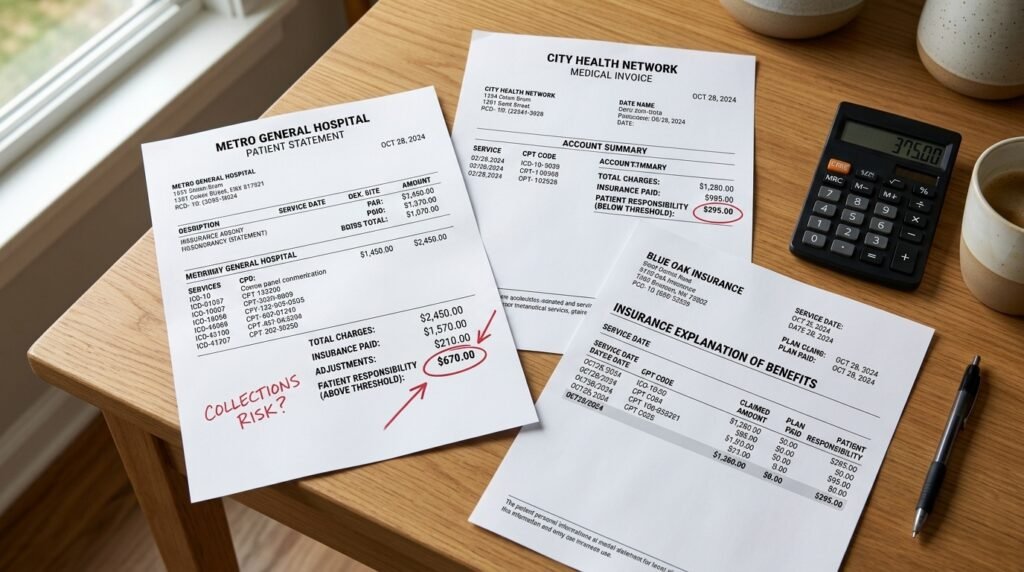
The $500 threshold concerns medical collection accounts reported to the credit bureaus.
It does not mean:
- every medical bill under $500 is cancelled;
- a provider cannot ask you to pay;
- a collection agency cannot contact you;
- every debt above $500 automatically damages your credit;
- or every hospital balance is treated the same way.
The wording that matters is the initial reported collection account balance.
TransUnion specifically states that medical collection debt with an initial reported balance under $500, as well as paid medical collection debt, does not appear on credit reports.
That distinction becomes important when insurance payments, discounts, multiple providers or partial payments are involved.
A simple Example
Suppose a hospital originally bills:
$700
Your insurer pays:
$300
Your patient responsibility becomes:
$400
The useful question is not simply, “Was the original hospital charge above $500?”
You need to determine the balance that was actually sent and reported as the medical collection account.
That is one reason you should verify the account rather than relying only on the amount printed on an old hospital statement.
Does Medical Debt Under $500 Go on Your Credit Report?
Under the current reporting policies of Equifax, Experian and TransUnion, medical collection accounts under the applicable $500 threshold generally do not appear on consumer credit reports.
But there is an important distinction:
Not appearing on your credit report and not owing the money are two different things.
A hospital, physician’s office or collection company may still attempt to collect a legitimate balance.
Your credit report is only one part of the issue.
Before deciding what to do with a smaller medical bill, find out:
- whether the amount is correct;
- whether insurance processed the claim correctly;
- whether you qualify for financial assistance;
- whether the bill is protected by federal or state law;
- and whether the provider will negotiate the balance.
Can You Pay a $1,000 Medical Collection Down to $499?
This is one of the most common misunderstandings surrounding the medical debt credit-reporting rules.
Imagine that a $1,000 medical collection has already been reported.
You pay $501 and leave a $499 balance.
It is tempting to assume the account should now qualify as medical debt under $500.
But the policies refer to the initial reported collection account balance, not simply whatever balance remains today.
That makes paying a larger collection down to $499 different from a medical collection that started with a reportable balance below $500.
If you are considering a partial payment primarily because you believe it will change how an existing collection is reported, verify the account information first.
Do not base the decision solely on the remaining balance.
What If You Have Several Medical Bills Under $500?
Medical care frequently creates more than one bill.
An emergency room visit might produce separate charges from:
- the hospital;
- the emergency physician;
- a radiologist;
- a laboratory;
- and an anesthesiologist.
Imagine receiving these three balances:
| Medical bill | Amount |
|---|---|
| Radiology | $380 |
| Anesthesiology | $425 |
| Hospital | $470 |
| Total | $1,275 |
Seeing $1,275 in total medical debt does not by itself tell you how those accounts will be treated for credit reporting.
The important question is how each collection account was furnished and what its initial reported balance was.
This is also why you should review every bill separately instead of treating a hospital visit as one single debt.
How Long Before Medical Debt Can Appear on Your Credit Report?
The three major credit bureaus established a 365-day waiting period for unpaid medical collections.
That year gives consumers time to resolve problems that are especially common with medical bills, including:
- insurance delays;
- incorrect billing codes;
- duplicate charges;
- missing insurance payments;
- financial assistance applications;
- and disagreements over what the patient actually owes.
An unpaid hospital bill therefore does not normally appear on your credit report the moment you miss its due date.
The provider may still contact you or send the account to collections before the 365-day reporting period has passed.
Those are separate events.
My Medical Bill Went to Collections. What Should I Do First?
Seeing a collection notice can make people want to pay immediately simply to make the problem disappear.
Check the bill first.
Start with the medical provider and compare the collection notice with:
- your original bill;
- your insurance Explanation of Benefits;
- any payments you already made;
- insurance adjustments;
- discounts;
- and the amount the provider says you currently owe.
Ask for an itemized medical bill if the charges are unclear.
Look for services you do not recognize, duplicate charges, incorrect dates or amounts that should have been covered by insurance.
If the collection does not belong to you or contains incorrect information, dispute the error rather than accepting it simply because a collector contacted you.
What If You Never Received the Medical Bill?
This happens more often than many people expect.
A bill may have gone to:
- an old address;
- the wrong apartment number;
- an outdated insurance record;
- a patient portal you rarely use;
- or a separate medical provider you did not realize was involved in your treatment.
Then months later, a collection letter appears.
Do not assume that a debt is either automatically legitimate or automatically fraudulent.
Verify the provider, date of service, amount owed and collection company.
Then compare that information with your insurance records.
If you do not recognize the account, request the information needed to verify it and review your credit reports for errors.
What If Insurance Should Have Paid the Bill?

A medical collection sometimes starts as an insurance problem rather than a debt problem.
For example, an insurer may deny a claim because:
- the provider used the wrong billing code;
- the claim was submitted incorrectly;
- insurance information was outdated;
- prior authorization information was missing;
- or the insurer believes the service was not covered.
Before paying a disputed balance, compare the provider’s bill with your Explanation of Benefits, often called an EOB.
The EOB should show what the provider charged, what the insurer allowed, what insurance paid and what amount the insurer says is your responsibility.
If those numbers do not match the bill, contact both the provider and your insurer.
A billing mistake is easier to address before it becomes an old collection account.
What If You Received a Surprise Out-of-Network Bill?
Some unexpected medical bills may have additional federal protections.
The No Surprises Act protects many people with private health insurance from certain unexpected out-of-network charges involving emergency services and some non-emergency services received at in-network facilities.
It also protects consumers from certain out-of-network air ambulance charges.
For example, you might choose an in-network hospital but unknowingly receive care from an out-of-network anesthesiologist or radiologist.
That does not automatically mean you must accept whatever balance appears on the bill.
If you believe a charge violates your rights, check the bill before paying or agreeing to a collection arrangement.
People who are uninsured or choose to self-pay may also have rights involving good-faith cost estimates. If you didn’t have health insurance or chose not to use it for the care, you may qualify for the federal patient-provider dispute process when a provider’s bill is at least $400 higher than that provider’s qualifying good-faith estimate. Other eligibility requirements also apply.
Didn’t the Government Ban Medical Debt From Credit Reports?
You may have seen headlines saying medical debt was being removed from credit reports entirely.
The situation changed.
The Consumer Financial Protection Bureau finalized a broader medical-debt credit-reporting rule in January 2025.
However, a federal court vacated that rule on July 11, 2025.
That means consumers should not assume that every form of medical debt is federally prohibited from appearing on a credit report in 2026.
The existing credit-bureau policies involving paid medical collections, the 365-day waiting period and qualifying medical collections below $500 remain especially important.
This distinction is worth checking whenever you read older articles about a nationwide medical-debt ban.
What Happens After You Pay a Medical Collection?
Paid medical collection debt is no longer included on credit reports under the policies adopted by Equifax, Experian and TransUnion.
If you recently paid a medical collection, give the reporting process time to update and then check your credit reports.
If you are still dealing with an unpaid account or want to understand what happens when a medical bill goes to collections, our full timeline explains the collection process, the 30-day validation period, the 365-day reporting rule, and what may happen next.
If a paid medical collection continues to appear when it should have been removed, dispute the inaccurate information with the appropriate credit bureau and keep documentation showing the payment.
This is one reason payment receipts and settlement confirmations are worth saving.
Can Medical Debt Lower Your Credit Score?
If an eligible unpaid medical collection appears on your credit report, its effect depends partly on the credit-scoring model being used.
There is no honest rule such as:
“$800 in medical debt will lower your score by 60 points.”
Credit scoring does not work that way.
The effect can vary based on:
- the scoring model;
- your existing credit history;
- other collections or late payments;
- account age;
- overall credit profile;
- and the information contained in your credit report.
Newer scoring models can treat medical collections differently from other collection accounts.
Different lenders may also use different scoring models.
That is why understanding what is a good credit score is only one part of preparing for a major loan. What appears on the underlying credit report matters too.
Can Medical Debt Affect a Mortgage Application?
Potentially.
Someone preparing to buy a home should not assume that every lender sees medical debt in exactly the same way.
Credit reports and credit scores are related, but they are not identical.
Different lending systems may use different scoring models, and underwriting can involve more than simply looking at the score shown in a consumer credit app.
If you expect to apply for a mortgage soon, review all three major credit reports early rather than discovering an unexpected medical collection during underwriting.
That gives you time to investigate incorrect information, resolve insurance disputes and document paid accounts.
Think Carefully Before Putting a Medical Bill on a Credit Card
Moving a medical bill onto a normal credit card can change the nature of the debt.
Suppose you have a $400 hospital balance and pay it with a Visa card.
The hospital has been paid.
Now you owe the credit card issuer.
If you later fail to make the credit card payments, the resulting delinquency is credit card debt, not a medical collection covered by the medical-debt reporting policies discussed above.
That does not mean using a card is always wrong.
It means you should understand what you are giving up before converting medical debt into another type of consumer debt, especially if you cannot pay the card balance quickly.
A provider’s interest-free payment plan or financial-assistance program may be worth checking first.
What If You Cannot Afford the Medical Bill?
Do not assume the amount printed on the first statement is your only option.
Contact the provider and ask about:
- an itemized bill;
- financial assistance;
- charity care;
- hardship discounts;
- uninsured or self-pay discounts;
- payment plans;
- billing corrections;
- and whether insurance can reprocess the claim.
Some hospitals have formal financial-assistance policies that can reduce or eliminate qualifying bills.
The earlier you contact the provider, the more options you may have.
Ignoring a bill because you cannot pay the entire balance today can make the situation harder to resolve later.
An unexpected medical bill is also one reason having some emergency savings can matter. Even a modest cash cushion may give you more room to resolve a billing problem without immediately turning to expensive debt.
If you already keep an emergency fund, a high-yield savings account can be one place to keep cash accessible while earning interest, depending on the account’s terms and your needs.
What Should You Do Based on Your Situation?
| Your situation | First thing to check |
|---|---|
| Medical bill under $500 | Verify whether the collection account qualifies for the under-$500 reporting policy |
| Bill started above $500 | Check the initial reported collection balance |
| Insurance reduced the amount | Compare the collection balance with your EOB and provider statement |
| Several small medical bills | Review each collection account separately |
| Bill is less than one year old | Understand the 365-day credit-reporting waiting period |
| Collection is already on your report | Verify the balance, age and accuracy |
| Paid medical collection still appears | Check for updated reporting and dispute inaccurate information |
| You never received the original bill | Verify the provider, service date and address information |
| Insurance should have paid | Contact both the provider and insurer |
| Unexpected out-of-network charge | Check your No Surprises Act protections |
| You cannot afford the bill | Ask about financial assistance and payment plans |
| You are applying for a mortgage | Review your credit reports well before applying |
Medical bills are rarely an isolated money problem. They can affect savings, monthly cash flow, debt repayment and future borrowing. Our personal finance and money management guide explains how those pieces fit together.
The Bottom Line
Medical debt can hurt your credit, but the answer depends on more than the amount printed on a hospital statement.
In 2026, the questions that matter include whether the bill went to collections, how old the debt is, what the initial reported collection balance was, whether the account has been paid and whether the bill itself is accurate.
The most important misconception is this:
A medical collection staying off your credit report does not automatically erase the debt.
If you receive a medical bill or collection notice, verify the amount before making a decision. Compare it with your insurance records, check for billing errors, understand your consumer protections and ask about financial assistance when needed.
The goal is not simply to protect a credit score.
It is to make sure you are paying the right amount, to the right party, for a debt you actually owe.
Frequently Asked Questions
Does medical debt under $500 affect your credit score?
Medical collection accounts below the applicable $500 reporting threshold generally do not appear on consumer credit reports under the policies used by the three major credit bureaus. If an account is not present on the credit report, it cannot directly affect a credit score calculated from that report.
Does medical debt disappear after one year?
No. The 365-day period relates to when qualifying unpaid medical collection debt may appear on a credit report. It does not mean the underlying debt is automatically cancelled after one year.
Does paying a medical collection remove it from your credit report?
Paid medical collection debt is excluded from credit reports under the current policies of Equifax, Experian and TransUnion. If a paid medical collection continues to appear incorrectly, review the account and dispute inaccurate reporting where appropriate.
Can a hospital send a $300 bill to collections?
A provider may still use collection methods for a legitimate unpaid bill even if the amount is below the medical collection threshold used by the major credit bureaus. Credit reporting and debt collection are not the same thing.
Can medical debt go to collections before 365 days?
Yes. A provider may send an unpaid medical bill to a collection company before 365 days have passed. The 365-day rule concerns when qualifying unpaid medical collection debt can appear on a credit report.
What if my medical bill is wrong?
Request an itemized statement and compare it with your Explanation of Benefits and other insurance records. Contact the provider and insurer to correct billing errors. If incorrect information appears on your credit report, you can also dispute it with the credit bureau.
Will medical debt affect buying a house?
An eligible unpaid medical collection may affect your credit profile, and mortgage lenders can use different credit-scoring and underwriting methods. Review your credit reports before applying for a mortgage so you have time to address inaccurate or unresolved medical collections.
Should I pay a medical bill with a credit card?
Consider the alternatives first. Once a medical bill is paid with a standard credit card, the amount you owe becomes credit card debt. If you later fall behind on the card, medical-debt credit-reporting protections generally do not apply to that credit card balance.
Is all medical debt banned from credit reports in 2026?
No. A broader CFPB rule intended to restrict medical debt on credit reports was vacated by a federal court on July 11, 2025. Existing credit-bureau policies still exclude paid medical collections and certain smaller or newer medical collections.
What is the first thing I should do when a medical bill goes to collections?
Verify the debt. Check the provider, date of service, original bill, insurance Explanation of Benefits, current balance and any previous payments before deciding how to resolve the account.








Leave a Reply