

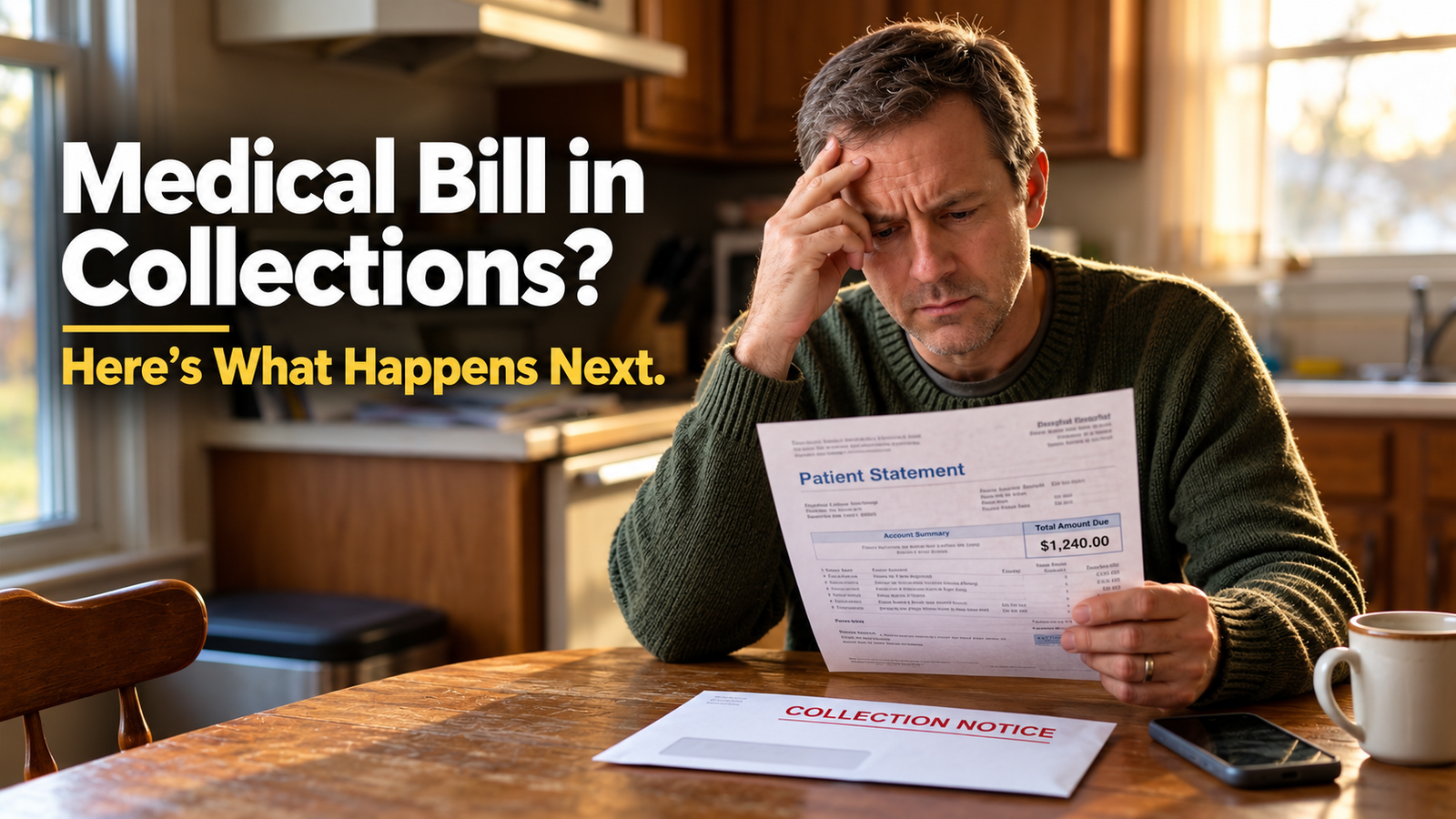
Your hospital bill is four months old.
The hospital stops calling.
Then a collection letter arrives.
Now the questions come quickly.
Did this just hurt your credit? Should you pay the hospital or the collection agency? Can you still negotiate the bill? What if insurance was supposed to pay it? And what happens if you do nothing?
Medical debt collections do not follow one universal 30-day, 90-day or 180-day schedule. Hospitals and medical practices have different billing policies. But there are several points in the process where your options, rights and credit-reporting risk can change.
Here is how the timeline generally works in 2026.
Quick Answer
An unpaid medical bill can be sent to a collection agency before it appears on your credit report. Those are two separate events.
Under current credit-bureau policies, qualifying unpaid medical collection debt generally must be more than 365 days delinquent and over $500 before it may appear on a consumer credit report. Under current nationwide credit-bureau policies, paid medical collections and qualifying medical collections with an initial reported balance under $500 generally should not appear on consumer credit reports.
If a third-party debt collector contacts you, you also have important federal rights. A collector generally must provide validation information about the debt, and a written dispute made within the applicable 30-day validation period can require the collector to pause collection until it verifies the debt.
For the latest federal explanation of how medical debt can affect credit reports, see the current CFPB medical-debt guidance.
EEZYPOST Medical Debt Timeline Checker
Use the EEZYPOST Medical Debt Timeline Checker to see where your medical bill may be in the collection process, when credit reporting could become a concern, and what you may want to check next.
This checker provides general educational information based on current medical-debt credit-reporting and debt-validation rules. Provider policies, state laws and individual circumstances can differ. It is not legal or financial advice.
What Happens When a Medical Bill Goes to Collections?
A medical bill can move from the provider’s billing department to a collection agency when it remains unpaid.
That does not automatically mean the debt has appeared on your credit report.
A collection agency may contact you by letter, phone or another permitted method and request payment. Under federal debt-collection rules, third-party collectors generally have to give you information that helps identify the debt, including the creditor, amount owed and instructions for disputing it.
Before paying, make sure the bill is accurate.
Medical debt can be complicated by insurance adjustments, duplicate charges, out-of-network services, billing errors and financial-assistance eligibility.
Medical Debt Collection Timeline
The timeline below is a practical guide, not a universal legal schedule.
A hospital may send an account to collections earlier or later depending on its own policies, insurance processing and state law.

Days 0–30: The Bill Has Arrived
At this stage, the medical provider is usually still handling the account directly.
This is the best time to check:
- whether insurance processed the claim;
- whether the patient responsibility matches your Explanation of Benefits;
- whether the bill contains duplicate or incorrect charges;
- whether you qualify for financial assistance;
- and whether the provider offers a payment plan.
If something looks wrong, do not wait months to question it.
Ask for an itemized bill and compare it with your insurance records.
Days 31–90: Resolve Insurance and Billing Problems Early
There is no federal rule saying a medical bill automatically enters collections on day 31 or day 90.
What matters is the provider’s billing policy.
During this period, you may receive reminder statements, calls or notices warning that the account could be referred for collection.
This is still a good time to contact the provider directly.
If you cannot afford the bill, ask about:
- financial assistance;
- charity care;
- hardship reductions;
- interest-free payment plans;
- self-pay discounts;
- or a billing review.
CMS states that nonprofit hospitals must provide financial assistance to eligible patients who cannot afford to pay, and other providers may offer assistance as well. CMS
Days 91–180: The Account May Move to Collections
Some medical providers may refer unpaid accounts to third-party collectors during this general period, but again, there is no universal nationwide “90-day collection rule.”
If a collection agency contacts you, slow down before sending money.
Verify:
Who is collecting?
Which medical provider is the original creditor?
What date of service is involved?
How was the amount calculated?
Did insurance pay anything?
Have you already made payments?
A legitimate debt collector generally must provide validation information either in the initial communication or shortly afterward.
The 30-Day Validation Period After a Collector Contacts You
This 30-day period is different from the age of the medical bill itself.

Once you receive the required validation information from a debt collector, the notice should state when the 30-day validation period ends.
If you dispute the debt in writing within that period, the collector generally must stop collection activity on the disputed amount until it provides verification.
This can matter if:
- the debt is not yours;
- the balance is wrong;
- insurance already paid;
- you already paid the provider;
- or the collection notice contains information you do not recognize.
Do not confuse this 30-day dispute window with the 365-day medical-debt credit-reporting period.
They are different rules.
Days 181–365: Collections Can Continue Even If the Debt Is Not Yet on Your Credit Report
This is where many people get confused.
A debt collector can be contacting you even though the medical collection has not yet appeared on your credit report.
Credit reporting and collection activity are separate.
The current medical-debt reporting policy generally gives qualifying medical collections a 365-day period before they may appear on consumer credit reports.
That time can give you an opportunity to:
- correct insurance mistakes;
- apply for financial assistance;
- negotiate with the provider;
- dispute an incorrect collection;
- or arrange payment.
But it does not mean the collector must simply wait quietly for a year.
After 365 Days: When Credit Reporting Can Become a Bigger Concern
According to current CFPB guidance, unpaid medical debt that is more than 365 days delinquent from the date of service and over $500 could appear on your credit reports.
That does not mean every qualifying debt will appear immediately on day 366.
It means the account may become eligible for reporting under the current nationwide credit-bureau policies.
If the collection appears, check:
- the initial reported collection balance;
- the date of service;
- whether the debt has already been paid;
- whether insurance adjustments are reflected;
- and whether the account actually belongs to you.
If something is inaccurate, dispute the error.
If you are unsure how lenders interpret your score, our guide to what is a good credit score explains the common score ranges.
Can a Medical Bill Under $500 Go to Collections?
Yes.
This is one of the biggest misconceptions.
A medical bill under $500 can still be sent to collections.
The under-$500 rule concerns credit reporting, not whether a legitimate debt can be collected.
So a collector may still contact you about a $300 or $400 medical bill even though that qualifying collection generally should not appear on your consumer credit reports under the current bureau policies.
For a deeper explanation of that distinction, see our guide on can medical debt hurt your credit.
Should You Pay the Hospital or the Collection Agency?
Do not guess.
First find out who currently owns or controls the account.
Sometimes the hospital still owns the debt and has simply hired an outside agency to collect it.
In other cases, the account may have been transferred or sold.
Call the provider’s billing department and ask:
- Do you still own the account?
- Can I still pay you directly?
- Will you recall the account from collections if I resolve it with you?
- Is financial assistance still available?
- What balance does your system show?
Then compare that information with the collector’s notice.
Do not assume that paying whichever party contacted you first is always the right move.
Can You Still Negotiate Medical Debt After It Goes to Collections?
Often, yes.
A bill entering collections does not automatically eliminate every option.
You may still be able to:
- request a lower balance;
- ask about a payment plan;
- apply for financial assistance;
- dispute an incorrect amount;
- or negotiate a settlement.
CMS specifically advises people whose bills are already in collections to tell collectors if they are applying for financial assistance and to ask whether collection activity can be paused while the application is reviewed. CMS
Get any agreement in writing before paying.
Can You Settle Medical Debt for Less?
A provider or collection agency may agree to accept less than the full balance, but there is no standard settlement percentage.
One account might be negotiable.
Another might not be.
Before offering a settlement, verify that the debt is correct.
If you reach an agreement, ask for written documentation showing:
- the agreed amount;
- whether that amount fully satisfies the debt;
- who will receive payment;
- and what will happen to any remaining balance.
Do not rely only on a verbal promise.
What If Insurance Made the Mistake?
This is one of the most important reasons not to pay a collection blindly.
Suppose the collector says you owe $1,200.
But your Explanation of Benefits shows your responsibility should have been $450.
That is not just a payment problem.
It may be a billing or insurance problem.

Compare:
Provider bill
Insurance EOB
Collection notice
Look for:
- missing insurance payments;
- rejected claims;
- coding mistakes;
- duplicate services;
- incorrect patient responsibility;
- or charges that may fall under federal surprise-billing protections.
The CFPB notes that debt collection or credit reporting involving medical charges that exceed amounts permitted by the No Surprises Act may violate federal law.
What If the Medical Collection Is Wrong?
Do not ignore it.
A debt collector’s validation notice should give you information about the account and explain how to dispute it.
If you dispute the debt in writing within the applicable 30-day validation period, the collector generally must pause collection of the disputed amount until it responds with verification.
Useful records include:
- insurance EOBs;
- hospital statements;
- payment receipts;
- financial-assistance approvals;
- email correspondence;
- and notes from phone calls.
Keep copies.
Can a Hospital or Debt Collector Sue You for Medical Debt?
A creditor or collector may sometimes pursue medical debt through the courts, subject to applicable federal and state law.
That does not happen automatically because a bill is late.
Rules vary considerably by state.
Nonprofit hospitals also have federal obligations involving financial assistance before they take certain extraordinary collection actions.
The IRS requires tax-exempt hospital facilities to make reasonable efforts to determine whether a patient is eligible for financial assistance before engaging in certain extraordinary collection actions. Those actions can include lawsuits, liens and certain other legal measures.
If you receive actual court papers, do not ignore them.
A lawsuit is different from a routine collection letter.
Can Medical Debt Lead to Wage Garnishment?
Potentially, but not simply because a collection agency sends you a letter.
Typically, a creditor would first need to pursue legal action and obtain whatever court authority applicable law requires before remedies such as wage garnishment could become available.
The details depend heavily on state law and the type of income involved.
If you are threatened with legal action or receive a lawsuit, consider speaking with a consumer-law attorney or legal-aid organization.
What Happens If You Ignore Medical Debt Completely?
Ignoring the bill does not guarantee it will disappear.
Possible outcomes can include:
- continued collection calls or letters;
- transfer to another collection agency;
- loss of opportunities to correct insurance problems;
- missed financial-assistance deadlines;
- credit reporting if the account eventually qualifies;
- or legal collection activity in some cases.
A debt collector can also continue trying to collect some older debts even after the statute of limitations for filing a lawsuit has expired, although federal law prohibits suing or threatening to sue on a time-barred debt.
Doing nothing is therefore a decision with consequences.
Does Medical Debt Ever Go Away?
There are three different clocks people often confuse.
Credit-reporting timeline
This determines whether qualifying medical collection information may appear on your credit reports.
Statute of limitations
This concerns how long legal action can be brought to collect a debt.
The period varies by state and circumstances. CFPB notes that many jurisdictions use periods between three and six years, but some are longer.
The debt itself
A statute of limitations expiring does not necessarily erase the debt.
A collector may still be able to request voluntary payment even if legal action is time-barred, subject to applicable law.
Be careful with very old debt because in some states a partial payment or acknowledgment can affect the statute-of-limitations calculation.
What If You Cannot Afford the Medical Bill?
Do not assume collections means you have no options left.
Contact the provider and ask whether you can still apply for:
- financial assistance;
- charity care;
- hardship relief;
- a lower negotiated balance;
- or a payment plan.
CMS says nonprofit hospitals must provide financial assistance to eligible patients who cannot afford to pay, and advises consumers to ask the hospital billing department directly about available programs.
Unexpected healthcare costs are also one reason emergency savings matter, even when the fund is still small.
For tax-exempt hospitals, federal rules also require written financial-assistance policies and certain procedures before extraordinary collection actions.
For money you are building for emergencies, a high-yield savings account can keep cash accessible while earning interest.
Medical Debt Timeline at a Glance
| Stage | What may be happening | What to do |
|---|---|---|
| 0–30 days | Provider billing | Check EOB, itemized bill and insurance |
| 31–90 days | Reminders and possible past-due notices | Ask about errors, assistance and payment plans |
| 91–180 days | Account may be referred to collections | Verify who owns the debt and validate the amount |
| 181–365 days | Collection activity may continue | Resolve disputes and financial assistance while credit-reporting protections may still apply |
| 365+ days | Qualifying $500+ unpaid medical collection may become reportable | Review credit reports and dispute inaccuracies |
| After collector notice | Separate 30-day validation period may apply | Dispute incorrect debt in writing promptly |
The first four time ranges are general billing stages, not mandatory legal deadlines.
What Should You Do Today?
If your medical bill has already gone to collections, use this order:
1. Verify the debt.
Make sure it is yours and the amount is correct.
2. Check insurance.
Compare the bill with your EOB.
3. Call the medical provider.
Ask whether it still owns the debt and whether assistance is available.
4. Read the collector’s validation notice.
Pay attention to the 30-day dispute deadline.
5. Do not pay an incorrect bill just to stop the calls.
Dispute inaccuracies.
6. Get agreements in writing.
Especially settlements and payment arrangements.
7. Check your credit reports.
If the debt appears when it should not, dispute the reporting.
The Bottom Line
A medical bill going to collections does not mean everything happens at once.
The collector may contact you months before the account becomes eligible to appear on your credit report.
The biggest mistake is treating every deadline as the same deadline.
There is the provider’s billing timeline.
There is the collector’s 30-day validation period.
There is the medical-debt 365-day credit-reporting period.
There may also be a state statute of limitations.
Understanding which clock you are dealing with makes it much easier to decide what to do next.
Medical debt is also part of the bigger picture of personal finance and money management, especially when unexpected healthcare costs collide with savings, credit and monthly cash flow.
If the amount looks wrong, verify it.
If insurance should have paid, investigate the claim.
If you cannot afford the bill, ask about financial assistance.
And if a collector contacts you, do not assume that receiving the letter means the debt is automatically accurate.
Frequently Asked Questions
Can medical debt go to collections before 365 days?
Yes. A provider may send an unpaid medical bill to a collection agency before 365 days have passed. The 365-day period relates to when qualifying unpaid medical collection debt may appear on your credit report, not when a provider can begin collection activity.
How long before a hospital sends a bill to collections?
There is no single nationwide deadline. Hospitals and medical providers use different billing and collection policies.
Should I pay a medical collection immediately?
First verify the debt, amount, insurance processing and collector. If the debt is correct, you can then evaluate payment, negotiation or financial-assistance options.
What is the 30-day rule for debt collectors?
After receiving required validation information, you generally have a 30-day validation period to dispute the debt. A timely written dispute can require the collector to pause collection until it provides verification.
Can a $400 medical bill be sent to collections?
Yes. The current under-$500 policy concerns credit reporting, not whether a provider or collector can seek payment.
Can medical debt hurt your credit after 365 days?
Qualifying unpaid medical debt that is more than 365 days delinquent and over $500 could appear on your credit reports under current guidance.
Can I negotiate medical debt after it goes to collections?
Potentially. You may still be able to negotiate, seek financial assistance, arrange payment or dispute an inaccurate balance.
Can a collection agency sue for medical debt?
Legal action may be possible depending on the debt and applicable state law. A debt collector cannot sue or threaten to sue on a time-barred debt under federal rules.
Does medical debt disappear after the statute of limitations expires?
Not necessarily. The statute of limitations usually concerns the time available to pursue legal action. A debt may still exist even after a lawsuit becomes time-barred.
Can I still get hospital financial assistance after the bill goes to collections?
Possibly. CMS advises consumers whose bills are already in collections to tell collectors they are seeking financial assistance and ask whether collections can be paused during the process.









Leave a Reply