

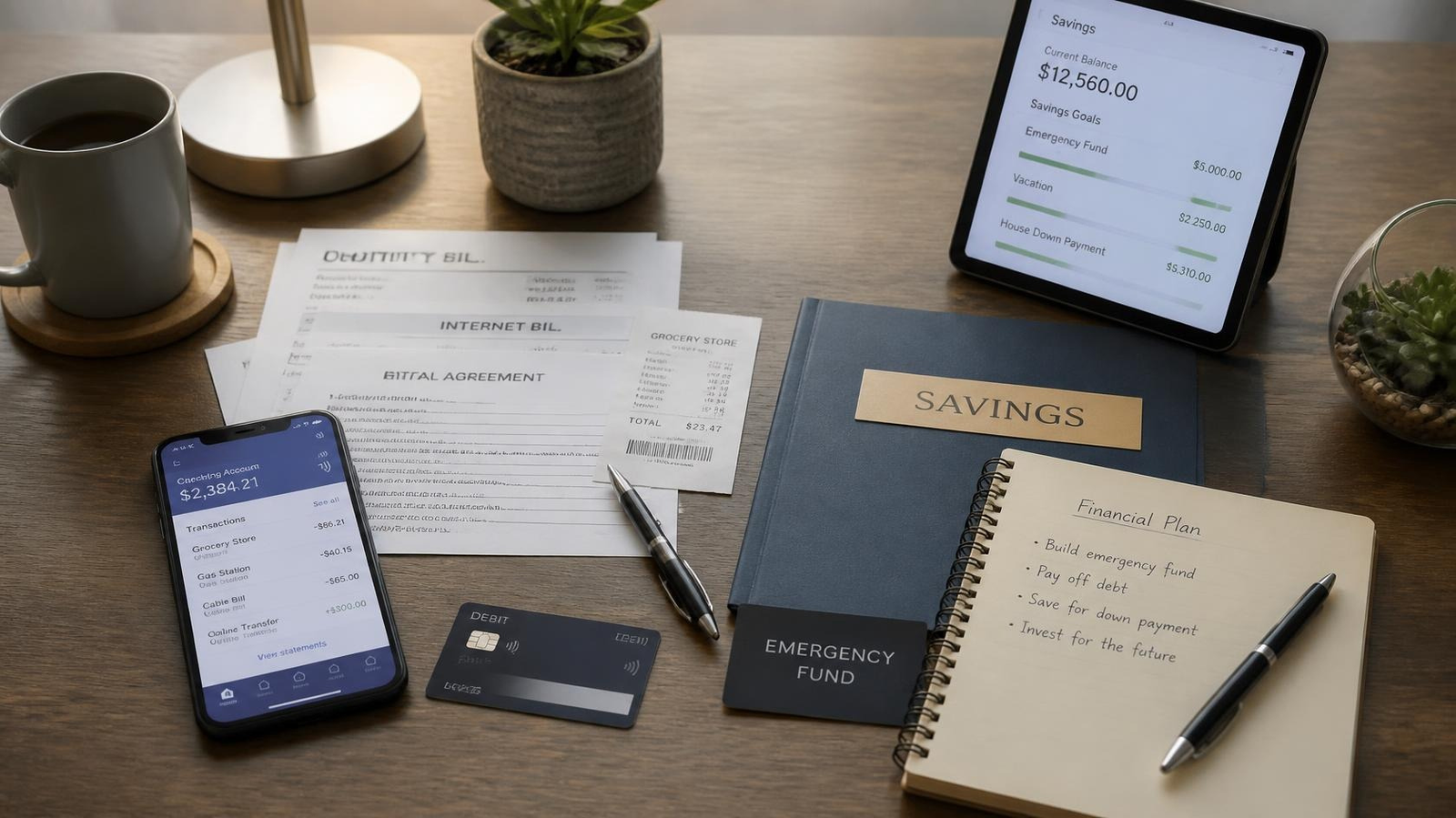
Savings vs. checking account is not just a question of where your money sits. It can affect how easily you pay your bills, how much interest your cash earns, and whether you’re prepared when an unexpected expense arrives. The good news is that you usually don’t have to choose just one. A checking account can handle the money you spend regularly, while a savings account can give the money you want to protect a separate place to sit and potentially earn interest.
For many people, the smartest setup isn’t checking or savings. It’s checking and savings, with each account doing a different job.
In simple terms, a checking account is generally designed for frequent transactions such as direct deposits, bill payments, debit-card purchases and everyday spending. A savings account is generally designed for money you want to set aside for emergencies, planned expenses and financial goals, and it typically earns interest.
The real question, then, isn’t simply which account is better.
It’s where should each dollar go?
Quick Answer: Savings vs. Checking Account
A checking account is usually best for money you expect to spend regularly. That can include your paycheck, rent or mortgage, utilities, subscriptions, groceries, transportation and other everyday purchases.
A savings account is generally better for money you want to keep separate from everyday spending. Common examples include an emergency fund, vacation savings, a future car purchase, a home down payment or other short-term financial goals.
Here’s the basic framework:
- Paycheck → Checking
- Bills → Checking
- Daily spending → Checking
- Emergency fund → Savings or high-yield savings
- Short-term goals → Savings or high-yield savings
- Cash you don’t need immediately → Consider a competitive savings account based on APY, fees and access
You can also have both accounts at the same bank or at different financial institutions.
The right choice depends less on choosing a winner and more on giving each account a clear job.
Checking vs. Savings Account at a Glance
| Feature | Checking Account | Savings Account |
|---|---|---|
| Main purpose | Everyday spending | Setting money aside |
| Interest/APY | Often low or none | Typically higher than checking |
| Debit card | Common | Depends on account |
| Checks | Common | Less common |
| Bill payments | Well suited | Less suited |
| Emergency fund | Possible | Common choice |
| Savings goals | Possible | Better suited |
| Access | Designed for frequent transactions | Accessible, but account rules vary |
| Best use | Money you expect to spend | Money you want to keep and grow |
The exact features, fees, interest rates and transaction rules vary by financial institution and account.
What Is a Checking Account?
A checking account is a deposit account designed for managing money you need to access frequently.
Think of it as your financial operating account.
Your employer may deposit your paycheck into it. You may use it to pay your rent, mortgage, utilities, insurance, subscriptions and credit-card bills. You can also use the associated debit card for purchases and withdraw cash from ATMs.
The Consumer Financial Protection Bureau (CFPB) explains that checking accounts are commonly used for everyday transactions, including receiving direct deposits and making payments, although available features and fees vary by account.
What Does a Checking Account Do?
A checking account gives you a convenient place to receive and spend money.
Typical uses include:
- Receiving direct deposits
- Paying rent or a mortgage
- Paying utility bills
- Paying credit-card balances
- Making debit-card purchases
- Sending electronic payments
- Using online bill pay
- Withdrawing cash
- Writing checks
- Transferring money to savings
- Receiving refunds or other payments
The important characteristic is access.
You generally don’t open a checking account because you want your money to sit untouched for years. You open one because you expect money to move in and out regularly.
Do Checking Accounts Earn Interest?
Some checking accounts pay interest, but many do not, and interest-bearing checking accounts may come with requirements or fees.
Some checking accounts pay interest, but they may have specific requirements or fees. The CFPB notes that interest-bearing checking accounts can have relatively low rates and may require minimum balances or other conditions.
That means you shouldn’t automatically choose an interest-bearing checking account just because it advertises an interest rate.
Consider the entire account:
- Interest rate
- APY
- Monthly fee
- Minimum balance
- Direct-deposit requirements
- ATM fees
- Overdraft policies
- Other account conditions
If a checking account pays a little interest but charges a monthly fee that exceeds what you earn, the higher rate isn’t necessarily helping you.
Thinking about an interest-earning checking account? Check the fine print first.
Some checking accounts offer attractive APYs, but the rate may depend on balance limits, direct deposit, debit-card activity, fees or other requirements.
Our free 2026 High-Yield Checking Account Checklist gives you a simple way to compare those details before opening an account.
Get the Free 2026 Checklist →
https://eezypost.kit.com/high-yield-checking-checklist
Free from EEZYPOST. Practical banking information without the hype.
What Is a Savings Account?
A savings account is a deposit account designed primarily for holding money you don’t expect to spend every day.
Instead of keeping all your available cash in the same account you use for groceries and bills, you can move money into savings and give it a separate purpose.
For example, you might have:
Checking: $2,500 for upcoming expenses and everyday spending
Savings: $8,000 for emergencies and financial goals
This separation can make it easier to see how much money is actually available for spending.
What Is a Savings Account Used For?
A savings account can be useful for money you want to keep accessible but don’t need for routine transactions.
Common uses include:
- Emergency savings
- Vacation funds
- Car repairs
- A future vehicle
- Home expenses
- A down payment
- Medical or other unexpected expenses
- Annual insurance payments
- Holiday spending
- Other short-term financial goals
Savings accounts are especially useful when you want to create some psychological distance between your spending money and your reserves.
If all your money is sitting in one checking account, it can be easy to see the entire balance as available to spend.
Separating your savings changes that.
Do Savings Accounts Earn Interest?
Generally, yes.
Savings accounts commonly pay interest on deposited money, although the rate varies by account and can change over time.
The annual percentage yield (APY) is a useful number to compare because it reflects the annualized return from interest, including the effect of compounding under the account’s terms.
For example, suppose you keep $10,000 in an account that earns a 4% APY for a full year and the rate and balance remain unchanged. The approximate interest would be $400 before taxes.
Actual earnings can differ because balances, rates and compounding may change.
Want to estimate your potential interest earnings? Use our high-yield checking account calculator to test different balances and APYs.
That’s one reason a savings account can be more appropriate than checking for money you don’t expect to spend soon.
What Are the Benefits of a Savings Account?
The main benefits include:
1. Separating savings from spending
Keeping savings away from your everyday spending account can make it harder to spend money accidentally.
2. Earning interest
Savings accounts generally pay interest, allowing your cash to earn something while remaining accessible.
3. Building an emergency fund
A dedicated savings account can provide a place for unexpected expenses without requiring you to rely immediately on credit cards or loans.
An emergency fund is money set aside for unexpected, necessary expenses rather than planned purchases. The amount you need depends on factors such as your essential expenses, income stability and access to other financial resources.
4. Saving toward specific goals
You can use separate savings accounts or account subcategories for goals such as travel, a car, a home or annual expenses.
5. Maintaining liquidity
Unlike many long-term investments, a standard savings account is designed to keep your money relatively accessible.
That combination of accessibility and interest is one reason savings accounts are commonly used for short-term cash reserves.
Savings vs. Checking Account: 9 Key Differences
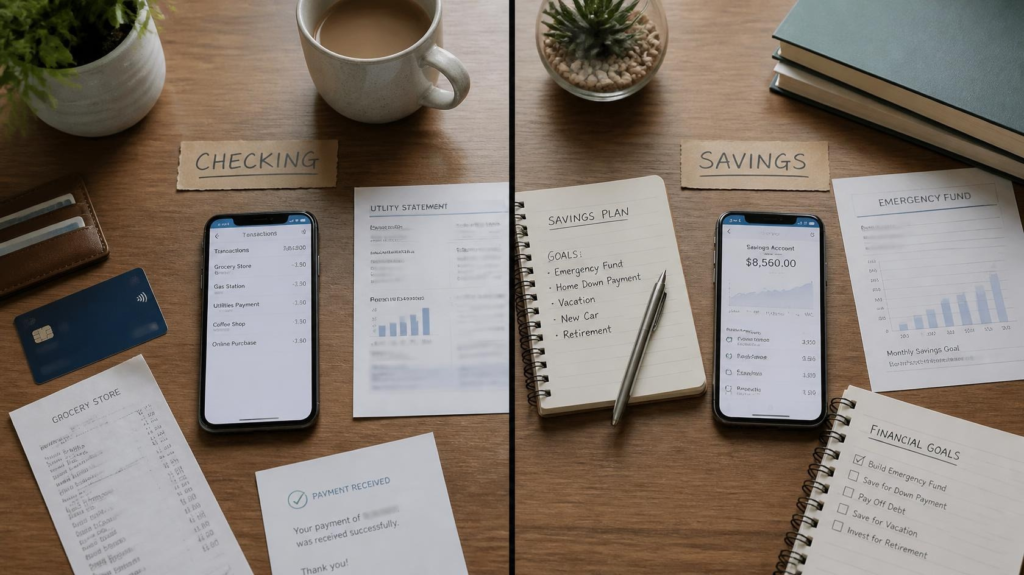
The biggest differences become clearer when you look at what each account is designed to do.
1. Purpose
The primary difference is purpose.
Checking is for spending.
Savings is for setting money aside.
A checking account is useful when money needs to move frequently. A savings account is useful when you want money to remain available but separated from everyday spending.
This doesn’t mean you can never spend money from savings or never keep savings in checking. It simply reflects the typical purpose of each account.
2. Interest and APY
Savings accounts generally have a stronger interest-earning purpose than traditional checking accounts.
Checking accounts may pay no interest or a relatively low rate. Some specialized checking accounts do pay interest, but they may have additional requirements or fees.
When comparing accounts, look beyond the advertised interest rate.
Check:
- APY
- Minimum balance requirements
- Monthly fees
- Direct-deposit requirements
- Promotional rates
- Rate-change conditions
- Withdrawal or transfer policies
A higher APY can be valuable, but only if the account’s conditions work for you.
3. Access to Your Money
Checking accounts are built around frequent access.
You may use your debit card several times a day, make electronic payments, write checks or transfer money.
Savings accounts are also accessible, but the account may have different rules concerning transfers, withdrawals, debit-card use or other transactions.
A bank or credit union can impose its own limits or fees on savings-account transactions.
The CFPB notes that financial institutions may charge fees or impose restrictions on certain savings-account transactions, depending on the account terms.
So don’t assume every savings account works exactly the same way.
4. Debit Cards
Checking accounts commonly come with debit cards.
You can generally use the card to:
- Buy groceries
- Pay at restaurants
- Shop online
- Pay for gas
- Withdraw cash
- Make other everyday purchases
Savings accounts may offer ATM or debit-card access, but that depends on the account.
If you plan to use a debit card constantly, checking is usually the more straightforward choice.
5. Checks
Checks are traditionally associated with checking accounts.
You may use a checking account to write checks for rent, contractors, services or other payments.
Some savings products may provide limited check-writing or payment features, but you should never assume they do.
Always check the specific account agreement.
6. Bill Payments
Checking accounts are generally better suited to recurring bills.
Your checking account may be connected to:
- Rent or mortgage payments
- Electricity
- Water
- Internet
- Cell phone service
- Insurance
- Streaming services
- Credit-card payments
- Loan payments
This is another reason to keep enough money in checking to cover your upcoming obligations.
Using savings as your primary bill-paying account can make your financial system more complicated and could expose you to account-specific transaction limits or fees.
7. Fees and Minimum Balances
Both checking and savings accounts can have fees.
Possible charges include:
- Monthly maintenance fees
- Excess transaction fees
- ATM fees
- Overdraft fees
- Non-sufficient funds fees
- Wire fees
- Other service charges
Some accounts waive monthly fees if you maintain a minimum balance or receive qualifying direct deposits.
Before opening an account, look at the complete fee schedule rather than focusing only on the interest rate.
8. Transaction Policies
This is one area where outdated advice can cause confusion.
You may still see articles claiming that federal law limits every savings account to six withdrawals or transfers per month.
That is not the current federal rule.
In April 2020, the Federal Reserve amended Regulation D and removed the six-per-month transfer and withdrawal limit from the definition of savings deposits. The former federal six-transfer limit is therefore no longer a universal federal requirement.
However, individual banks and credit unions may still impose their own transaction limits or fees under the terms of a particular account.
Always check your account agreement for the current rules.
9. Best Use
The easiest way to remember the difference is:
Checking = money with a job today.
Savings = money with a job later.
Your checking account can handle your regular cash flow.
Your savings account can hold money for emergencies and future goals.
Neither is automatically “better.” They solve different problems.
Where Should You Keep Your Money?
Instead of asking whether checking or savings is better, assign each dollar a purpose.
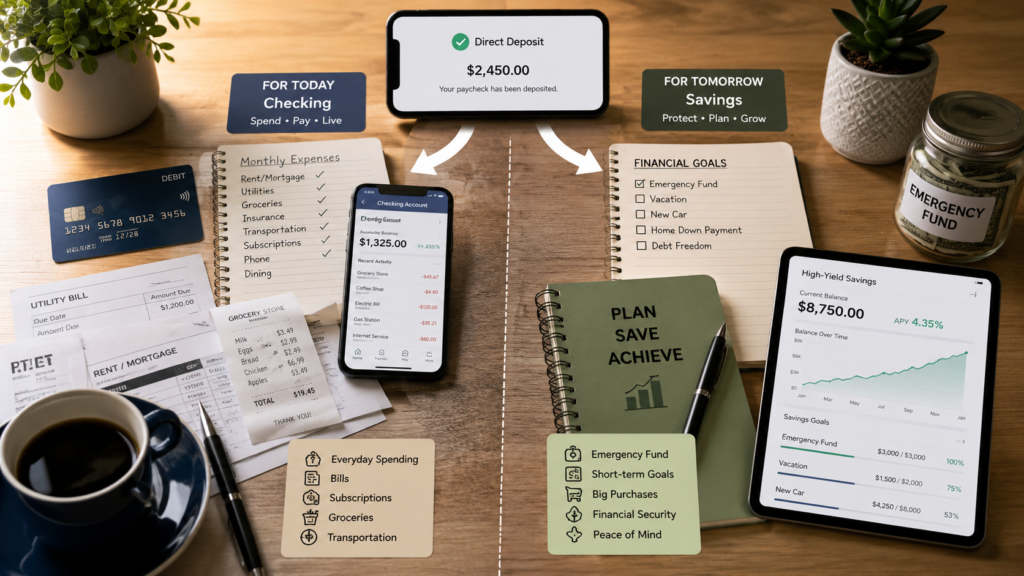
Money for Everyday Spending → Checking
Money you expect to spend in the near future generally belongs in checking.
That can include:
- Your next rent payment
- Utilities
- Groceries
- Transportation
- Subscriptions
- Insurance
- Credit-card payments
- Regular discretionary spending
The goal isn’t to keep as much money as possible in checking.
The goal is to keep enough there to comfortably handle your normal cash flow.
Money for Emergencies → Savings or HYSA
Emergency money generally deserves a separate place.
An emergency fund is designed for expenses you didn’t plan for, such as:
- A major car repair
- An unexpected home expense
- A sudden necessary trip
- A temporary income interruption
- Other urgent expenses
A savings account or high-yield savings account can be useful because the money remains relatively accessible while potentially earning interest.
Money for Short-Term Goals → Savings or HYSA
Money you’re saving for a known goal can also fit well in savings.
For example:
Vacation: $2,000
New car: $8,000
Home project: $3,500
Annual insurance bill: $1,200
Keeping these funds separate from checking makes the goal visible and reduces the temptation to spend the money on something else.
Money You Don’t Need Immediately → Consider APY, Fees and Access
If you have a larger amount of cash that you don’t expect to use for everyday expenses, compare the account’s:
- APY
- Fees
- Minimum balance
- Withdrawal and transfer rules
- Access options
- Rate conditions
- FDIC or NCUA insurance status, as applicable
A high-yield savings account may be worth considering when the goal is to earn a more competitive return while keeping the money relatively accessible.
If you’re comparing high-yield savings accounts, don’t choose based on APY alone. Look at fees, minimum balance requirements, withdrawal and transfer rules, access options and whether the rate is competitive for the current market.
For more guidance on comparing these accounts, see our guide to Best High-Yield Savings Accounts.
Checking vs. Savings vs. High-Yield Savings
A high-yield savings account isn’t necessarily a completely different category from a savings account.
It is generally a savings account designed to offer a more competitive interest rate than many traditional savings accounts.
Here’s the simplest comparison:
| Account | Primary Job | Typical Access | Interest Potential | Best For |
|---|---|---|---|---|
| Checking | Spending | Frequent | Low or none | Bills and everyday purchases |
| Traditional Savings | Saving | Accessible | Usually higher than checking | Emergency funds and goals |
| High-Yield Savings | Saving while seeking competitive APY | Accessible, account-dependent | Often higher than traditional savings | Larger cash reserves and savings goals |
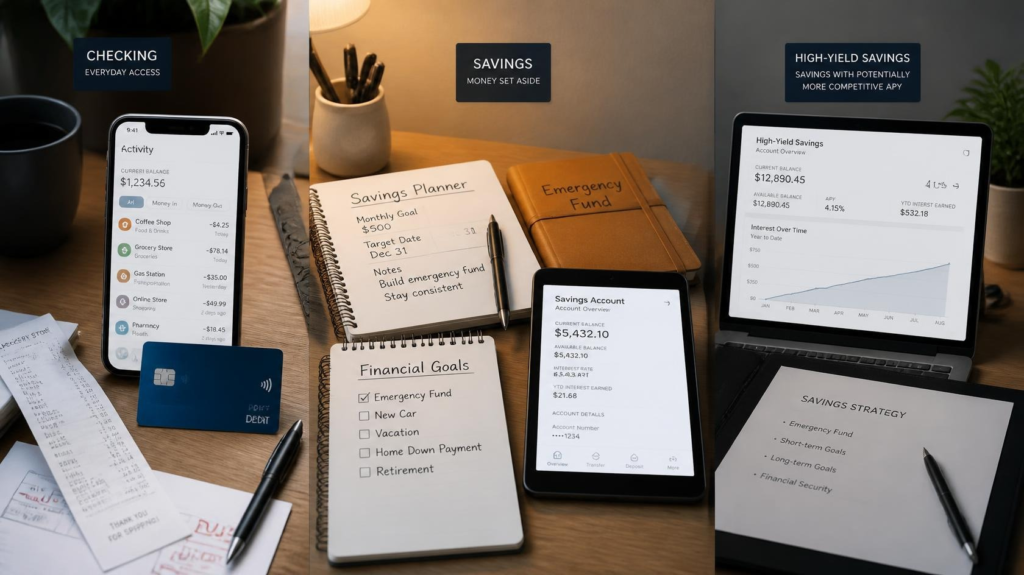
The important word is competitive.
A high-yield savings account does not guarantee that its rate will always be the highest available. Rates can change, and account requirements vary.
If you’re comparing HYSAs, don’t look at APY alone. Consider whether the account has monthly fees, minimum balances, transfer requirements or access restrictions that matter to you.
Should You Have Both a Checking and Savings Account?
For many people, yes.
Having both can create a simple two-account system.
Checking
Use it for:
- Paychecks
- Rent or mortgage
- Utilities
- Subscriptions
- Groceries
- Transportation
- Everyday purchases
- Regular bills
Savings or HYSA
Use it for:
- Emergency savings
- Vacation
- Car
- Home purchase
- Home repairs
- Annual expenses
- Other financial goals
This separation creates a useful mental boundary.
When you look at your checking balance, you know approximately how much is available for normal spending.
When you look at your savings balance, you know how much you’ve protected for future needs.
You can also automate transfers between the two accounts.
For example, if you get paid every two weeks, you could automatically move a set amount into savings on payday.
That turns saving into a system rather than something you have to remember to do.
How Much Should You Keep in Checking vs. Savings?
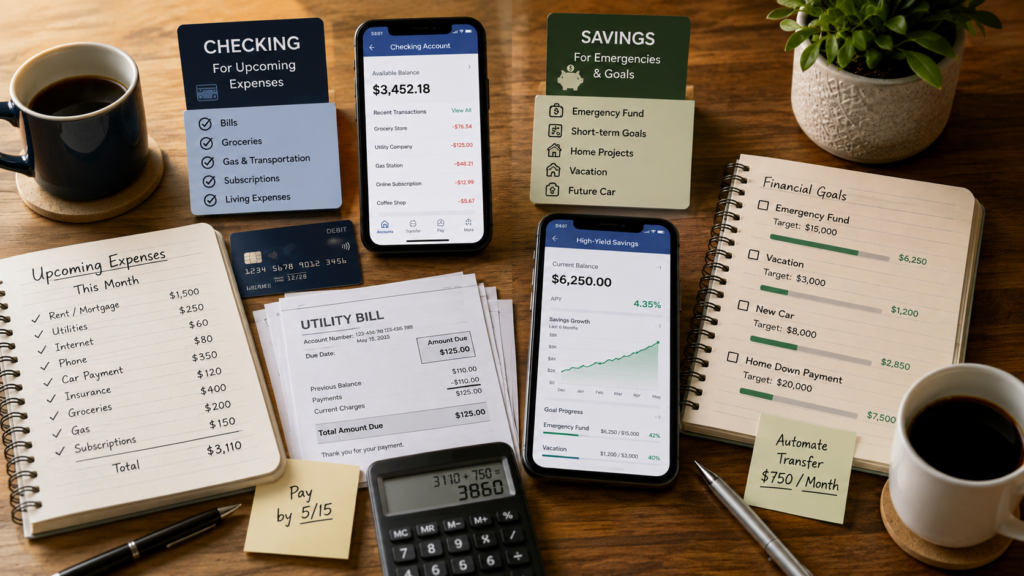
There isn’t one correct dollar amount for everyone.
Someone with a stable salary paid twice a month may need a different checking balance than someone whose income changes from week to week.
Instead of choosing an arbitrary number, consider what each account needs to accomplish.
Checking: Upcoming Expenses + Normal Spending + Buffer
Your checking balance should generally be enough to cover:
- Upcoming bills
- Expected everyday spending
- Scheduled automatic payments
- A reasonable cash-flow buffer
For example, if your next paycheck arrives in two weeks and you know you have several bills due before then, your checking balance needs to account for those obligations.
You don’t necessarily need to keep your entire emergency fund in checking.
Savings: Emergency Fund + Short-Term Goals + Planned Reserves
Your savings balance can include:
- Emergency savings
- Money for known upcoming expenses
- Short-term goals
- Other cash reserves
How much you need depends on your income, expenses, job stability, household situation and financial obligations.
Instead of asking, “What is the magic savings number?”
Ask:
If something unexpected happened tomorrow, how much cash would I realistically need?
That question produces a much more useful answer.
Can You Use a Savings Account Like a Checking Account?
Sometimes, but that doesn’t mean you should.
Depending on the financial institution, a savings account may provide:
- ATM access
- Transfers
- Online transfers
- Mobile banking
- Debit-card access
- Check deposit
- Other payment features
But the exact features vary.
A savings account may also have transaction limits or fees even though the Federal Reserve no longer imposes the old six-transfer federal limit.
For everyday spending, checking is usually simpler.
A savings account works better when you want to hold money rather than constantly move it.
Can You Write Checks From a Savings Account?
Usually, checking accounts are the account designed for writing checks.
Some financial institutions may offer savings products with payment features, but check-writing availability depends on the specific account.
If writing checks is important to you, confirm that the account explicitly supports it before opening the account.
Can You Deposit a Check Into a Savings Account?
In many cases, yes.
You may be able to deposit a check into a savings account through:
- A bank branch
- An ATM
- Mobile check deposit
- Other deposit methods offered by the institution
If your bank accepts mobile or ATM check deposits, you may be able to deposit a check directly into either a checking or savings account, although available deposit methods and fund-availability policies vary by institution.
There can also be a difference between when a bank accepts a check and when the deposited funds become available for withdrawal.
Are Savings Accounts Limited to Six Withdrawals?
No, not as a universal federal requirement.
This is one of the most important updates to understand when reading older articles about savings accounts.
The Federal Reserve removed the former Regulation D six-per-month limit on convenient transfers and withdrawals from savings deposits in 2020.
However, individual financial institutions can still set their own policies.
For example, a bank may choose to:
- Limit certain types of transfers
- Charge an excessive-use fee
- Require another account for frequent transactions
- Apply specific withdrawal conditions
So the practical rule is:
Don’t assume there is a federal six-withdrawal rule. Check your account’s current terms instead.
Are Checking and Savings Accounts FDIC Insured?
Checking and savings accounts at FDIC-insured banks can generally qualify for federal deposit insurance, subject to the applicable coverage rules.
The standard FDIC coverage limit is $250,000 per depositor, per FDIC-insured bank, per ownership category.
Importantly, the limit generally applies to your deposits within an ownership category, not separately to every individual account.
For example, if you have $150,000 in a checking account and $150,000 in a savings account as single-owner deposits at the same FDIC-insured bank, the $300,000 total would generally be considered together for the $250,000 single-account coverage limit.
If you have deposits approaching the insurance limit, the FDIC’s deposit insurance calculator can help you understand how coverage may apply to different account ownership categories.
Different ownership categories can receive separate coverage under FDIC rules.
Common categories include:
- Single accounts
- Joint accounts
- Certain retirement accounts
- Trust accounts
- Certain employee benefit accounts
- Certain business accounts
The details can become more complicated with multiple ownership structures, beneficiaries and accounts, so anyone with deposits approaching or exceeding the standard coverage limit should verify their specific situation with the FDIC.
FDIC insurance generally covers eligible bank deposit products such as checking accounts, savings accounts, certificates of deposit and certain other deposits. It does not insure stocks, bonds, mutual funds or other investments against market losses.
Credit unions have separate federal insurance through the National Credit Union Administration when the credit union is federally insured.
Which Account Should You Choose?
The best choice depends on what you want the money to do.
Choose Checking If You Need:
- Everyday spending
- A debit card
- Frequent transactions
- Direct deposit
- Regular bill payments
- Check writing
- Easy access to spending money
Checking is your everyday financial hub.
Choose Savings If You Need:
- An emergency fund
- Money for short-term goals
- A place to separate savings from spending
- Interest on your cash
- A reserve for future expenses
Savings is your financial holding area.
Consider a High-Yield Savings Account If You:
- Are building a larger savings balance
- Want to seek a more competitive APY
- Don’t need the money for everyday transactions
- Want your cash to remain relatively accessible
- Are comfortable with the account’s requirements and access methods
The key is to compare the entire account, not just the headline APY.
Comparing APYs? Don’t stop at the headline rate.
A higher APY isn’t always the better deal. The balance eligible for that rate, qualification requirements, fees and fallback rate can all affect what you actually earn.
Download the free EEZYPOST 2026 High-Yield Checking Account Checklist and use it to compare the details that matter.
Download the Free Checklist →
https://eezypost.kit.com/high-yield-checking-checklist
Free. Practical. No spam. Unsubscribe anytime.
A Simple System for Managing Both Accounts
You don’t need a complicated budgeting system to make checking and savings work together.
A simple approach is:
Step 1: Receive your income in checking
Your paycheck or other regular income can arrive in your checking account.
Step 2: Cover your expected bills
Keep enough in checking for rent, utilities, debt payments, subscriptions and other scheduled expenses.
Step 3: Move savings automatically
Transfer a predetermined amount to savings after payday or according to your budget.
Step 4: Keep emergency savings separate
Treat your emergency fund as money reserved for genuine unexpected needs, rather than ordinary spending.
Step 5: Use savings for planned goals
Create separate goals for things such as travel, a car, home expenses or annual bills.
Step 6: Review your account terms
Every few months, check whether your account still offers reasonable fees, APY and features for your needs.
This system gives every dollar a purpose.
Before you move your money, compare the account—not just the APY.
Use the free EEZYPOST 2026 High-Yield Checking Account Checklist to review APY, balance caps, qualification requirements, fees and other account terms.
It takes the guesswork out of comparing high-yield checking accounts.
Get Your Free Checklist →
https://eezypost.kit.com/high-yield-checking-checklist
Free EEZYPOST Money Brief. Practical information for smarter banking decisions.
The Bottom Line
The savings vs. checking account decision doesn’t have to be an either-or choice.
For most people, checking and savings can work better together than either account alone.
Checking is generally where your spending money belongs.
Savings is generally where money for emergencies, goals and future expenses belongs.
And if you have a substantial amount of cash that you don’t need for daily spending, a high-yield savings account may be worth considering if its APY, fees, access and requirements fit your situation.
The most useful question isn’t:
“Should I use checking or savings?”
It’s:
“What job does this money need to do?”
If the money needs to pay a bill tomorrow, checking makes sense.
If the money needs to cover an emergency six months from now, savings may make more sense.
If the money can sit untouched while still remaining accessible, comparing competitive savings accounts may be worthwhile.
Once each dollar has a job, the checking-versus-savings decision becomes much easier.
Frequently Asked Questions
1. Is it better to keep money in checking or savings?
It depends on what you need the money for. Checking is generally better for everyday spending and upcoming bills, while savings is generally better for emergency funds, short-term goals and money you don’t expect to spend regularly.
Many people benefit from using both.
2. Can I have both a checking and savings account?
Yes. You can generally have both, either at the same financial institution or at different institutions. Using checking for everyday expenses and savings for reserves can make it easier to separate spending from saving.
3. Does a savings account earn interest?
Generally, yes. Savings accounts commonly pay interest, although rates vary by financial institution and account. The APY is a useful figure when comparing accounts because it reflects the annualized effect of interest and compounding.
4. What does a checking account do?
A checking account is designed for frequent transactions. Common uses include receiving direct deposits, paying bills, making debit-card purchases, withdrawing cash, writing checks and transferring money.
5. Can you write checks from a savings account?
Some savings products may offer payment features, but checking accounts are generally designed for check writing. Always verify the specific account’s features before assuming checks are supported.
6. How much money should I keep in checking?
Keep enough to cover upcoming bills, normal spending and a reasonable buffer. The appropriate amount depends on your income schedule, expenses, payment dates and financial stability.
There is no universal checking-account balance that works for everyone.
7. How much money should I have in savings?
Your savings target depends on your expenses, income stability, emergency needs and financial goals. Instead of focusing on one arbitrary dollar amount, consider how much you would realistically need for unexpected expenses and planned short-term goals.
8. Can I use a savings account for everyday spending?
You may be able to make withdrawals, transfers or even certain purchases from some savings accounts, depending on the institution. However, savings accounts may have account-specific transaction limits or fees, making checking generally more suitable for everyday spending.
9. Is a high-yield savings account better than a regular savings account?
It can be useful if you’re looking for a more competitive APY on money you want to keep accessible. But “better” depends on the complete account. Compare APY, fees, minimum balances, access options and account requirements before making a decision.
10. Are checking and savings accounts FDIC insured?
Eligible checking and savings deposits at FDIC-insured banks can generally receive FDIC insurance, subject to applicable limits and ownership categories. The standard limit is $250,000 per depositor, per insured bank, per ownership category.
If you use a federally insured credit union, deposits are generally insured through the NCUA rather than the FDIC.
Editorial note:
Banking products, APYs, fees and account terms can change. Always review the current disclosures and terms provided by the financial institution before opening or moving money into an account. This article is for educational purposes and is not individualized financial advice.
Sources: Federal Deposit Insurance Corporation (FDIC), Federal Reserve, and Consumer Financial Protection Bureau (CFPB).






Leave a Reply