


Saving $10,000 in one year sounds difficult until you break the goal into smaller numbers.
To save $10,000 over 12 months, you need to set aside about $833 per month, $192 per week, or roughly $27.40 per day.
But there is an important catch: you do not necessarily need to find an extra $833 in your budget every month.
A more realistic strategy is to combine several sources of savings. You might reduce some recurring expenses, automate part of every paycheck, earn additional income, and put windfalls such as a tax refund or work bonus toward the goal.
The right approach depends on your income, expenses, debt, and existing savings. The goal is not to make your life miserable for 12 months. It is to create a system that makes reaching $10,000 possible without relying on willpower alone.
This guide explains how to build that system, how much you need to save each month, where to find the money in your budget, and what to do if you fall behind.
How Much Do You Need to Save to Reach $10,000?
The simplest way to approach the goal is to divide $10,000 by your deadline.
| Timeline | Amount to Save |
|---|---|
| 12 months | $833.33 per month |
| 6 months | $1,666.67 per month |
| 4 months | $2,500 per month |
| 52 weeks | About $192.31 per week |
| 26 biweekly paychecks | About $384.62 per paycheck |
| 12 months | About $27.40 per day |
You do not have to follow the daily figure literally. Monthly or paycheck-based savings are usually easier to manage because most household income and bills are organized around pay periods and monthly expenses.
The important number is your monthly savings gap.
For example, suppose you can comfortably save $500 per month from your regular paycheck.
At that rate, you would save $6,000 in a year.
Your remaining gap would be $4,000.
Instead of trying to cut another $333 from your monthly budget, you could combine smaller changes:
- $150 per month from reduced expenses
- $100 per month from extra income
- $83 per month from occasional windfalls or other savings
Together, those changes close the gap.
That is the basic idea behind the $10,000 Savings Gap Method.
Can You Really Save $10,000 in One Year?
Yes, but whether it is realistic depends on your financial situation.
Someone earning $100,000 with relatively low fixed expenses may be able to save $10,000 without making major lifestyle changes.
Someone earning $40,000 while supporting a family and carrying expensive debt may find the same target extremely difficult.
That does not mean the second person is bad at saving. It means the goal needs to be considered in relation to cash flow.
The Consumer Financial Protection Bureau recommends getting a realistic picture of where your money comes from and where it goes before setting a savings plan.
Before committing to $10,000, ask yourself:
- How much do I take home each month?
- How much are my essential expenses?
- How much debt do I have?
- How much am I already saving?
- Do I have an emergency fund?
- Is my income stable?
- Are there large expenses coming during the year?
If the numbers do not work, you have three choices:
- Save more each month.
- Increase the amount of money coming in.
- Give yourself more time.
There is nothing wrong with taking 18 months instead of 12 months if that makes the plan sustainable.
The $10,000 Savings Gap Method
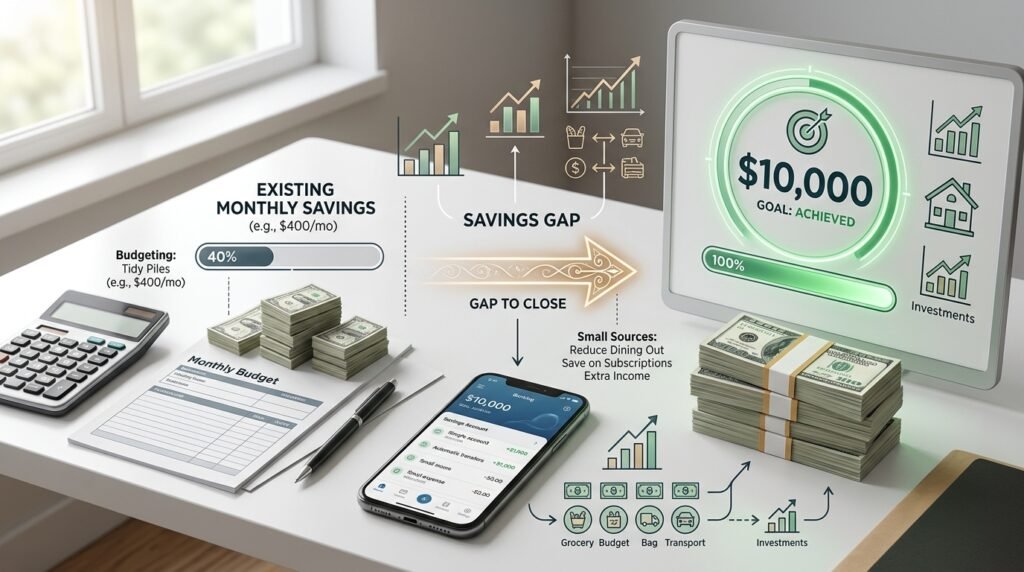
Instead of asking, “How can I find $10,000?” start with a smaller question:
How much of the $10,000 can my current budget already produce?
Then calculate the gap.
Step 1: Find your current monthly surplus
Look at your actual take-home income and expenses.
Do not rely on memory.
Review several months of bank and credit-card transactions so you capture expenses that happen less frequently, such as insurance, medical costs, gifts, school expenses, travel, and annual subscriptions. The CFPB similarly recommends reviewing several months of spending when building a realistic budget.
Suppose your numbers look like this:
Monthly take-home income: $5,000
Essential and regular expenses: $4,200
Current surplus: $800
That gives you an important starting point.
You are already close to the $833 monthly requirement.
You may only need to find another $33 per month.
Step 2: Calculate your remaining savings gap
Suppose you can currently save $600 per month.
Over 12 months:
$600 × 12 = $7,200
Your remaining gap is:
$10,000 − $7,200 = $2,800
Now the problem looks much smaller.
You need to find about $233 per month rather than $833.
Step 3: Reduce expenses
Look for expenses that can be reduced without damaging your quality of life.
Start with large recurring expenses rather than obsessing over tiny purchases.
Step 4: Increase income
If your budget has little room for cuts, additional income may be the more practical solution.
Step 5: Automate the difference
Once you know what you can realistically save, automate it.
The CFPB says automatic transfers can make saving more consistent, including transfers from checking to savings or splitting a paycheck so part goes directly into savings.
Choose a $10,000 Savings Plan That Fits Your Income
There is no single correct way to save $10,000.
The CFPB also notes that savings contributions can be structured around different time periods, including daily, weekly, or payday amounts.
Here are four approaches.

The $833-per-month plan
This is the simplest approach.
Transfer approximately $833 into savings every month.
It works best if your income is stable and your budget has enough room.
The paycheck-by-paycheck plan
If you are paid twice a month, you could aim for about $417 per paycheck.
If you receive 26 biweekly paychecks each year, the target is approximately $385 per paycheck.
This approach can feel easier because you are dividing the goal according to when money actually arrives.
The weekly plan
Saving approximately $192 per week gets you to roughly $10,000 over 52 weeks.
This can work particularly well for people with weekly income or those who prefer smaller, frequent transfers.
The hybrid plan
For many people, this is the most realistic option.
For example:
- $500 per month from your normal budget
- $150 per month from expense reductions
- $100 per month from extra income
- $83 per month from bonuses, refunds, or other irregular money
Total:
$833 per month
The point is not where every dollar comes from.
The point is creating a repeatable system that gets you to the target.
Where to Find Money in Your Budget
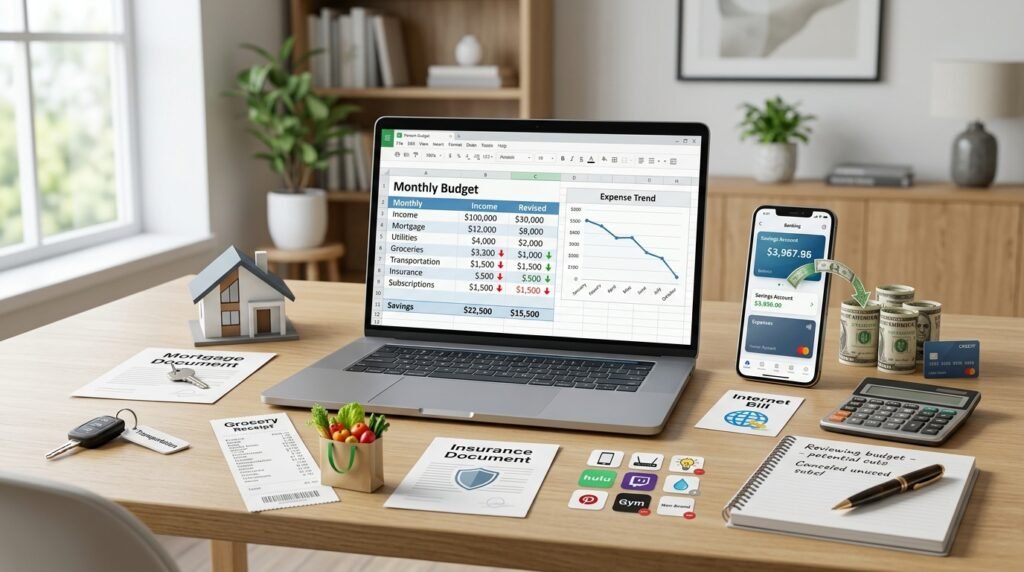
If you are serious about saving $10,000, do not start by cutting every enjoyable activity from your life.
Start with expenses that are large, recurring, and relatively easy to change.
Start with your largest recurring expenses
Review:
- Housing
- Transportation
- Insurance
- Phone plans
- Internet
- Utilities
- Debt payments
- Subscription services
A $100 monthly reduction creates $1,200 of annual savings.
A $250 monthly reduction creates $3,000.
Large recurring expenses can therefore have a much bigger impact than dozens of tiny spending cuts.
Reduce food and grocery spending
Food can be another flexible category.
That does not mean living on the cheapest food possible.
Instead, look for patterns.
You might:
- Plan meals before shopping.
- Compare grocery prices.
- Reduce food delivery.
- Cook larger batches.
- Use food you already have before buying more.
- Set a weekly restaurant budget.
If you reduce food spending by $100 per month, that is another $1,200 toward your annual goal.
Review subscriptions and recurring charges
Go through your bank and credit-card statements.
Look for:
- Streaming services
- Fitness memberships
- Apps
- Software
- Cloud storage
- Delivery memberships
- Subscription boxes
- Services you rarely use
You may discover recurring expenses you forgot about.
Lower transportation costs
Transportation can be one of the largest household expenses.
Depending on your circumstances, potential savings might come from:
- Combining errands
- Reducing unnecessary driving
- Shopping around for insurance
- Using public transportation
- Carpooling
- Maintaining your vehicle properly
- Delaying a vehicle upgrade
Do not make a major transportation decision solely to save a few dollars without considering the full cost.
Review insurance and household bills
It can be worth reviewing insurance premiums and other recurring household bills.
Ask whether you are paying for coverage or services you no longer need, and compare available options when appropriate.
The goal is not simply to spend less.
The goal is to make sure your money is going toward things that matter to you.
How to Make Up the Difference With Extra Income

Sometimes your budget simply does not have enough room to produce another $833 per month.
In that situation, increasing income can be more effective than cutting expenses further.
Overtime and extra shifts
If your employer offers overtime, additional shifts may be one of the simplest ways to increase income.
Before relying on overtime, remember that availability can change.
Do not build a 12-month savings plan around overtime that your employer cannot consistently provide.
Freelancing and contract work
Depending on your skills, you may be able to earn additional money through:
- Writing
- Design
- Consulting
- Tutoring
- Photography
- Programming
- Administrative work
- Digital services
Even an additional $200 to $300 per month can make a significant difference over a year.
Sell things you no longer need
Look around your home for items you no longer use.
Furniture, electronics, clothing, tools, sports equipment, and other possessions may generate one-time cash.
Do not count uncertain sales as guaranteed monthly income.
Instead, treat them as opportunities to accelerate the goal.
Use bonuses and windfalls strategically
A tax refund, work bonus, cash gift, or other unexpected payment can give your savings goal a major boost.
The CFPB specifically identifies one-time inflows such as tax refunds as opportunities to put money toward savings goals.
You do not necessarily have to save 100% of every windfall.
For example, you might decide in advance that 70% goes toward the $10,000 goal and 30% can be used for something else.
The important thing is having a rule before the money arrives.
Your 12-Month $10,000 Savings Plan
If you save the same amount every month, your progress would look like this:
| Month | Monthly Contribution | Total Saved |
|---|---|---|
| 1 | $833 | $833 |
| 2 | $833 | $1,666 |
| 3 | $833 | $2,499 |
| 4 | $833 | $3,332 |
| 5 | $833 | $4,165 |
| 6 | $833 | $4,998 |
| 7 | $833 | $5,831 |
| 8 | $833 | $6,664 |
| 9 | $833 | $7,497 |
| 10 | $833 | $8,330 |
| 11 | $833 | $9,163 |
| 12 | $837 | $10,000 |

The final month is slightly higher because rounding the monthly amount to $833 leaves a small balance.
You can avoid this by using the exact monthly target of about $833.33.
However, you do not have to save the same amount every month.
For example, someone with seasonal income could save less during slower months and more during months with higher earnings.
The CFPB notes that people can use different savings strategies based on their income, including specific amounts per day, week, or payday, and that automatic recurring transfers can help make contributions consistent.
How to Automate Your $10,000 Savings Goal

Automation is one of the easiest ways to turn a savings goal into a habit.
Instead of waiting until the end of the month to see what is left, move the planned savings first.
For example, if you are paid every other Friday, you could schedule an automatic transfer shortly after payday.
If you receive $2,000 in take-home pay and want to save $385 from that paycheck, the transfer can happen automatically.
You then build your spending plan around the remaining amount.
The CFPB recommends automatic savings as a way to make contributions more consistent, while also warning that you should monitor your checking balance so an automatic transfer does not create overdraft problems.
A simple system could look like this:
Paycheck arrives → automatic savings transfer → bills and spending → next paycheck
You can also ask your employer whether your paycheck can be split between checking and savings accounts. Some employers offer this through direct deposit.
Where Should You Keep $10,000 While Saving?

For a short-term savings goal, accessibility matters.
A dedicated savings account can help separate the money from your everyday spending.
For emergency savings, the CFPB recommends keeping money accessible and explains that a dedicated emergency fund can help households handle unexpected expenses without immediately turning to credit cards or loans.
A high-yield savings account may also be worth considering if you want your cash to earn interest while remaining relatively accessible.
If you are comparing accounts, pay attention to:
- APY
- Monthly fees
- Minimum balance requirements
- Withdrawal or transfer rules
- Account access
- Whether the institution is FDIC-insured
The FDIC states that deposits at FDIC-insured banks are automatically covered up to at least $250,000 per depositor, per insured bank, for each ownership category.
FDIC insurance applies to eligible deposit accounts, not investments such as stocks, bonds, or mutual funds.
For more information about choosing a savings account, see our guide to high-yield savings accounts.
How to Save $10,000 on Different Incomes
The same $10,000 target can look completely different depending on income.
How to save $10,000 on a $40,000 income
A $10,000 annual savings target represents a significant portion of gross income at this level.
Rather than assuming you can simply save $833 every month, first examine whether the target is compatible with your essential expenses.
You may need a combination of:
- Expense reductions
- Additional income
- Tax refunds or bonuses
- A longer timeline
If saving $10,000 in 12 months would leave you unable to cover basic expenses or unexpected bills, extending the deadline may be the smarter choice.
How to save $10,000 on a $50,000 income
At this income level, the target may still require substantial planning.
Start by calculating your actual take-home pay rather than using gross salary.
Then determine how much you already save.
If you are already saving $400 per month, you need another $433 per month to reach the 12-month target.
That gap might be easier to close with a combination of spending reductions and additional income.
How to save $10,000 on a $60,000 income
A $60,000 income can provide more room for savings, but your expenses still determine what is realistic.
Someone living in a high-cost area may have considerably less disposable income than someone earning the same salary in a lower-cost area.
Focus on your personal cash flow rather than comparing your savings rate with someone else’s.
How to save $10,000 on a $75,000 income
At this income level, the biggest opportunity may be preventing lifestyle inflation.
When income increases, it is easy for spending to rise at the same time.
If you receive a raise, directing some of the increase automatically toward savings can help you reach the goal without feeling like you suddenly lost money.
What if you earn less than $40,000?
Do not assume that a $10,000 annual savings goal must be completed in 12 months.
You might choose an 18-month or 24-month goal instead.
The most useful savings plan is one you can actually maintain.
What If You Fall Behind on Your $10,000 Goal?
This is where many savings plans fail.
Someone misses a month, decides the goal is ruined, and stops trying.
One missed month does not destroy the plan.
It simply changes the remaining monthly target.
Suppose you planned to save $833 during the first three months but only saved $1,800.
Your original target was approximately $2,500.
You are therefore about $700 behind.
You could divide that $700 across the remaining nine months.
That would require roughly another $78 per month.
The new monthly target would be approximately:
$833 + $78 = $911
That may be manageable.
If it is not, you have another option: extend the deadline.
The CFPB recommends regularly monitoring savings progress and adjusting the strategy when circumstances change.
A savings plan should be flexible enough to survive real life.
How to Save $10,000 in 6 Months
Saving $10,000 in six months requires approximately:
$10,000 ÷ 6 = $1,666.67 per month
That is twice the monthly pace of a 12-month plan.
For most households, that means the strategy cannot rely on ordinary spending cuts alone.
You may need a combination of:
- Significant additional income
- A large bonus
- A tax refund
- Selling valuable items
- Temporary lifestyle reductions
- Existing savings
- A substantial increase in your savings rate
If reaching $10,000 in six months would require you to stop paying bills, take on new debt, or eliminate necessary expenses, the deadline is probably too aggressive.
How to Save $10,000 in 18 Months
Extending the goal to 18 months reduces the required monthly contribution to approximately:
$10,000 ÷ 18 = $555.56 per month
That can make a major difference.
Someone who cannot realistically save $833 per month may be able to save $556.
The longer timeline may also allow you to build an emergency fund, pay down expensive debt, and avoid extreme spending cuts.
A slower plan that you actually complete is better than an aggressive plan you abandon after three months.
Should You Save $10,000 Before Paying Off Debt?
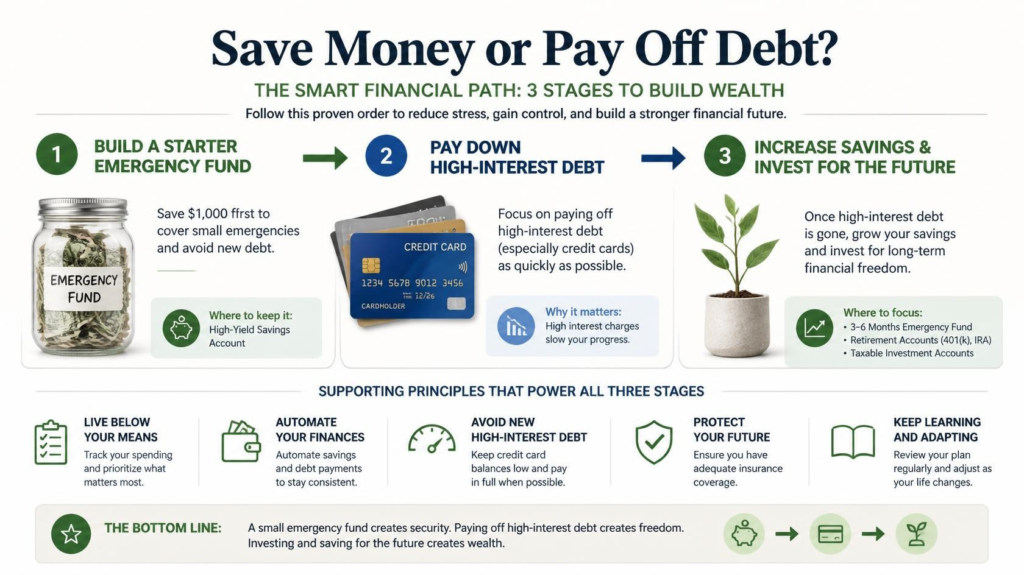
Not necessarily.
Your debt interest rate matters.
High-interest credit-card debt can grow quickly, so blindly putting every available dollar into savings while carrying expensive debt may not be the best strategy.
At the same time, having no cash reserve can leave you vulnerable when something unexpected happens.
The CFPB notes that without emergency savings, financial shocks can lead people to rely on credit cards or loans, potentially creating additional debt.
A practical approach may be to build an initial emergency cushion while continuing required debt payments, then prioritize high-interest debt depending on your circumstances.
For a deeper comparison, see our guide on whether you should save money or pay off debt.
What Should You Do After Saving $10,000?
Reaching $10,000 is not the end of your financial plan.
It gives you options.
Build or strengthen your emergency fund
If the $10,000 was simply a general savings goal, determine how much of it should remain available for emergencies.
An emergency fund is designed for unexpected expenses such as major repairs, medical bills, or loss of income.
Pay down high-interest debt
If you have expensive debt, directing some of your newly available cash flow toward it may make sense.
Save for a major purchase
You might use the money for:
- A home down payment
- A vehicle
- Education
- A major move
- A planned business expense
Increase retirement contributions
Once your short-term financial foundation is stronger, you can consider increasing retirement savings according to your circumstances.
If your employer offers a retirement-plan match, make sure you understand the rules and whether you are taking full advantage of the available match.
Consider investing
Money you need soon generally deserves a different approach from money you will not need for many years.
Do not treat your emergency savings as money that needs to chase investment returns.
Your time horizon and ability to tolerate losses matter.
Is Saving $10,000 a Year Good?
For many households, saving $10,000 in a year is a significant accomplishment.
But the number itself does not tell the whole story.
Someone earning $40,000 and saving $10,000 has a very different savings rate from someone earning $150,000 and saving the same amount.
It is better to measure your progress against your own income, expenses, debt, goals, and financial responsibilities.
The CFPB’s recent financial well-being research also shows that higher financial well-being is associated with higher levels of liquid savings and more frequent automated deposits, although those figures describe survey groups rather than a recommended savings target for every person.
The real victory is developing a repeatable system.
If you can save $10,000 this year and continue saving afterward, the habit may be more valuable than the first $10,000 itself.
A Simple $10,000 Savings Checklist
If you want to start today, follow this sequence:
- Set your deadline.
- Calculate your monthly savings target.
- Review several months of actual spending.
- Calculate how much you already save.
- Find your savings gap.
- Cut large unnecessary recurring expenses.
- Identify realistic ways to increase income.
- Decide how much of bonuses and windfalls will go toward savings.
- Open or designate a separate savings account.
- Automate transfers after payday.
- Track your progress every month.
- Adjust the plan when your income or expenses change.
You do not need to make every change at once.
Start with the numbers you can control.
Frequently Asked Questions
How much do I need to save each month to have $10,000 in a year?
You need to save approximately $833.33 per month to reach $10,000 over 12 months, assuming you start from $0 and do not count interest.
How much should I save from each paycheck to reach $10,000?
If you are paid twice a month, saving about $417 per paycheck will get you close to $10,000 over 12 months. If you are paid biweekly 26 times per year, the target is approximately $385 per paycheck.
Is saving $10,000 a year good?
Yes, saving $10,000 in a year can be a strong financial milestone. However, whether it is a good target for you depends on your income, expenses, debt, emergency savings, and other financial goals.
How can I save $10,000 if I don’t make much money?
Start by calculating your existing monthly surplus rather than assuming you need to find $833 in new savings. Combine expense reductions, additional income, automatic savings, and one-time money such as tax refunds or bonuses. If the numbers still do not work, extend the timeline.
What is the fastest way to save $10,000?
The fastest approach is usually a combination of increasing income, reducing major expenses, and directing large one-time payments toward the goal. A six-month goal requires about $1,667 per month, so it generally requires a much larger cash-flow change than a 12-month plan.
Where should I keep $10,000 while saving?
For money intended for short-term goals or emergencies, an accessible deposit account may be appropriate. If you use a bank, verify that it is FDIC-insured. The FDIC says eligible deposits at insured banks are generally insured up to at least $250,000 per depositor, per insured bank, per ownership category.
Should I save $10,000 or pay off debt first?
There is no universal answer. Consider the interest rate on your debt, your emergency savings, and your ability to handle an unexpected expense. High-interest debt deserves particular attention, but having no emergency reserve can also leave you vulnerable to new borrowing when something goes wrong.
Can I save $10,000 in less than a year?
Yes, but the required monthly savings increase substantially. For example, a six-month target requires approximately $1,667 per month. Make sure the shorter deadline is realistic before committing to it.
The Bottom Line
Saving $10,000 in a year comes down to a simple number: about $833 per month.
But you do not have to find that entire amount in one place.
Start with what your current budget can already save. Then calculate the gap between that amount and your target.
From there, combine the tools available to you:
Save what you can. Cut what you can reasonably cut. Earn what you can realistically earn. Automate the process.
If $10,000 in 12 months is too aggressive, change the timeline instead of abandoning the goal.
A 12-month target is useful, but the bigger objective is building a financial system that continues working after you reach $10,000.
Your first $10,000 can be a savings goal.
The habit you build getting there can become a much bigger financial advantage.
Editorial note: This article provides general educational information and is not individualized financial, investment, tax, or debt advice. Financial decisions should be based on your personal circumstances and, when appropriate, guidance from a qualified professional.










Leave a Reply