
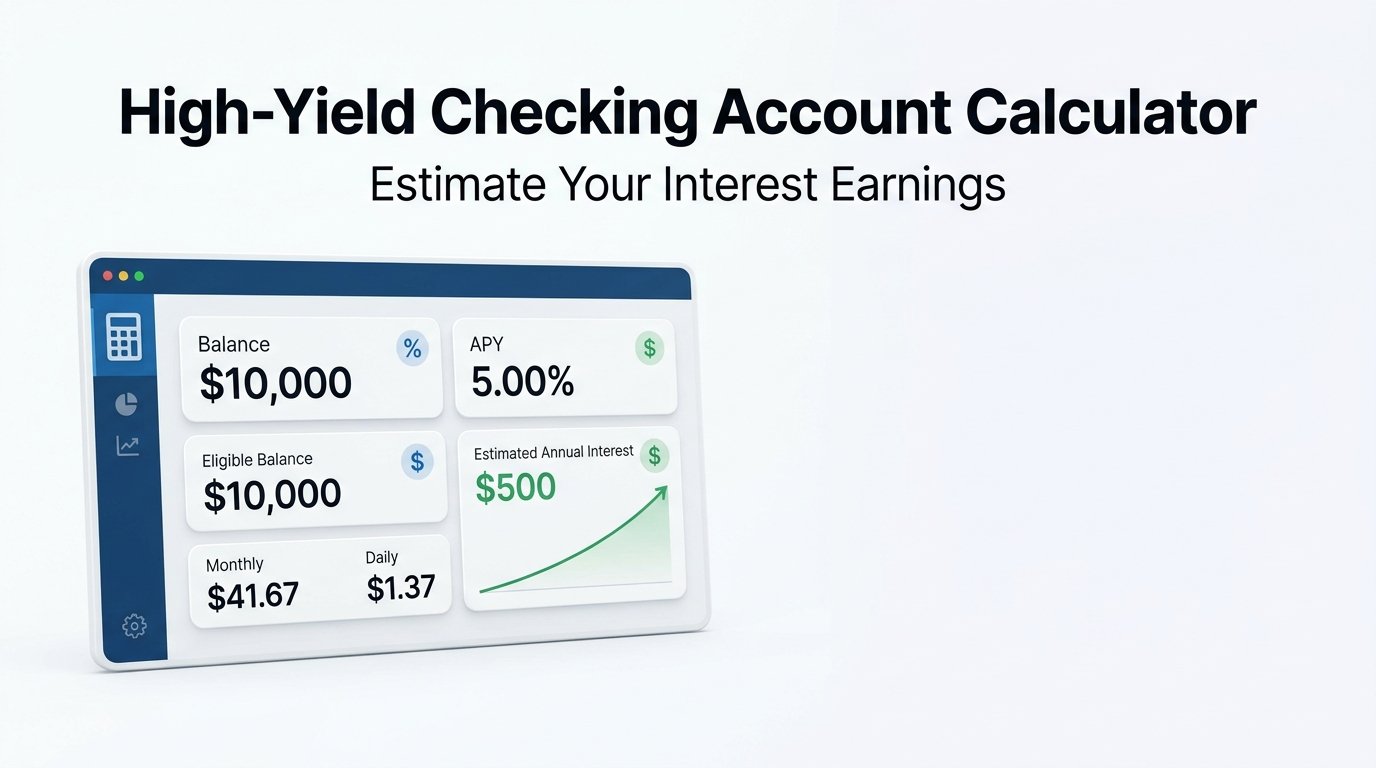
Our high yield checking account calculator helps you estimate how much interest you could earn based on your balance, APY and eligible balance limit. A high-yield checking account can help you earn interest on money you already keep available for everyday spending. But the advertised APY is only part of the comparison. Balance limits, direct deposit requirements, debit-card activity, monthly fees and other conditions can significantly affect what you actually earn.
Use the High-Yield Checking Account Calculator below to estimate your potential interest earnings based on your balance, APY and eligible balance limit. The calculation is an estimate and does not guarantee the rate or earnings offered by any financial institution.
High-Yield Checking Account Calculator
Estimate how much interest you could earn from a high-yield checking account based on your balance and APY.
Estimated Earnings
Estimates assume the displayed APY remains unchanged for a full year and that all account requirements are met. Actual earnings can vary because APYs may change, balance tiers may apply, and account requirements may affect eligibility.
How to Use the High Yield Checking Account Calculator
Enter the amount of money you expect to keep in your checking account, the advertised APY and the maximum balance eligible for that APY. The calculator uses those figures to estimate your potential annual, monthly and daily interest earnings.
For example, if an account offers a 5% APY on balances up to $10,000 and you keep $10,000 in the account, the estimated annual interest would be approximately $500 if the APY remains unchanged for a full year and you meet all account requirements.
If you have more money than the account’s eligible balance limit, the calculator only applies the advertised APY to the eligible amount. This is important because some high-yield checking accounts offer attractive APYs but limit the balance that can earn that rate.
Why Balance Limits Matter
A high APY does not necessarily mean the account will produce the highest return. Some high-yield checking accounts apply their advertised rate only to a specific balance tier. Money above that limit may earn a much lower rate or no interest at all.
When comparing checking accounts, look at the APY, eligible balance, account requirements and fees together. The actual dollar amount you can earn is often more useful than comparing advertised APYs alone.
How Much Can You Earn With a High-Yield Checking Account?
Your potential earnings depend on three main factors: the amount you keep in the account, the APY and the portion of your balance that qualifies for the advertised rate. A higher APY can produce more interest, but a balance cap can reduce the amount that actually earns that rate.
For example, if you keep $10,000 in a checking account earning 5% APY and the entire $10,000 qualifies, the estimated interest is about $500 over one year. If only $5,000 qualifies for the advertised APY, the same rate would produce approximately $250 in annual interest on the eligible balance.
High-Yield Checking Account Earnings Examples
| Balance | APY | Eligible Balance | Estimated Annual Interest |
|---|---|---|---|
| $5,000 | 5% | $5,000 | $250 |
| $10,000 | 5% | $10,000 | $500 |
| $15,000 | 5% | $10,000 | $500 |
| $25,000 | 4% | $25,000 | $1,000 |
| $50,000 | 3.5% | $50,000 | $1,750 |
Important: These are illustrative examples, not claims about any specific bank or credit union.
These examples assume the APY remains unchanged for a full year and that all applicable account requirements are satisfied. Actual interest can differ because financial institutions may change APYs, use balance tiers, impose qualification requirements or calculate interest according to their account terms.
High-Yield Checking vs. High-Yield Savings
High-yield checking and high-yield savings accounts can both pay interest, but they are designed for different purposes. Checking accounts are generally built for everyday spending, bill payments and easy access to your money, while savings accounts are typically better suited for money you do not need to spend regularly.
A high-yield checking account may make sense when you want to earn interest while keeping your money available for debit-card purchases, direct deposits and everyday transactions. A high-yield savings account may be more appropriate for an emergency fund or other savings goal where frequent transactions are not necessary.
Before choosing an account, compare the APY, balance limits, monthly fees, withdrawal or transaction rules and qualification requirements. A higher advertised APY is not automatically the better choice if the account has conditions that do not fit the way you manage your money.
High-Yield Checking vs. Traditional Checking
Traditional checking accounts are primarily designed for convenient access to your money and everyday transactions, while high-yield checking accounts add the potential to earn interest on qualifying balances. The trade-off is that high-yield accounts may have additional requirements, such as direct deposit, debit-card purchases, electronic statements or minimum monthly activity.
If you rarely use your debit card or do not want to meet monthly requirements, a traditional checking account with fewer conditions may be simpler. If you already meet the requirements and keep a meaningful balance in checking, a high-yield account can potentially turn some of that idle cash into interest.
How the High Yield Checking Account Calculator Works
The calculator estimates interest by applying the entered APY to the portion of your checking account balance that qualifies for the advertised rate. If your balance is higher than the eligible balance limit, the calculator uses the eligible amount rather than applying the APY to your entire balance.
For example, if you enter a $20,000 balance, a 5% APY and a $10,000 eligible balance, the calculator applies the 5% rate to $10,000 rather than the full $20,000.
Estimated Annual Interest Formula
Estimated annual interest = eligible balance × APY ÷ 100
For example, $10,000 × 5% = approximately $500 in estimated annual interest.
Estimated Monthly and Daily Interest
The calculator divides the estimated annual interest by 12 to provide an approximate monthly figure and by 365 to provide an approximate daily figure. These figures are simplified estimates and should not be interpreted as the exact amount a financial institution will credit to your account.
Why Your Actual Earnings May Be Different
Your actual interest earnings may differ from the calculator’s estimate. APYs can change, some accounts use multiple balance tiers, and certain accounts require qualifying activities such as direct deposits or debit-card transactions. Failing to meet those requirements may result in a lower APY.
Interest calculations can also vary according to the financial institution’s account terms and calculation methods. Always review the current account disclosures before opening an account or moving money.
Frequently Asked Questions About High-Yield Checking Accounts
What is a high-yield checking account?
A high-yield checking account is a checking account that offers a higher interest rate than many traditional checking accounts. Some accounts require qualifying activities such as direct deposit, debit-card purchases or electronic statements to receive the advertised APY.
How much can I earn with a high-yield checking account?
Your potential earnings depend on your balance, APY and the amount of your balance eligible for the advertised rate. For example, $10,000 earning 5% APY would produce approximately $500 in interest over one year if the rate remains unchanged and all requirements are met.
Do high-yield checking accounts have balance limits?
Some do. A financial institution may offer a high APY only up to a specific balance, such as $10,000, $15,000 or $25,000. Amounts above the qualifying balance may earn a lower rate or no interest, so checking the balance cap is essential when comparing accounts.
What are the requirements for a high-yield checking account?
Requirements vary by financial institution. Common conditions include qualifying direct deposits, a minimum number or amount of debit-card purchases, electronic statements, online banking activity or other monthly requirements. Always check the current account terms before opening an account.
Is a high-yield checking account better than a high-yield savings account?
It depends on how you use your money. High-yield checking can be useful when you want interest while maintaining convenient access for everyday spending. High-yield savings may be better for money you’re setting aside for an emergency fund or another savings goal. Compare the APY, access rules, balance limits and account requirements before choosing.
Can a high-yield checking account lose its high APY?
Yes. Many high-yield checking accounts require customers to meet specific monthly qualifications to receive the advertised APY. If those requirements are not met, the account may earn a substantially lower rate. APYs can also change over time, so review the current terms regularly.
Are high-yield checking accounts safe?
Checking accounts at FDIC-insured banks are generally covered by FDIC deposit insurance within applicable limits. Checking accounts at federally insured credit unions are generally covered by NCUA share insurance within applicable limits. Consumers should verify the institution’s insurance status and understand the applicable coverage limits.
Are High-Yield Checking Accounts Insured?
Whether your money is insured depends on the financial institution. Deposits at an FDIC-insured bank are generally covered by FDIC deposit insurance up to applicable limits. Deposits at federally insured credit unions are generally covered by NCUA share insurance up to applicable limits.
Insurance protects eligible deposits or shares against the failure of a covered institution. It does not guarantee a particular APY, prevent an account’s interest rate from changing or protect against losses from investments that are not covered deposits or shares.
Calculator Disclaimer
This calculator provides estimates for educational purposes only. It is not financial advice and does not represent an offer, guarantee or endorsement of any bank or credit union. APYs, balance limits, fees and qualification requirements can change. Actual earnings may differ from the estimates shown. Always verify current rates, terms, fees, eligibility requirements and insurance coverage directly with the financial institution before opening an account or depositing money.