


Last updated: September 2026
You finally have some money sitting in savings, but there is a problem.
Your credit card still has a balance. Maybe you have a car loan, student loans, or a personal loan too. Every month, part of your paycheck goes toward interest while the money in your savings account sits untouched.
So, should you pay off debt or save?
For most people, the best answer is not to put every available dollar into only one of them. You need enough cash to handle a real emergency without immediately borrowing again, but carrying expensive debt for years can cost far more than your savings account earns.
The right decision comes down to four numbers: your emergency cash, essential monthly expenses, debt interest rate, and savings yield.
Should You Pay Off Debt or Save First?
If you have high-interest debt, especially credit-card debt, paying it down should usually become a major priority once you have some emergency cash available.
That does not necessarily mean draining your savings account to zero.
Emergency savings exists for expenses you cannot easily predict, such as a car repair, medical bill, home repair, or temporary loss of income. The Consumer Financial Protection Bureau says having a cash reserve can help prevent a financial shock from turning into additional credit-card or loan debt.
The practical approach is:
- Keep enough accessible cash to handle a reasonable emergency.
- Make at least the required payments on every debt.
- Identify the debt charging the highest interest rate.
- Compare that rate with what your savings earns.
- Direct additional money where it produces the greatest financial benefit without leaving you dangerously short of cash.
The interest-rate difference can be much larger than many people realize.
Start With Your Emergency Cash
Before sending a large chunk of savings to a lender, calculate what would remain afterward.
Suppose your essential monthly expenses are:
- Rent or mortgage: $1,600
- Food: $550
- Utilities: $300
- Transportation: $400
- Insurance and minimum debt payments: $650
Your basic expenses are roughly $3,500 per month.
Someone with a stable two-income household may feel comfortable with a different cash reserve than a single-income household with variable earnings.
There is no universal emergency-fund number that works for everyone.
Once you decide how much emergency cash to keep, consider storing it in a high-yield savings account where it can remain accessible while earning interest. If you are deciding where that emergency money belongs, understanding savings versus checking accounts can help you separate everyday spending money from cash you want to keep available for emergencies.
CFPB specifically notes that the amount needed depends on the person’s circumstances and the unexpected expenses they are likely to face.
Consider factors such as:
- job stability
- number of income earners
- health expenses
- children or other dependents
- homeownership
- vehicle reliability
- insurance deductibles
- how quickly you could replace lost income
If you are unsure what cash reserve makes sense for your situation, EEZYPOST also explains how much money you should have in savings based on expenses, emergencies, and financial goals.
This is why “use all your savings to pay off debt” can be poor advice even when the math initially favors paying the debt.
If the next emergency forces you to put $4,000 straight back onto the credit card, you have not solved the underlying problem.
Compare Your Debt APR With Your Savings APY
This is where the decision becomes much clearer.
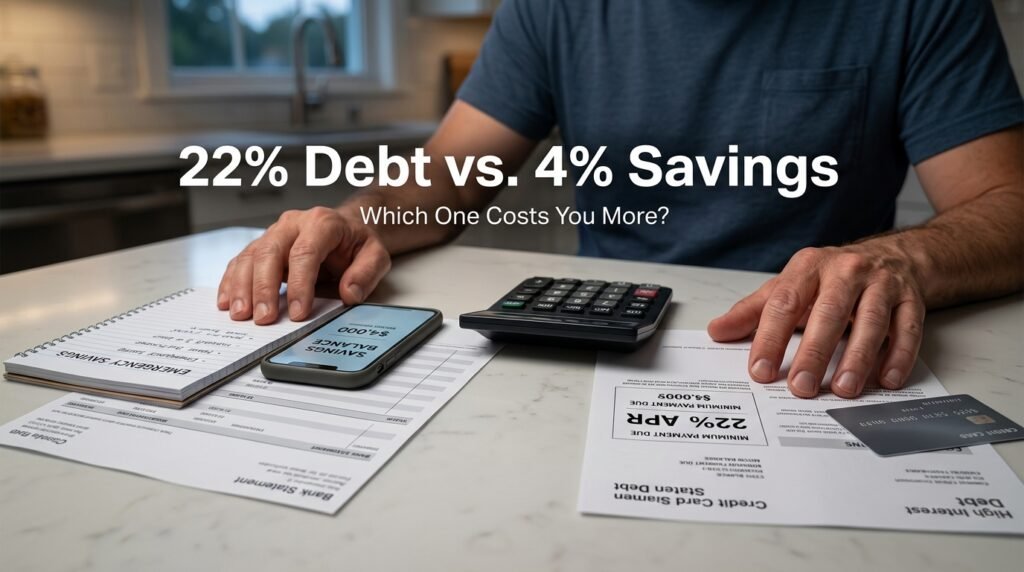
Imagine you have:
Credit-card balance: $8,000
Credit-card APR: 22%
Savings available: $10,000
Savings APY: 4%
Ignoring compounding and changes to the balance for a simple comparison:
$8,000 × 22% = $1,760
That is approximately how much annual interest an unchanged $8,000 balance would generate at 22%.
Now compare $8,000 kept in savings earning 4%:
$8,000 × 4% = $320
The approximate difference is:
$1,760 − $320 = $1,440
Keeping that $8,000 in savings while carrying the credit-card balance could therefore create roughly a $1,440 annual interest-rate gap, before considering taxes on interest income or changes to the debt balance.
This is only an illustration, not a prediction of an actual credit-card bill, because card interest usually accrues based on daily balances and payments.
The example is still useful because it exposes the underlying economics.
High-Interest Credit Card Debt Changes the Equation
Credit-card debt deserves special attention because rates remain high.
The Federal Reserve’s August 2026 G.19 consumer-credit release reports an average rate of 22.15% for credit-card accounts that were assessed interest in May 2026.
At rates around that level, the cost of carrying a revolving balance can overwhelm what a normal savings account earns.
For example, paying off $5,000 of debt charging 22% effectively avoids future interest at that rate on the balance you eliminate, assuming you would otherwise carry it.
That does not mean a 22% debt payment is identical to earning a guaranteed 22% investment return. Taxes, payment timing, compounding, new purchases, fees, and changing balances matter.
But it does show why high-interest debt often deserves more urgency than maximizing a savings balance.
When Paying Off Debt First Usually Makes More Sense

Aggressive debt repayment becomes especially attractive when:
- the debt carries a very high APR
- you already have some emergency savings
- your income is relatively stable
- you are consistently paying credit-card interest
- your debt is preventing progress toward other financial goals
- you could rebuild savings relatively quickly
Credit-card debt at 20% or more is very different from a fixed-rate loan charging 4%.
Treating all debt the same can lead to poor decisions.
Debt balances and account changes can also affect your credit profile, so it helps to understand what is a good credit score and which factors influence your score over time.
Instead, list every debt with:
| Debt | Balance | APR | Minimum Payment |
|---|---|---|---|
| Credit card | $8,000 | 22% | $240 |
| Car loan | $12,000 | 6% | $360 |
| Student loan | $18,000 | 4.5% | $210 |
In this example, the credit card deserves much closer attention than the student loan because every dollar of balance carries a substantially higher interest cost.
When Keeping More Savings May Make Sense

Debt repayment is not automatically the first priority in every situation.
Keeping more cash may make sense when:
Your income is uncertain
Freelancers, commission-based workers, business owners, or workers facing possible layoffs may need a larger reserve.
Your debt has a very low interest rate
The decision between keeping savings and eliminating a 3% or 4% fixed loan is much less obvious than the decision involving a 22% credit card.
You expect a major expense soon
A known roof repair, medical expense, move, insurance deductible, or necessary vehicle replacement is different from optional spending.
Using savings to pay debt and then borrowing again for a predictable expense can simply move the debt around.
You have a temporary 0% promotional rate
A genuine 0% promotional credit-card offer changes the short-term calculation.
However, know exactly when the promotional period ends and what rate applies afterward.
Can You Save and Pay Off Debt at the Same Time?

Yes, and for many households this is the most realistic strategy.
You might decide to maintain a minimum emergency reserve while directing most additional monthly cash toward high-interest debt.
For example, someone with $1,000 left after essential expenses could choose:
- $750 toward high-interest debt
- $250 toward savings
Another household may choose 90/10 or 60/40.
There is no magic percentage.
The purpose is to prevent two problems simultaneously:
Problem 1: expensive debt continues growing.
Problem 2: one emergency forces you straight back into borrowing.
Your allocation should reflect which risk is greater in your situation.
A Simple Debt-or-Savings Decision Table
| Your Situation | What Deserves Attention |
|---|---|
| No emergency savings and high-interest debt | Establish some emergency cash, then attack the expensive debt |
| Large savings balance and 20%+ credit-card debt | Consider using excess savings to reduce the card balance |
| Low-interest fixed debt | Compare the rate with savings returns and other financial goals |
| Unstable employment | Keeping a larger cash reserve may be appropriate |
| 0% promotional debt | Build a payoff plan before the promotional rate expires |
| Upcoming unavoidable expense | Preserve enough cash to cover it |
| Multiple debts | Prioritize the highest-cost balances while maintaining required payments |
The important word is excess savings.
Money needed to pay next month’s rent is not excess cash. Neither is money reserved for a known insurance deductible or unavoidable repair.
What About Your 401(k)?
There is an important difference between reducing new retirement contributions and withdrawing money that is already inside a 401(k).
Withdrawing retirement money to pay consumer debt can create tax consequences.
The IRS says taxable distributions from qualified retirement plans before age 59½ may be subject to regular income tax plus an additional 10% tax on early distributions, unless an exception applies.
That makes a retirement withdrawal very different from transferring ordinary savings from your bank account.
Also consider whether your employer provides a matching contribution. Giving up employer matching money may change the calculation substantially.
Before using retirement assets to eliminate debt, check your specific plan rules and tax situation.
EEZYPOST Example: $10,000 Saved and $8,000 in Credit Card Debt
Consider this hypothetical situation:
Savings: $10,000
Essential monthly expenses: $3,000
Credit-card balance: $8,000
Credit-card APR: 22%
Savings APY: 4%
Stable employment: Yes
Using all $8,000 of savings to eliminate the card would leave only $2,000 in cash, less than one month of essential expenses.
Keeping all $10,000 in savings, however, leaves an expensive 22% balance outstanding.
A middle-ground approach could be:
- Decide how much emergency cash needs to remain accessible.
- Use cash above that threshold against the card.
- Continue directing monthly surplus toward the remaining balance.
- Rebuild the emergency fund after expensive revolving debt is controlled.
For example, keeping $6,000 available would provide approximately two months of this household’s essential expenses.
The remaining $4,000 could reduce the credit-card balance from $8,000 to $4,000 immediately.
That would reduce the amount exposed to high credit-card interest without leaving the household with no cash reserve.
This is not a recommendation for every household. It demonstrates why the best solution often sits between the extremes of “save everything” and “empty the savings account.”
What to Do Next
Start with a simple four-step check.
1. Calculate your essential monthly expenses.
Use actual bills rather than guessing from your salary.
If you are not sure how much money actually reaches you after taxes and deductions, use the EEZYPOST Paycheck Calculator to estimate your take-home pay before setting a monthly debt-payment target.
2. Decide what emergency reserve makes sense for your situation.
Think about job stability, family obligations, health costs, transportation, and major upcoming expenses.
3. Write down every debt and APR.
Do not focus only on balances. A smaller debt carrying a much higher rate may be costing you more.
4. Compare the numbers.
If expensive debt is costing far more than your savings earns, consider whether cash above your emergency reserve could be used to reduce that debt.
The goal is not simply to become debt-free as quickly as possible.
The better goal is to reduce expensive debt without leaving yourself so cash-poor that the next emergency starts the debt cycle again.
Frequently Asked Questions
Is it better to pay off debt or save money?
It depends on the type of debt, its interest rate, your emergency savings, and your income stability. High-interest credit-card debt often deserves priority once you have some emergency cash available. Low-interest debt may justify a more balanced approach.
Should I use all my savings to pay off credit-card debt?
Usually, the decision should consider what would remain afterward. Draining savings completely can leave you vulnerable to an emergency that forces you to borrow again. Calculate the emergency reserve you realistically need before deciding how much savings is available for debt repayment.
Should I build an emergency fund before paying off debt?
Having at least some emergency cash can reduce the risk that an unexpected expense sends you deeper into debt. The appropriate amount depends on your financial circumstances, job stability, expenses, and household responsibilities.
How do I decide between paying debt and saving?
Compare your debt APR with your savings APY, calculate your essential expenses, determine how much emergency cash you need, and identify the costliest debts. The larger the difference between a high debt APR and your savings return, the stronger the financial case for reducing that debt.
Is paying off a credit card better than putting money in savings?
If the credit card charges a much higher interest rate than the savings account earns, paying down the card can produce a substantial financial benefit. However, keeping enough cash for genuine emergencies remains important.
Should I save money while paying off debt?
You can. Many households maintain an emergency reserve and continue adding smaller amounts to savings while directing most available cash toward high-interest debt.
Should I pay off debt before saving for a house?
It depends on the debt’s interest rate, monthly payment, your emergency reserves, down-payment target, and mortgage timeline. High-interest credit-card balances may deserve priority, while low-rate debt requires a more detailed comparison.
Should I stop contributing to my 401(k) to pay off debt?
Reducing new contributions and withdrawing existing retirement money are very different decisions. Consider any employer match before lowering contributions. Taxable early withdrawals from qualified retirement accounts may also be subject to income tax and an additional 10% tax unless an IRS exception applies.
EEZYPOST
This article provides general educational information and is not individualized financial, tax, or investment advice.








Leave a Reply