

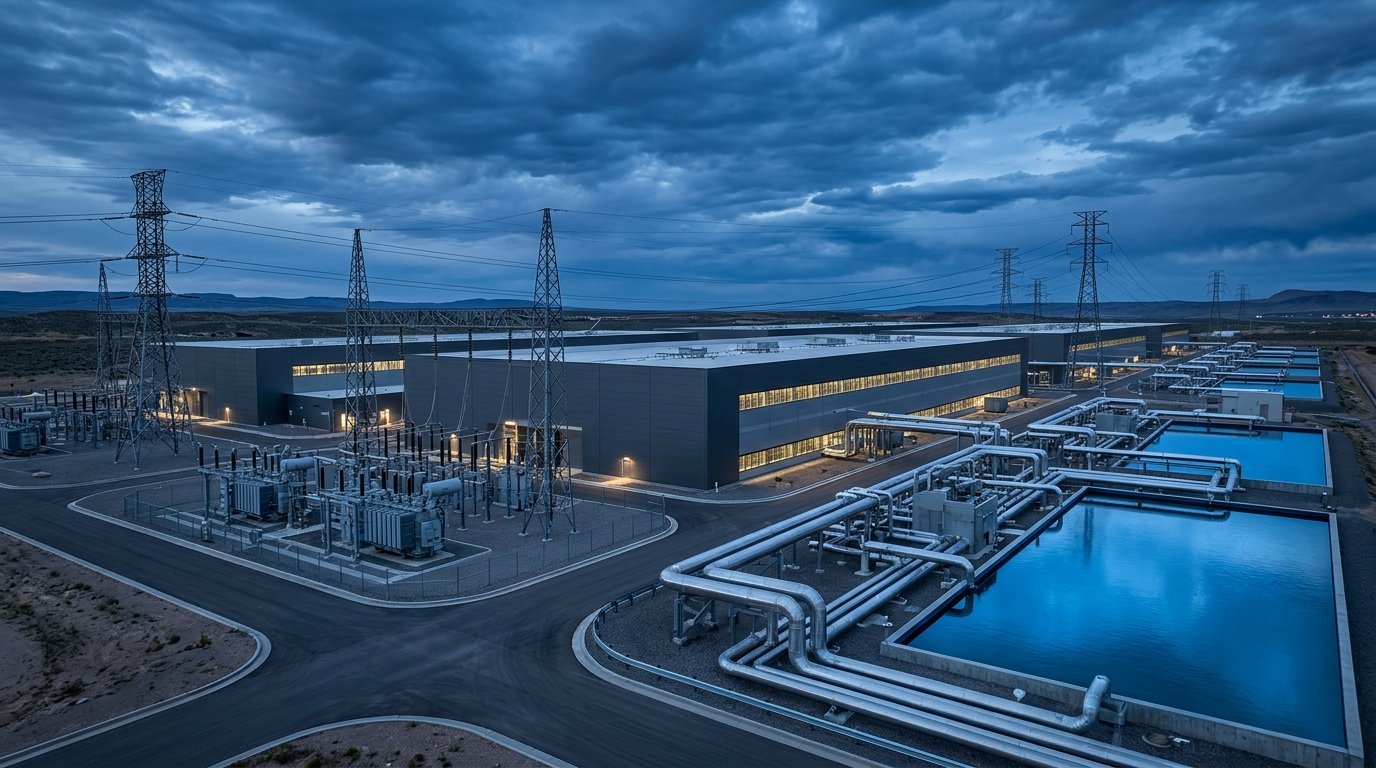
Artificial intelligence is creating a new infrastructure race across the United States.
The competition is no longer only about who has the fastest AI model or the most advanced GPUs. Companies also need enormous amounts of electricity, high-capacity transmission, suitable land, cooling infrastructure, fiber connections and, in many locations, reliable access to water.
That is turning AI data centers into a major issue for utilities, developers, local governments, investors and communities.
The water question is especially complicated because there is no single number that describes how much water an AI data center uses. Water demand depends on the facility’s cooling technology, climate, server efficiency, electricity source and even how efficiently the computing workload is performed.
A 2025 study from researchers associated with Lawrence Berkeley National Laboratory found that workload-level water use can vary by more than 10,000-fold depending on these factors. In other words, saying that “AI uses X gallons of water” without explaining the location and infrastructure can be deeply misleading.
At the same time, the scale of the infrastructure buildout is becoming difficult to ignore. And while AI’s broader environmental footprint includes carbon emissions, hardware manufacturing, electronic waste and other impacts, the rapid expansion of data centers is bringing a different set of questions directly into local communities.
The International Energy Agency’s latest analysis estimates that global data-center electricity consumption will roughly double from 485 TWh in 2025 to 950 TWh in 2030, while electricity consumption from AI-focused data centers is projected to grow even faster.
For the United States, the stakes are particularly high.
Here’s why AI data centers are increasingly becoming a story about water, electricity, real estate and local communities—not just technology.
Why AI Data Centers Need So Much Infrastructure
A modern AI data center is essentially a large computing facility filled with servers and specialized accelerators such as GPUs.
Those machines perform enormous numbers of calculations, but they also generate heat.
That creates three fundamental infrastructure requirements:
- Electricity to operate the computing equipment
- Cooling to remove the heat
- Physical infrastructure to connect the facility to power, networks and other services
The growth of AI is pushing all three requirements higher.
According to the IEA, accelerated servers—equipment increasingly associated with AI workloads—are becoming a major source of data-center electricity growth.
The IEA projects electricity consumption from accelerated servers to grow around 30% annually in its base case through 2030.
The U.S. is particularly exposed to this trend because it already has one of the world’s largest data-center markets.
The IEA estimates that U.S. data centers consumed around 180 TWh of electricity in 2024. It also expects data-center expansion to account for roughly half of U.S. electricity-demand growth through 2030.
That means the AI infrastructure story is increasingly connected to the country’s physical infrastructure.
The Water Problem Is More Complicated Than “AI Uses Water”
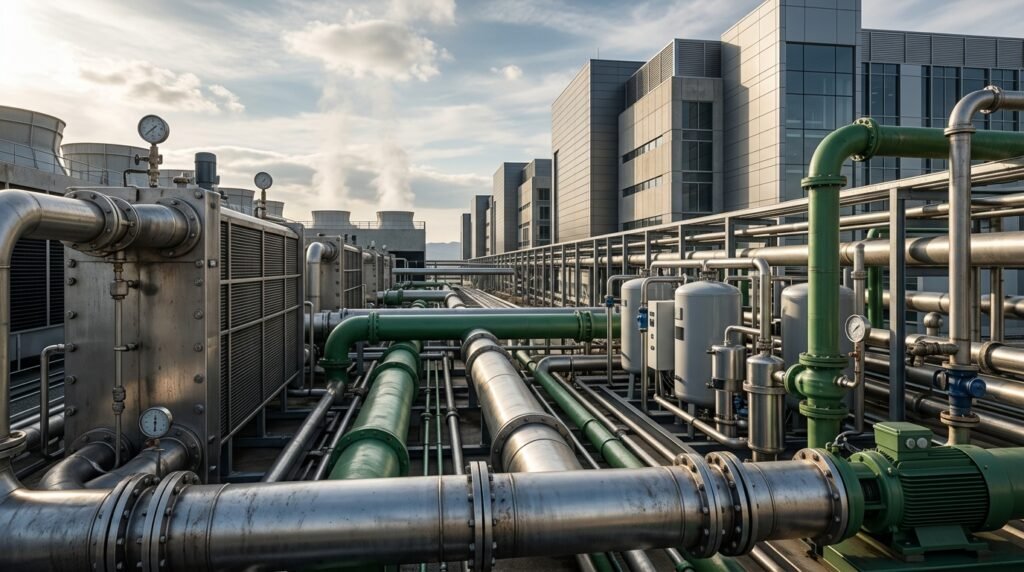
One of the biggest mistakes in discussions about AI and water is treating every data center as if it uses water in exactly the same way.
It doesn’t.
Some facilities can rely heavily on water-based cooling. Others can reduce direct water consumption through alternative cooling technologies. Climate also matters because a facility operating in a hot environment can face different cooling requirements from one operating in a cooler climate.
The U.S. Environmental Protection Agency has also examined opportunities to treat and reuse certain wastewater sources for applications including data-center cooling.
A 2025 LBNL study found that water use depends on a combination of:
- Server efficiency
- Electricity generation
- Server utilization
- Cooling technology
- Infrastructure efficiency
- Climate
- Inactive servers
- Hardware replacement cycles
The researchers concluded that there is no universal “best” solution for minimizing water use because the optimal approach depends on the facility and its location.
That is an important distinction for homeowners, investors and policymakers trying to understand the impact of new AI infrastructure.
Where Does an AI Data Center Use Water?
There are two major categories to understand.
Direct Water Use
The first is water used directly at the facility.
Depending on the design, water may be involved in cooling systems, heat rejection, humidification or other building operations.
Cooling towers, for example, can consume water through evaporation and other losses.
The exact amount varies dramatically from one facility to another.
Indirect Water Use
The second category is less obvious.
There is also an important distinction between water withdrawal and water consumption. A facility may withdraw water from a source but return some of it, while consumed water generally refers to water that is not returned to the immediate water system, such as water lost through evaporation. That distinction matters when comparing data-center water claims because the two measurements can produce very different numbers.
This is another reason readers should be cautious when comparing water-use statistics from different facilities or studies.
A data center consumes electricity, and some electricity-generation technologies also consume water.
That means the total water footprint of computing can extend beyond the data-center property itself.
Researchers studying data-center water use therefore distinguish between water consumed directly at the facility and water associated with electricity generation.
This creates what can be thought of as a power-water nexus.
A community evaluating a large data center therefore needs to consider more than the water pipes running into the building.
It may also need to consider how the electricity serving that facility is generated.
Why Location Can Change the Water Footprint
Location is one of the most important pieces of the puzzle.
Imagine two otherwise similar AI data centers.
One operates in a region with abundant water, a relatively cool climate and an electricity mix with comparatively low water consumption.
Another operates in a hot, water-stressed region and depends on a cooling system with greater direct water requirements.
The two facilities can deliver similar computing services while creating very different local resource pressures.
That is why national averages can sometimes hide the most important local questions.
A 2025 review of U.S. data centers found that water use and environmental risk need to be considered at a location-specific level.
For communities considering a new project, the important question isn’t simply:
“How much water does an AI data center use?”
It is:
“How much water would this particular facility use, from which source, during which seasons, and under what local conditions?”
The Cooling Technology Race
The growth of AI is also changing the engineering of data centers.
Traditional air-based cooling becomes more difficult as computing equipment becomes more powerful and concentrated.
That is encouraging greater interest in liquid-based cooling approaches.
Direct-to-Chip Liquid Cooling
In direct-to-chip systems, liquid is brought much closer to the heat-generating components.
Instead of relying entirely on air to move heat away from the chips, liquid can transfer heat more efficiently.
This can become increasingly important as AI hardware produces higher heat densities.
Closed-Loop Systems
Closed-loop cooling can potentially reduce the need for continuously consuming fresh water because the same coolant can circulate through the system rather than being continually replaced.
However, “closed loop” does not automatically mean zero water consumption.
The overall design still matters.
Air Cooling and Hybrid Systems
Some facilities can use air-based or hybrid systems depending on climate and engineering requirements.
This highlights an important point:
The water footprint of an AI data center is an engineering decision as much as it is an AI decision.
The choice of cooling technology can materially influence water use.
AI Data Centers Are Also Becoming a Real Estate Story
This is where the subject becomes particularly interesting for the U.S. economy.
AI companies need land.
But they don’t need just any land.
A suitable data-center site may need:
- Large parcels of land
- Access to high-capacity electricity
- Transmission infrastructure
- Reliable water or alternative cooling resources
- Fiber connectivity
- Roads and construction access
- Appropriate zoning
- Local permitting
- Proximity to existing infrastructure
- A utility capable of serving the load
That means the value of a potential data-center site can depend heavily on infrastructure.
A piece of inexpensive rural land may look attractive on a map but become economically impractical if connecting it to the power grid requires years of infrastructure upgrades.
Conversely, land near existing transmission capacity and fiber networks can become strategically valuable.
This is one reason AI infrastructure is increasingly intersecting with commercial real estate.
Could AI Data Centers Affect Nearby Real Estate?
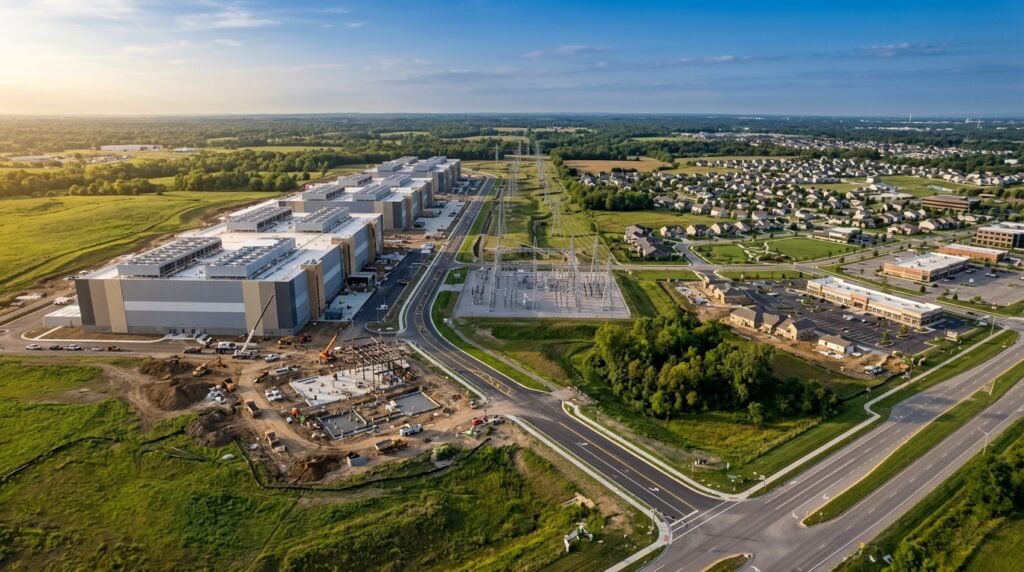
Potentially—but the answer depends heavily on location and project characteristics.
A major data-center development can create construction activity, jobs, tax revenue and demand for local services.
That can benefit surrounding communities.
The effect may also depend on what infrastructure accompanies the project. A data-center campus that requires new substations, transmission upgrades, roads or water infrastructure can have a different local economic impact from a project that can connect largely to existing systems. For homeowners and investors, the infrastructure plan may therefore be just as important as the data-center building itself.
But large infrastructure projects can also create concerns about:
- Noise
- Water availability
- Electricity demand
- Road traffic
- Land-use changes
- Property taxes
- Local utility rates
- Environmental impacts
The effect on residential property values is therefore unlikely to be uniform across the country.
A new facility could be economically positive in one community while creating substantial local opposition in another.
For homeowners, the most useful question is not simply whether “data centers are good or bad for real estate.”
It is whether a particular project changes the economic fundamentals of the surrounding area.
The Electricity Connection May Be Even Bigger Than the Water Story
Water receives considerable attention because it is visible and locally sensitive.
But electricity may be the larger infrastructure constraint.
Lawrence Berkeley National Laboratory’s June 2026 U.S. data-center energy update estimates that data centers could account for 11.8% of total U.S. electricity consumption by 2030 in its central estimate, with a scenario range of 9.5% to 15.3%.
The IEA’s latest analysis also says U.S. data centers are expected to account for about half of electricity-demand growth through 2030.
That has major implications for utilities.
A new AI campus can represent a very large concentrated electricity load arriving in a specific location.
Unlike millions of small household appliances spread across a country, data centers can place enormous demand on particular substations, transmission lines and generation resources.
Why the Power Grid Is Becoming a Bottleneck
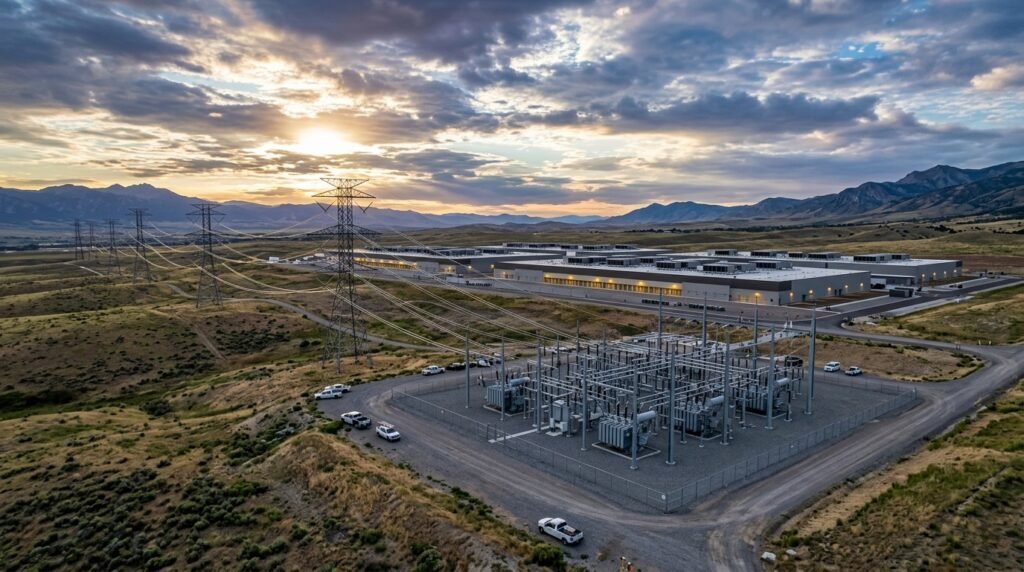
The physical grid cannot always expand as quickly as companies want to build AI infrastructure.
The IEA’s 2026 analysis identifies grid connections and other infrastructure bottlenecks as an increasing constraint on data-center expansion.
New projects may require:
- New substations
- Transmission upgrades
- Generation capacity
- Transformers
- Grid interconnections
- Backup power
- Energy storage
- Regulatory approvals
The IEA reported in 2026 that data-center expansion is increasingly running into bottlenecks involving transformers, gas turbines, advanced chips, grid connections and planning processes.
This creates an unusual situation.
The technology industry can have the money and the demand for a new AI data center but still face a basic physical problem:
There may not be enough infrastructure available to connect it.
Why States Are Competing for Data Centers
Large AI and cloud projects can bring substantial investment into a region.
That can encourage states and local governments to compete for projects through:
- Tax incentives
- Economic-development programs
- Infrastructure support
- Land agreements
- Faster permitting
- Utility arrangements
For governments, the calculation can be complicated.
A data center can generate construction activity, property-tax revenue and economic investment.
But the community may also need to finance infrastructure improvements or manage increased demand for electricity and water.
That is why the economic value of a data center should be evaluated alongside its infrastructure costs.
The Semiconductor Connection: The Water Story Starts Before the Data Center
There is another piece of the story that is easy to overlook.
AI’s water footprint does not necessarily begin when a GPU enters a data center.
Semiconductor manufacturing can require highly purified water for processes involved in producing advanced chips.
That means the physical infrastructure supporting AI extends across multiple stages:
Raw materials → semiconductor manufacturing → servers → data centers → electricity generation → cooling → AI services
Each stage has its own environmental and infrastructure requirements.
This is one reason a narrow calculation focused only on the water entering a particular data-center building may not capture the full resource footprint of AI.
Why the Numbers You See Online Can Be Misleading
You may see headlines claiming that one AI prompt uses a particular amount of water or that a data center consumes a fixed number of gallons per day.
Those figures can be useful illustrations, but they should not automatically be treated as universal measurements.
Why?
Because water use can change based on:
- Location
- Weather
- Cooling design
- Server efficiency
- Electricity source
- Workload
- Utilization
- Data-center architecture
- Time of day
- Season
The LBNL-backed 2025 research is particularly important here because it found enormous variation in workload-level water consumption.
So when evaluating an AI water claim, ask:
What facility? What location? What cooling system? What electricity source? What workload? What year?
Without those details, the number may tell only part of the story.
What Communities Should Ask Before Approving an AI Data Center
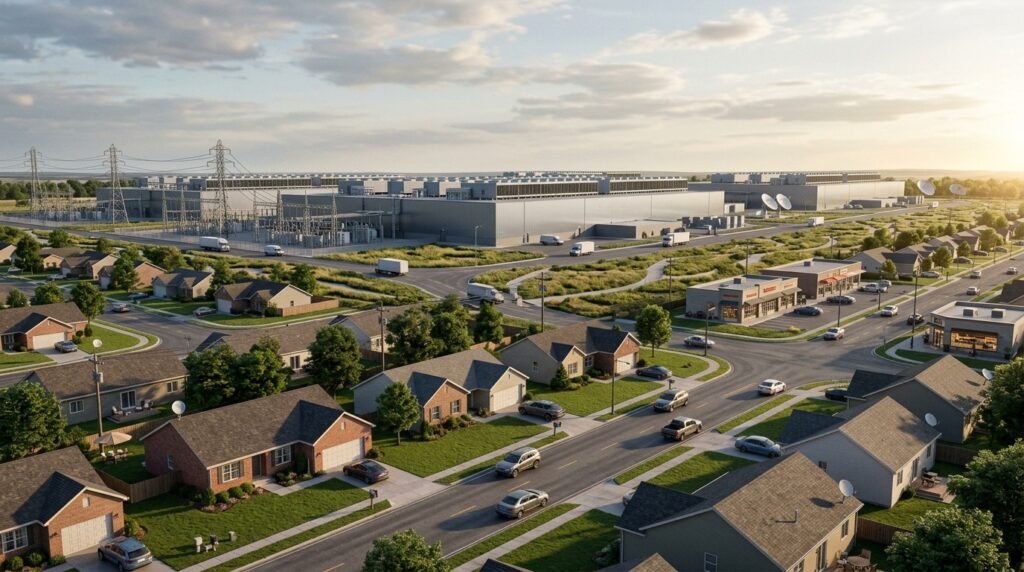
Local governments and residents do not have to choose between supporting technology and protecting resources.
A better approach is to ask for detailed information before a major project is approved.
Questions can include:
Water
- How much water will the facility require?
- What is the expected annual and peak consumption?
- Where will the water come from?
- Will potable water be used?
- What happens during drought conditions?
- Are recycled or non-potable sources possible?
Electricity
- How much electricity will the facility require?
- Who pays for grid upgrades?
- What generation resources will supply it?
- Will the project increase local transmission requirements?
Environment
- What cooling technology will be used?
- What are the facility’s water-efficiency targets?
- How will emissions be managed?
- What happens to waste heat?
Community
- How many permanent jobs will be created?
- What infrastructure will taxpayers fund?
- Will the project affect local utility rates?
- What are the expected property-tax benefits?
- How will noise and construction impacts be managed?
These questions turn a vague debate about “AI’s environmental impact” into a measurable infrastructure discussion.
What This Could Mean for Investors
The AI data-center boom is creating opportunities beyond AI software companies.
Infrastructure supporting the expansion can include:
- Utilities
- Power generation
- Transmission equipment
- Transformers
- Cooling systems
- Data-center construction
- Fiber networks
- Industrial real estate
- Semiconductor manufacturing
- Energy storage
That does not mean every company connected to data centers will be a good investment.
It does mean investors should understand that AI infrastructure is becoming a much broader economic ecosystem.
The biggest opportunity may not always sit with the company selling the AI model.
It could sit with the companies supplying the physical infrastructure that allows those models to operate.
The Bigger U.S. Story: AI Is Becoming Physical Infrastructure
For years, artificial intelligence was mostly discussed as software.
If you’re new to the technology itself, our complete beginner’s guide to artificial intelligence explains how AI works and why its computing requirements continue to expand.
That is changing.
AI increasingly requires physical infrastructure that looks much more like traditional industrial development:
Land + electricity + cooling + water + chips + fiber + buildings + financing + regulation
The IEA’s latest research illustrates the scale of the transition. Global data-center electricity consumption is projected to roughly double between 2025 and 2030, while AI-focused data-center power use is expected to grow even faster.
The U.S. is at the center of this expansion.
That makes AI data centers an important story for more than technology readers.
It matters to homeowners, investors, utility customers, developers, policymakers and local communities.
What Comes Next for AI Data Centers?
The next stage of the AI infrastructure race will probably be defined by constraints.
Companies already know how to build more computing capacity.
The harder question is where that computing capacity can physically operate.
The winning locations may increasingly be those that can provide a combination of:
- Reliable electricity
- Available transmission capacity
- Efficient cooling
- Sustainable water resources
- Fiber connectivity
- Suitable land
- Permitting support
- Reasonable operating costs
That could reshape parts of the U.S. commercial real-estate market and influence where new infrastructure investment flows.
It may also accelerate innovation in cooling, energy storage, power generation and water efficiency.
The Bottom Line
AI data centers are becoming one of the most important new infrastructure stories in the United States.
Water is part of that story—but it should not be viewed in isolation.
The real issue is the interaction between water, electricity, cooling, land, technology and local infrastructure.
A data center’s environmental footprint can vary dramatically depending on where it is built and how it is designed. Research from Lawrence Berkeley National Laboratory shows why simple nationwide water-use numbers can be misleading, while the latest electricity forecasts show that data-center demand is becoming large enough to influence the U.S. power system.
That means the future of AI will not be determined only by better models and faster chips.
It will also depend on something much more physical:
Where can we build the infrastructure needed to power, cool and connect the next generation of AI?
And increasingly, that question is becoming a real-estate, energy and water question as much as a technology one.
Frequently Asked Questions
How much water do AI data centers use?
There is no single number that applies to every AI data center. Water consumption varies significantly depending on cooling technology, climate, server efficiency, electricity source, workload and facility design. Research published in 2025 found that workload-level water use can vary by more than 10,000-fold.
Why do AI data centers need water?
Some data centers use water as part of their cooling systems to remove heat generated by servers. Water can also be associated indirectly with the electricity used by the facility because some forms of electricity generation consume water.
Does every AI data center use a lot of water?
No. Water consumption varies significantly between facilities. Cooling technology, climate, infrastructure efficiency and electricity sources can all change the water footprint.
Why are AI data centers using so much electricity?
AI servers use specialized computing hardware such as GPUs and other accelerators. These systems can consume substantial electricity while processing AI workloads, and additional energy is required for cooling and other facility infrastructure.
Could AI data centers increase electricity bills?
Potentially, depending on the local utility, rate structure, infrastructure investments and how the costs of serving large new loads are allocated. The effect will differ by region and utility.
Can liquid cooling reduce AI data-center water use?
It can, depending on the specific system. Direct-to-chip and closed-loop approaches can change how heat is removed and may reduce certain forms of direct water consumption. However, total water impact also depends on electricity generation and other infrastructure factors.
Why does the location of an AI data center matter?
Location affects access to electricity, water, cooling conditions, transmission infrastructure, fiber networks, land and permitting. It can also determine how much pressure a facility places on local resources.
Could AI data centers affect real estate?
They can influence commercial real estate by increasing demand for suitable industrial land and infrastructure. Effects on nearby residential property can vary depending on jobs, taxes, infrastructure, noise, utilities and community conditions.
What is the power-water nexus?
The power-water nexus describes the relationship between electricity production and water use. Data centers consume electricity, while some electricity-generation technologies also require water, creating an indirect water footprint.
Is AI’s environmental impact only about data centers?
No. AI’s broader footprint also includes semiconductor manufacturing, hardware production, electricity generation, construction, transportation, water use and electronic waste.
For a broader explanation of AI’s environmental footprint, see EEZYPOST’s AI carbon footprint and environmental impact coverage.








Leave a Reply