


Artificial Intelligence for Beginners
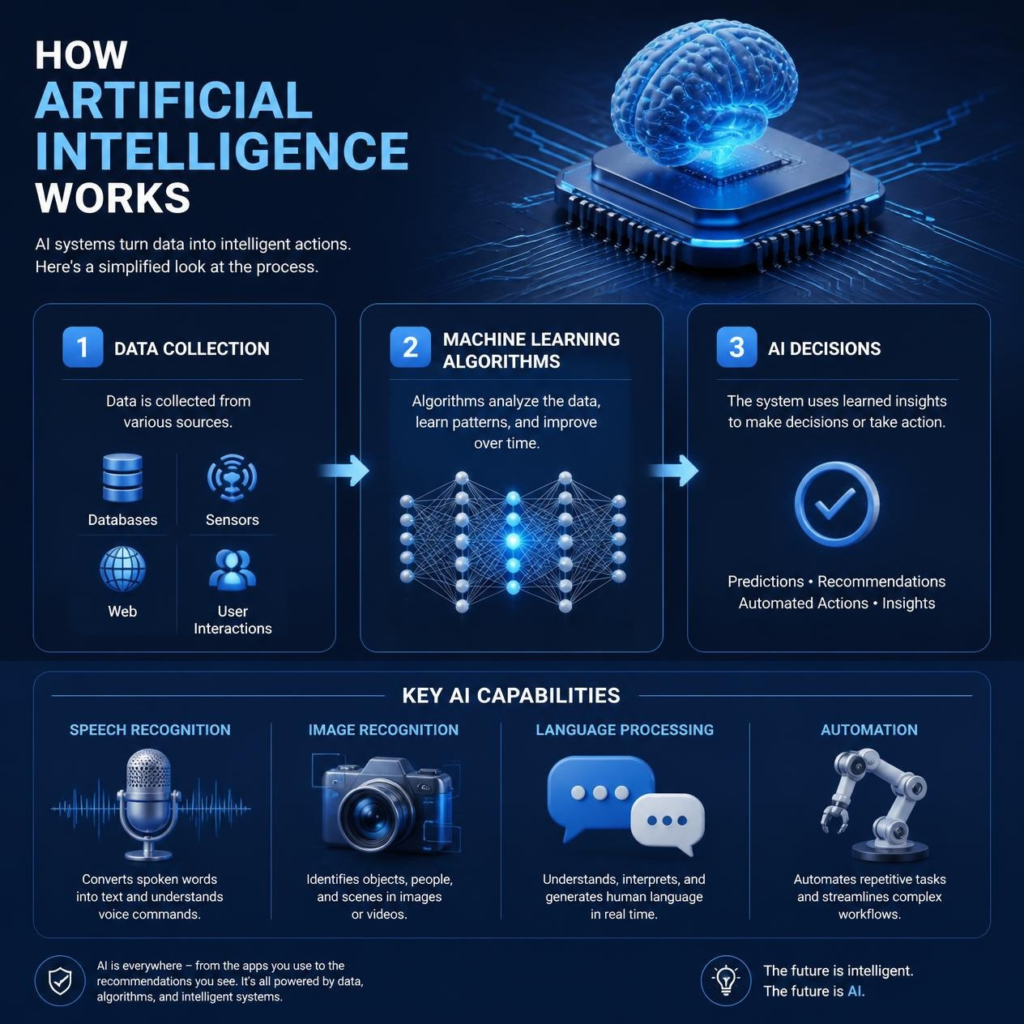
Artificial intelligence (AI) is the technology that enables computers and software to perform tasks that typically require human intelligence, such as understanding language, recognizing images, finding patterns in data, making predictions, and generating content.
You may already use AI every day without realizing it. Voice assistants, recommendation systems, spam filters, navigation apps, facial recognition, online customer support, and generative AI tools all use forms of artificial intelligence.
But what is artificial intelligence actually doing behind the scenes? Modern AI systems use algorithms and large amounts of data to identify patterns and produce predictions, classifications, recommendations, or generated outputs. Many of today’s most advanced systems use machine learning, where models learn patterns from data rather than relying entirely on manually written rules.
AI is a broad field that includes machine learning, deep learning, natural language processing, computer vision, generative AI, and other techniques. Understanding these foundations makes it easier to evaluate what AI can do, where it is being used, and what its limitations are.
In this artificial intelligence for beginners guide, we’ll explain what AI means, how it works, the main types of AI, real-world applications, its benefits and limitations, essential terminology, and practical ways to begin learning about this rapidly developing technology.
Defining Artificial Intelligence: The Basics
Artificial intelligence (AI) is a field of computer science focused on building systems that can perform tasks that normally require aspects of human intelligence. These tasks can include recognizing patterns, understanding language, analyzing images, making predictions, solving problems, and generating content.
Unlike traditional software that follows explicitly programmed rules for every situation, many modern AI systems use machine learning to identify patterns in data. A machine learning model is trained using examples and mathematical techniques so it can produce useful outputs when given new information.
For example, an email service can use AI to identify patterns associated with spam. A navigation application can analyze traffic and road conditions to help estimate travel times. An image-recognition system can classify objects in photographs, while a generative AI system can create text, images, audio, or other content from user instructions.
It is important to understand that AI is not a single technology. It is an umbrella term covering multiple approaches, including machine learning, deep learning, natural language processing, computer vision, robotics, and generative AI.
AI systems also have limitations. They can produce incorrect results, reflect problems in their training data, or perform poorly when they encounter situations outside the conditions for which they were designed. Understanding both the capabilities and limitations of AI is essential for using the technology responsibly.
For a more detailed introduction, see EEZYPOST’s guide to What Is Artificial Intelligence? A Complete Beginner’s Guide.
Categories of Artificial Intelligence
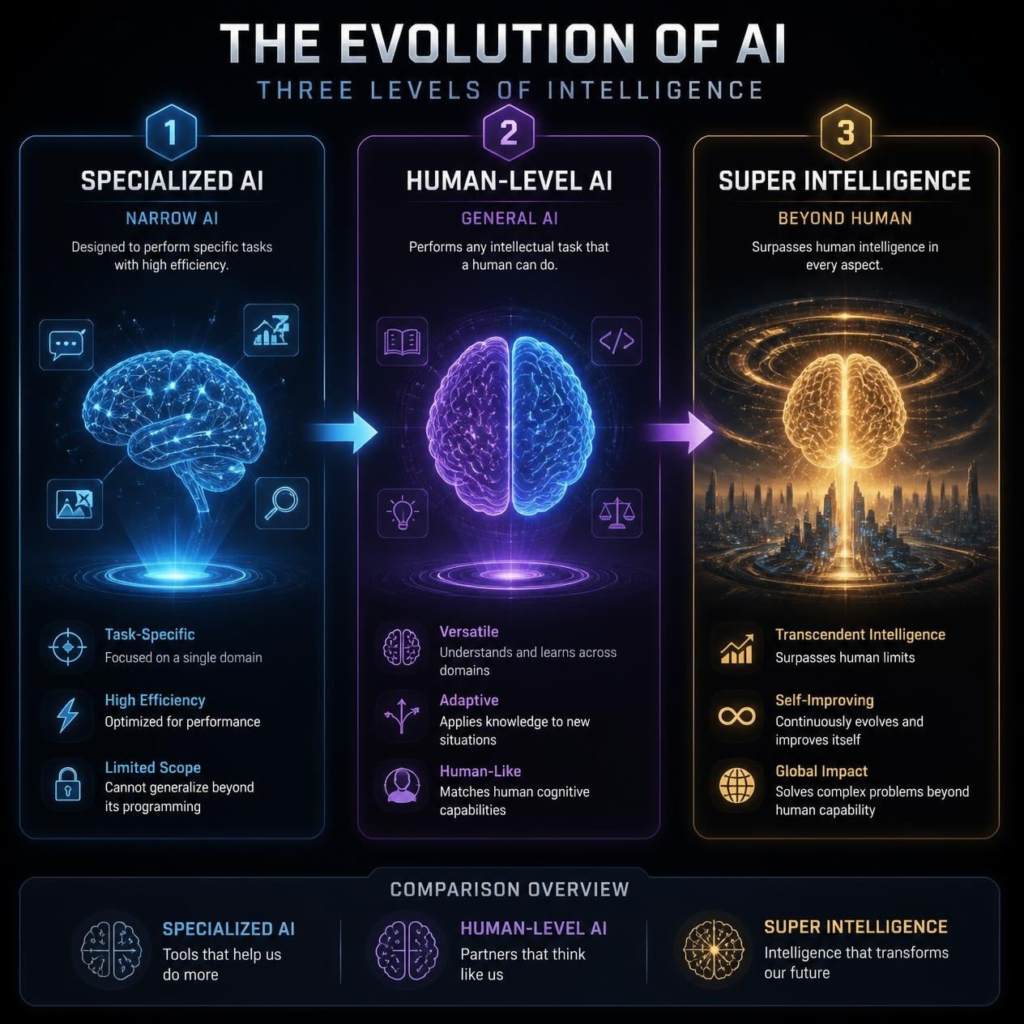
Artificial intelligence is often classified according to the range of tasks a system can perform. The three commonly discussed categories are Narrow AI, Artificial General Intelligence (AGI), and Artificial Superintelligence (ASI).
The first category describes the AI systems available today. The other two describe hypothetical or future forms of artificial intelligence that would have capabilities far beyond today’s specialized systems.
Narrow AI
Narrow AI, also called Artificial Narrow Intelligence (ANI), is designed to perform specific tasks or operate within a defined area. Virtually all AI systems in practical use today fall into this category.
Examples include:
- Image-recognition systems that identify objects or faces
- Recommendation systems used by streaming and shopping platforms
- Voice assistants and conversational AI
- Spam and fraud detection systems
- Navigation and traffic-prediction systems
- Generative AI tools that create text, images, audio, or code
A narrow AI system can be extremely capable within its specific area without possessing general human-like intelligence. For example, an AI system designed to analyze medical images may perform a specialized task extremely well but cannot independently switch to unrelated activities such as running a business or learning to play a musical instrument.
Artificial General Intelligence (AGI)
Artificial General Intelligence (AGI) refers to a hypothetical AI system with broad intellectual capabilities comparable to humans across many different types of tasks.
An AGI system would theoretically be able to learn new tasks, reason across different domains, adapt to unfamiliar situations, and apply knowledge from one area to another without being built specifically for each individual task.
AGI has not been conclusively achieved. Researchers and companies continue to debate how general intelligence should be defined and what capabilities would be required to demonstrate it.
Artificial Superintelligence (ASI)
Artificial Superintelligence (ASI) is a hypothetical form of AI that would surpass human intellectual capabilities across a broad range of domains.
Unlike Narrow AI, which is designed for specific tasks, ASI is generally discussed as a theoretical future possibility. Questions surrounding superintelligence include AI safety, control, alignment, governance, and the potential effects of systems that could outperform humans in areas such as scientific reasoning, strategic planning, and problem-solving.
Narrow AI vs. AGI vs. ASI
The key difference is the breadth of intelligence:
- Narrow AI: Performs specific tasks and represents the current state of practical AI.
- AGI: Would perform a broad range of intellectual tasks at a human-like level.
- ASI: Would theoretically exceed human intelligence across most or all intellectual domains.
Understanding this distinction is important because headlines about advanced AI can sometimes blur the difference between technologies that exist today and concepts that remain theoretical.
The Mechanics of Artificial Intelligence
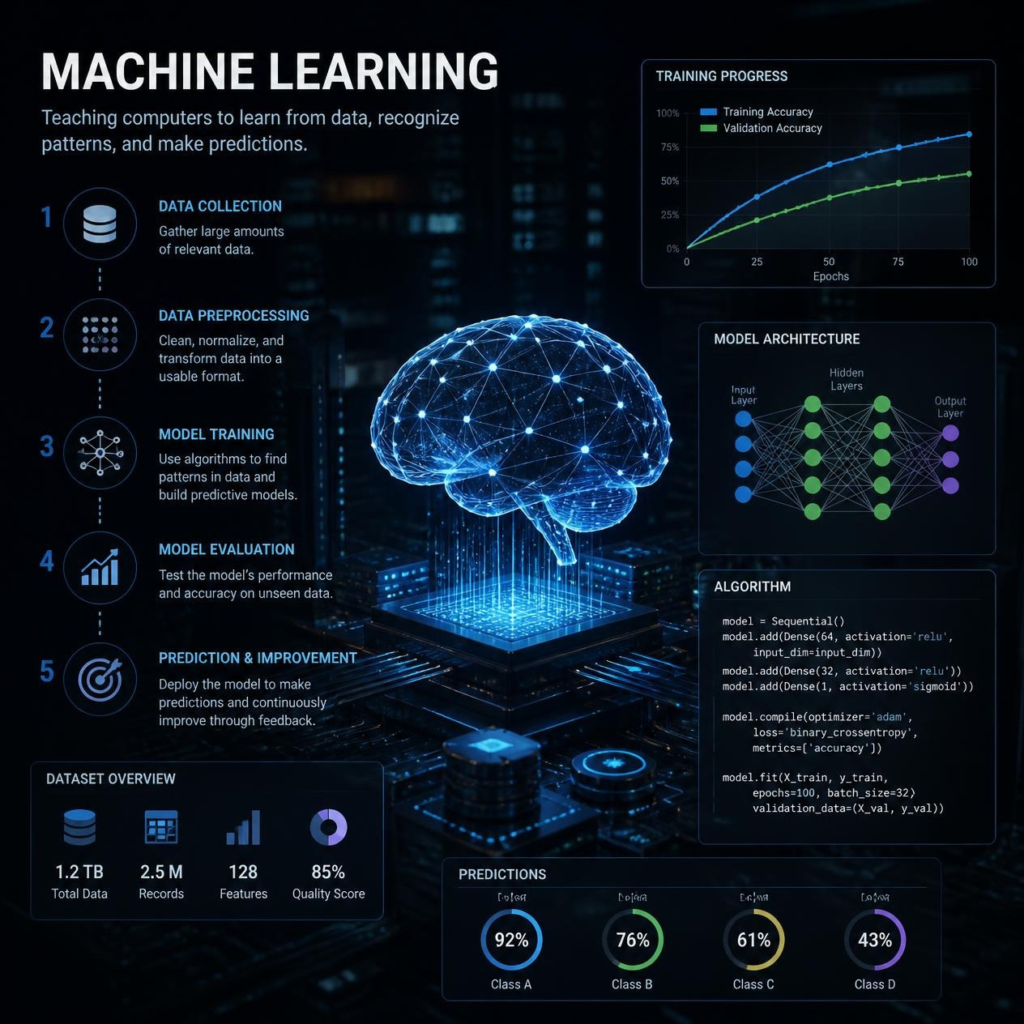
Artificial intelligence can be built using different computational techniques, but many of today’s most capable AI systems rely heavily on machine learning. Instead of programming every possible response manually, developers train models to identify patterns in data and use those patterns to generate predictions or outputs.
Three important concepts for understanding modern AI are machine learning, neural networks and deep learning, and large language models (LLMs).
Machine Learning Fundamentals
Machine learning (ML) is a branch of AI in which computer models learn patterns from data and use those patterns to make predictions, classifications, recommendations, or other decisions.
Machine learning is commonly discussed through three broad approaches:
- Supervised learning: The model learns from examples that include known answers. For example, a spam-detection model can be trained using emails labeled as spam or legitimate, allowing it to identify similar patterns in new messages.
- Unsupervised learning: The model works with data that does not have predefined labels and attempts to identify meaningful patterns or groupings. Customer segmentation is one example where businesses can use clustering techniques to identify groups of customers with similar characteristics.
- Reinforcement learning: The system learns through interactions with an environment, receiving rewards or penalties based on its actions. This approach has been used in areas such as game-playing systems, robotics, and decision-making research.
Machine learning does not mean that a model automatically becomes more intelligent every time it is used. In many systems, learning takes place during a specific training process, while the resulting model is later used to process new information.
Neural Networks and Deep Learning
Neural networks are machine learning models made up of interconnected computational units that process information through multiple layers. They are loosely inspired by biological neural networks, although artificial neural networks work very differently from the human brain.
Deep learning refers to machine learning methods that use neural networks with multiple layers. Deep learning has contributed to major advances in image recognition, speech processing, language translation, generative AI, and other applications.
Modern deep-learning systems can contain very large numbers of parameters and require substantial computing resources for training. Their performance depends not only on model architecture but also on factors such as training data, computing resources, optimization methods, and evaluation.
Large Language Models
Large language models (LLMs) are AI models trained on large collections of text and other data to learn statistical patterns in language. They can process prompts and generate text based on patterns learned during training.
Examples of well-known LLM families include GPT, Claude, Gemini, and Llama.
LLMs can perform tasks such as answering questions, summarizing information, translating text, generating drafts, assisting with programming, and analyzing documents. However, they do not guarantee factual accuracy. They can produce incorrect or misleading information, so important outputs should be independently verified.
Many modern AI applications combine LLMs with other technologies, such as retrieval systems, external tools, databases, and software applications. This allows an AI system to do more than simply generate text from a prompt.
Understanding these three concepts, machine learning, deep learning, and large language models, provides a useful foundation for understanding how many modern AI systems are developed and used.
How AI Is Being Used Today
Artificial intelligence is no longer limited to research laboratories. AI systems are now used in many products, services, and business processes that people interact with every day.

Artificial intelligence is no longer limited to research laboratories. AI systems are now used in many products, services, and business processes that people interact with every day.
The technology can help organizations analyze information, automate repetitive tasks, recognize patterns, personalize experiences, support decision-making, and generate content. The way AI is used varies significantly by industry, and many applications still require human review and oversight.
Healthcare and Medical Research
AI is being used in healthcare to support tasks such as medical-image analysis, clinical research, administrative work, and patient communication.
Machine learning systems can help researchers analyze large datasets and can assist trained professionals in identifying patterns in medical images. AI is also being explored for drug discovery and other areas of biomedical research.
AI does not replace medical professionals. In healthcare, the reliability of the system, quality of the data, privacy, and appropriate human oversight are especially important.
Financial Services
Financial institutions use AI and machine learning for applications such as fraud detection, transaction monitoring, customer support, risk analysis, and document processing.
For example, an AI system can examine large numbers of transactions and identify patterns that may indicate unusual activity. Financial organizations can then use these signals as part of their broader review and security processes.
Transportation and Mobility
AI plays an important role in modern transportation. It can be used for route optimization, traffic prediction, driver-assistance features, logistics planning, and research into autonomous vehicles.
Advanced vehicle systems use computer vision and other machine-learning techniques to interpret information from cameras, sensors, and other sources. Autonomous driving remains a complex field that requires extensive testing, safety controls, and regulatory oversight.
E-Commerce and Online Shopping
Online retailers use AI to improve product recommendations, search results, inventory planning, customer support, and other parts of the shopping experience.
Recommendation systems can analyze signals such as previous interactions and product preferences to suggest potentially relevant products. Businesses can also use AI to analyze customer behavior and identify patterns that may improve their services.
Education and Learning
AI tools are increasingly being used to support students, teachers, and educational organizations.
Examples include personalized learning systems, language-learning applications, automated feedback, study assistants, and tools that help educators create or organize educational materials.
AI can provide useful support, but students and educators should verify important information because AI systems can sometimes produce inaccurate answers or misleading explanations.
Arts, Entertainment, and Content Creation
Generative AI can create or transform text, images, audio, video, and computer code. This has opened new possibilities for artists, designers, marketers, developers, and other creators.
AI tools can help with brainstorming, drafting, editing, image generation, music production, and other creative workflows. Human direction remains important because AI-generated content can contain errors, unwanted patterns, or outputs that do not match the creator’s intended result.
AI in Everyday Life
You may encounter AI without explicitly thinking of it as artificial intelligence. Examples include:
- Spam filtering in email
- Voice recognition and virtual assistants
- Search and recommendation systems
- Smartphone photography features
- Navigation and traffic prediction
- Fraud alerts from financial services
- Customer-service chatbots
- Personalized content recommendations
- Generative AI writing and image tools
These examples show why understanding artificial intelligence is becoming increasingly useful. AI is not one single application. It is a collection of technologies being incorporated into many different products, services, and workflows.
Advantages of Artificial Intelligence
Artificial intelligence can provide significant benefits when it is designed, deployed, and monitored appropriately. Its value often comes from processing information at scale, automating repetitive work, identifying patterns, and helping people make better-informed decisions.
Faster Data Processing
AI systems can process large amounts of information much faster than humans in many situations. This can help organizations analyze documents, transactions, images, customer interactions, and other datasets more efficiently.
Automation of Repetitive Tasks
AI can automate certain repetitive activities, allowing people to spend more time on tasks that require judgment, creativity, communication, or specialized expertise.
Examples include sorting documents, responding to routine customer questions, summarizing information, and processing structured data.
Pattern Recognition
Machine learning systems can identify patterns in large datasets that may be difficult to detect manually. This can be useful for applications such as fraud detection, recommendation systems, medical research, forecasting, and quality control.
Personalization
AI can help businesses and digital services tailor experiences to individual users. Recommendation systems, for example, can use information about previous interactions to suggest products, videos, music, articles, or other content that may be relevant to a user.
Improved Productivity
AI tools can assist with research, writing, coding, analysis, communication, and other knowledge-based tasks. When used appropriately, these tools can help individuals and organizations complete certain workflows more efficiently.
Support for Innovation
AI can help researchers, engineers, businesses, and creators explore ideas and analyze complex information. In fields such as scientific research and drug discovery, machine learning is being used to investigate large datasets and identify potentially useful patterns.
Scalability
Once an AI-powered process has been properly developed and deployed, it can often handle large volumes of tasks without requiring a proportional increase in human labor. However, scaling AI also requires appropriate computing resources, monitoring, security, and quality controls.
AI therefore works best as a tool that augments human capabilities rather than automatically replacing human judgment. The benefits depend on the quality of the data, the design of the system, the specific use case, and how responsibly the technology is deployed.
Challenges and Drawbacks
Artificial intelligence can provide significant benefits, but it also introduces technical, social, economic, and security challenges. Understanding these limitations is important for anyone learning about AI or considering how to use it.
Bias and Discrimination
AI systems can reproduce or amplify patterns contained in their training data. If the data used to develop a system contains historical biases or does not adequately represent certain groups, the resulting system may produce unfair outcomes.
This is particularly important in areas such as hiring, lending, healthcare, and other decisions that can significantly affect people’s lives. Developers and organizations need appropriate testing, monitoring, and human oversight to identify and reduce potential bias.
Inaccurate or Fabricated Information
Generative AI systems can sometimes produce information that appears convincing but is incorrect. This is often called an AI hallucination.
The risk is particularly important when AI is used for medical, legal, financial, scientific, or other high-stakes information. Users should verify important claims against reliable sources rather than assuming that an AI-generated response is automatically accurate.
Employment and Workforce Changes
AI and automation can change the way work is performed. Some tasks may become automated, while other jobs may change as workers use AI tools to complete parts of their responsibilities.
The overall effect on employment can vary by industry, occupation, technology, and economic conditions. AI may eliminate some tasks while also creating demand for new skills and roles. Workers and organizations therefore need to adapt as the technology develops.
Privacy and Data Security
AI systems can process large amounts of information, which creates important privacy and security considerations.
Organizations need to understand what information is collected, where it is stored, who can access it, and how it is used. Sensitive personal or business information should not be entered into AI tools without understanding the relevant privacy and security protections.
Cybersecurity Risks
AI can be used for both defensive and malicious purposes. Security teams can use AI to detect unusual activity and identify potential threats, while attackers can potentially use AI to automate parts of phishing, social engineering, malware development, or other attacks.
AI-generated deepfakes and synthetic audio can also make it harder to distinguish authentic material from manipulated content.
Lack of Explainability
Some advanced AI systems can be difficult to interpret. A model may produce a prediction or recommendation without providing a simple explanation that humans can easily understand.
This lack of explainability can create challenges in regulated or high-stakes environments where organizations need to understand why a system produced a particular result.
AI Safety and Responsible Use
As AI systems become more capable, questions about safety, reliability, human oversight, accountability, and responsible deployment become increasingly important.
AI should therefore be treated as a powerful technology that requires appropriate safeguards rather than as an infallible decision-maker. Understanding both its capabilities and limitations is essential for using artificial intelligence responsibly.
Essential AI Vocabulary
Learning a few fundamental AI terms makes it much easier to understand how artificial intelligence systems work. These are some of the most common concepts beginners will encounter.
Algorithm
An algorithm is a defined sequence of instructions or computational steps used to solve a problem or perform a task. In AI and machine learning, algorithms help systems process data and learn or make predictions.
Dataset
A dataset is a collection of information used to train, evaluate, or test an AI or machine learning system. Depending on the application, a dataset can contain text, images, audio, video, numbers, or other types of information.
Model
An AI model is a computational system that has learned patterns from data during training. Once trained, a model can process new information and produce outputs such as predictions, classifications, recommendations, or generated content.
Training
Training is the process of using data and computational methods to adjust a machine learning model so that it can recognize useful patterns and perform a particular task.
Inference
Inference is the process of using a trained AI model to generate an output from new input. For example, when an AI model analyzes an image and identifies an object, the model is performing inference.
Neural Network
A neural network is a type of machine learning model made up of interconnected computational units arranged in layers. Neural networks are widely used in areas such as image recognition, speech processing, and generative AI.
Natural Language Processing
Natural language processing (NLP) is an area of AI focused on enabling computers to process, analyze, understand, and generate human language.
NLP is used in applications such as translation, search, voice assistants, chatbots, text analysis, and language models.
Computer Vision
Computer vision is an area of AI that enables computers to analyze and interpret visual information such as images and video.
Applications include object detection, facial recognition, medical-image analysis, manufacturing inspection, and autonomous systems.
Generative AI
Generative AI refers to AI systems that can create new content based on learned patterns and user inputs. Depending on the system, this can include text, images, audio, video, or computer code.
Large Language Model
A large language model (LLM) is an AI model trained on large amounts of data to process and generate language. LLMs are used in conversational AI, writing assistance, coding tools, summarization, translation, and many other applications.
Prompt
A prompt is the instruction or input provided to an AI system. A prompt can be a question, command, description, or set of instructions that guides the system toward a desired output.
Understanding these terms provides a foundation for exploring more advanced topics such as generative AI, AI agents, deep learning, and artificial general intelligence.
Beginning Your AI Education Journey
Learning artificial intelligence does not require an advanced computer science degree or years of programming experience. Beginners can start with the fundamentals, build practical skills gradually, and choose a learning path based on their goals.
1. Build a Strong AI Foundation
Start by understanding the concepts behind modern AI before diving into complex mathematics or programming.
Learn the basics of:
- What artificial intelligence is and how it differs from traditional software
- Machine learning and how models learn patterns from data
- Neural networks and deep learning
- Generative AI and large language models
- Natural language processing and computer vision
- AI agents and how they use models, tools, and external information
- AI limitations, bias, privacy, security, and responsible use
A solid conceptual foundation makes more advanced AI topics much easier to understand.
Beginners can also explore Microsoft’s AI learning resources for structured introductions to AI concepts and practical skills.
2. Learn the Tools You Actually Need
You do not need to become a professional programmer before experimenting with AI.
For nontechnical beginners, start by learning how to:
- Write effective prompts
- Evaluate AI-generated information
- Use AI tools for research, writing, analysis, and productivity
- Work with structured data such as spreadsheets
- Understand basic AI workflows and automation
If you want to build AI applications, learning Python is an excellent next step because it is widely used for data analysis, machine learning, and AI development.
3. Practice With Real AI Platforms
Theory becomes much easier to understand when you experiment with working systems.
Try beginner-friendly environments where you can explore AI models, datasets, and notebooks without building everything from scratch. Platforms such as Google Colab and Hugging Face can help you move from reading about AI to actually testing models and workflows.
Start with small experiments. For example, you could compare how different AI models summarize the same article, classify simple data, extract information from text, or generate and improve a piece of content.
4. Build Small Projects
You learn AI more effectively by creating practical projects than by only watching tutorials.
Begin with simple ideas such as:
- A document summarizer
- A question-and-answer assistant
- A basic text classifier
- A customer-support chatbot
- A content research assistant
- A spreadsheet analysis workflow
- An AI-powered recommendation tool
Your first project does not need to be impressive. The goal is to understand how data, models, prompts, tools, and outputs fit together.
5. Develop AI Skills Step by Step
Once you understand the fundamentals, gradually move into more advanced subjects.
A practical progression is:
AI fundamentals → Python → data handling → machine learning → neural networks → generative AI → LLM applications → AI agents
For learners who want a more structured path into machine learning, the Machine Learning Specialization on Coursera provides hands-on coverage of core machine-learning concepts and practical applications.
You do not have to follow every branch. Choose the areas that match your interests and career goals.
6. Learn to Evaluate AI, Not Just Use It
One of the most important skills for an AI beginner is knowing when an AI system may be wrong.
AI can produce inaccurate information, biased outputs, fabricated citations, or overly confident answers. Always verify important claims, especially when AI is being used for financial, legal, medical, scientific, or business decisions.
Learning how to question, test, compare, and verify AI outputs is just as important as learning how to generate them.
7. Keep Learning as AI Evolves
Artificial intelligence is developing rapidly, so the tools and techniques you learn today will continue to change.
Follow reliable technical documentation, research updates, reputable educational resources, and real-world AI developments. Focus on understanding the underlying concepts rather than becoming dependent on a single AI tool.
The most valuable long-term skill is the ability to learn new AI systems as they emerge.
A Simple Beginner Roadmap
If you are starting from zero, keep it simple:
Week 1: Learn AI fundamentals and essential terminology.
Week 2: Experiment with generative AI and different prompting techniques.
Week 3: Learn basic Python and work with simple datasets.
Week 4: Build a small AI project and evaluate its results.
You can then continue toward machine learning, deep learning, LLM applications, or AI agents depending on your goals.
The objective is not to learn everything about artificial intelligence at once. Start with the fundamentals, practice regularly, build small projects, and gradually move toward more advanced AI systems.
What Lies Ahead for AI
Artificial intelligence is moving beyond simple chatbots and recommendation systems. As models become more capable, AI is increasingly being integrated into software, devices, business processes, scientific research, and everyday products.
For beginners, the important point is not to predict exactly what AI will look like years from now. Instead, it is useful to understand the major directions in which the technology is developing.
1. More Capable Multimodal AI
Modern AI systems can increasingly work with multiple types of information, including text, images, audio, video, and structured data.
This means future AI applications can combine different forms of information instead of treating each type separately. A single system might analyze a document, understand an image, listen to spoken instructions, and produce a written or visual response.
2. The Growth of AI Agents
AI is also moving toward systems that can do more than generate an answer.
AI agents can use models together with tools, software, databases, APIs, and other external systems to complete multi-step tasks. Depending on how they are designed, an agent might research information, organize data, create a plan, use a software tool, and return a completed result.
These systems are still developing, and their reliability depends heavily on the underlying models, tools, permissions, and safeguards.
3. AI on Devices and at the Edge
More AI processing is moving directly onto smartphones, computers, vehicles, cameras, and other connected devices.
This approach, often called edge AI, can reduce dependence on remote servers and may improve response times, privacy, or offline functionality for certain applications. However, devices have limited computing resources, so many advanced AI workloads will continue to rely on cloud infrastructure.
4. AI in Science, Medicine, and Industry
AI is increasingly being used to assist researchers and professionals with complex tasks such as analyzing large datasets, identifying patterns, generating predictions, optimizing processes, and exploring potential solutions.
In science and medicine, AI can help researchers analyze information and accelerate parts of the research process. In manufacturing, logistics, finance, agriculture, and other industries, AI can support forecasting, quality control, automation, and decision-making.
AI does not eliminate the need for human expertise. In high-stakes fields especially, human review, validation, and accountability remain essential.
5. Greater Focus on AI Safety and Governance
As AI becomes more capable and widely deployed, questions about safety, privacy, security, transparency, copyright, bias, and accountability are becoming increasingly important.
Governments, technology companies, researchers, and organizations are developing rules, standards, and policies for responsible AI development and deployment.
The goal is to make AI systems more reliable and useful while reducing foreseeable risks. Understanding these issues will become an important part of AI literacy for both technical and nontechnical users.
6. AI Will Become Part of More Everyday Software
AI is likely to become less of a separate destination and more of a built-in feature of the software people already use.
Search engines, productivity applications, customer-service systems, creative tools, business software, operating systems, and mobile devices can increasingly incorporate AI features directly into their workflows.
This shift means that understanding basic AI concepts will become useful even for people who never work as AI engineers or data scientists.
The Bigger Picture
The future of artificial intelligence is not simply about creating machines that are more intelligent. It is also about determining how these systems should be designed, controlled, evaluated, and used.
For beginners, the best approach is to build a strong understanding of today’s AI technologies while remaining open to how quickly the field can change. The fundamentals of data, models, machine learning, reasoning, evaluation, and responsible use will remain valuable even as individual AI tools and products evolve.
Frequently Asked Questions About Artificial Intelligence for Beginners
What is artificial intelligence in simple terms?
Artificial intelligence is technology that enables computers and software to perform tasks that typically require aspects of human intelligence, such as recognizing patterns, understanding language, analyzing information, making predictions, and generating content.
How does artificial intelligence work?
Modern AI systems often use machine learning models trained on large amounts of data. During training, models learn patterns in the data. During inference, they use those learned patterns to produce outputs such as predictions, classifications, recommendations, or generated content.
What are the main types of artificial intelligence?
The three commonly discussed categories are Narrow AI, Artificial General Intelligence (AGI), and Artificial Superintelligence (ASI). Narrow AI is the type used in practical applications today, while AGI and ASI remain hypothetical concepts.
Is artificial intelligence the same as machine learning?
No. Machine learning is a branch of artificial intelligence. AI is the broader field, while machine learning uses algorithms and data to enable systems to learn patterns and produce useful outputs without relying entirely on manually programmed rules.
Do I need programming skills to learn AI?
No. Beginners can learn AI concepts and use many AI tools without programming experience. However, learning Python can be valuable if you want to build AI applications, work with datasets, or study machine learning and deep learning more deeply.
What can artificial intelligence be used for?
AI is used in areas such as healthcare, finance, transportation, education, e-commerce, cybersecurity, customer service, content creation, scientific research, and many everyday software applications. The specific capabilities and reliability of an AI system depend on how it is designed and trained.
Can artificial intelligence make mistakes?
Yes. AI systems can produce inaccurate, biased, incomplete, or misleading results. Generative AI can also produce convincing information that is not factual. Important information should therefore be verified against reliable sources, particularly when AI is used for financial, legal, medical, scientific, or other high-stakes decisions.
Final Thoughts
Artificial intelligence is no longer limited to research laboratories or specialized technology companies. It is already part of search, software, finance, healthcare, education, transportation, entertainment, and many everyday digital services.
For artificial intelligence for beginners, the most important starting point is understanding the fundamentals. AI is a broad field that includes machine learning, deep learning, natural language processing, computer vision, generative AI, and increasingly capable AI agents.
At the same time, understanding AI means understanding its limitations. AI systems can produce inaccurate information, reflect biases in their training data, create privacy and security risks, and make mistakes when used without appropriate human oversight.
The technology will continue to evolve, but the core principles remain valuable: understand how AI works, question its outputs, verify important information, and use it responsibly.
Whether you want to use AI more effectively, build AI-powered applications, or simply understand how this technology is changing the world, learning the fundamentals gives you a strong foundation for what comes next.









Leave a Reply