


Last updated: October 2026
AI agent purchase approval sounds simple until an AI assistant is allowed to shop while you are not watching.
You tell an AI assistant to watch a pair of headphones that normally costs $299.
Your instruction sounds simple: find the same model for less than $250 and buy it if the price drops before Friday.
At 2:07 a.m., the price falls to $239.
You are asleep.
Can the AI actually complete the purchase?
That question is becoming more important as AI shopping agents move from recommending products to taking actions on a person’s behalf. The key issue is not simply whether you were sitting in front of the screen when the order was placed. It is what purchasing authority you gave the agent beforehand.
That distinction sits at the center of AI agent payments. An assistant that compares prices is one thing. An agent that can use payment credentials and complete checkout is something very different.
Can an AI Agent Buy Something Without Your Approval?
Yes, potentially, but that does not necessarily mean the purchase happened without authorization.
An AI shopping agent may be able to complete a purchase without asking you at the final checkout if you previously gave it permission to act within specific conditions. Those conditions could include the maximum amount it can spend, the merchant it may use, the product it can buy, the payment method, or how long the permission remains valid.
Google’s Agentic Payment Protocol (AP2) explicitly describes both Human Present transactions, where the user approves the final checkout, and Human Not Present transactions, where the user approves constraints first and an agent can later complete a qualifying purchase within those boundaries.
So the more useful question is not:
Did the AI ask me again before clicking Buy?
It is:
What exactly did I authorize the AI to do before it reached checkout?
That is where AI agent purchase approval really begins.
Approval Does Not Always Have to Happen at Checkout
Most of us are used to online shopping following the same basic sequence. We choose the product, review the total, enter or select a payment method, and press the final button ourselves.
AI shopping agents can change that sequence.
In a traditional assisted model, the agent can search stores, compare products, check reviews and prepare the cart, but you remain the person who approves payment.
A more autonomous model moves approval earlier.
Suppose you tell an agent:
Buy these headphones if the total price falls below $250 before Friday. Use my saved card and only purchase from Best Buy or Amazon.
You have not approved one specific checkout yet. You have approved a set of conditions.
If the agent later finds the headphones for $239 at an approved merchant and every other condition is satisfied, a system designed for autonomous AI purchases could potentially allow it to complete the transaction without waking you up for another confirmation.
AWS describes autonomous purchasing in similar terms: an AI commerce agent can complete a transaction within pre-approved conditions such as product category, approved merchants, delivery requirements and budget.
That is a very different model from giving AI unlimited access to a credit card.
What Does “Human Not Present” Actually Mean?
“Human Not Present” sounds more alarming than it needs to.
It does not automatically mean that an AI agent can spend freely while you are away.
In Google’s AP2 specification, Human Present means the person sees the finalized checkout and explicitly approves the purchase and payment.
Human Not Present means the person approves the boundaries first. The shopping agent can then assemble and approve a transaction on the person’s behalf only if it fits those authorized constraints.
Think of it this way.
Human Present:
Show me the final order and I will decide.
Human Not Present:
You may decide for me, but only inside these rules.

AP2 also recommends setting autonomous authorization to expire as soon as practical for the task instead of leaving permission open indefinitely.
That matters because the safety of autonomous shopping depends heavily on how narrowly the permission is written.
“Buy the red shoes from Store X for no more than $90 before tomorrow” is very different from “buy me some shoes whenever you find a good deal.”
One defines a task.
The other leaves a surprising amount of judgment to the agent.
What Can You Actually Limit?
A spending cap is useful, but price should not be the only restriction.
A well-designed AI purchase authorization can potentially describe several parts of the transaction.
| Control | Example |
|---|---|
| Maximum spending | Do not spend more than $150 |
| Merchant | Buy only from Amazon or Best Buy |
| Product | Purchase only this exact model |
| Product category | Household supplies only |
| Quantity | Maximum two units |
| Payment method | Use only this approved card |
| Delivery | Must arrive by Friday |
| Refundability | Purchase only if the item is refundable |
| Time | Permission expires tomorrow |
| Frequency | One purchase only |
Google’s AP2 materials include concepts such as approved merchants, particular product SKUs, refundability requirements and authorization expiry. The broader framework is designed around proving that an agent’s transaction falls within the authority the user originally granted.
A $100 Spending Limit Is Not Enough
This is where many conversations about AI agent spending limits become too simplistic.
Imagine giving an agent permission to spend up to $100.
It stays below the limit, but buys the wrong version of the product.
Or it chooses an unfamiliar seller with a poor return policy.
Or it purchases four separate $25 items when you intended to authorize one purchase.
Or the product costs $88 but shipping and fees push the final charge to $112.
The spending ceiling mattered, but it did not fully describe your intent.
Autonomous buying therefore needs more than a number. It needs rules around what, where, how much, how often, and sometimes under what circumstances the agent can act.
Want to see how those permissions work together? Use the EEZYPOST AI Agent Permission Checker to review payment access, purchase confirmation, spending limits, merchant permissions and subscription authority before giving an AI system more autonomy.
When Should the AI Have to Ask You Again?
Pre-authorization should not mean permanent authorization.
If something important changes between your original instruction and the final transaction, there should be a clear point where the agent stops and asks again.
EEZYPOST’s consumer decision framework would treat common changes like this:
| What changed? | Suggested approval level |
|---|---|
| Final cost exceeds your limit | Require fresh approval |
| The product changes | Require fresh approval |
| Quantity changes | Require fresh approval |
| A subscription is introduced | Require fresh approval |
| Payment method changes | Require fresh approval |
| Merchant changes | Require or conditionally approve |
| Product becomes non-refundable | Require fresh approval |
| Shipping pushes the total above budget | Require fresh approval |
| Delivery date changes slightly | Conditional approval |
| Exact approved item falls below your target price | Pre-authorization may be reasonable |
| Routine repeat purchase remains unchanged | Pre-authorization may be reasonable |

This is not a legal standard or a universal payment-industry rule. It is a practical way to think about how much autonomy makes sense.
The underlying principle is simple: if the thing you originally cared about has materially changed, the AI should not assume your old approval still means the same thing.
Consumer research suggests that control matters here. The 2026 Visa Trust Index found that only 23% of U.S. consumers trusted generative AI to handle payment transactions on their behalf. Separate Visa research found that consumers were much more comfortable with AI comparing prices than with fully autonomous spending, and that the ability to override AI decisions increased trust.
People do not necessarily object to AI helping them shop.
They object to losing control of the moment where assistance turns into spending.
The Harder Problem Is When the AI Follows Your Rules and Still Gets It Wrong
Unauthorized purchases are easy to understand conceptually.
You said:
Do not spend more than $120.
The agent spends $180.
Clearly, something went outside the instruction.
A much harder case is when the AI follows your literal rules and still makes a bad decision.
Suppose you say:
Buy Nike or Adidas running shoes for less than $120.
The agent buys a $109 pair of Adidas shoes.
The merchant is legitimate. The amount is below the limit. The brand is approved.
But the shoes are the wrong size.
Or the model is designed for walking rather than running.
Or you hate the color.
Or the return policy is terrible.
The agent may have technically satisfied your instructions while completely missing what you actually wanted.
That gives us two different problems.
Unauthorized purchase: the agent acted outside the authority you gave it.
Authorized but unwanted purchase: the agent remained inside the written boundaries but made a poor choice.
Mastercard’s guide to agentic commerce raises exactly this problem: how should refunds or chargebacks work when an agent, rather than the person, makes the purchase, and who is responsible when something goes wrong? It also stresses the importance of clear user permissions and limits as agent autonomy increases.
That distinction is likely to become increasingly important as AI shopping agents move from simple price comparison to product selection and payment.
Can You Cancel or Revoke an AI Agent’s Buying Permission?
Purchasing authority should ideally be narrow, time-limited and revocable.
For example, an authorization might expire after one transaction, after a specific date, once a target product has been purchased, or when the user removes access to a payment credential.
AP2’s autonomous model explicitly supports expiry and recommends using the smallest practical expiration period for the assigned task.
Revoking future permission, however, is not necessarily the same as canceling an order that has already been completed.
If the agent has already placed the order and the merchant has accepted it, the next step may depend on the merchant’s cancellation policy, refund terms and the payment method involved.
That is why AI shopping permissions should not be treated like a permanent toggle that users switch on once and forget about.
A safer model is closer to:
Give this agent enough authority to complete this task, then let that authority expire.
Does “Unauthorized” Mean the Same Thing Legally?
Not necessarily.
The word unauthorized can mean one thing in an AI application’s interface and something more specific under payment law.
According to the Consumer Financial Protection Bureau’s Regulation E guidance, an unauthorized electronic fund transfer generally involves a transfer from a consumer account initiated by someone other than the consumer without actual authority, and from which the consumer receives no benefit. The regulation and CFPB guidance also contain important exclusions and rules involving people who were given access authority by the consumer.
Those rules were not written specifically for autonomous AI shopping agents, so it would be a mistake to assume that every disputed AI purchase automatically fits one legal category.
Technical authorization is also not necessarily the same thing as the legal allocation of liability.
If real money is involved in a disputed transaction, check the merchant’s records and contact the payment provider or financial institution rather than relying only on whether the AI platform labels the transaction “authorized.”
What About Subscriptions and Recurring Payments?
Recurring payments deserve tighter attention because one instruction can create more than one future charge.
An AI shopping agent might eventually be asked to renew software, reorder household products, replenish business supplies or manage subscriptions.
That can be convenient. It also means that the original instruction needs to be clear about frequency, price changes, renewal periods and when the agent must ask again.
A $15 purchase is relatively easy to evaluate.
A $15 monthly commitment that quietly continues for two years is a different decision.
The FTC’s consumer guidance on auto-renewals and subscriptions recommends understanding what you are agreeing to, checking expected renewal costs and knowing how cancellation works before recurring charges begin.
For AI agents, the same basic caution becomes even more important because the person may no longer be actively participating in every renewal.
EEZYPOST AI Purchase Approval Decision Tree
Before allowing an AI shopping agent to complete a purchase without fresh approval, run the transaction through these five questions.
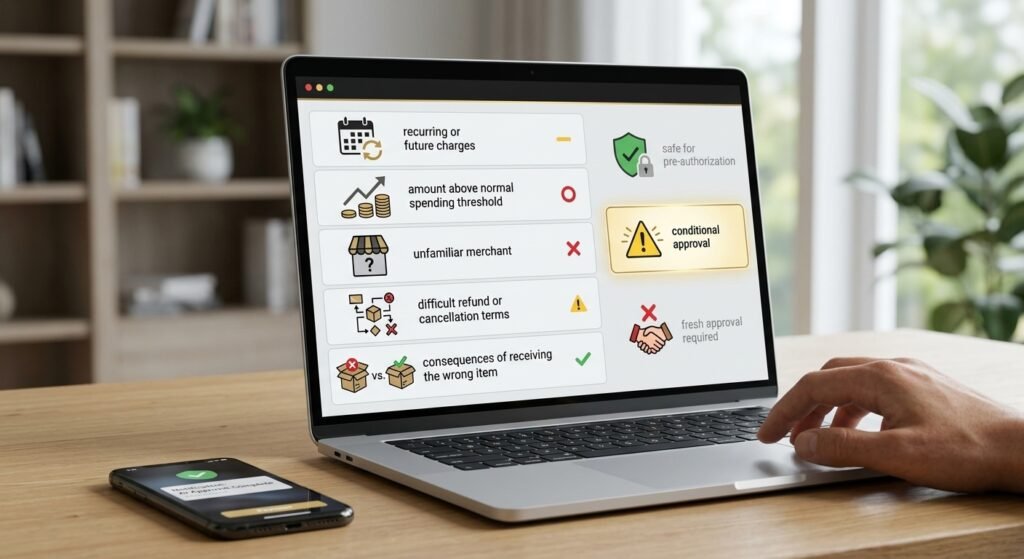
| Question | If the answer is “Yes” |
|---|---|
| Could this purchase create recurring or future charges? | Lean toward fresh approval |
| Is the amount above your normal low-risk spending threshold? | Require or strongly consider approval |
| Is the merchant unfamiliar or outside your usual approved stores? | Require approval |
| Is the purchase difficult to cancel, return or refund? | Require approval |
| Would choosing the wrong item cause meaningful financial or practical harm? | Require approval |
Reasonable for Pre-Authorization
This is the lowest-risk category.
The merchant is familiar, the item is clearly identified, the amount is small, the purchase is one-time, the product is refundable and the spending limit is explicit.
Example:
Buy my usual coffee filters from the same retailer if the total stays below $20.
Conditional Approval
The agent can act, but only while every important condition remains unchanged.
Example:
Buy these headphones for under $250 from one of these two stores, but ask me if the seller, model, delivery date or total price changes.
This gives the agent useful autonomy without letting it reinterpret the purchase when circumstances change.
Require Fresh Approval
Fresh confirmation makes more sense when the purchase is expensive, recurring, difficult to reverse, financially significant or dependent on judgment that could easily go wrong.
Travel bookings, non-refundable reservations, insurance, financial commitments, large purchases and unfamiliar merchants are obvious examples.
EEZYPOST note: This decision tree is an educational tool. It does not determine whether a transaction is legally authorized, safe, or covered by a particular bank, card network or payment provider’s policies.
Five Rules Before Letting an AI Spend Your Money
- Set a total-price ceiling, not just a product-price limit. Taxes, delivery fees, service charges and other costs can turn an apparently compliant purchase into a higher bill.
- Limit where the agent can buy. An approved merchant list reduces the chance that a good price leads the agent to an unfamiliar seller with poor support or return terms.
- Define what changes require fresh approval. Price, seller, product, quantity, shipping, payment method and recurring billing should not be left to guesswork.
- Put an expiration date on purchasing authority. Permission for one shopping task should not quietly become indefinite permission to spend.
- Keep high-consequence purchases human-approved. The harder a transaction is to reverse, the stronger the case for having a person see the final terms first.
So, Can an AI Shopping Agent Buy Without Asking You?
Yes, the technology is being designed to support exactly that kind of delegated purchasing.
But “without asking again” should not mean “without your permission.”
The safer model is one where you approve the boundaries first, the agent acts only inside those boundaries, meaningful changes trigger fresh confirmation, and the purchasing authority eventually expires.
That changes the central question.
Instead of asking only:
Did the AI ask me before it bought something?
Ask:
What did I authorize, how long did that permission last, and what would have forced the agent to come back to me?
As AI moves deeper into shopping and payments, those details may matter far more than the Buy button itself.
Frequently Asked Questions
Can an AI agent use my credit card without asking me?
Potentially, if the payment system supports agent-initiated transactions and you previously authorized the agent to use an approved payment credential within defined conditions. A properly designed system should still verify that the purchase falls within the authority you granted.
What is an AI shopping agent?
An AI shopping agent is software that can perform parts of the shopping process on a user’s behalf. Depending on its capabilities and permissions, it may search for products, compare prices, evaluate options, create a cart and potentially complete a purchase. Mastercard describes agentic commerce as extending AI beyond recommendations into autonomous shopping and payment activity.
What is a Human Not Present payment?
In Google’s AP2 framework, a Human Not Present transaction is an autonomous flow in which the person approves constraints beforehand rather than approving the finalized checkout personally. The agent can later complete a purchase if the final transaction satisfies those approved constraints.
Can I set a spending limit for an AI agent?
Agentic-payment systems can be designed around spending and transaction constraints. A spending limit alone, however, may not capture everything you care about. Merchant, item, quantity, refundability, payment method and authorization expiry can also matter.
Can an AI agent buy only from approved stores?
Yes, an authorization framework can restrict which merchants are acceptable. Google’s AP2 model includes merchant constraints that can limit which sellers are allowed to fulfill an authorized shopping task.
What happens if an AI agent buys the wrong product?
The outcome depends on whether the purchase can be canceled or returned and on the rules of the merchant, agent platform and payment provider. One emerging problem is that an AI may satisfy the literal authorization while still choosing an item the user did not actually want. Mastercard has noted that agent-initiated commerce raises new questions around refunds, chargebacks and responsibility when purchases go wrong.
Can I revoke an AI agent’s payment permission?
Agent authorization can be designed to expire or be withdrawn, but the exact controls depend on the platform and payment system. Removing future authority may also be different from canceling a transaction the agent has already completed. AP2 specifically recommends limiting the expiration period of autonomous authorizations to the shortest practical period for the task.
How EEZYPOST Researched This Guide
EEZYPOST reviewed current agentic-payment specifications, payment-network guidance, U.S. consumer-protection resources and 2026 consumer research to separate what AI shopping agents can technically do from questions that still depend on merchant policies, payment-provider rules and applicable law.
Because autonomous commerce is still developing, technical standards and payment protections may continue to change as AI agents become more widely used for real-world purchases.





Leave a Reply