

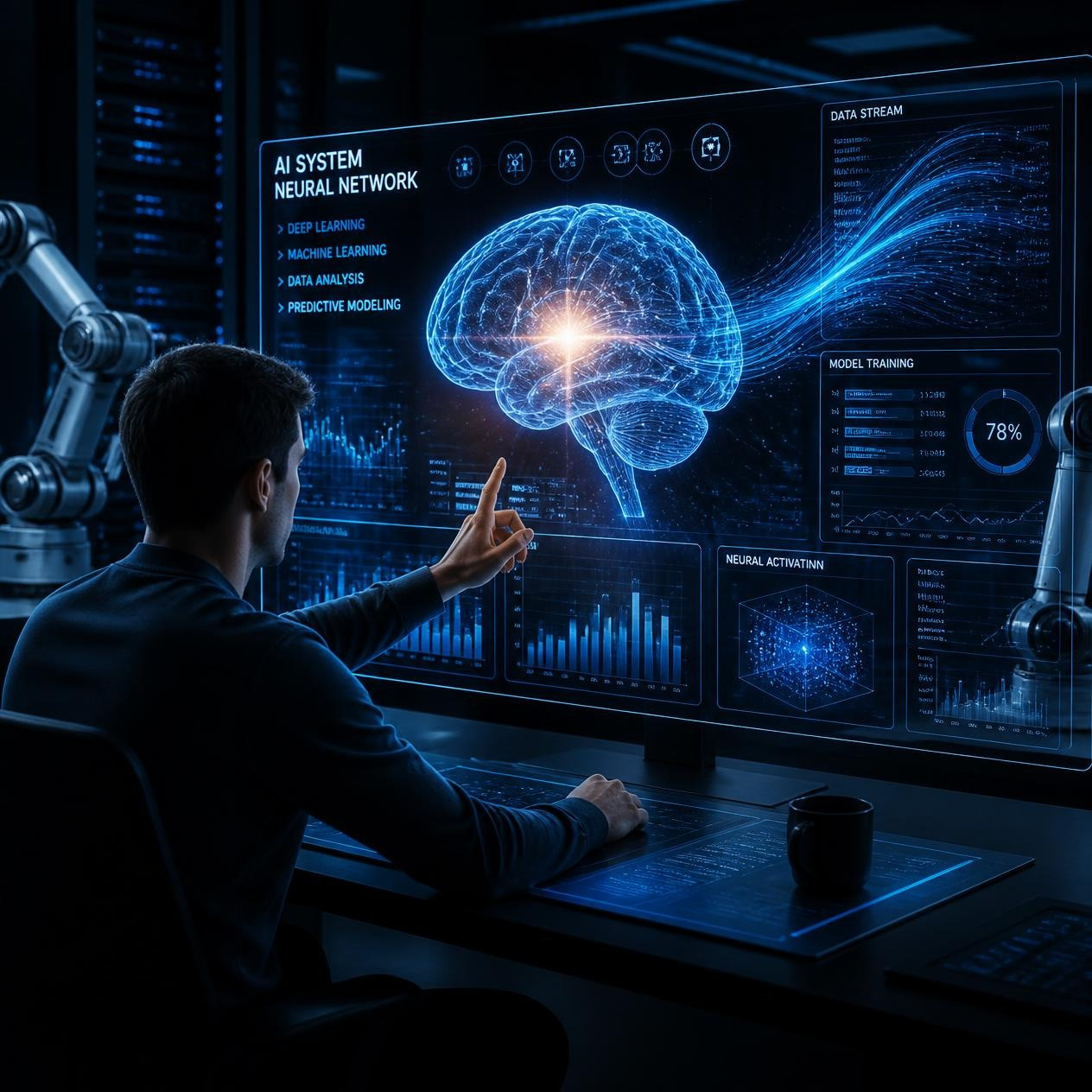
What Is Artificial Intelligence? A Complete Beginner’s Guide (2026)
Artificial intelligence (AI) is a field of computer science focused on creating systems that can perform tasks that typically require aspects of human intelligence. These tasks can include understanding language, recognizing images, identifying patterns, making predictions, solving problems, and generating content.
You may already use artificial intelligence every day without realizing it. Search engines, recommendation systems, spam filters, navigation apps, voice assistants, fraud-detection systems, customer-service chatbots, and generative AI tools all use different forms of AI.
So, what is artificial intelligence actually doing behind the scenes? Modern AI systems use algorithms, models, and data to identify patterns and produce outputs such as predictions, classifications, recommendations, or generated content. Many modern AI systems rely on machine learning, where models are trained on data to learn patterns that can be applied to new information.
Artificial intelligence is a broad field that includes machine learning, deep learning, natural language processing, computer vision, robotics, generative AI, and other computational techniques. Different AI systems are designed for different purposes, and their capabilities and limitations depend on how they are developed and deployed.
In this complete beginner’s guide, you’ll learn what artificial intelligence is, how AI works, the main types of AI, where it is used, its benefits and risks, and what the future of artificial intelligence may look like.
If you’re completely new to the subject, our artificial intelligence for beginners guide provides a practical introduction to AI concepts, applications, benefits, risks, and essential terminology.
What Is Artificial Intelligence?
Artificial intelligence (AI) is a broad field of computer science concerned with building computational systems that can perform tasks associated with human intelligence. These tasks include recognizing patterns, understanding language, analyzing images, making predictions, solving problems, and generating content.
AI is not a single technology. It includes multiple approaches and techniques, such as machine learning, deep learning, natural language processing, computer vision, robotics, and generative AI.
Many modern AI systems use machine learning. During training, a model is exposed to data and adjusted to learn patterns relevant to a particular task. After training, the model can use those learned patterns during inference to process new inputs and produce outputs.
For example, a spam-filtering system can be trained using examples of unwanted and legitimate messages. Once trained, it can analyze new messages and estimate whether they are likely to be spam. A computer-vision model can similarly process an image and classify or detect objects based on patterns learned during training.
The U.S. National Institute of Standards and Technology (NIST) describes AI in terms of machine-based systems that can make predictions, recommendations, or decisions for human-defined objectives. This helps illustrate an important point: AI systems can produce useful outputs without having human consciousness, emotions, or understanding.
Artificial intelligence is already used in search, recommendations, fraud detection, language tools, image analysis, customer support, scientific research, and many other applications. However, the capabilities of an AI system depend on its model, training data, design, and deployment environment.
Understanding this basic definition is the first step toward understanding how artificial intelligence works and why different AI systems can behave very differently. advances in computing power, cloud technology, and the availability of massive datasets. Today, AI powers everything from online search engines to medical diagnosis systems and self-driving vehicle research.
How Does Artificial Intelligence Work?
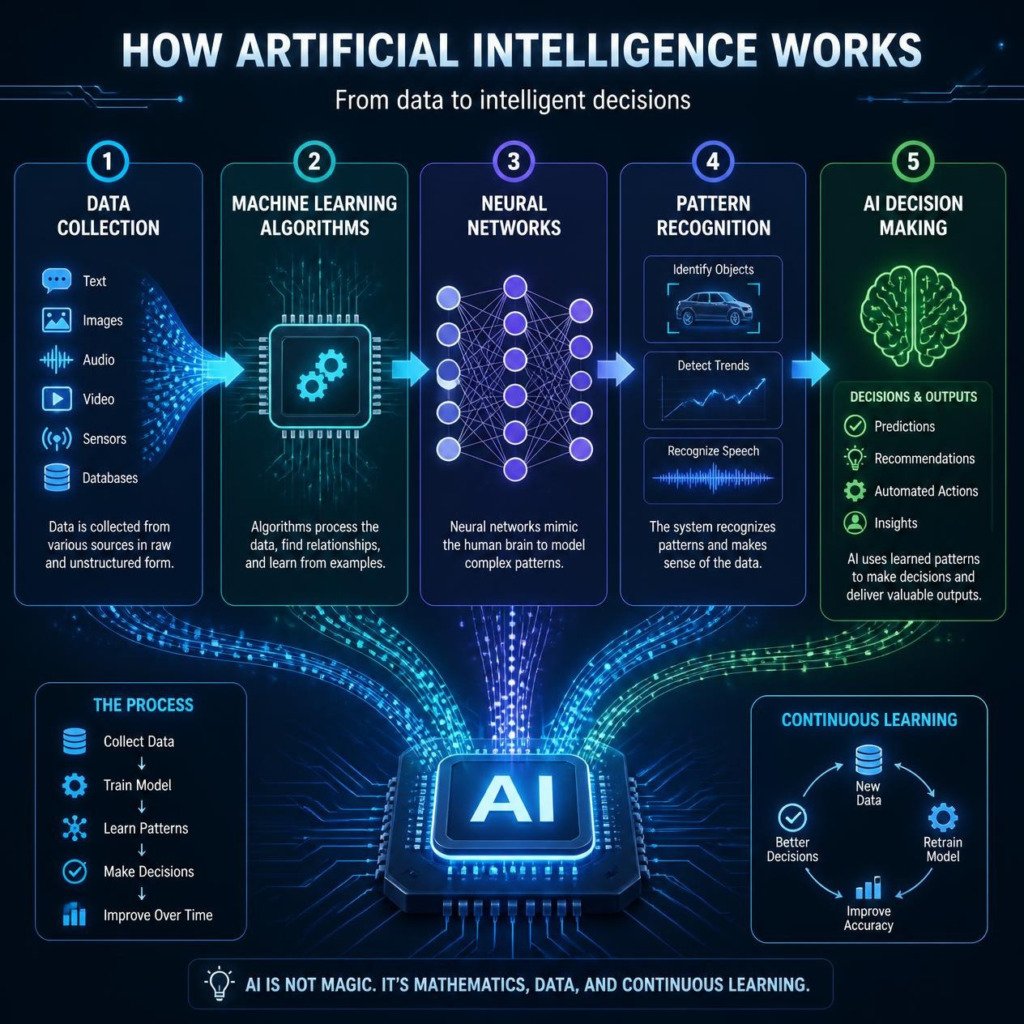
Artificial intelligence works by combining data, algorithms, and computational models to identify patterns and produce useful outputs. Depending on the system, those outputs may include predictions, classifications, recommendations, generated text or images, or decisions that support a particular task.
Most modern AI systems follow a basic process:
- Data collection: Relevant data is gathered, prepared, and organized for the task.
- Training: A machine learning model processes examples and adjusts its internal parameters to learn patterns in the data.
- Evaluation: The model is tested against data it has not previously seen to measure how well it performs.
- Inference: After training, the model processes new inputs and generates an output based on the patterns it learned.
- Monitoring and improvement: Developers can evaluate performance, identify errors, update data or models, and improve the system when necessary.
For example, an AI system designed to identify objects in photographs may be trained on many labeled images. During training, the model learns statistical patterns associated with different objects. When a new photograph is provided, the trained model can analyze it and estimate which objects are present.
Modern AI systems can become highly capable, but they do not automatically understand information in the same way humans do. Their performance depends on factors such as training data, model architecture, instructions, available computing resources, and the environment in which the system is deployed.
Some AI applications also use additional components beyond the model itself. These can include databases, search systems, external tools, sensors, retrieval systems, or software applications that provide the model with additional information or capabilities.
The sections below explain several of the technologies that make modern artificial intelligence possible, beginning with machine learning.
Machine Learning
Understanding what is artificial intelligence also means understanding how machine learning fits within the broader field of AI.
Machine learning (ML) is one of the most important approaches used to build artificial intelligence systems. Instead of programming every rule manually, developers train a machine learning model using data so it can identify patterns and use those patterns to make predictions or classifications.
A simple example is email spam detection. A machine learning model can be trained using examples of messages labeled as spam or legitimate. After training, the model can analyze a new message and estimate whether it is likely to be spam.
Machine learning can use different learning approaches depending on the task:
- Supervised learning: The model learns from labeled examples, such as images with known categories or transactions marked as fraudulent or legitimate.
- Unsupervised learning: The model looks for patterns or structures in data without predefined labels, such as grouping similar customers or documents.
- Reinforcement learning: The system learns through interactions with an environment, receiving feedback that helps it improve its strategy over time.
Machine learning is used in recommendation systems, fraud detection, forecasting, search, image recognition, language applications, and many other areas of technology.
It is important to distinguish training from inference. Training is the process of learning patterns from data, while inference is when a trained model processes new information and produces an output.
Deep Learning
Deep learning is a specialized approach within machine learning that uses artificial neural networks with multiple layers to process complex patterns in large amounts of data.
These neural networks are loosely inspired by the way biological nervous systems process information, but they are mathematical and computational systems rather than digital versions of the human brain.
Deep learning has become especially important because it can work effectively with complex and unstructured data, including images, audio, video, and text. It powers many modern applications such as image recognition, speech recognition, language models, recommendation systems, and generative AI.
For example, a deep learning system trained on large collections of images can learn patterns that help it recognize objects or classify images. A language model can similarly learn statistical relationships within text and use them to generate or analyze language.
Deep learning typically requires substantial amounts of training data and computational resources. Its performance also depends heavily on the quality and suitability of the data used to train the model.
The relationship can be summarized simply:
Artificial Intelligence → Machine Learning → Deep Learning
AI is the broader field, machine learning is one major approach within AI, and deep learning is a specialized type of machine learning.
Natural Language Processing (NLP)
Natural language processing (NLP) is an area of artificial intelligence that enables computers to process, analyze, and generate human language.
NLP is used in many technologies people interact with every day, including search engines, translation tools, voice assistants, chatbots, email systems, and generative AI applications.
Common NLP tasks include:
- Text classification: Categorizing text, such as identifying spam or determining the topic of a document.
- Sentiment analysis: Estimating whether text expresses a positive, negative, or neutral sentiment.
- Machine translation: Converting text from one language into another.
- Information extraction: Identifying useful information such as names, dates, locations, or other entities within text.
- Question answering: Processing a question and generating a relevant response.
- Text generation: Producing natural-language content from an input or instruction.
Modern language models use machine learning techniques to identify statistical patterns in very large collections of text and other data. These patterns allow models to process language and generate responses, but they do not mean the system has human-like consciousness or understanding.
NLP has become a major part of modern AI because language is one of the primary ways people interact with computers. Advances in NLP have also contributed to the rapid development of conversational AI, generative AI, and AI-powered search.
Computer Vision
Computer vision is an area of artificial intelligence that enables computers to process and interpret information from images and video.
Computer vision systems can analyze visual data to identify objects, detect patterns, classify images, recognize text, and support other tasks that require visual analysis.
Common applications include:
- Image classification: Assigning an image to a category, such as identifying different types of objects.
- Object detection: Locating and identifying specific objects within an image or video.
- Facial recognition: Comparing facial features to determine whether they match a known identity, where legally and appropriately deployed.
- Optical character recognition (OCR): Detecting and converting text contained in images or scanned documents into machine-readable text.
- Medical image analysis: Helping researchers and healthcare professionals analyze images such as X-rays, CT scans, and other medical imagery.
- Autonomous systems: Processing information from cameras and other sensors to help machines understand their surroundings.
Modern computer vision often relies on machine learning and deep learning models trained on large collections of visual data. During inference, the trained model can analyze new images or video and produce an output based on patterns learned during training.
Computer vision is particularly important because it allows AI systems to work with information that is difficult to represent using text alone. Combined with language, audio, and other forms of data, it also contributes to the development of multimodal AI systems.
These technologies help explain what is artificial intelligence in practical terms: AI combines different computational techniques to process information and produce useful outputs for specific tasks.
Types of Artificial Intelligence
Artificial intelligence can be classified in several ways, but one of the most common frameworks describes AI according to the breadth of its capabilities. This framework distinguishes between narrow AI, artificial general intelligence (AGI), and artificial superintelligence (ASI).
It is important to note that AGI and ASI are theoretical concepts rather than established categories of widely deployed AI systems.
Narrow AI
Narrow AI, also called weak AI, refers to AI systems designed to perform specific tasks or a defined range of tasks. Virtually all widely deployed AI systems today fall into this category.
Examples include:
- Search engines that rank and retrieve information
- Recommendation systems that suggest products, videos, or articles
- Spam filters that classify unwanted messages
- Fraud-detection systems that identify suspicious transactions
- Speech-recognition systems that convert spoken language into text
- Computer-vision systems that detect or classify objects
- Generative AI systems that create text, images, audio, video, or code
A narrow AI system can be highly capable within its intended task while still lacking the broad, flexible intelligence associated with humans.
Artificial General Intelligence (AGI)
Artificial general intelligence (AGI) refers to a hypothetical form of AI capable of performing a broad range of intellectual tasks with a level of flexibility comparable to human intelligence.
An AGI system would theoretically be able to learn and apply knowledge across different domains rather than being designed primarily for a specific task.
Despite significant advances in AI, there is no universally accepted standard confirming that AGI has been achieved. Researchers and technology companies also differ in how they define and measure general intelligence.
Artificial Superintelligence (ASI)
Artificial superintelligence (ASI) is a hypothetical form of AI that would exceed human intellectual capabilities across virtually all cognitive domains.
ASI remains a theoretical concept. It is often discussed in research and debates about the long-term implications, governance, safety, and societal impact of increasingly capable AI systems.
A Simple Way to Understand the Categories
The distinction can be summarized as:
Narrow AI: Designed for specific tasks or domains
AGI: Hypothetical AI with broad, general-purpose intellectual capabilities
ASI: Hypothetical AI that would surpass human intelligence across a wide range of cognitive abilities
Understanding this distinction helps separate the AI systems people use today from possible future forms of artificial intelligence.
Examples of Artificial Intelligence in Everyday Life
Artificial intelligence is already part of many everyday digital experiences, often working in the background rather than appearing as an obvious AI tool.
Here are some common examples:
- Search engines: AI helps interpret search queries, identify relevant information, and improve how results are ranked and presented.
- Recommendation systems: Streaming services, shopping platforms, and social networks use algorithms and machine learning models to recommend content, products, or accounts based on available signals.
- Navigation apps: AI and related data-processing systems can help estimate travel times, analyze traffic conditions, and suggest routes.
- Email and messaging: AI can help detect spam, filter unwanted messages, suggest replies, and organize communications.
- Smartphone cameras: Computational photography and AI-based models can assist with image enhancement, scene recognition, portrait effects, and other camera features.
- Voice assistants: Speech-recognition and language-processing technologies allow devices to interpret spoken commands and respond to requests.
- Online shopping: AI can support product recommendations, search, customer service, demand forecasting, and fraud detection.
- Banking and payments: Financial institutions use machine learning and other analytical systems to help identify unusual transactions and assess potential fraud.
- Generative AI: Tools based on modern AI models can generate or transform text, images, audio, video, and computer code from user instructions.
These examples show that artificial intelligence is not limited to robots or futuristic machines. Much of today’s AI operates inside software and digital services that people use every day.riences.
Real-World Applications of Artificial Intelligence
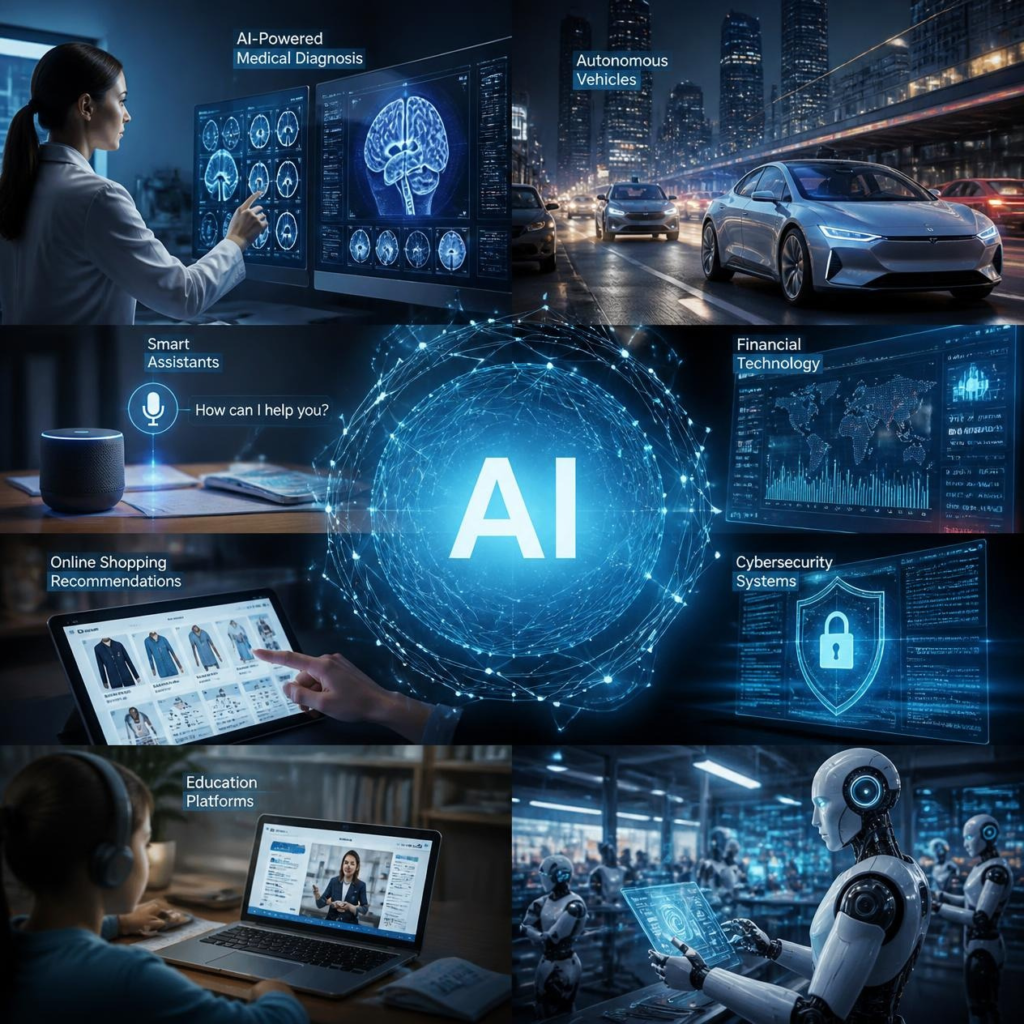
Knowing what is artificial intelligence becomes more meaningful when you see how these technologies are applied across real industries.
Artificial intelligence is being used across industries to analyze information, automate repetitive processes, support decision-making, and create new products and services. The role of AI varies by application, and in many high-stakes settings it is used to assist human professionals rather than replace human judgment.
Healthcare
AI can help analyze medical images, identify patterns in clinical data, support drug discovery, and assist with administrative tasks. Researchers are also exploring AI for disease research, personalized treatment approaches, and clinical decision support.
Finance
Banks and financial companies use machine learning and other AI techniques for fraud detection, transaction monitoring, risk analysis, customer support, document processing, and financial forecasting.
Education
AI can support personalized learning, tutoring systems, writing assistance, translation, accessibility tools, and administrative workflows. Educators can also use AI tools to create learning materials and provide feedback, while human oversight remains important.
Transportation
AI contributes to route optimization, traffic prediction, driver-assistance technologies, logistics, and fleet management. Autonomous-driving research also relies on AI systems that process information from cameras, sensors, maps, and other sources.
Retail and E-Commerce
Retailers use AI for product recommendations, search, demand forecasting, inventory management, customer service, pricing analysis, and fraud prevention. Generative AI is also being used to assist with product descriptions, marketing content, and customer interactions.
Manufacturing
Manufacturers can use AI for predictive maintenance, quality inspection, production optimization, robotics, and supply-chain planning. Computer-vision systems can inspect products for defects and identify issues that may be difficult to detect manually.
Cybersecurity
AI can help security teams analyze large volumes of activity, identify unusual patterns, detect potential threats, prioritize alerts, and support incident investigations. At the same time, attackers can also use AI to develop more sophisticated scams and other cyber threats.
Science and Research
AI is increasingly used to analyze complex datasets, model scientific processes, search through research information, and accelerate experimentation. Applications span areas such as materials science, biology, climate research, astronomy, and drug discovery.
Across these industries, the value of AI depends on how well the system is designed, evaluated, monitored, and integrated into the surrounding workflow. AI can be powerful, but it does not eliminate the need for domain expertise, appropriate safeguards, and human oversight.
Benefits of Artificial Intelligence
A clear understanding of what is artificial intelligence also requires looking at what these systems can do well and where they can provide practical value.
Artificial intelligence can provide significant benefits when it is appropriately designed, deployed, and monitored. Its value comes from the ability to process information at scale, identify patterns, automate certain tasks, and assist people with complex workflows.
Faster Data Processing
AI systems can process and analyze large volumes of data much faster than humans can manually review the same information. This can help organizations identify patterns, summarize information, and support data-driven decisions.
Automation of Repetitive Tasks
AI can automate repetitive activities such as document classification, data extraction, customer-service responses, scheduling, and quality checks. This can allow people to spend more time on tasks requiring judgment, creativity, or direct interaction.
Pattern Recognition
Machine learning models can identify statistical patterns in data that may be difficult to detect manually. This capability supports applications such as fraud detection, image analysis, recommendations, forecasting, and anomaly detection.
Personalization
AI can help digital services adapt experiences to individual users. Recommendation engines, learning platforms, search systems, and other applications can use available information to provide more relevant results or suggestions.
Productivity and Decision Support
AI tools can assist with research, writing, coding, analysis, summarization, customer support, and other knowledge-based tasks. When their outputs are reviewed appropriately, these tools can help people complete certain workflows more efficiently.
Scalability
Once an AI system is deployed, it can process large numbers of requests or data points without requiring every task to be handled manually. This makes AI useful for services that operate at significant scale.
Innovation and New Capabilities
AI can enable products and workflows that were previously difficult or impractical to build. Generative AI, computer vision, speech technologies, scientific models, and AI-powered automation are creating new ways to interact with software and analyze complex information.
However, these benefits are not automatic. AI systems can produce inaccurate, biased, or unreliable results, so their effectiveness depends on the quality of the data, model, implementation, evaluation, and human oversight.ence to improve productivity, reduce costs, enhance customer experiences, and make better decisions based on data.
Challenges and Risks of Artificial Intelligence
Artificial intelligence can provide substantial benefits, but it also introduces technical, economic, social, privacy, and security challenges. Understanding these limitations is essential when evaluating AI systems and deciding where they should be used.
Inaccurate or Fabricated Information
Generative AI systems can sometimes produce information that sounds convincing but is incorrect. The reliability of AI systems can also depend on how models are trained, evaluated, connected to external tools, and deployed. Our coverage of the OpenAI and Hugging Face incident provides a real-world example of why AI development and system security require careful oversight. These outputs are often called AI hallucinations. The risk can be particularly important when AI is used for research, education, finance, healthcare, or other areas where inaccurate information can have serious consequences.
Important information should therefore be verified against reliable sources rather than accepted solely because an AI system presents it confidently.
Bias and Fairness
AI systems can reproduce or amplify patterns found in their training data or development processes. If the underlying data is incomplete, unbalanced, or contains historical biases, an AI system may produce unfair or inaccurate results for certain groups or situations.
Developers can use testing, evaluation, representative data, and monitoring to identify and reduce these risks, although eliminating bias completely can be difficult.
Privacy
AI systems may process large amounts of personal, behavioral, business, or other sensitive information. Poorly designed systems or inappropriate data practices can create privacy risks.
Organizations should consider what data is collected, how it is stored, who can access it, and whether it is appropriate to use that information for AI-related purposes.
Security and Cybersecurity
AI introduces new security considerations. Attackers may attempt to manipulate AI systems, exploit vulnerabilities, steal information, or use AI to make existing cyberattacks more effective.
At the same time, defenders can use AI to analyze security data, identify suspicious activity, and prioritize potential threats.
Job and Workforce Changes
AI can automate some tasks and change how many jobs are performed. The impact is likely to vary significantly by occupation and industry.
Some roles may experience task automation, while others may increasingly involve working alongside AI tools. New responsibilities and job categories can also emerge as organizations adopt the technology.
Lack of Explainability
Some advanced AI models can be difficult to interpret because their internal decision processes involve large numbers of learned parameters and complex relationships.
This can make it challenging to explain exactly why a particular output was produced. Explainability and transparency can be especially important in high-impact applications.
Misuse and Ethical Concerns
AI can be used for beneficial purposes, but the same underlying technologies may also be misused to create deceptive content, impersonation, automated scams, or other harmful applications.
Responsible deployment therefore requires appropriate safeguards, testing, monitoring, and clear rules governing how AI systems can be used.
Reliability and Human Oversight
An AI system can perform well in one environment and poorly in another. Changes in data, inputs, operating conditions, or user behavior can affect its performance.
For important decisions, appropriate human oversight, independent verification, and ongoing evaluation can help reduce the consequences of AI errors.
The key lesson is that artificial intelligence is a tool with capabilities and limitations. Responsible AI use requires understanding both sides rather than assuming that an AI-generated result is automatically accurate, fair, or appropriate.
The Future of Artificial Intelligence
As AI capabilities continue to develop, understanding what is artificial intelligence also means understanding how today’s systems may evolve in the years ahead.
The rapid development of advanced AI is also shaping competition for research talent, investment, and leadership across the technology industry. Our analysis of Dario Amodei and the AI talent war explores one example of how the race to develop increasingly capable AI systems is changing the industry.
Artificial intelligence is evolving rapidly, with research and development moving beyond traditional prediction and classification systems toward models that can work across multiple types of information, use external tools, and perform increasingly complex tasks.
Several developments are likely to shape the next stage of AI.
Multimodal AI
Multimodal AI systems can work with more than one type of information, such as text, images, audio, video, and other data. This allows AI applications to understand and generate different forms of content within the same workflow. Research and development from organizations such as Google AI are helping advance multimodal models and other AI capabilities.
AI Agents
AI agents are designed to carry out sequences of tasks rather than simply respond to a single prompt. Depending on their design, an agent may reason through a task, use software tools, retrieve information, interact with external systems, and adapt its actions based on intermediate results. For a deeper look at this emerging technology, explore our guide to AI agents.
As agentic AI develops, reliability, security, permissions, and human oversight will become increasingly important.
AI on Devices and at the Edge
Some AI processing is moving closer to where data is generated, including smartphones, vehicles, industrial equipment, and other connected devices. Edge AI can reduce dependence on remote servers for certain tasks and may improve response times or privacy in appropriate applications.
AI for Science and Discovery
AI is increasingly being used to help researchers analyze large datasets, identify patterns, generate hypotheses, simulate complex systems, and accelerate scientific discovery. These applications can support work in areas such as medicine, biology, materials science, climate research, and physics.
Organizations such as OpenAI are also advancing increasingly capable AI systems that can assist with complex reasoning, research, and problem-solving tasks. As these systems become more capable, careful evaluation, human oversight, and appropriate safeguards remain important.
More Personalized Software
AI is likely to become increasingly integrated into everyday software. Instead of using separate tools for search, writing, analysis, coding, communication, and automation, users may interact with AI systems that can coordinate several capabilities within a single workflow.
Governance and AI Safety
As AI systems become more capable, questions surrounding safety, transparency, privacy, accountability, copyright, security, and responsible deployment will become increasingly important.
Governments, researchers, technology companies, and standards organizations are working on different approaches to managing these risks. The future development of AI will therefore depend not only on technical progress but also on how societies choose to develop, evaluate, deploy, and govern increasingly capable systems.
The most important point is that the future of artificial intelligence is not determined by technology alone. Its impact will depend on how people, organizations, and governments use these systems and how effectively their benefits are balanced against their limitations and risks.allenges.
Frequently Asked Questions
What is artificial intelligence in simple terms?
Artificial intelligence is technology that enables computer systems to perform tasks that can involve capabilities such as recognizing patterns, understanding language, analyzing information, making predictions, solving problems, or generating content.
How does artificial intelligence work?
Modern AI systems commonly use algorithms, data, and trained models to identify patterns and produce outputs. In machine learning, a model learns patterns during training and then applies those patterns to new inputs during inference.
Is artificial intelligence the same as machine learning?
No. Artificial intelligence is the broader field, while machine learning is one approach used to develop AI systems. Deep learning is a specialized form of machine learning that uses multi-layer neural networks.
Where is artificial intelligence used?
AI is used across many areas, including search engines, recommendation systems, finance, healthcare, education, transportation, retail, manufacturing, cybersecurity, customer service, scientific research, and content creation.
What are the main benefits of artificial intelligence?
AI can help process large amounts of information, automate repetitive tasks, identify patterns, personalize digital experiences, support decision-making, increase productivity, and enable new types of software and services.
What are the main risks of artificial intelligence?
Important risks include inaccurate outputs, bias, privacy concerns, cybersecurity threats, misuse, lack of explainability, workforce disruption, and unreliable performance in situations outside a system’s intended environment.
Will artificial intelligence replace human jobs?
AI may automate some tasks and change how certain jobs are performed, but the impact will vary by occupation and industry. Some roles may be significantly affected, while others may increasingly involve collaboration between people and AI systems. New responsibilities and job categories may also emerge.
Is artificial intelligence safe to use?
AI can be useful and safe for many applications when it is appropriately designed, tested, monitored, and used within suitable boundaries. However, AI systems can make mistakes, so important information and high-impact decisions may require human review and independent verification.
Conclusion
Artificial intelligence is a broad field of computer science that enables machines to perform tasks involving capabilities such as pattern recognition, prediction, language processing, image analysis, problem-solving, and content generation.
Modern AI depends heavily on machine learning and related technologies, but AI is much broader than any single model or application. From search engines and recommendation systems to healthcare research, financial services, cybersecurity, robotics, and generative AI, these technologies are becoming part of an expanding range of digital and physical systems.
At the same time, AI has important limitations. Systems can produce inaccurate results, reflect bias in their data, create privacy and security risks, and behave unpredictably outside the conditions for which they were developed.
Understanding both the capabilities and limitations of artificial intelligence is essential for using the technology responsibly. As AI continues to evolve, its long-term impact will depend not only on technical advances but also on how people and organizations develop, evaluate, deploy, and govern these systems.








Leave a Reply