
Updated October 21, 2026 | EEZYPOST Science & Environment
How much drinkable water is on Earth? There isn’t one scientifically established percentage of Earth’s water that’s ready and safe for people to drink. Roughly 2.5% of the planet’s water is freshwater, according to the U.S. Geological Survey (USGS). UN-Water separately estimates that about 0.5% of Earth’s water is usable and available freshwater. Neither figure means the water is automatically safe to swallow.
That difference matters. A lake may hold freshwater but also contain harmful microorganisms. A well may supply a family for decades but require testing for arsenic or nitrates. And a large reservoir might contain freshwater that must pass through treatment before it reaches a kitchen tap.
Here’s what the numbers actually say, how much water exists on Earth, and why safe drinking water can be difficult to secure even on a planet covered in blue.
How Much Drinkable Water Is on Earth? Quick Answer
The most useful answer separates freshwater quantity from drinking-water safety.
| Measure | Approximate figure | What it means |
|---|---|---|
| Earth’s water that is saline | 97.5% | Mostly oceans, plus other saline water |
| Earth’s water that is freshwater | 2.5% | A physical classification, not a safety test |
| Usable and available freshwater | 0.5% | UN-Water’s estimate of available freshwater, not certified drinking water |
| Earth’s water that is safe to drink | No single global percentage | Safety depends on location, contaminants, treatment and monitoring |
The USGS provides the freshwater distribution figures in its Where Is Earth’s Water? data. The separate 0.5% estimate appears in UN-Water’s water and climate change facts.
The distinction to remember: Freshwater means relatively little dissolved salt. Potable water means water considered safe for human consumption under applicable health standards. Those are different measurements.
What Percentage of Earth’s Water Is Drinkable?
Searches for “percentage of drinkable water on Earth” often return a neat number: 1%, 0.5%, or even less. The problem isn’t necessarily the arithmetic. It’s the label attached to it.
You can calculate the share of Earth’s total water stored as freshwater. Researchers also estimate how much is in glaciers, groundwater, lakes and rivers. But a universal inventory of all water that is safe to drink right now would require information about contamination, treatment, infrastructure and local safety standards across the world. The commonly cited distribution tables do not provide that result.
Imagine two streams with the same low salt content. One is upstream of pollution and appropriately treated. The other is contaminated by runoff. Both can be freshwater, but it would be wrong to call both safe drinking water without testing.
This is why we won’t use the phrase “only 0.5% of Earth’s water is drinkable” as a scientific fact. UN-Water’s 0.5% estimate describes usable and available freshwater, not water whose potability has been verified.
If Earth Had 100 Liters of Water, How Much Would Be Fresh?
A small-scale example makes the percentages easier to picture.
Imagine that all the water on Earth, from oceans to glaciers to underground aquifers, could fit into a 100-liter container:
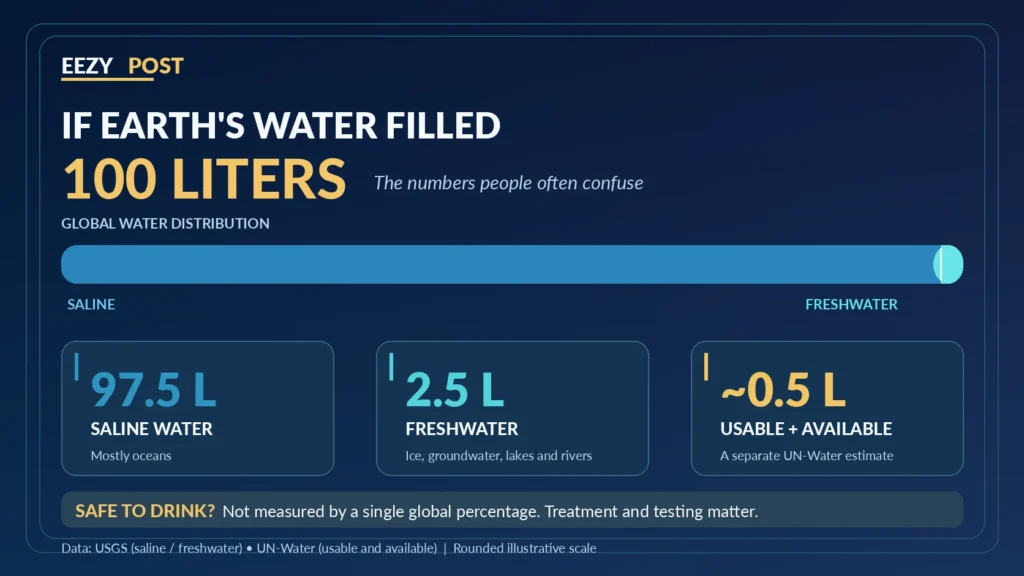
- About 97.5 liters would be saline water.
- About 2.5 liters would be freshwater in all forms, including ice and underground reserves.
- Roughly 0.5 liter would represent UN-Water’s separate estimate of usable and available freshwater.
That final half-liter is not a measured amount of instantly drinkable water. It could still require testing, treatment and delivery. These rounded figures come from different global estimates, so the illustration is for scale rather than a literal inventory of every glass of drinking water.
It’s also a reminder of why comparing percentages without defining them causes confusion. The amount of freshwater, the amount people can access, and the amount proven safe to drink are not interchangeable.
Where Is Most of Earth’s Freshwater Stored?
Most of the planet’s freshwater isn’t sitting in the rivers and lakes people visit. USGS estimates break it down approximately like this:
| Freshwater reservoir | Share of Earth’s freshwater |
|---|---|
| Ice caps, glaciers and permanent snow | 68.7% |
| Fresh groundwater | 30.1% |
| Surface water and other freshwater reservoirs | About 1.2% |
Source: USGS global water distribution estimates. Figures are rounded.
Glaciers and Ice Sheets
Glaciers contain a vast freshwater reserve, but much of it is locked away in remote ice. Its existence doesn’t mean it can economically or sustainably supply communities on the other side of the world. Changes in snowpack and glacial melt can also alter the seasonal water supplies that downstream communities depend on.
Groundwater
Fresh groundwater is held in pores and fractures beneath the surface. Wells make it indispensable for households, farms and towns, particularly where a river or reservoir isn’t nearby. But water underground isn’t automatically clean. Local geology can introduce naturally occurring contaminants, while land use can add pollutants.
Lakes, Rivers and Other Sources
Lakes and rivers hold only a tiny fraction of all Earth’s water, yet they are central to many drinking-water systems. A small reservoir can matter enormously to the people living around it. What’s important is less the percentage of the planet it represents and more whether it can provide reliable, clean water at the right time and place.
How Much of Earth’s Surface Is Covered by Water?
About 71% of Earth’s surface is covered by water, according to USGS. That familiar figure answers a different question from the percentage of the planet’s water supply that’s fresh.
- 71%: How much of Earth’s surface area is covered by water.
- 2.5%: The approximate share of Earth’s total water volume classified as freshwater.
These percentages have different denominators. It’s a mistake to compare them as though they measure the same thing.
How Much Water Is There in the World in Liters?
USGS estimates that Earth contains about 1.386 billion cubic kilometers of water. Since one cubic kilometer equals one trillion liters, that’s approximately 1.386 sextillion liters (1.386 × 10²¹ liters). This is an estimate of all water, not a global stockpile of bottled or safe drinking water.
You can check the underlying volume in the USGS water inventory.
What Makes Freshwater Safe to Drink?
A water source can look crystal clear and still be unsafe. The contaminants that matter aren’t always visible, and a pleasant taste is not a reliable safety test.
Potential hazards include harmful microorganisms and chemicals such as arsenic, lead and nitrates. Water treatment and testing address different risks, and a method that deals with one contaminant may not handle another.
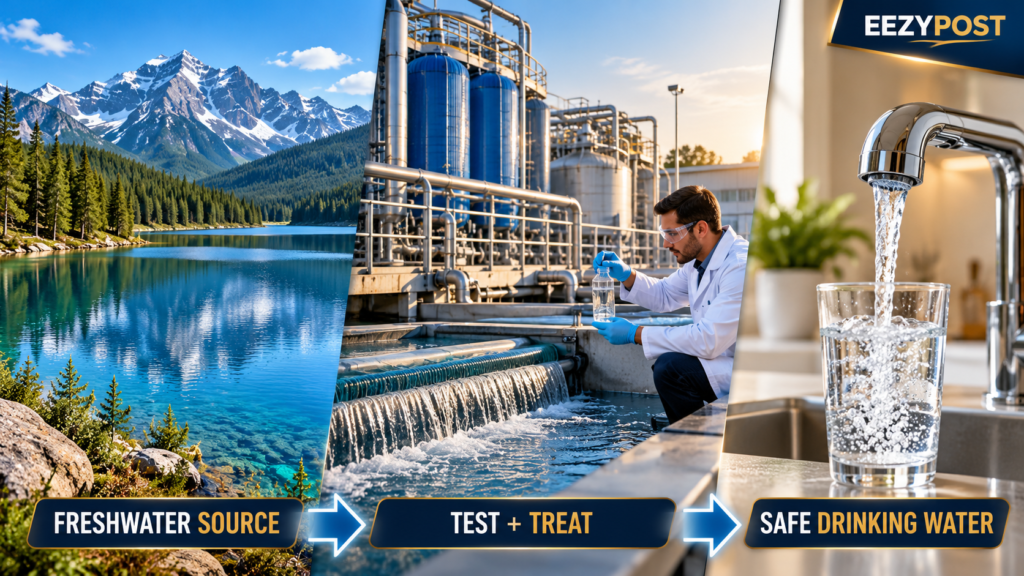
The path from freshwater source to drinking water typically includes source protection, appropriate treatment, monitoring and safe distribution. The steps vary by location and water quality. For example, water drawn from a river may need multiple treatment stages, while a groundwater system may face a different combination of hazards.
This is also why boiling is not a universal fix: it can inactivate many disease-causing microorganisms when done correctly, but it doesn’t reliably remove dissolved salts or many chemical contaminants.
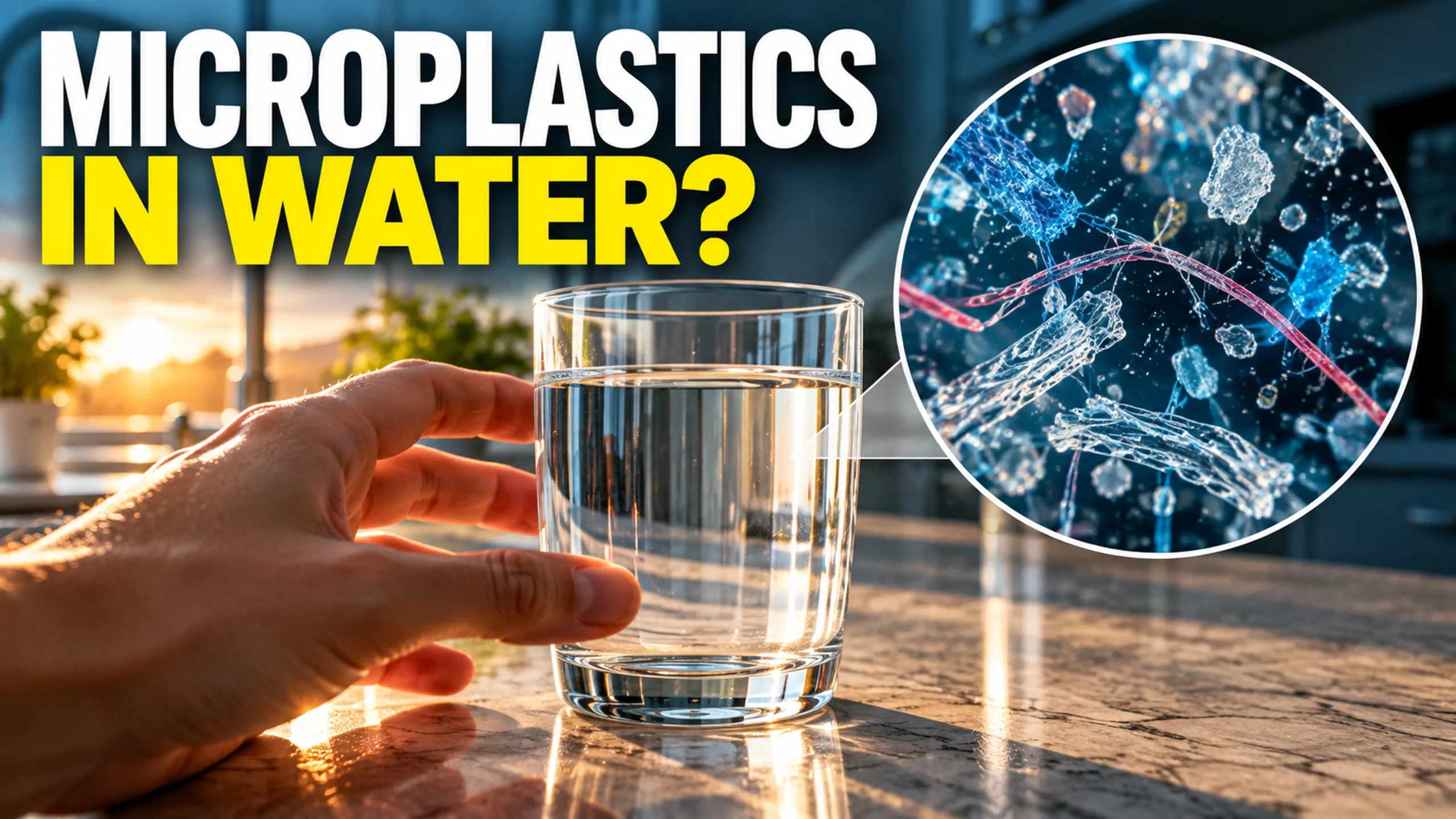
For an example of how water quality differs from simple water availability, see our related guide to removing microplastics from drinking water, which explains verified filter claims and their limitations.
Where Does Drinking Water Come From in the United States?
U.S. households provide a practical example of why water supply and drinking-water safety must be considered together.
According to the Centers for Disease Control and Prevention, around nine in ten people in the United States get their drinking water from public water systems. Those systems commonly draw from surface water, groundwater or a combination of the two.
Public utilities treat and monitor water under applicable requirements. If you’re served by a public system, its annual water-quality report is a useful place to begin when checking local conditions.
If Your Home Uses a Private Well
Private wells are different from public water systems. The property owner is generally responsible for arranging appropriate testing and maintenance.
The U.S. Environmental Protection Agency recommends testing private wells annually for total coliform bacteria, nitrates, total dissolved solids and pH, with additional tests when local conditions or suspected contamination warrant them. A well that supplied safe water previously can still develop a problem.
The broader lesson applies beyond America: water becomes dependable drinking water through quality control and infrastructure, not simply because the source is fresh.
How Much Clean Drinking Water Is Left on Earth?
There’s no countdown clock showing that Earth will run out of water on a particular date. Water continues moving through evaporation, rainfall, rivers, ice and groundwater as part of the water cycle. But that doesn’t guarantee enough safe, usable water everywhere.
A community may experience shortage because reservoirs fall during drought, groundwater is withdrawn faster than it recharges, a source becomes polluted, or pipes and treatment systems cannot deliver water reliably.
These are real access and water-management problems, not evidence that the planet’s water suddenly vanishes.
In its 2025 global drinking-water update, the World Health Organization and UNICEF reported that 2.1 billion people lacked safely managed drinking water in 2024. That measures access to a defined drinking-water service, not the fraction of the planet’s water that physically exists.
The report defines safely managed drinking water using criteria including an improved source located on premises, available when needed and free from contamination. This is a more human-centered way to understand the problem than a single global “drinkable water percentage.”
Can Rivers, Rainwater and Seawater Become Drinking Water?
River water: Rivers are important supply sources, but water drawn straight from a river should not be assumed safe. Treatment and testing depend on local contamination risks.
Rainwater: Rainwater harvesting can support households in some places. Collection surfaces, storage tanks and airborne or environmental contamination can affect safety, so collected water isn’t automatically potable.
Groundwater: Some wells provide excellent water, while others require treatment for naturally occurring substances or pollution. Regular testing is especially important for private well users.
Seawater: Desalination can produce freshwater from saltwater, but it requires specialized processes, energy and infrastructure. Converting seawater into usable drinking water is possible, not effortless or universally economical.
Why Do Some Websites Say Only 1% of Earth’s Water Is Drinkable?
That claim usually starts with a valid observation: most of Earth’s water is saline and much of the freshwater is frozen or difficult to access. But the wording often changes along the way. “Accessible freshwater” becomes “drinkable water,” as though no testing or treatment were needed.
Those are not the same categories. If you see a striking percentage online, ask three questions: A percentage of what? According to which source? And does ‘drinkable’ mean naturally fresh, physically accessible, or actually safe to consume?
It’s reasonable to say that safely available freshwater is limited. It’s not reasonable to label a particular global percentage as proven potable without a method that measures potability.
Frequently Asked Questions
How Much Drinkable Water Is on Earth?
There is no single verified percentage of all Earth’s water that is safe to drink immediately. About 2.5% is freshwater, while UN-Water estimates 0.5% is usable and available freshwater. Water quality and treatment determine drinking safety.
What Percentage of Earth’s Water Is Freshwater?
About 2.5% of Earth’s water is freshwater, according to USGS. Most of that freshwater is stored in ice and underground, rather than in lakes and rivers.
What Percent of Water Is Drinkable?
No universal scientific percentage describes all water that is potable. Figures such as 2.5% freshwater or 0.5% usable and available freshwater should not be relabeled as the share that’s safe to drink.
What Percent of Earth Is Water?
Approximately 71% of Earth’s surface is water-covered. That’s different from the composition of Earth’s entire water supply.
How Many Liters of Water Are in the World?
Using USGS’s estimate of 1.386 billion cubic kilometers, there are approximately 1.386 × 10²¹ liters of water on Earth. Most of it is saline, not drinking water.
How Much Clean Drinking Water Is Left on Earth?
There is no universal remaining quantity or deadline. The water cycle continues, but freshwater access and safety are affected by drought, contamination, groundwater depletion and infrastructure. WHO and UNICEF reported 2.1 billion people without safely managed drinking water in 2024.
Is Freshwater From a River or Lake Safe to Drink?
Not necessarily. Freshwater can contain disease-causing organisms and chemicals, and treatment requirements vary by source. Do not assume that clear-looking natural water is safe to drink without appropriate testing or treatment.
Can Boiling Saltwater Make It Drinkable?
Simply boiling seawater in an open pot does not remove its dissolved salts from the water left behind. Desalination methods, including distillation that captures and condenses steam, can separate salt from water when properly operated.
How EEZYPOST Checked These Figures
We compared the USGS global water inventory with UN-Water’s estimate of usable and available freshwater, then checked drinking-water access and U.S. safety guidance against WHO/UNICEF, CDC and EPA publications. These organizations answer different questions. We have kept their definitions separate instead of presenting a misleading “percentage that’s safe to drink.”
This article is a review of publicly available evidence. EEZYPOST did not independently measure global water volumes or test drinking-water samples. Figures are rounded and depend on the sources’ stated methodologies.
Primary sources:
- U.S. Geological Survey: Where Is Earth’s Water?
- U.S. Geological Survey: How Much Water Is There on Earth?
- UN-Water: Water and Climate Change
- WHO/UNICEF: Global Drinking Water Update, August 2025
- CDC: Drinking Water Sources
- EPA: Protect Your Home’s Water
The Bottom Line
Earth has plenty of water, but only about 2.5% is freshwater, and an even smaller share is usable and available. No single global statistic tells us how much is immediately safe to drink.
The question that matters most isn’t just how much water exists. It’s whether people can access a reliable source that has been appropriately protected, tested and treated. Understanding those differences is far more useful than repeating a dramatic but misleading percentage.

Leave a Reply