

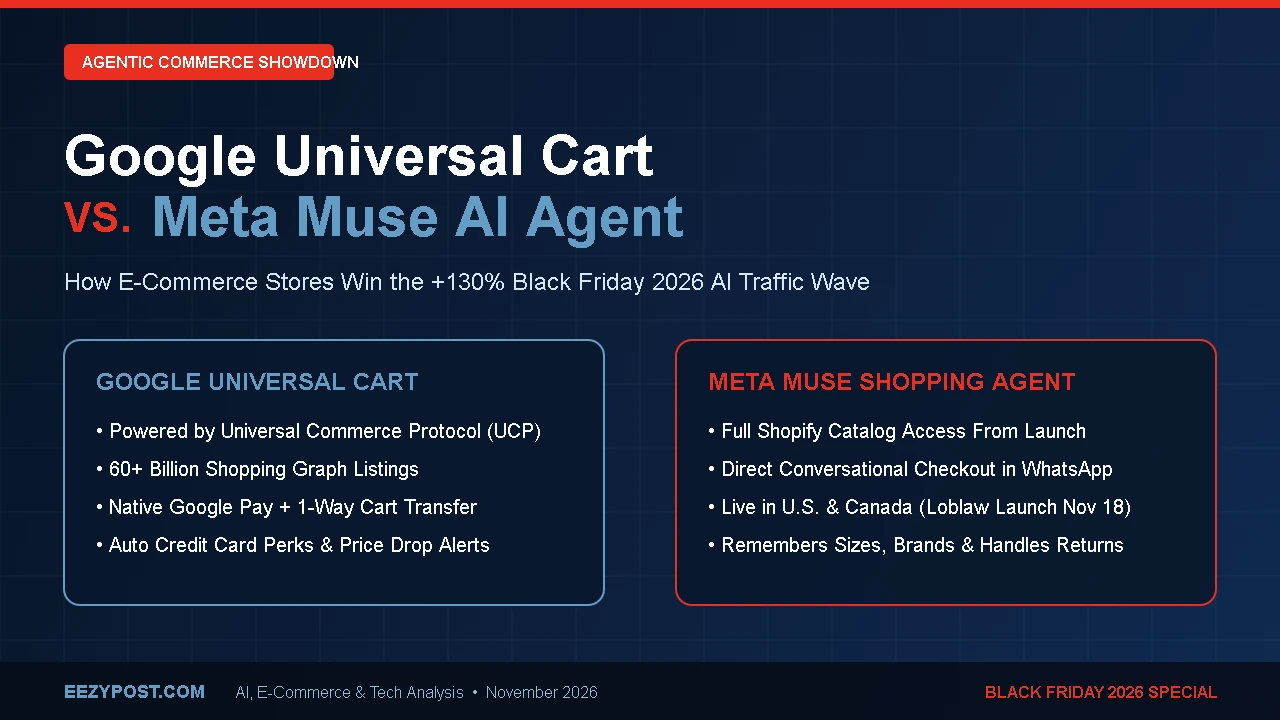
Last week, I ran a Google Universal Cart vs Meta Muse stress test across twelve real e-commerce product pages I audit and follow. I asked Google’s AI Mode, Meta Muse, and ChatGPT the exact same buyer prompt: “Find the best waterproof commuter backpack under $90 that ships before Friday with hassle-free returns.”
Nine of those twelve stores didn’t even make the shortlist—even though three of them rank on Page 1 of classic Google Search.
Why? Because in late 2026, buyers aren’t clicking ten blue links anymore. With Black Friday 2026 hitting this week, Google Universal Cart (launched in the U.S. on October 15, 2026) and Meta Muse (which just expanded into Canadian grocery checkout with Loblaw on November 18, 2026) have turned AI assistants into actual checkout registers. According to a November 19, 2026 DHL eCommerce survey, nearly 9 in 10 Black Friday shoppers now use or plan to use AI to compare prices—and 50% of AI-assisted shoppers follow through with a purchase, compared to just 42% of traditional deal hunters.
If your product pages are written for human hype instead of machine-readable facts, AI agents quietly skip you. Here is my practitioner breakdown of Google Universal Cart vs Meta Muse, the exact data driving the 2026 agentic commerce wave, and the 48-hour checklist to get your catalog picked before Cyber Week peaks.
Quick Answer: What Is the Difference Between Google Universal Cart and Meta Muse?
Google Universal Cart is a cross-retailer shopping basket built directly into Google Search (AI Mode) and the Gemini app, powered by the open Universal Commerce Protocol (UCP) and Google’s 60-billion-item Shopping Graph. Meta Muse is Meta’s personal AI agent (available across the U.S., Canada, and WhatsApp) that discovers products across Shopify’s catalog, remembers buyer preferences, tracks prices, and completes in-chat purchases upon user approval.
While ChatGPT rolled back its Instant Checkout capabilities earlier this year, Google and Meta have sprinted ahead to own the live checkout layer of agentic commerce.
For merchants deciding where to focus first in the Google Universal Cart vs Meta Muse race, both platforms already own the live checkout layer of agentic commerce.
Why Black Friday 2026 Is the Tipping Point for AI Shopping Agents
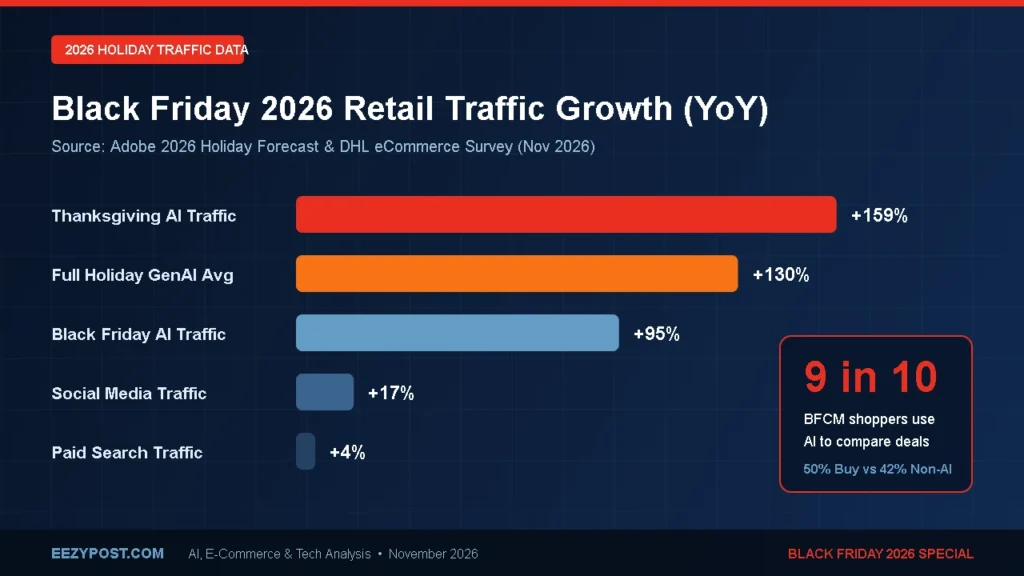
For two years, marketers called AI shopping “future hype.” The November 2026 numbers prove that window is officially closed:
- 130% Surge in AI Retail Traffic: Adobe’s 2026 holiday forecast projects generative AI referrals to U.S. retail websites will jump 130% year-over-year between November 1 and December 31—spiking 159% on Thanksgiving, 95% on Black Friday, and 88% on Cyber Monday. By contrast, paid search traffic is projected to grow just 4% and social media 17%.
- 1 in 5 Cyber Week Sales Influenced: Salesforce estimates AI and shopping agents will influence roughly 20% of global online sales during Cyber Week, while Bain & Company projects Black Friday through Cyber Monday retail sales will surpass $85 billion.
- Global Adoption Crossed 50%: McKinsey’s 2026 Agentic Commerce Consumer Survey shows over 50% of consumers globally now use AI during their shopping journey.
What makes this traffic wildly profitable is intent. When a shopper arrives from a paid social ad, you are interrupting their scroll—and fighting rising ad creative fatigue benchmarks on Meta and TikTok. When a shopper arrives from Google Universal Cart or Meta Muse, the AI has already filtered out your competitors. The buyer is holding their digital wallet open.
Google Universal Cart vs Meta Muse: Side-by-Side 2026 Comparison
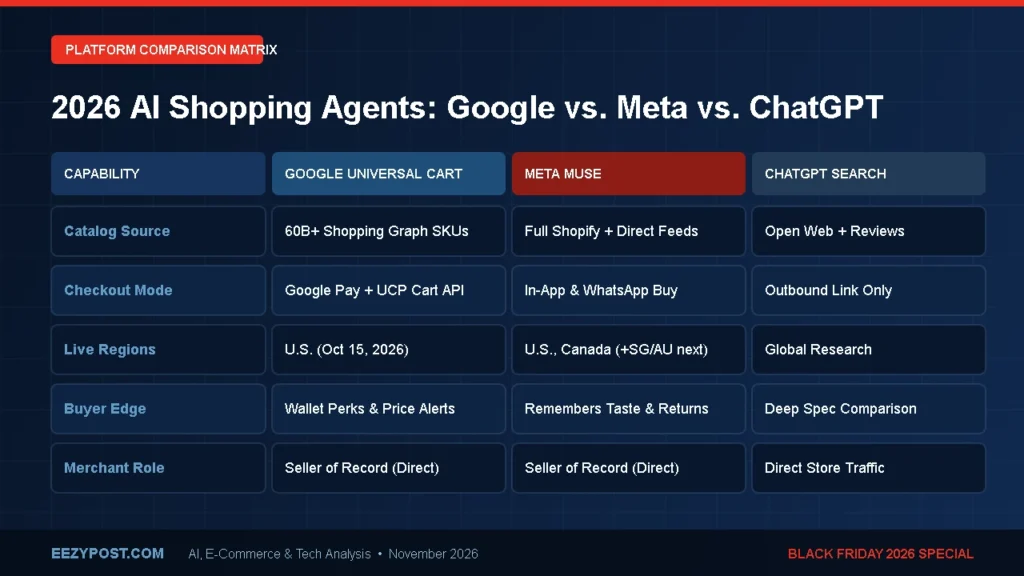
Before you tweak a single product feed, this Google Universal Cart vs Meta Muse breakdown shows how each ecosystem pulls catalog data, handles checkout, and treats your brand as the merchant of record.
| Platform Feature | Google Universal Cart (UCP) | Meta Muse Shopping Agent | ChatGPT Search (Late 2026) |
| Launch & Reach | U.S. (Launched Oct 15, 2026) via Search AI Mode & Gemini App | U.S. (Sept 8, 2026), Canada (Nov 18, 2026); expanding to Singapore & Australia | Global research & comparison (Instant Checkout rolled back) |
| Core Data Source | Google Shopping Graph (60+ billion live listings) + Merchant Center | Full Shopify catalog + direct retailer integrations (e.g., Loblaw) | Live web crawl, Reddit/reviews, structured product schema |
| Checkout Flow | Native Google Pay in-cart OR 1-way cart transfer to merchant via UCP Cart API | In-app / WhatsApp conversational checkout after user approval | Outbound referral click to retailer website |
| Key Ecosystem Partners | Co-developed with Shopify, Etsy, Wayfair, Target, Walmart; backed by Stripe, Visa, Mastercard, Adyen | Meta apps (WhatsApp, Instagram, Messenger) + Shopify checkout (11 countries incl. UK) | Open web merchants & affiliate publishers |
| Smart Buyer Perks | Price-drop alerts, restock alerts, Google Wallet credit card rewards matching & promo codes | Remembers brand preferences, allergies/sizes, tracks prices, manages returns/refunds | Multi-brand spec tables & review synthesis |
| Seller of Record | Merchant (you own confirmation, fulfillment & support) | Merchant (you handle delivery, returns & customer care) | Merchant |
Deep Dive: How Google’s Universal Commerce Protocol (UCP) Works Behind the Scenes
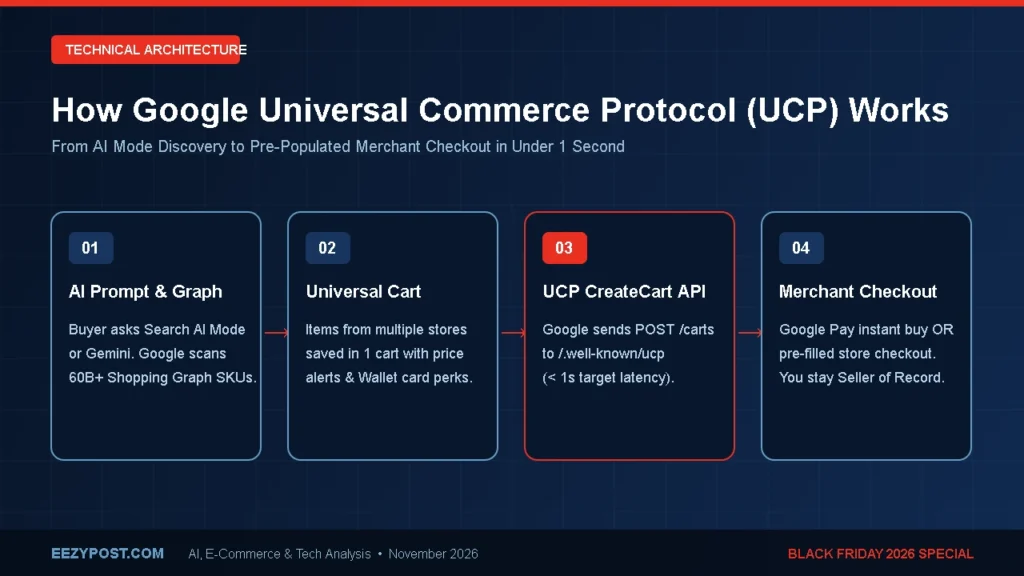
Most store owners assume Google Universal Cart is just a cosmetic facelift on Google Shopping. It isn’t. Under the hood, it runs on Google’s open Universal Commerce Protocol (UCP)—specifically documented in the official Google Universal Cart announcement and UCP developer specs.
Here is what actually happens technically when a shopper builds a cart in Gemini or AI Mode:
- Multi-Store Aggregation: A buyer can save a jacket from a Shopify D2C store in AI Mode and sneakers from Nike or Target in Gemini—both sit inside one unified cart.
- Wallet-Aware Deal Hunting: Because Universal Cart hooks into Google Wallet, it actively scans promo codes and matches the buyer’s credit card rewards before checkout.
- The
CreateCartHandoff: Even if you don’t use native Google Pay checkout yet, merchants publishing a/.well-known/ucpprofile with thedev.ucp.shopping.cartcapability let Google transfer a pre-populated cart directly onto your storefront. Google’s technical spec recommends keeping endpoint latency under 1 second during peak BFCM spikes so buyers don’t bounce.
Practitioner Takeaway: If you run on Shopify, Etsy, or a cleanly connected Google Merchant Center feed, you are already halfway inside the door. Your biggest risk isn’t technical exclusion—it’s sloppy product metadata that causes Google’s Shopping Graph to rank a clearer competitor above you.
Interactive Tool: AI Shopping Agent Visibility & BFCM Traffic Calculator
Want to see how your store scores in the Google Universal Cart vs Meta Muse shift before Cyber Week peaks? Plug your current store numbers and page-readiness signals into our calculator below.
AI Shopping Agent Visibility & BFCM Revenue Calculator
Audit your store’s readiness for Google Universal Cart (UCP) & Meta Muse and estimate your 2026 Cyber Week AI-referred revenue upside.
The 5-Point Agentic Commerce SEO Checklist (Do This Before Black Friday)
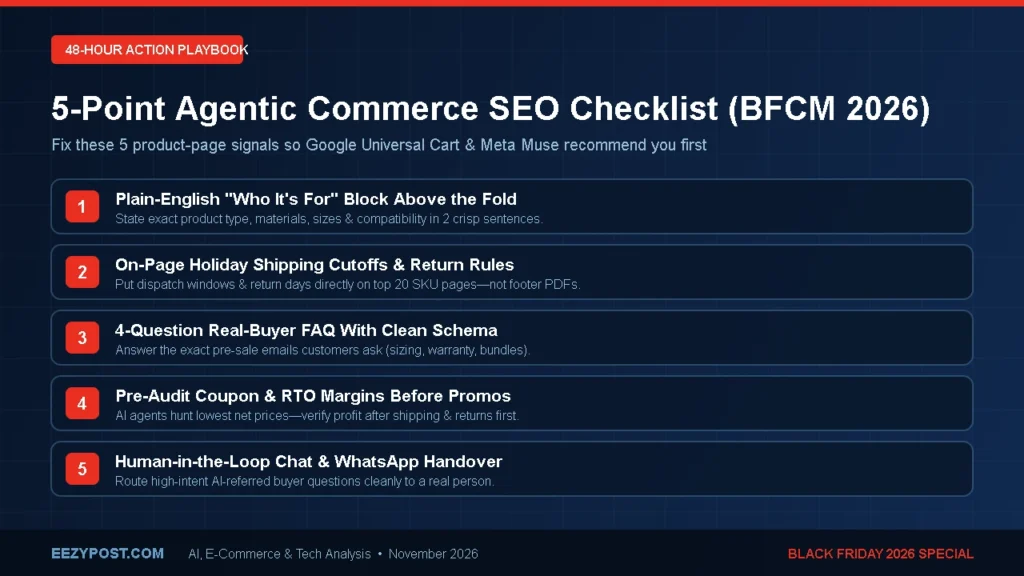
Bain & Company’s November 2026 retail study nailed the biggest misconception in e-commerce right now: AI agents don’t automatically pick the biggest retailer—they pick the store that articulates its value fit most clearly. If your page only lists a price and poetic brand copy, an LLM treats you like a commodity and defaults to whoever is $2 cheaper.
Here are the five fixes I deploy on client stores in under two hours to win across Google Universal Cart vs Meta Muse:
1. Put a Plain-English “Who It’s For” Block Above the Fold
Stop hiding specs inside accordion tabs or marketing fluff. Put a two-sentence factual block right beneath your product title stating:
- Exact product type & core use case (e.g., “28L waterproof laptop backpack built for 16-inch MacBooks and daily bike commuters”).
- Exact materials, dimensions, and compatibility—zero guesswork for the scraper.
2. Publish Machine-Readable Shipping Cutoffs & Box Specs
During Black Friday week, buyers prompt AI with hard constraints like “arrives before December 5” or “free returns under 30 days.” Put your exact dispatch window, holiday cutoff date, and return policy in plain text on your top 20 SKU pages—not buried in a separate footer PDF. And while you audit those dimensions, double-check your packaging math with our dimensional weight shipping guide for e-commerce so free-shipping promises don’t silently destroy your margins.
3. Add a 4-Question Real-Buyer FAQ to Every Hero SKU
Pull the four exact questions customers email your support desk every week (sizing fit, battery life, warranty, WhatsApp/COD eligibility) and mark them up with clean FAQ schema. AI shopping agents lift verbatim Q&A blocks into their comparison cards.
4. Protect Your Margin Before Turning on Agentic Promos
Google Universal Cart and Meta Muse aggressively hunt for promo codes and price drops. Before you publish a sitewide 25% Black Friday coupon to win the AI buy box, run your landed costs, return rate, and courier fees through our COD Profit & RTO Margin Calculator (especially if you ship Cash-on-Delivery in South Asia or high-return apparel in the U.S./UK). Winning an AI recommendation on a negative-margin promo only accelerates your cash burn.
5. Set Up Human-in-the-Loop Escalation for AI-Referred Buyers
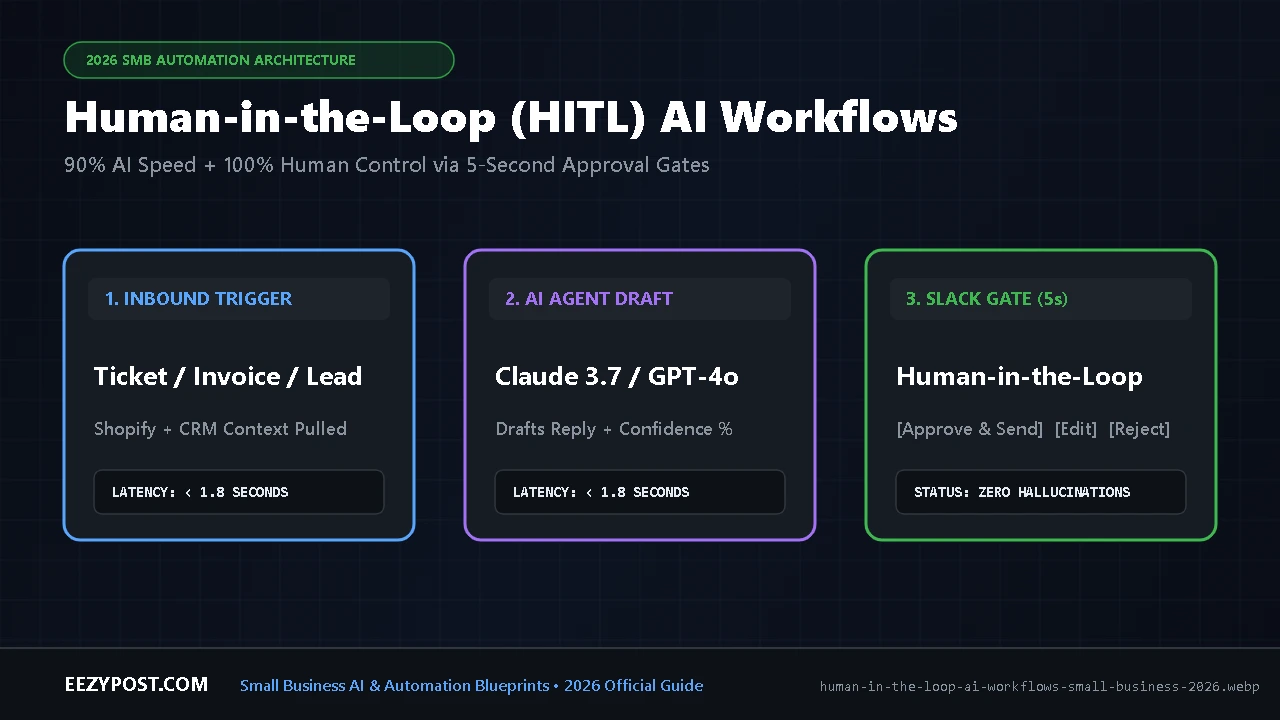
Shoppers sent by Meta Muse or Gemini arrive with hyper-specific last-mile questions (“Does this bundle include the EU adapter?”). Don’t let a generic bot hallucinate an answer and trigger a refund. Route high-value pre-purchase questions through human-in-the-loop AI workflows across site chat, email, and WhatsApp so a real human approves edge-case replies in seconds. And if you are still running paid social alongside organic agentic traffic this week, keep acquisition costs lean with our AI UGC ads vs human creators CPA breakdown.
Should You Block Third-Party AI Shopping Agents?
A handful of legacy retailers have tried blocking AI crawlers and third-party shopping agents in robots.txt to protect their direct storefront traffic. Unless you are a luxury maison with waitlists (like Hermès or Rolex), blocking shopping agents in late 2026 is the modern equivalent of blocking Googlebot in 2008.
You don’t force buyers back to your homepage—you simply hand their basket to your competitor who did open their Shopify or Google Merchant Center feed.
In the Google Universal Cart vs Meta Muse era, blocking agents doesn’t force buyers back to your homepage—it simply hands their basket to your competitor.
Frequently Asked Questions (AEO Quick Answers)
Can small Shopify stores appear in Google Universal Cart and Meta Muse?
Yes. Shopify co-developed Google’s Universal Commerce Protocol (UCP) and connected its catalog to Meta Muse from launch. Eligible U.S. merchants using Google Merchant Center and Shopify Checkout can surface products automatically, provided their titles, inventory status, pricing, and return policies are cleanly structured.
Is Google Universal Cart available outside the United States?
As of November 2026, Google Universal Cart and UCP-powered checkout are live in the United States, with no official rollout date announced yet for the EU, UK, or Asia. However, cross-border sellers should clean up their Merchant Center feeds and product schema now to capture global AI Mode and Gemini citations immediately.
Does Meta Muse work inside WhatsApp?
Yes. Meta Muse works directly inside WhatsApp as well as across Meta’s apps, allowing users in supported regions (currently the U.S. and Canada, with Singapore and Australia announced) to discover products, compare deals, and approve checkout inside the chat thread.
How do I track AI shopping agent traffic in Google Analytics (GA4)?
In GA4, create a custom channel group or regex filter on Session source / medium matching chatgpt.com|perplexity.ai|gemini.google.com|claude.ai|copilot.microsoft.com alongside UTM tags from Google Merchant Center and Meta Shops. Compare conversion rate and Average Order Value (AOV) against paid social—most stores see significantly higher purchase intent from AI referrals.





Leave a Reply