


Conclusion First
You waited three months for that raise letter. Seven percent. Not huge, but at least it was recognition. Then the paycheck arrived. You opened it and stared at the number for ten seconds.
It was only $16 more than last month.
You start to wonder: did I calculate wrong, or is the world playing a joke on me?
There is a Reddit post with a title that says it directly: “I got a 15% raise and only take home $150 more — where did my raise go?” The poster said their salary went from $47.5K to about $54K. By their math, take-home should have increased by roughly $400. Instead, net pay rose by only $150. Federal withholding jumped from $377 to $763 — more than double.
The comment section exploded. People told them to compare pay stubs from before the raise, and to ask HR for a breakdown. In the end, they discovered: it was a payroll software glitch, and HR confirmed it and paid the difference back.
That story ends well. But the middle part — “was I cheated?” — is something almost everyone has experienced.
Where Your Money Went: Three Layers of Explanation
Layer One: Retro Pay and Your New Salary Landed on the Same Check
If you received a check that combined “back pay + new salary,” the payroll system treated that money as if “you will earn this much every time going forward” when estimating withholding.
Here is an example. Your original salary was $74,000. It rose to $79.5K, effective April 1, but the back pay did not arrive until August. That retro paycheck contained more than four months of difference, plus the new salary, deposited all at once.
What the system saw was this person received over $4,600 this time. If it annualizes that as $4,600 times 26 pay periods, your “annual income” looks close to $120K. The system withholds at that bracket.
Layer Two: Marginal Tax Rate ≠ What You Actually Pay
The U.S. tax system is progressive, but “progressive” means: only the portion of money above a certain threshold is taxed at the higher rate.
Of a $79.5K salary, only the $5,500 above $74K falls into the higher bracket. During normal pay periods, the payroll system spreads that $5,500 across 26 checks, withholding a little extra each time — a smooth process.
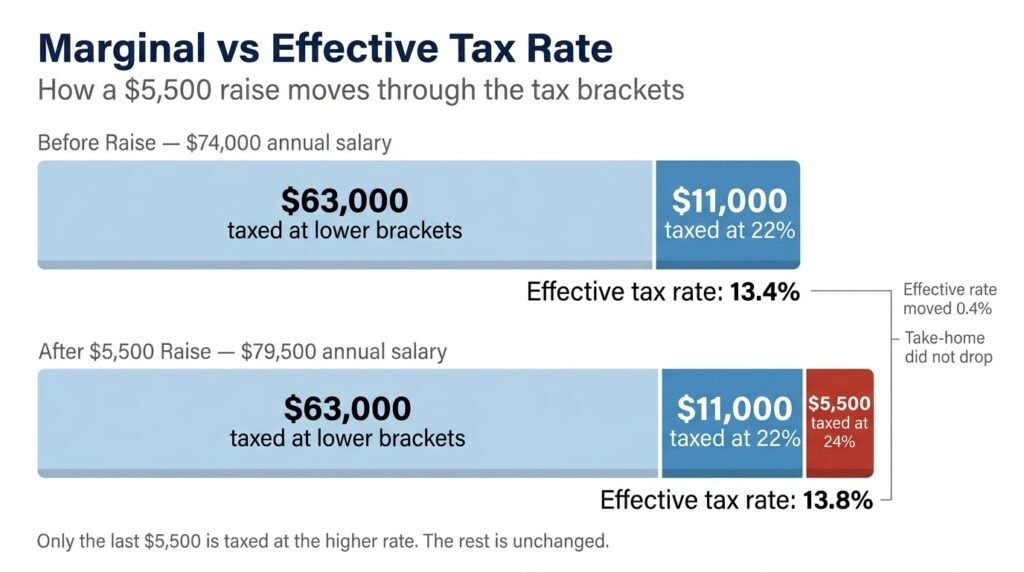
But the retro check crammed four-plus months of difference into a single payment. The system “saw” an abnormally high single payment and withheld based on that abnormal value. The IRS classifies retro pay as “supplemental wages.” Employers can either withhold at a flat 22% rate, or combine it with regular wages and calculate on the total.
Most payroll systems choose the second option — the one you experienced.
Layer Three: When It Is Actually an Error
In that Reddit case about $150, HR ultimately confirmed it was a payroll software bug, and the company refunded the difference.
Another user posted the same problem on Reddit after a 7.4% raise. Their federal withholding jumped from $295.68 to $463.12, and state withholding rose from $110.34 to $156.61. The advice in the comments was simple: wait for the next normal paycheck and check again. Because the retro check is a one-time anomaly, the next regular paycheck’s withholding should return to a smooth level based on the new salary.
If the second month is still abnormally low, that is when you take both pay stubs to HR or payroll and ask them to explain the calculation logic.
What You Can Do Next
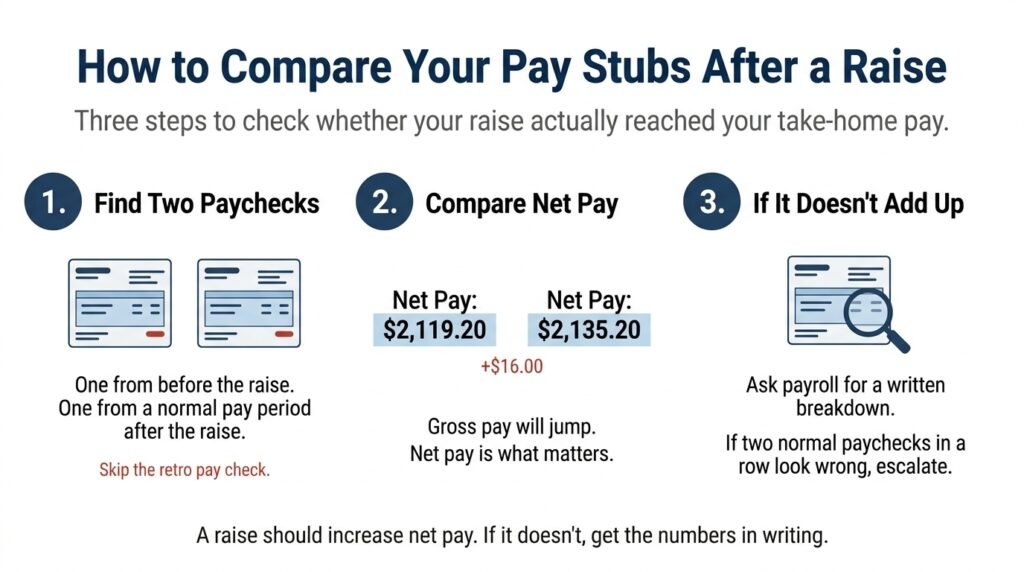
Step One: Compare two normal paychecks — one before the raise, one after. Ignore the check that included retro pay. Find a regular paycheck from before the raise and a regular paycheck from after the raise (not the retro one). Compare gross, federal withholding, state withholding, and FICA line by line.
Step Two: Calculate your “effective tax rate” change. A 7.4% raise should not reduce your net pay. If a normal paycheck shows lower net income than before the raise, there may genuinely be a calculation problem.
Step Three: If two consecutive normal paychecks look wrong, request a breakdown. Ask HR or payroll for a written explanation of how your withholding was calculated. You can say: “I want to confirm how my federal and state withholding was calculated — can you show me the breakdown?” Most payroll departments will cooperate.
Step Four: Remember that year-end filing balances it out. If this was purely a withholding mechanism issue (too much withheld), you will get the difference back when you file your tax return. The IRS logic is: payroll withheld too much, but when you file, your final tax liability is calculated on actual annual income, and the excess is refunded.
Step Five: If you want a rough number right now, use a calculator. Open the EEZYPaycheck calculator, enter your annual salary, pay frequency, and state, and see how much state tax should theoretically be withheld per paycheck under 2026 state withholding rules. If the result is far from what your actual pay stub shows, that is a reasonable reason to go ask payroll to reconcile the numbers.
EEZYPOST provides general information about paycheck withholding mechanics. This article is not tax advice. Actual withholding depends on your W-4, state withholding certificate, and payroll system. For guidance specific to your situation, consult a qualified tax professional or your state tax agency.
FAQ
Why did my take-home pay barely change after a raise?
Two reasons usually explain this. First, the raise may have moved your top income into a higher tax bracket, which raises withholding on that small portion only. Second, if a retro pay check landed in the same deposit, the payroll system may have annualized that single payment at a higher rate. In both cases, the difference is usually corrected at tax filing.
Is it normal for my federal withholding to jump 50% after a small raise?
It can happen when retro pay and new salary land on the same check. The payroll system treats that single payment as if it represents your new annual income, which pushes withholding into a higher bracket. Wait for the next normal paycheck. If it returns to baseline, the spike was a one-time event.
Will I get the extra withholding back?
Yes, if the withholding exceeded your actual tax liability for the year. When you file your return, your final tax is calculated on actual annual income. Any amount withheld above that is refunded. The IRS does not keep the difference.
How long should I wait before contacting payroll?
Wait two normal pay periods after the retro check clears. If the second consecutive paycheck still shows lower net pay than expected, request a written breakdown. One abnormal check is common. Two in a row is worth escalating.
What should I say when I contact payroll?
Ask for a written explanation of how federal and state withholding were calculated for the specific pay period. Request the gross-to-net breakdown. If the math does not match the published withholding tables, ask whether a system correction is needed. Keep the request factual, not emotional.
Does a raise ever actually reduce my take-home pay?
No. A raise cannot reduce net pay under normal withholding rules. Higher income moves a small portion into a higher bracket, but the lower brackets and everything below them remain taxed at the same rates. If your take-home pay decreased after a raise, it is a withholding timing issue or a payroll error — not a tax rule.
What is the difference between retro pay and a normal raise?
A normal raise changes your per-period gross wage going forward. Retro pay is a lump-sum catch-up for the months the raise was active but not yet reflected in your paychecks. Retro pay is treated as supplemental wages and may be withheld differently from your regular wages.
Can I adjust my W-4 to prevent this from happening again?
You can adjust your W-4 to change withholding on future regular paychecks, but W-4 changes do not affect how payroll withholds retro pay. Retro pay withholding is determined by the employer’s payroll system, not by your W-4. The best you can do is confirm the retro amount and wait for the following normal period.
What if my state withholding changed but my federal did not?
State and federal withholding use different formulas and different tables. A change in one does not require a change in the other. If only the state line looks off, check your state’s 2026 withholding tables and confirm the payroll system is using the current version. States update formulas annually.
Do I need to file an amended return if the withholding was wrong?
Not usually. Withholding errors are corrected at filing. If the payroll system withheld too much, you claim it as a credit on your return. If it withheld too little, you owe the difference. An amended return is only needed if you already filed and then discover a reporting error on the original return.
Written by: Shahid Kayani
Reviewed: September 2026
Methodology: Based on IRS Publication 15 and state Department of Revenue withholding guidance










Leave a Reply