


Last updated: September 2026
I was twenty-three the first time I sat down to “figure out my money.”
I had a decent job. A bank account. A vague sense that I should probably be saving something. But when I actually opened a spreadsheet and tried to write down what I earned and what I spent, I realized something uncomfortable: I had no idea what I was doing. Not a clue. Nobody had ever shown me.
I’m not alone in that.
Financial literacy in America has hit a ten-year low. According to the 2026 TIAA Institute-GFLEC Personal Finance Index, U.S. adults correctly answered just 47% of basic personal finance questions on average, the lowest result in the survey’s ten-year history. For Gen Z, the average was even lower at 38%. We’re not talking about advanced investing strategy here. We’re talking about understanding interest rates, inflation, borrowing, insurance and financial risk.
Meanwhile, only 47% of Americans say they have enough liquidity or access to funds to cover a $1,000 emergency expense. One-third say they would go into debt to cover it. And nearly one in four Americans have no emergency savings at all, according to Bankrate’s latest research.
This isn’t a guide about getting rich. It’s not about picking stocks or crypto or whatever’s trending this week. It’s about the practical system for managing money that most of us were supposed to learn somewhere along the way, from a parent, a teacher, a mentor, but never did.
If that sounds familiar, keep reading. This is the manual nobody handed you.
Why Personal Finance Management Feels So Hard (It’s Not Your Fault)
Let’s get one thing straight before we go any further: struggling with money doesn’t mean you’re bad with money.
The financial literacy data tells a different story. The financial system can be complicated, and financial education doesn’t always cover the decisions adults face every day. We teach algebra and Shakespeare. We don’t always teach how a credit score works, what an APR actually means, how insurance protects your finances, or why an emergency fund matters.
There’s another factor too, one that doesn’t get talked about enough. Workers with very low financial literacy spend nearly 11 hours per week dealing with money issues at work, according to the 2026 TIAA Institute-GFLEC Personal Finance Index. That’s more than an entire lost workday every week. The time can involve worrying about finances, checking balances, dealing with bills or trying to solve financial problems while you’re supposed to be working.
So when you feel like you can’t get ahead financially, remember this: you may simply need a clearer system and better information.
The good news is that personal finance becomes much easier once you understand how the pieces fit together. It just requires someone to lay it out clearly.
That’s what this guide does.
The 5 Pillars of Managing Personal Finances
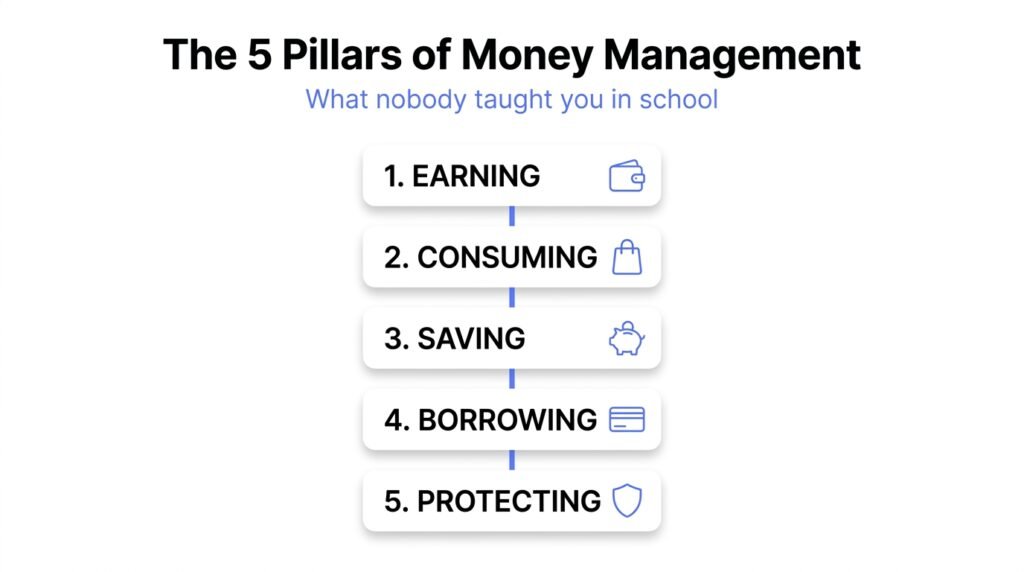
Almost every money decision you’ll make falls into one of five categories.
- Earning: what comes in
- Consuming: what goes out
- Saving: what you keep
- Borrowing: what you owe
- Protecting: what you safeguard
Most financial advice focuses on one pillar and ignores the rest. Budgeting apps focus on spending. Investing content focuses on saving and growing money. Debt content focuses on borrowing. But managing personal finances, actually managing them, means understanding how all five interact.
We’ll go through each one. By the end, you’ll have a framework you can apply to almost any financial situation, whether you’re making $30,000 or $300,000.
The five pillars at a glance
| Pillar | What it means | First action |
|---|---|---|
| Earning | Understanding your income and take-home pay | Check your net pay |
| Consuming | Managing needs, wants and recurring expenses | Review one month of spending |
| Saving | Building cash reserves and financial goals | Automate a small transfer |
| Borrowing | Managing credit cards and other debt | Record one balance and APR |
| Protecting | Managing insurance and financial risks | Review one coverage gap |
Pillar 1: Earning: The Money You Actually Have
Here’s something nobody tells you when you get your first job offer: the salary number is not what you take home.
If you’re offered a $60,000 salary, your actual take-home pay will be lower after federal income tax, Social Security, Medicare, state and local taxes where applicable, health insurance premiums, retirement contributions and other payroll deductions.
The exact amount depends on your filing status, where you live, your benefits and your withholding elections.
That’s why the number that matters for your personal budget isn’t the salary printed on your offer letter. It’s the amount that actually reaches your bank account.
This matters because most financial advice assumes you know your real number.
“Save 20% of your income,” they say.
Twenty percent of what?
The number on the offer letter or the number that actually hits your bank account?
What to do this week: Find your most recent pay stub. Look at the “net pay” line, the amount that actually landed in your account. Multiply it by the number of paychecks you receive in a typical year. That’s your starting point for understanding your real take-home income.
If you’re considering a side hustle, do the same calculation on that income. Bank of America’s 2026 Gen Z research found that 16% of Gen Z respondents had picked up a side hustle as one of the ways they were managing rising costs. Remember that freelance or self-employment income can come with taxes and business expenses, so the amount you earn isn’t necessarily the amount you get to keep.
Pillar 2: Consuming: Why Budgets Fail (And What Works Instead)
The 50/30/20 rule says you should spend 50% of your income on needs, 30% on wants and save 20%.
It’s clean. It’s memorable. It’s also not a universal law.
If rent, childcare, transportation or healthcare consume a large portion of your income, forcing your finances into a fixed percentage can make the exercise frustrating rather than useful.
A better way to think about budgeting is to treat it as a system for making decisions with the money you actually have.
The first thing to accept is that budgeting is a skill, not a personality trait.
If you’ve tried and failed to stick to a budget, you didn’t necessarily fail because you lack discipline. Your budget may simply have been unrealistic for your income and expenses.
A newer approach is what people call “loud budgeting,” the practice of being open about financial limits instead of feeling pressured to spend money just to keep up socially.
Bank of America’s 2026 research found that 42% of Gen Z practice “loud budgeting,” while 75% said they take active steps to save money when making social plans.
The idea is simple: instead of silently stressing about money and saying yes to everything, you say something like, “I can’t make that dinner, it’s not in my budget this month.”
No apology. No elaborate excuse.
It sounds small, but being honest about your limits can make spending decisions easier.
The second thing is automation.
If you hate spreadsheets, stop trying to track every dollar manually.
Instead, consider setting up an automatic transfer shortly after you get paid. A small amount, even $25, moved automatically into savings every payday can add up to $650 over a year if you’re paid twice a month.
Here’s the thing about automation: it removes one decision from your routine.
You don’t need to remember to save money every payday if the transfer happens automatically.
Budgeting apps can help with tracking and planning, but you don’t need an app to begin. You need a system that you can actually maintain.
What to do this week: Set up one automatic transfer. Any amount. Make it small enough that you won’t miss it. The goal isn’t to build a huge balance overnight. It’s to build the habit.
Pillar 3: Saving: The Emergency Fund Problem
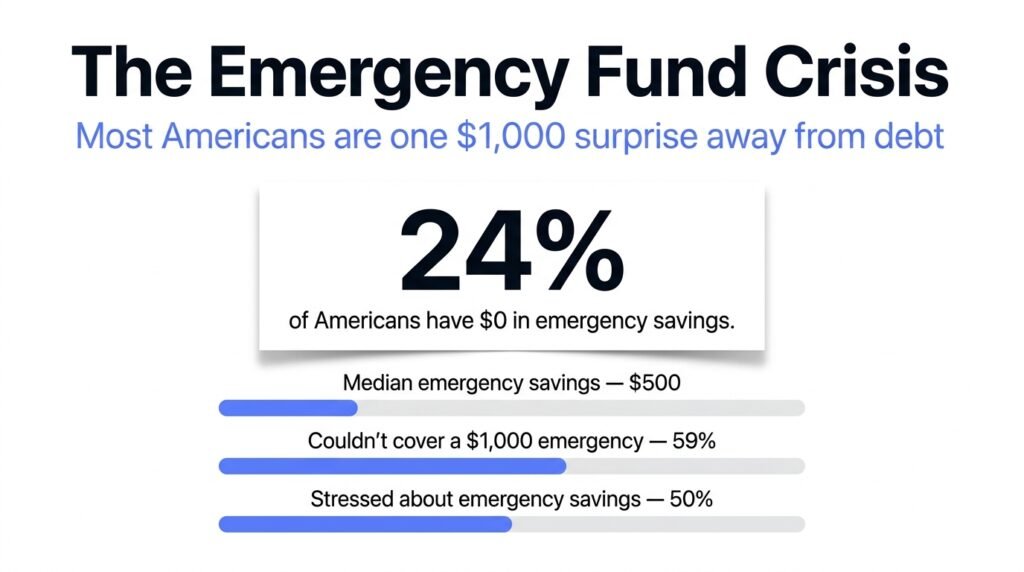
The standard advice is that you should have three to six months of expenses saved in an emergency fund. That’s a good goal. It’s also a goal that most Americans are nowhere near.
The numbers are brutal. About 24% of Americans have no emergency savings at all. The median emergency savings balance is just $500. And 59% of people say they couldn’t cover a $1,000 emergency without borrowing money.
Read that last one again. A thousand dollars. That’s not a life-changing amount. It’s a transmission repair. A root canal. A last-minute flight for a family emergency. And more than half the country would have to put it on a credit card or borrow from someone.
If you’re in that position, the standard advice to “save three to six months of expenses” is so far out of reach that it’s demoralizing. So let’s start smaller.
**The $500 rule.** Forget three to six months for now. Your first goal is $500. That’s enough to handle most small emergencies without reaching for a credit card. Once you hit $500, aim for $1,000. Once you hit $1,000, then you can start thinking about months of expenses.
Where should you keep this money? Not in your checking account, where you’ll see it and spend it. Not in the stock market, where it can lose value right when you need it. A high-yield savings account is the right answer for most people. These accounts currently pay around 4-5% APY, which means your emergency fund actually earns something while it sits there.
If you’re in a lower-income bracket, check whether your state offers a matched savings program — sometimes called an Individual Development Account or IDA. These programs match your savings dollar-for-dollar up to a certain limit. It’s free money, and most people don’t know they exist.
What to do this week: Open a high-yield savings account. Set up an automatic transfer of any amount — even $10. The account is the container. The transfer is the habit. Both matter more than the amount.
Pillar 4: Borrowing: The Debt Reality Americans Face
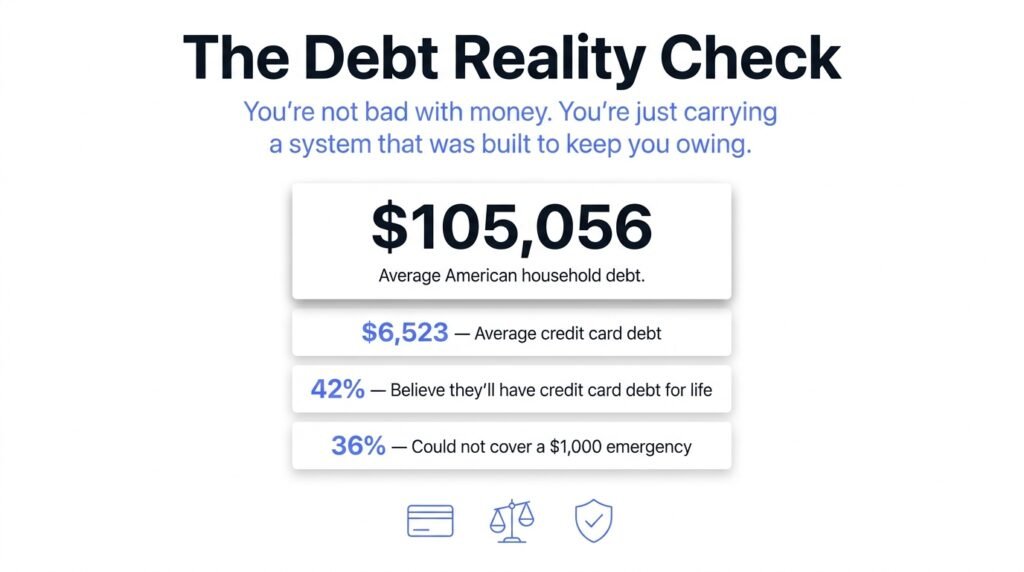
Americans carry substantial amounts of consumer debt, but the number looks different depending on what type of debt you’re measuring.
Experian reported that U.S. consumers owed $18.57 trillion in total debt as of September 2025. Its data showed an average total debt balance of $105,444 per consumer, including mortgages and other forms of debt.
For credit cards specifically, TransUnion reported an average balance of $6,523 per borrower in the third quarter of 2025. Experian reported an average credit card balance of $6,768 in September 2025.
The exact number matters less than understanding your own numbers.
Debt payoff strategies aren’t complicated. There are basically three approaches worth understanding:
The avalanche method.
List your debts from highest interest rate to lowest. Pay the minimum on everything, then put every extra dollar toward the debt with the highest interest rate.
Mathematically, this can reduce the amount of interest you pay over time.
The snowball method.
List your debts from smallest balance to largest. Pay the minimum on everything, then put extra money toward the smallest balance.
The advantage is psychological: eliminating a small balance can give you a visible win and simplify your list of debts.
Consolidation.
You may be able to combine multiple debts into one loan or use a balance-transfer offer with a lower interest rate. This can simplify payments and potentially reduce interest, but fees, promotional periods, eligibility requirements and the new interest rate all matter.
Consolidation doesn’t erase the debt. It changes how the debt is structured.
Which payoff approach should you use?
Look at the interest savings, your cash flow and the approach you are most likely to maintain. The avalanche method generally minimizes interest when all other factors are equal. The snowball method can make progress easier to see because smaller balances disappear first.
One thing to ignore: national debt headlines when you’re trying to fix your personal finances.
You can’t manage the federal government’s balance sheet from your kitchen table.
You can manage your credit card balance.
If you already have money saved but still owe thousands on a high-interest credit card, deciding what to do next isn’t always straightforward. Our guide on should I use savings to pay off debt explains how to compare interest costs, protect your emergency fund, and calculate how much you can safely put toward your balance.
If you haven’t checked your credit report or score recently, do that this week. You can review your credit report through annualcreditreport.com and many banks and credit-card issuers provide credit-score information to customers.
Knowing your score isn’t about judgment. It’s about information.
You can’t make a better financial decision about credit if you don’t know where you stand.
What to do this week: Log into one debt account and write down the balance, interest rate and minimum payment.
Just one.
You don’t need to make a perfect plan yet. You just need to see the number.
Pillar 5: Protecting: The Risk Nobody Prepares For
This is the pillar almost everyone skips.
It’s not fun.
Nobody wants to think about getting sick, losing a job or having their apartment flooded. But protecting what you’ve built is just as important as building it.
Here’s the uncomfortable data: comprehending financial risk is the weakest area measured by the 2026 TIAA Institute-GFLEC Personal Finance Index. Americans correctly answered only 36% of risk-related questions on average.
Retirement knowledge is also weak. Only 27% of adults correctly identified how much Medicare covers in retirement, according to the same research.
The protection checklist is simple, even if the details get complicated.
Health insurance
If you don’t have health coverage through an employer or another source, compare plans and potential financial assistance through HealthCare.gov or your state’s health insurance marketplace.
Don’t assume the cheapest monthly premium is automatically the cheapest plan. Look at the deductible, out-of-pocket maximum, network and covered services.
Renters or homeowners insurance
Renters insurance is one of the most overlooked forms of financial protection.
A renters policy can cover personal belongings, liability and certain additional living expenses if a covered event makes your home temporarily uninhabitable.
Your landlord’s insurance generally protects the building, not your personal belongings.
Disability insurance
Ask yourself a simple question:
If you couldn’t work for six months because of an illness or injury, how would you pay your bills?
Disability insurance can replace part of your income if a covered disability prevents you from working. If your employer offers coverage, review the benefit amount, waiting period, exclusions and cost before deciding whether it fits your needs.
If employer coverage isn’t available, you can investigate individual disability policies.
Life insurance
Life insurance is most relevant when someone depends on your income or financial support.
If you have children, a spouse or another person who relies on you financially, life insurance may be an important part of your financial plan.
Term life insurance is one option to consider because it provides coverage for a specified period, typically at a lower cost than permanent policies for many people.
If nobody depends on your income, your need for life insurance may be different.
The point isn’t to buy every insurance product on the market.
The point is to understand which financial risks you’re carrying and decide which ones you can afford to handle yourself.
What to do this week: Look at your latest pay stub and insurance documents. Find out what health, disability and other coverage you already have. Then identify one gap you want to research.
You don’t have to buy anything today.
Just get the information.
Your 30-Day Money Management Action Plan
Knowing the framework is one thing.
Doing something with it is another.
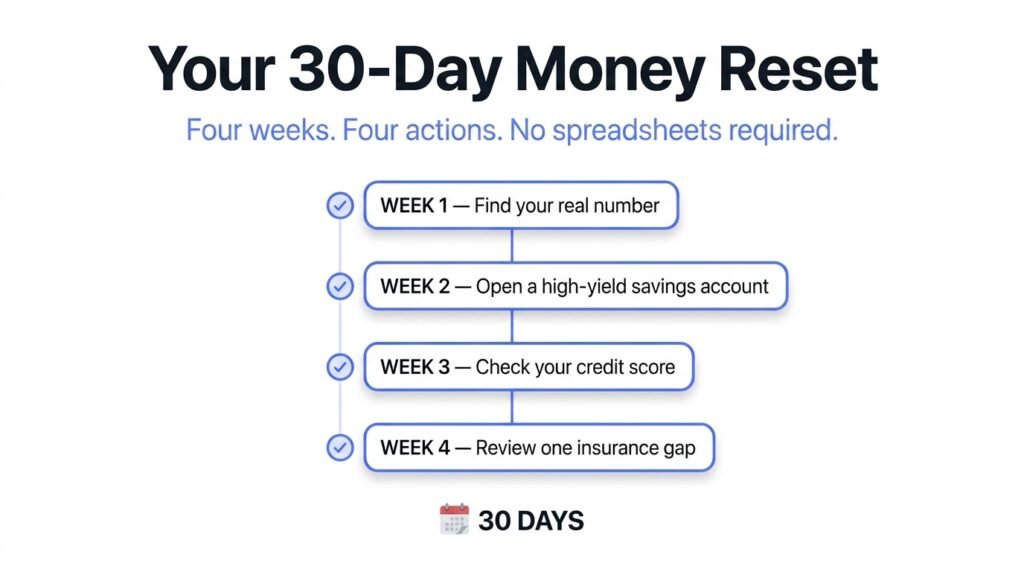
Here’s a simple plan for the next 30 days. No massive life overhaul. Just four small actions.
Week 1: Find your real number
Pull out a recent pay stub.
Look at the net pay.
Write down how often you’re paid and estimate your normal monthly take-home income.
That’s your starting point.
Week 2: Build your savings system
If you don’t have an emergency savings account, open one that fits your needs.
Set up an automatic transfer.
Any amount is fine.
Even $10.
The habit matters more than making the first transfer huge.
Week 3: Check your credit
Review your credit report and credit score.
Write down the number.
Don’t judge it.
Just know it.
Look for errors, accounts you don’t recognize and balances that need attention.
Week 4: Review one insurance gap
Look at your pay stub, insurance documents and bank statements.
Do you have health coverage?
Renters or homeowners insurance?
Disability coverage?
Life insurance if someone depends on your income?
Choose one gap and research it.
You don’t have to buy anything yet.
Just get the information.
That’s it.
Four weeks.
Four actions.
No complicated spreadsheet required.
Frequently Asked Questions
What is the 50/30/20 rule and does it work?
The 50/30/20 rule is a budgeting guideline that suggests allocating 50% of income to needs, 30% to wants and 20% to savings or debt repayment. It can be a useful starting framework, but it isn’t a universal rule. Housing costs, family size, income, debt and other expenses can make those percentages unrealistic. Treat it as a guideline you can adjust rather than a requirement you have to meet.
How much emergency savings do I actually need?
Three to six months of expenses is a common long-term recommendation, but the right amount depends on your income, job stability, household responsibilities and expenses. If you currently have little or no savings, start with a smaller milestone such as $500 or $1,000, then work toward one month of essential expenses before building a larger reserve.
What’s the fastest way to pay off credit card debt?
The avalanche method targets the highest interest rate first and generally minimizes interest when other factors are equal. The snowball method targets the smallest balance first, which can provide faster visible progress. Both can work. The important thing is to keep making minimum payments on every account while directing extra money toward your chosen target.
Should I save or invest first?
For many people, building an emergency fund before investing heavily can reduce the risk of having to sell investments or borrow when an unexpected expense occurs. If your employer offers a retirement contribution match, compare the value of capturing that match with your emergency-fund and debt priorities. Your situation matters, so there isn’t one universal order that applies to everyone.
What’s the best budgeting app for beginners?
You don’t need an app to start managing your money.
A simple spending plan, one automatic savings transfer and a weekly review of your accounts can be enough to establish the habit.
If you want budgeting software, compare the features, pricing, account connections and budgeting method before choosing one. The right tool is the one you will actually use consistently.
The Bottom Line
Personal finance isn’t one giant problem you have to solve all at once.
It’s five smaller systems working together.
Earn enough to support your life.
Spend intentionally.
Save for the unexpected.
Manage what you owe.
Protect what you’ve built.
You don’t need to become an expert this week.
You just need to understand your next decision.
Start with one number.
Then one account.
Then one habit.
That’s how money management gets easier.
This article is part of EEZYPOST’s personal finance series. Next up: “Best Budgeting Apps in 2026: We Tested 12, Here’s What Actually Works.”
A quick note from the author
I wrote this for the version of myself at twenty-three, sitting at a kitchen table with a spreadsheet open, trying to figure out why nobody had ever explained any of this.
If that’s you right now, I hope this helps.
Start with one thing.
This week.
That’s enough.
About the Author
Shahid Kayani is the founder of EEZYPOST, an independent news and information platform covering personal finance, technology, business and modern life.









Leave a Reply