


7 Essential Insights into Artificial Intelligence for Beginners
Artificial Intelligence for Beginners:
You’ve likely encountered machine intelligence in your daily life—whether through voice-activated assistants, facial recognition on your smartphone, or eerily relevant product suggestions. Yet, many people remain uncertain about what artificial intelligence truly encompasses. Beyond the sci-fi narratives featuring autonomous robots and sensationalized media coverage, AI represents a sophisticated field combining mathematics, computational methods, and theories of human cognition. This comprehensive guide demystifies the subject from the ground level, offering essential insights for anyone starting their journey into Artificial Intelligence for Beginners.
Defining Artificial Intelligence: The Basics
Artificial Intelligence (AI) encompasses computer-based systems engineered to carry out operations that traditionally demand human-level reasoning. These operations span speech recognition, problem-solving, language conversion, visual object detection, and content generation.
Fundamentally, AI involves constructing intelligent programs capable of absorbing information, identifying regularities within that information, and responding to those patterns with limited human guidance. Examples include email filtering mechanisms that evolve to recognize unwanted messages, route-planning software that forecasts congestion patterns, and diagnostic imaging platforms that detect abnormalities in medical scans.
The distinguishing element is the word “intelligence.” Conventional computer programs operate according to predetermined instructions. AI-driven applications, conversely, enhance their capabilities as they process additional information. They evolve and adjust. This learning capacity and ability to extend knowledge to new situations distinguishes AI from basic computational tools. For more general information on this topic, you can visit the Artificial Intelligence category on EezyPost.
Categories of Artificial Intelligence
Specialists organize AI through multiple classification approaches. The most prevalent method categorizes it according to sophistication levels.
Specialized AI (Limited AI)
Specialized AI concentrates on executing a particular function or a group of interconnected functions. All operational AI systems currently available belong to this classification. Common instances include:
•Visual recognition systems that categorize images (distinguishing between different animals, for example)
•Personalized suggestion systems found on platforms like Amazon, Spotify, and Netflix
•Interactive voice systems and digital assistants including Siri, Alexa, and Google Assistant
•Transaction monitoring systems employed by financial institutions to identify irregular activities
Specialized AI can exceed human capabilities within its designated area. For instance, DeepMind’s AlphaFold demonstrates exceptional proficiency in forecasting how proteins will fold. However, it cannot perform unrelated tasks like composing poetry. This limitation is intentional.
Universal AI (Advanced AI)
Universal AI would demonstrate intellectual capacity equivalent to human cognition across diverse domains. Such a system could independently master cooking, artistic composition, medical diagnostics, and business negotiations without specialized instruction. Currently, no such system has been developed. This remains an active research frontier with significant ongoing discussion.
Transcendent AI
Transcendent AI would demonstrate cognitive abilities surpassing human intelligence in nearly all fields. This concept predominantly exists in theoretical frameworks and future-focused research on safety concerns. It is not a near-term objective for any current research organization.
The Mechanics of Artificial Intelligence
AI employs numerous methodologies. The approaches generating contemporary breakthroughs belong to a field known as machine learning. To understand more about the broader context of technological advancements, explore the Technology section on EezyPost.
Machine Learning Fundamentals
Machine learning (ML) involves instructing computational models using extensive information collections, enabling them to produce forecasts or judgments without predetermined instructions for each circumstance. Three primary approaches exist:
•Supervised Learning: The model receives examples with correct answers (pairs of inputs and outputs) and learns to apply this pattern to new inputs. Filtering spam emails exemplifies this: the system learns from thousands of emails marked as either “unwanted” or “legitimate.”
•Unsupervised Learning: The model processes information without labels and identifies underlying relationships. Marketing teams frequently apply clustering, an unsupervised method, to categorize customers according to comparable purchasing patterns.
•Learning Through Experimentation: The model advances through iterative trial-and-error processes within a specific context, gaining incentives for successful actions and disincentives for unsuccessful ones. DeepMind employed this approach to prepare AlphaGo to surpass world-class Go competitors.
Neural Networks and Deep Learning
Deep learning employs artificial neural networks containing numerous interconnected layers. These networks replicate, in simplified form, how biological neural systems transmit information. Deep learning drives most recent AI breakthroughs: photo analysis, voice generation, multilingual translation, and content synthesis.
The term “deep” alludes to the quantity of interconnected layers. Initial neural networks contained just a few layers. Contemporary designs like transformers incorporate dozens or hundreds of layers.
Advanced Language Systems
Advanced language systems (LLMs) represent deep learning models educated on massive text collections. They comprehend statistical connections between terms and can create coherent, contextually fitting language. GPT-4, Claude, Gemini, and Llama are well-known instances. These systems power conversational interfaces, programming helpers, text condensing applications, and numerous other functions.
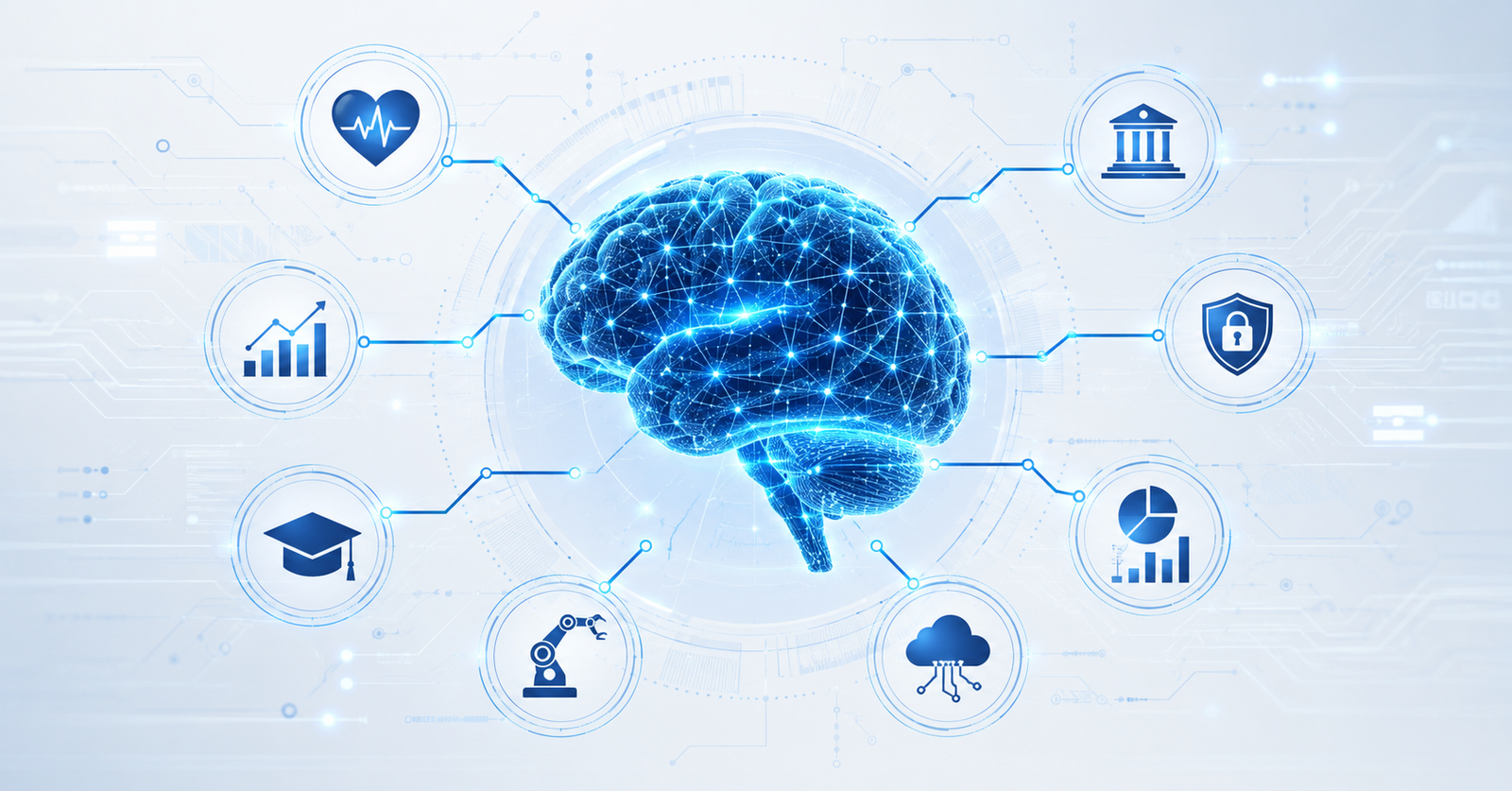
How AI Is Being Used Today
AI has moved beyond academic research environments. It now operates within everyday products and services utilized by billions globally.
Medical and Healthcare Applications
AI supports medical professionals by identifying irregularities in radiological scans. It expedites pharmaceutical research through molecular simulation. Forecasting algorithms recognize individuals susceptible to hospital readmission, facilitating timely medical action.
Financial Services
Financial organizations employ AI for loan evaluation, algorithmic financial trading, regulatory compliance screening, and automated customer support. Anomaly detection algorithms examine spending activity instantaneously and can halt questionable transactions almost immediately.
Automotive and Mobility
Autonomous vehicle developers including Waymo and Cruise utilize AI for environmental awareness, anticipating other road users’ actions, and determining optimal pathways. Standard automobiles incorporate AI for cruise control adaptation, steering assistance, and automated parking.
Commerce and Online Shopping
Algorithmic recommendations substantially influence earnings for major retailers like Amazon, Spotify, and Netflix. Intelligent pricing algorithms modify costs according to market demand, stock levels, and competitor pricing. Visual recognition technology powers stores without traditional checkout personnel.
Learning and Education
Customizable educational systems modify material difficulty according to individual learner advancement. Intelligent educational aids deliver prompt evaluation of written work and mathematical solutions. Language education software employs voice analysis to assess pronunciation accuracy.
Arts and Entertainment
Synthetic content generation produces visual art, soundtracks, films, and written material. Platforms like Midjourney, DALL-E, and Stable Diffusion generate artwork from written descriptions. Content creation assistants support the development of promotional materials, web articles, and programming scripts.
Advantages of AI Implementation
AI provides quantifiable benefits across multiple sectors.
•Velocity: AI examines vast data quantities more rapidly than human operators. A computational system can evaluate hundreds of diagnostic images in the duration required for a single medical specialist to examine one.
•Scope: AI manages workloads that would be unfeasible for human teams to handle. Overseeing trillions of social network communications daily is achievable solely through automation.
•Reliability: AI maintains consistent performance without experiencing exhaustion, loss of focus, or emotional responses. It implements consistent standards from the initial application through subsequent applications.
•Financial Efficiency: Streamlining repetitive operations enables personnel to concentrate on strategic responsibilities and decreases organizational spending.
•Innovation: AI discovers correlations beyond human perception. In genetic research, AI has uncovered chromosomal mutations linked to illnesses that specialists had previously missed for extended periods.
Challenges and Drawbacks
While powerful, AI has significant limitations.
Prejudice and Discrimination
AI systems absorb characteristics from their instructional materials. When instructional materials contain prejudicial patterns, these biases transfer to the system. Recruiting systems educated on skewed résumé collections have exhibited discrimination toward female applicants. Image recognition technologies have demonstrated higher failure frequencies for individuals with darker complexions. For more on AI ethics, refer to this article from Harvard Professional Development .
Inaccurate or Fabricated Information
Advanced language systems occasionally produce statements that seem credible but contain inaccuracies. This phenomenon is termed fabrication. This poses substantial dangers in critical sectors including medical practice and legal services.
Employment Transitions
Mechanization modifies employment landscapes. Certain positions will become obsolete. Certain professions will transform. Historical precedent indicates technological advancement also generates fresh employment opportunities, yet these transitions can create hardship for impacted communities.
Cybersecurity Concerns
AI can be misused. Deepfakes employ AI to fabricate realistic video and audio content. Targeted assaults manipulate visual recognition systems by introducing imperceptible alterations to pictures. Robotic warfare platforms generate significant moral dilemmas.
Lack of Clarity
Numerous AI systems, notably sophisticated neural network designs, operate as “unexplainable systems.” They generate results without transparent reasoning. This absence of interpretability creates difficulties in sectors requiring strict oversight and responsibility.
Essential Vocabulary
Becoming proficient in AI conversations requires familiarity with key terminology.
•Procedure: A sequence of operations a machine executes to accomplish a task.
•Educational Material: The information utilized to instruct a machine learning system.
•Trained System: The mathematical framework that emerges following algorithm instruction.
•Application: Employing an educated system to generate forecasts using novel information.
•Interconnected Nodes: A technological framework modeled after organic neural systems, featuring linked components (nodes) structured in sequential levels.
•Language Understanding: The branch of AI dedicated to facilitating machine comprehension, analysis, and generation of human communication.
•Visual Analysis: The AI discipline enabling machines to comprehend and analyze pictorial and video content.
Beginning Your AI Education Journey
You don’t require advanced academic credentials to grasp AI. Here’s a practical approach for Artificial Intelligence for Beginners:
•Establish Foundational Knowledge: Examine beginner-friendly resources to comprehend AI fundamentals and operational principles. This piece provides an excellent foundation.
•Study Programming Languages: Python dominates the AI development landscape. Complimentary training programs on platforms like Codecademy and freeCodeCamp can accelerate your progress.
•Enroll in Specialized Training: Andrew Ng’s Machine Learning Specialization through Coursera represents one of the most accessible starting points . It addresses supervised methods, unsupervised methods, and real-world application.
•Experiment with Accessible Platforms: Leverage resources like Google Colab to execute machine learning code directly in your internet browser without setup requirements. Investigate Hugging Face to examine pre-existing trained systems.
•Create Practical Applications: Put your knowledge into practice. Construct a feelings analyzer using film evaluations. Develop an interactive chatbot. Design a picture categorization system. Hands-on projects deepen comprehension in ways theoretical study cannot achieve.
What Lies Ahead for AI
AI development is accelerating. Multiple factors are influencing its development.
•Cross-Domain Learning Systems can simultaneously handle language, pictures, sound, and video content. This enables possibilities including AI helpers capable of observing your display and reacting to verbal input concurrently.
•Autonomous AI Systems represent platforms capable of organizing activities, accessing resources, and performing intricate operations without human direction. Rather than addressing a single inquiry, these systems can investigate subjects, arrange reservations, or resolve technical issues.
•Localized Intelligence is distributing computational capability to handheld devices, wearable technology, and linked devices. Executing systems on individual machines decreases response delays, strengthens information protection, and operates without internet connectivity.
•Legal Frameworks are advancing to match technological progress. The European Union’s AI Regulatory Framework, enacted in 2024, establishes guidelines for high-consequence AI systems. Additional nations are formulating comparable legislation. Creating responsible AI has become both a moral duty and a regulatory requirement.
Final Thoughts
What constitutes artificial intelligence? It represents the scientific and technical discipline of constructing systems capable of learning from information, recognizing underlying structures, and producing judgments. It encompasses both specialized applications addressing particular requirements and theoretical concepts of broad-based machine reasoning.
AI is neither mysterious nor inherently harmful. It is an instrument, molded by the information it learns from and the objectives its creators establish. Comprehending its mechanisms enables more informed utilization, permits critical examination of its capabilities, and empowers engagement in determining its trajectory.
Whether you’re pursuing academic studies, seeking professional advancement, or simply intellectually curious, commencing your AI education journey immediately is advantageous. This field is progressing swiftly, and those possessing comprehensive knowledge will have the most informed perspective on emerging developments.
References
[1] Ethics in AI: Why It Matters – Harvard Professional Development:

Leave a Reply