

What Is Artificial Intelligence? A Complete Beginner’s Guide (2025)
Artificial intelligence (AI) is transforming the way people live, work, and communicate. From voice assistants like Siri and Google Assistant to recommendation systems on Netflix and Amazon, AI has become an essential part of everyday life. Businesses, governments, and individuals increasingly rely on artificial intelligence to improve efficiency, automate repetitive tasks, and solve complex problems.
Despite its rapid growth, many people still ask what is artificial intelligence, how it works, and why it has become one of the most important technologies of the 21st century. Whether you’re a student, professional, entrepreneur, or simply curious about technology, understanding AI is becoming an essential skill in today’s digital world.
In this comprehensive guide, you’ll learn what is artificial intelligence, how it works, its different types, real-world applications, benefits, challenges, and what the future may hold for this revolutionary technology.
Before exploring advanced concepts, it’s important to understand what is artificial intelligence and why it has become one of the most influential technologies of the modern era. Whether you’re interested in technology, business, or education, learning the fundamentals of AI provides valuable insight into how intelligent systems are shaping the future
What Is Artificial Intelligence?
Artificial Intelligence (AI) is a branch of computer science that focuses on creating machines and software capable of performing tasks that normally require human intelligence.
These tasks include:
- Learning from data
- Understanding natural language
- Recognizing speech and images
- Solving problems
- Making decisions
- Identifying patterns
- Predicting outcomes
Unlike traditional software that follows fixed instructions, modern AI systems learn from experience. By analyzing large amounts of data, they improve their performance over time instead of relying solely on fixed programming.
According to the National Institute of Standards and Technology (NIST), artificial intelligence refers to systems capable of performing functions that are typically associated with human intelligence, such as learning, reasoning, planning, and decision-making.
https://www.nist.gov/artificial-intelligence
Artificial intelligence has evolved rapidly over the past decade due to advances in computing power, cloud technology, and the availability of massive datasets. Today, AI powers everything from online search engines to medical diagnosis systems and self-driving vehicle research.
How Does Artificial Intelligence Work?
Artificial intelligence works by processing large amounts of data, identifying patterns, and making predictions using advanced algorithms.
Instead of following only predefined instructions, AI systems learn from examples. The more high-quality data they receive, the more accurate their predictions and decisions become over time.
Understanding what is artificial intelligence also means understanding how AI systems process data, recognize patterns, and improve their performance over time. Instead of relying solely on fixed programming, modern AI models continuously learn from experience, making them more accurate and efficient.
Most modern AI systems are built using several core technologies.
Machine Learning
Machine learning is a subset of artificial intelligence that enables computers to learn from data without being explicitly programmed for every task.
Machine learning powers:
- Spam filters
- Product recommendations
- Fraud detection
- Predictive analytics
- Personalized advertising
Related: Read our guide on What Is Machine Learning? A Complete Beginner’s Guide.
(What Is Machine Learning? A Complete Beginner’s Guide.)
Deep Learning
Deep learning is an advanced form of machine learning that uses artificial neural networks inspired by the human brain.
Deep learning is responsible for major breakthroughs in:
- Image recognition
- Voice assistants
- Language translation
- Medical diagnosis
- Autonomous driving
Natural Language Processing (NLP)
Natural Language Processing enables computers to understand, interpret, and generate human language.
Popular NLP applications include:
- ChatGPT
- Google Translate
- Customer support chatbots
- Voice assistants
- AI writing assistants
Computer Vision
Computer vision allows machines to understand visual information from images and videos.
It is widely used in:
- Facial recognition
- Medical imaging
- Manufacturing quality control
- Security systems
- Autonomous vehicles
Types of Artificial Intelligence
Artificial intelligence is commonly divided into three categories based on its capabilities.
Narrow AI (Weak AI)
Narrow AI is designed to perform one specific task.
Examples include:
- Siri
- Alexa
- ChatGPT
- Netflix recommendations
- Google Search
- Face Unlock
- Spam detection
Nearly every AI application available today belongs to this category.
General AI (Strong AI)
General AI refers to a machine capable of performing any intellectual task that a human can perform.
Although researchers continue working toward this goal, General AI has not yet been achieved.
Superintelligent AI
Superintelligent AI is a theoretical form of AI that would surpass human intelligence across every field.
While this idea is frequently discussed by researchers and appears in science fiction, it remains speculative and has not been developed.
Examples of Artificial Intelligence in Everyday Life
Many people use artificial intelligence every day without realizing it.
Some common examples include:
- Google Maps suggesting the fastest route
- Netflix recommending movies
- Spotify creating personalized playlists
- Gmail filtering spam emails
- Face Unlock on smartphones
- Amazon recommending products
- ChatGPT answering questions
- Virtual assistants like Siri and Google Assistant
- Banking fraud detection
- Social media content recommendations
These everyday examples clearly answer the common question, what is artificial intelligence, by showing how AI has become part of our daily routines. From smartphones to online shopping and digital banking, artificial intelligence works behind the scenes to deliver faster, smarter, and more personalized experiences.
Real-World Applications of Artificial Intelligence
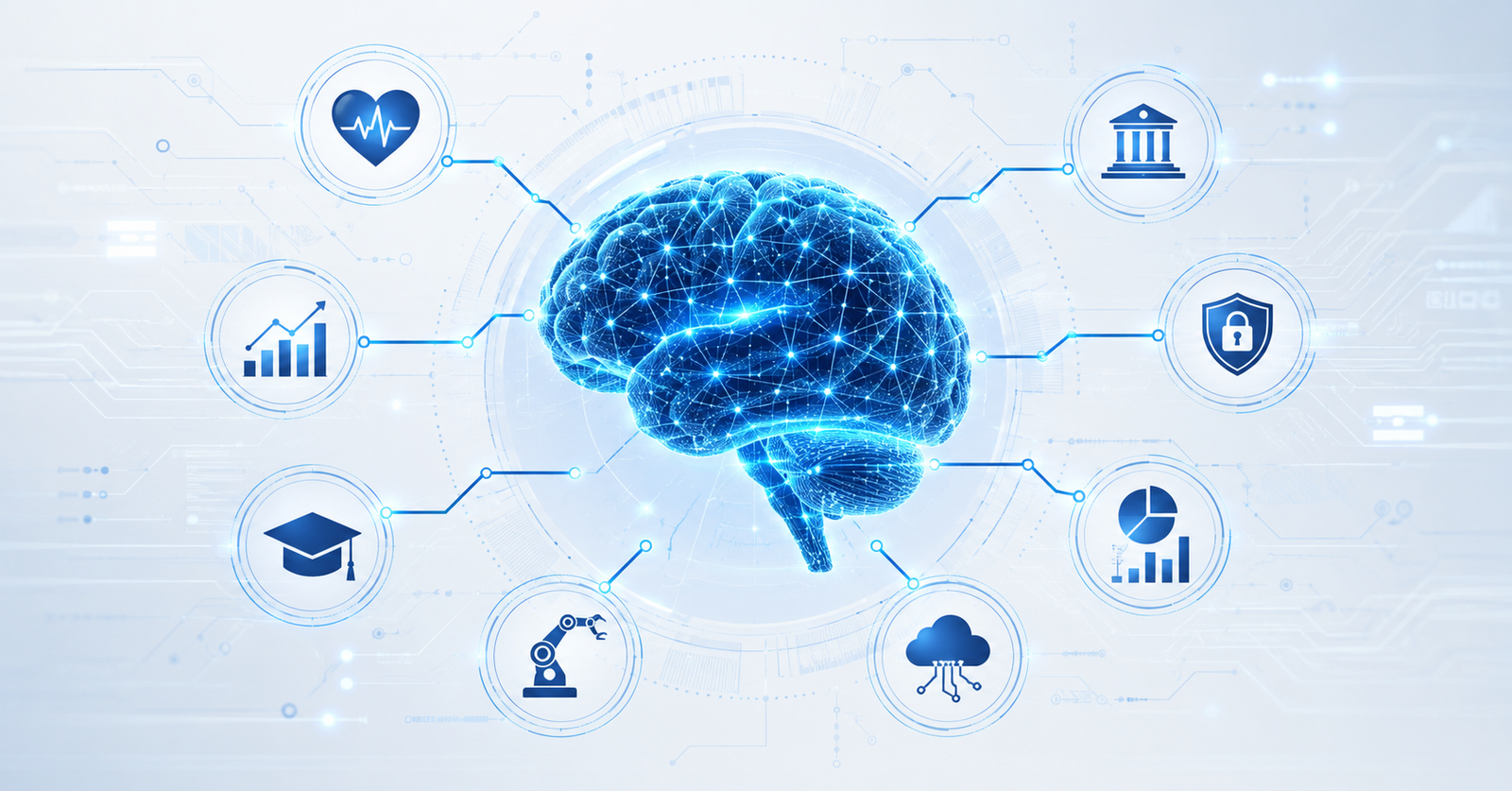
Artificial intelligence is transforming industries around the world by improving efficiency, reducing costs, and enabling better decision-making.
Healthcare
AI helps doctors analyze medical images, detect diseases earlier, accelerate drug discovery, monitor patients remotely, and improve treatment planning.
Finance
Banks and financial institutions use AI to detect fraud, assess credit risk, automate customer support, analyze financial markets, and improve security.
Education
Educational platforms use AI to provide personalized learning experiences, automated grading, language translation, and virtual tutoring.
Transportation
Artificial intelligence powers GPS navigation, traffic prediction, route optimization, and supports the development of autonomous vehicles.
Retail and E-commerce
Online retailers use AI to recommend products, forecast demand, optimize inventory, personalize shopping experiences, and improve customer service.
Manufacturing
Manufacturers rely on AI-powered robots for quality control, predictive maintenance, process automation, and production optimization.
Cybersecurity
Artificial intelligence helps detect cyber threats, identify suspicious behavior, prevent fraud, and respond to attacks faster than traditional security systems.
Benefits of Artificial Intelligence
Artificial intelligence is transforming the way businesses operate and how people interact with technology. By automating repetitive tasks and analyzing vast amounts of data, AI helps organizations make faster, smarter, and more accurate decisions.
Some of the most significant benefits of artificial intelligence include:
- Increased productivity through automation
- Faster and more accurate decision-making
- Improved customer experiences through personalization
- Reduced operational costs
- Better healthcare outcomes
- Enhanced cybersecurity
- Improved business forecasting
- Greater innovation across industries
- 24/7 availability through AI-powered virtual assistants
- Better data analysis and predictive insights
Once you understand what is artificial intelligence, it becomes easier to recognize why organizations across the world are investing heavily in AI-powered technologies. Businesses use artificial intelligence to improve productivity, reduce costs, enhance customer experiences, and make better decisions based on data.
Challenges and Risks of Artificial Intelligence
Although artificial intelligence offers enormous benefits, it also presents several challenges that require responsible development and careful regulation.
Job Displacement
Automation can replace repetitive and routine tasks, potentially affecting certain jobs. At the same time, AI is creating new opportunities in data science, machine learning, cybersecurity, robotics, and software development.
Privacy Concerns
AI systems often rely on large amounts of personal data. Organizations must protect user information through strong privacy policies, secure data handling, and compliance with data protection regulations.
Bias and Fairness
AI models are only as good as the data used to train them. Biased or incomplete datasets can produce unfair or inaccurate outcomes, making regular testing and monitoring essential.
Security Risks
Cybercriminals can misuse artificial intelligence to automate phishing attacks, generate fake content, or develop more advanced malware. At the same time, AI also strengthens cybersecurity by detecting threats more quickly.
Ethical Concerns
The growing use of AI in healthcare, finance, education, and law enforcement raises important ethical questions about transparency, accountability, fairness, and human oversight. Responsible AI development should always prioritize safety and public trust.
The Future of Artificial Intelligence
Artificial intelligence is expected to become even more integrated into everyday life over the next decade. Advances in machine learning, robotics, natural language processing, and computer vision will continue to transform industries and create new opportunities.
Future developments may include:
- More advanced healthcare diagnostics
- Smarter virtual assistants
- Personalized education platforms
- Autonomous transportation
- Intelligent robotics
- Improved climate research
- Faster scientific discoveries
- More efficient businesses
- Enhanced cybersecurity systems
As more people ask what is artificial intelligence, researchers continue developing more advanced AI systems capable of solving increasingly complex problems. Future innovations are expected to improve healthcare, education, scientific research, transportation, and countless other industries while supporting human creativity and productivity.
Organizations like OpenAI and Google AI continue investing in research to build more capable and responsible artificial intelligence systems.
External Links (DoFollow):
Rather than replacing humans entirely, AI is expected to become a powerful tool that enhances human abilities, supports better decision-making, and helps solve global challenges.
Frequently Asked Questions
What is Artificial Intelligence?
Artificial intelligence (AI) is a branch of computer science that develops machines and software capable of performing tasks that normally require human intelligence, such as learning, reasoning, decision-making, language understanding, and problem-solving.
How Does Artificial Intelligence Work?
Artificial intelligence works by processing data, recognizing patterns, and learning from experience using algorithms such as machine learning and deep learning. These systems improve their performance over time without being explicitly programmed for every possible situation.
Is Artificial Intelligence the Same as Machine Learning?
No. Artificial intelligence is the broader field, while machine learning is one of its subsets. Machine learning focuses on enabling computers to learn from data without explicit programming.
Where Is Artificial Intelligence Used Today?
Artificial intelligence is used across many industries, including:
- Healthcare
- Finance
- Education
- Transportation
- Manufacturing
- Retail
- Cybersecurity
- Entertainment
- Agriculture
- Customer Service
What Are the Advantages of Artificial Intelligence?
The main advantages of artificial intelligence include increased efficiency, improved accuracy, faster decision-making, automation of repetitive tasks, better customer experiences, enhanced healthcare, and stronger cybersecurity.
What Are the Risks of Artificial Intelligence?
Potential risks include job displacement, privacy concerns, biased decision-making, cybersecurity threats, misinformation, and ethical challenges. Responsible AI development helps reduce these risks.
Will Artificial Intelligence Replace Human Jobs?
Artificial intelligence will automate certain repetitive tasks, but it is also expected to create new careers related to AI development, data analysis, cybersecurity, robotics, and AI governance. In many industries, AI will work alongside people rather than replacing them entirely.
Is Artificial Intelligence Safe?
Artificial intelligence can be safe when designed, tested, and used responsibly. Governments, businesses, and researchers continue developing ethical guidelines and regulations to ensure AI benefits society while minimizing risks.
Conclusion
If someone asks what is artificial intelligence, the simplest answer is that it is a technology that enables computers and machines to learn, reason, solve problems, and assist humans in performing tasks that traditionally require human intelligence. As AI continues to evolve, understanding its capabilities and limitations will become an increasingly valuable skill.
Artificial intelligence is no longer a futuristic concept. It is already transforming industries, improving everyday experiences, and driving innovation around the world. From healthcare and finance to education and cybersecurity, AI is helping people and organizations work more efficiently and make smarter decisions.
While artificial intelligence presents challenges related to privacy, ethics, and employment, its potential to improve lives and solve complex global problems is enormous. Learning what is artificial intelligence today will help individuals, businesses, and students prepare for a future where intelligent systems play an even greater role.
As AI technology continues to evolve, staying informed about its applications, benefits, and responsible use will become increasingly important for success in the digital age.
Explore more technology guides, AI tutorials, and the latest digital trends on the EEZYPOST homepage.


Leave a Reply