


A good credit score can make borrowing easier, but what counts as “good” depends on the scoring model, lender, and type of credit you are applying for.
For most base FICO® Scores, a score of 670 to 739 is considered good, 740 to 799 is very good, and 800 to 850 is exceptional. FICO Scores generally range from 300 to 850, although some industry-specific FICO scoring models use a 250 to 900 range.
What Is a Good Credit Score? Credit Score Ranges Explained for 2026
What is a good credit score in 2026?
For most base FICO® Scores, a score of 670 to 739 is considered good. A score between 740 and 799 is very good, while 800 to 850 is exceptional.
Your credit score can affect your ability to qualify for credit cards, mortgages, auto loans, personal loans, and other financial products. It can also influence the interest rate and terms a lender offers you.
However, what is a good credit score depends on the scoring model, lender, and type of credit you are applying for. There is no single score that guarantees approval or the lowest interest rate.
In this guide, you’ll learn about credit score ranges, what 650, 700, 750, and 800 scores mean, how FICO compares with VantageScore, what credit score you may need to buy a home or car, and practical ways to improve your credit.
Quick Answer: What Is a Good Credit Score?
For a standard base FICO Score, 670 to 739 is considered good.
| Credit Score | FICO Rating | What It Generally Means |
|---|---|---|
| 300–579 | Poor | Higher perceived credit risk |
| 580–669 | Fair | Below the typical good-credit range |
| 670–739 | Good | Solid credit profile |
| 740–799 | Very Good | Strong credit profile |
| 800–850 | Exceptional | Top-tier credit range |
FICO’s standard base scoring system uses a range from 300 to 850. Individual lenders may use different FICO versions or other scoring models.
So, if you’re asking what is a good credit score, the simplest answer is 670 or above for a base FICO Score.
That does not mean someone with a 650 score cannot qualify for credit. Different lenders and financial products have different requirements.
Credit Score Ranges Explained
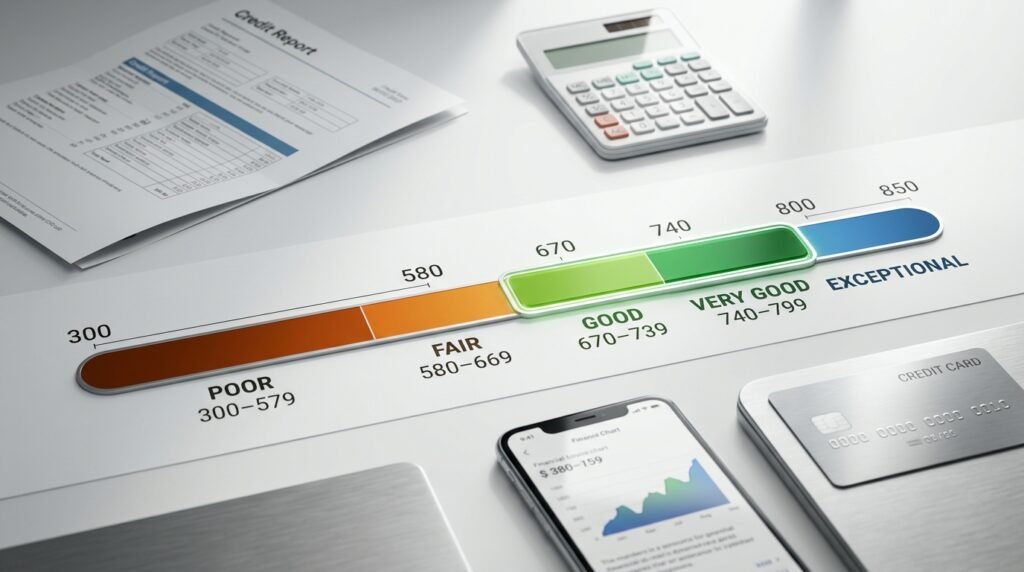
Understanding the different credit score ranges can help you put your number into perspective.
300–579: Poor Credit
A FICO Score below 580 is considered poor.
Borrowing may be more difficult in this range, and some lenders may charge higher interest rates or require additional conditions.
If your score is in this range, improving your payment history and managing revolving debt can be important steps.
580–669: Fair Credit
Scores from 580 through 669 fall into the fair range.
Someone with a score near 669 is in a different position from someone near 580, even though both fall into the same broad category.
Moving into the good range can provide access to more borrowing options, although lender requirements vary.
670–739: Good Credit
A score from 670 to 739 is generally considered good under FICO’s standard ranges.
If you have a score in this range, you have already moved beyond fair credit.
Still, what is a good credit score for a particular loan can vary. A lender may consider your income, debts, employment, down payment, loan amount, and credit history in addition to your score.
740–799: Very Good Credit
Scores between 740 and 799 are considered very good.
A higher score can strengthen your overall credit profile, although it does not guarantee approval or a specific interest rate.
For many borrowers, reaching the very good range is more useful than obsessing over reaching a perfect score.
800–850: Exceptional Credit
A score from 800 to 850 is considered exceptional.
An 800 score indicates a very strong credit profile, but there is usually little reason to take unnecessary financial risks simply to increase an 800 score to 850.
Responsible borrowing and maintaining a clean payment history are more important long-term goals.
Is 700 a Good Credit Score?

Yes. A 700 credit score is generally considered good under the standard FICO ranges.
A 700 score falls comfortably inside the 670–739 good-credit range.
If you’re wondering what is a good credit score for a credit card or loan, a 700 score can put you in a solid position, but approval still depends on the lender and the product.
Two people with the same credit score can receive different decisions because lenders also evaluate income, existing debt, credit history, and other information.
Is 750 a Good Credit Score?
Yes. A 750 credit score is very good according to the standard FICO ranges.
Because 750 falls within the 740–799 range, it is above the threshold for good credit.
A 750 score can represent a strong credit profile, but it does not automatically qualify you for every financial product or guarantee the lowest available interest rate.
Is 800 a Good Credit Score?
An 800 credit score is considered exceptional, not merely good.
Under the standard FICO ranges, 800 through 850 is the exceptional category.
If you have an 800 score, improving it further may have little practical value compared with maintaining the habits that produced the score.
How Rare Is an 800 Credit Score?
An 800 or higher score is at the top end of the standard FICO range.
The exact percentage of consumers with scores at this level can change over time, so it is better to focus on the scoring range rather than treating 800 as a universal measure of financial success.
You do not need an 800 score to have good credit.
A score of 670 or above is already considered good, while 740 or above falls into the very good category.
What Is the Average Credit Score in the US?
The average credit score in the United States can provide useful context, but it should not become your primary financial target.
Credit scores vary according to age, credit history, debt, payment behavior, and other factors.
Experian reported that the average FICO Score in the U.S. was 713 in 2025, down from 715 in 2024.
Rather than comparing yourself with the national average, focus on improving your own credit profile.
FICO vs. VantageScore: What’s the Difference?
FICO and VantageScore are different credit-scoring systems.
Many commonly used FICO and VantageScore models use a 300–850 scale, but they calculate and interpret credit information differently.
FICO also offers industry-specific scoring models for products such as auto loans and credit cards. Some of these scores use a 250–900 range instead of 300–850.
This is why you may see different scores when checking your credit through different services.
Which Credit Score Matters Most?
It depends on the lender and the financial product.
A mortgage lender may use different FICO versions from an auto lender or credit-card issuer. Some lenders may use VantageScore.
The score you see through a free credit-monitoring service may therefore not be identical to the score a lender uses.
What Factors Affect Your Credit Score?
Credit-scoring models use different calculations, but several factors are important in traditional FICO scoring.
These include:
- Payment history
- Amounts owed
- Length of credit history
- New credit
- Credit mix
FICO identifies payment history and amounts owed as two of the most influential categories in its traditional scoring framework.
Payment History
Paying your bills on time is one of the most important ways to protect your credit profile.
Set up automatic payments or reminders if they help you avoid missed due dates.
Credit Utilization
Credit utilization describes how much of your available revolving credit you are using.
For example, if your credit-card limits total $10,000 and your balances total $2,000, your utilization is 20%.
Lower utilization is generally better for your credit profile.
Length of Credit History
The age of your credit accounts can contribute to your credit history.
Before closing an older account, consider whether doing so could affect your available credit, account history, or overall financial situation.
New Credit
Applying for several new accounts within a short period can affect your credit profile.
Only apply for new credit when you have a genuine reason to do so.
Credit Mix
Your experience managing different types of credit can be considered by scoring models.
However, you should never take on unnecessary debt just to create a particular credit mix.
How Many Credit Cards Should I Have?
There is no magic number of credit cards that guarantees a good credit score.
Some consumers have excellent credit with one card, while others responsibly manage several accounts.
The important question is not simply how many credit cards should I have, but whether you can manage every account responsibly.
Having multiple cards can increase your total available credit, which may help lower your utilization ratio if your balances remain controlled.
However, opening unnecessary accounts can create additional applications, new-account activity, and opportunities to accumulate debt.
How Many Credit Cards Should I Have to Build Credit?
You do not necessarily need multiple cards to build credit.
For many people, one responsibly managed credit card can help establish a payment history.
The key is to make payments on time, keep balances manageable, and avoid spending more simply because additional credit is available.
Is It Good to Have Multiple Credit Cards?
It can be, as long as you can manage them.
Multiple credit cards can offer higher combined credit limits and different rewards or benefits.
But each additional account also creates another payment obligation.
The best number is the number you can manage without missing payments or accumulating unaffordable debt.
What Credit Score Do You Need to Buy a House?
There is no single credit score that guarantees mortgage approval.
Mortgage requirements vary according to the loan program, lender, borrower, property, and other factors.

For conventional mortgages, a FICO Score above 620 is generally required by lenders, although requirements can vary. A higher score may put a borrower in a stronger position for available terms. Your credit score is also worth considering alongside current mortgage rates, because the cost of borrowing depends on more than the home’s purchase price.
Your credit score is only one part of a mortgage application.
If you’re preparing to purchase your first home, understanding the full home-buying process can help you plan for your down payment, closing costs, mortgage, and other expenses.
Lenders can also consider:
- Income
- Debt-to-income ratio
- Down payment
- Employment and income history
- Existing debts
- Loan amount
- Property type
- Loan program
What Credit Score Do You Need for a $400,000 House?
The $400,000 price of a house does not create one universal credit-score requirement.
The required score can depend on the mortgage program, lender, down payment, income, debt-to-income ratio, and amount being borrowed.
For example, someone putting 20% down will have a different loan amount from someone making a smaller down payment.
So when considering what is a good credit score for a $400,000 house, don’t look at the score alone. Your entire financial profile matters.
What Credit Score Do You Need for a Car Loan?
There is no universal credit score required for every auto loan.
Auto lenders can use different scoring models, including industry-specific FICO Auto Scores. FICO says its industry-specific scores can range from 250 to 900.
Your credit score can influence the interest rate and financing options available to you, but lenders may also consider income, down payment, loan term, vehicle price, and existing debt.
How to Improve Your Credit Score
If your score is lower than you want, focus on sustainable improvements rather than quick fixes.
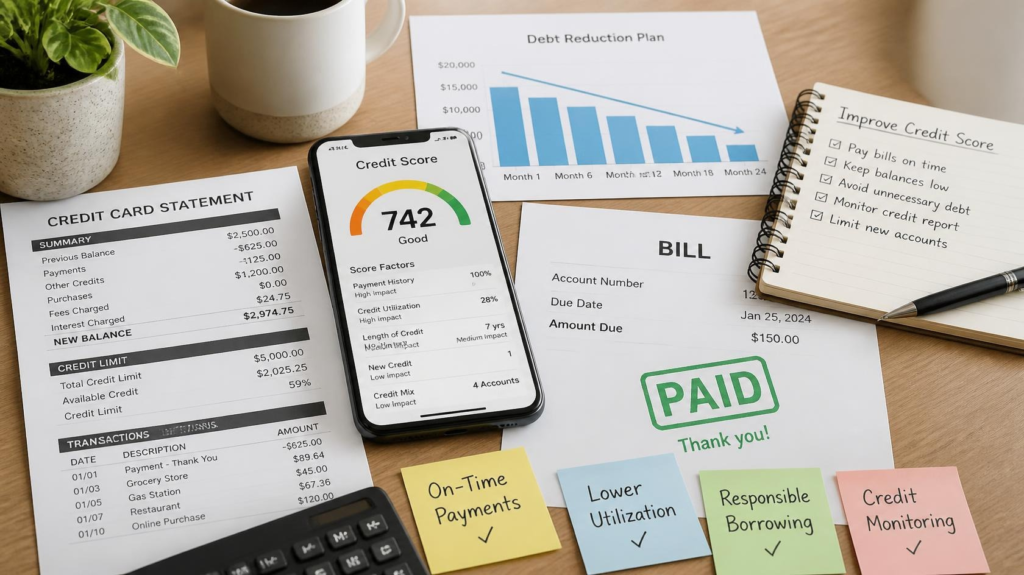
1. Pay Every Bill on Time
Payment history is one of the most important parts of traditional FICO scoring.
Automatic payments and reminders can help prevent accidental late payments.
2. Reduce Credit-Card Balances
Reducing revolving balances can lower your credit utilization.
If you have high credit-card balances, paying them down can be an important part of improving your credit profile.
3. Avoid Unnecessary Credit Applications
Only apply for new credit when you need it.
Multiple applications within a short period can create unnecessary hard inquiries and new-account activity.
4. Keep Older Accounts Open When Appropriate
Older accounts can contribute to your credit history.
However, you should not keep an account open if it creates unnecessary fees or financial problems.
5. Review Your Credit Reports
Check your credit reports for inaccurate or outdated information.
The Consumer Financial Protection Bureau recommends regularly checking your credit reports and provides guidance on disputing inaccurate information.
If you find an error, you can follow the appropriate dispute process with the credit bureau and information provider involved.
How to Raise Your Credit Score From 650 to 750
Moving from a 650 score to a 750 score can take time.
There is no guaranteed formula or exact timeline, but several habits can help:
- Pay every bill on time.
- Reduce high credit-card balances.
- Keep revolving utilization under control.
- Avoid unnecessary new credit applications.
- Monitor your credit reports.
- Keep well-managed older accounts when appropriate.
If you’re trying to raise your credit score from 650 to 750, focus on the factors you can control rather than looking for an instant credit-score boost.
How Long Does It Take to Build Credit?
There is no fixed timeline for building credit.
The answer depends on whether you are starting with no credit history, rebuilding damaged credit, or improving an existing profile.
Someone starting from scratch needs time to establish accounts and create a record of responsible payments.
Someone with existing credit may see changes sooner as balances, payment history, and other reported information change.
The most important factor is consistency.
How to Build Credit From Scratch
If you have little or no credit history, start with an account that you can comfortably manage.
A secured credit card can be one option for people who qualify.
Use the account responsibly, make payments on time, and keep your balance under control.
You should never borrow more than you can afford simply to build a credit score.
The purpose of building credit is to demonstrate responsible financial behavior, not to create unnecessary debt.
Why Can Your Credit Score Change?
Your credit score can change when information on your credit reports changes.
A newly reported balance, payment, account, credit limit, application, or delinquency can affect your score.
You may also see different scores at the same time because different scoring models evaluate the information differently.
A difference between scores does not automatically mean one is incorrect.
How Often Should You Check Your Credit Score?
Regularly monitoring your credit can help you understand changes to your financial profile.
Checking your own credit is different from applying for new credit. A lender’s hard inquiry can affect your credit profile, while checking your own score generally does not have the same effect.
It is also important to review your credit reports rather than looking only at the three-digit score.
You can also review your credit reports through the federally authorized AnnualCreditReport.com website.
Does a Good Credit Score Guarantee Loan Approval?
No.
A good credit score can strengthen your application, but it does not guarantee approval.
Lenders can also evaluate:
- Income
- Employment
- Existing debts
- Debt-to-income ratio
- Loan amount
- Down payment
- Credit history
- Other underwriting requirements
This is why what is a good credit score cannot be answered with one number for every borrower.
What Is the Best Credit Score to Aim For?
For most consumers, there is little reason to obsess over reaching exactly 850.
A base FICO Score of 670 to 739 is good, 740 to 799 is very good, and 800 to 850 is exceptional.
While building credit, it is also useful to understand how everyday banking products such as checking and savings accounts work.
Instead of chasing a perfect number, focus on building a healthy credit profile.
That means:
- Pay bills on time
- Keep credit-card balances manageable
- Avoid unnecessary debt
- Limit unnecessary credit applications
- Monitor your credit reports
- Maintain accounts responsibly
Building good credit is only one part of a healthy financial plan. It is also important to understand where to keep your savings and how different savings accounts work.
Frequently Asked Questions
What is a good credit score?
For a standard base FICO Score, 670 to 739 is considered good. Scores of 740 to 799 are very good, while 800 to 850 are exceptional.
Is 700 a good credit score?
Yes. A 700 FICO Score is within the good range.
Is 750 a good credit score?
Yes. A 750 FICO Score is within the very good range.
Is 800 a good credit score?
Yes. An 800 FICO Score is considered exceptional.
Is 650 a good credit score?
A 650 FICO Score is considered fair because it falls within the 580–669 range.
What is considered an excellent credit score?
The terminology can vary, but FICO classifies 800 to 850 as exceptional under its standard scoring ranges.
What credit score do I need to buy a house?
There is no universal minimum for every mortgage. Many conventional lenders look for a FICO Score around 620 or higher, but requirements vary by lender and loan program.
How many credit cards should I have?
There is no ideal number. One responsibly managed card can be enough for building credit, while some consumers successfully manage multiple cards.
How can I improve my credit score?
Pay bills on time, reduce revolving balances, avoid unnecessary applications, monitor your credit reports, and maintain responsible credit accounts.
How long does it take to build credit?
There is no fixed timeline. Building or rebuilding credit depends on your starting point, account history, payment behavior, and the information reported to the credit bureaus.
Does checking my credit score lower it?
Checking your own credit score is generally different from applying for new credit. A lender’s hard inquiry can affect your credit profile, while checking your own score generally does not have the same effect.
The Bottom Line
So, what is a good credit score in 2026?
For a standard FICO Score, 670 to 739 is good, 740 to 799 is very good, and 800 to 850 is exceptional.
But your credit score is only one part of your financial profile.
Whether you’re preparing to buy a home, applying for a car loan, looking for a new credit card, or simply trying to improve your finances, responsible credit habits matter more than chasing a perfect number.
Pay your bills on time, keep revolving balances manageable, avoid unnecessary debt, and monitor your credit reports.
A strong credit profile can give you more financial options and put you in a better position when you need to borrow.










Leave a Reply