


Elon Musk Memory Shortage
By Shahid Kayani | August 17, 2026
Elon Musk has put a new spotlight on a part of the artificial intelligence industry that many people rarely think about: memory.
The SpaceX CEO recently identified memory as a major limitation for the continued expansion of AI computing. His comments have now drawn renewed attention as investors and technology companies focus on a growing shortage of advanced memory used by AI systems.
The issue matters because building more powerful AI models is not simply a race to produce faster processors. AI systems also need enormous amounts of memory to store and move the data required by increasingly complex workloads.
That is putting companies such as Micron, Samsung and SK hynix at the center of an increasingly important part of the AI infrastructure story.
But what exactly is causing the memory problem, and could it eventually affect the broader AI boom?
Elon Musk Says Memory Is Now a Major AI Bottleneck
Musk has repeatedly highlighted memory as an increasingly important constraint for AI infrastructure as the global supply of advanced memory comes under pressure.
In discussing the pace at which AI infrastructure can expand, Musk identified memory as the current bottleneck rather than simply focusing on computing power.
The comment has since received renewed attention because memory supply has become increasingly important as AI companies deploy larger data centers and more sophisticated AI systems.
The timing is significant.
The AI industry has spent years focused on graphics processing units, or GPUs, because GPUs provide the enormous computational power required to train and operate modern AI models.
But having enough computing power is only part of the equation.
Those processors need to be supplied with data quickly enough to keep them working efficiently.
That is where memory becomes critical.
Why Does AI Need So Much Memory?
Artificial intelligence systems process enormous amounts of information.
During AI training and inference, processors repeatedly access model parameters, intermediate calculations and other data. As models become larger and workloads become more demanding, the amount of memory required can increase substantially.
Traditional computer memory is not necessarily fast enough to keep high-performance AI processors supplied with data at the speeds they need.
This is one reason the industry has increasingly turned toward high-bandwidth memory, commonly known as HBM.
HBM is designed to provide very high data bandwidth while operating alongside advanced processors.
In simple terms, you can think of an AI accelerator as an extremely fast worker.
The processor can perform calculations very quickly, but it still needs a steady supply of information.
If the information cannot reach the processor quickly enough, some of that expensive computing capacity can effectively sit waiting.
That makes memory bandwidth an important part of overall AI performance.
What Is HBM and Why Is It So Important?
High-bandwidth memory is a specialized form of memory designed for demanding computing applications.
Unlike conventional memory modules used in ordinary PCs, HBM uses stacked memory structures and a much wider connection to the processor.
The goal is to move large quantities of data quickly.
That makes HBM particularly useful for AI accelerators and high-performance computing systems.
As AI models become more complex, demand for HBM has increased because the processors powering those systems need faster access to large amounts of data.
This has created an unusual situation in the semiconductor industry.
The AI boom is not simply increasing demand for processors.
It is increasing demand for the memory that works alongside those processors.
And producing advanced memory is not something manufacturers can expand overnight.
Why AI Memory Supply Is Struggling to Keep Up
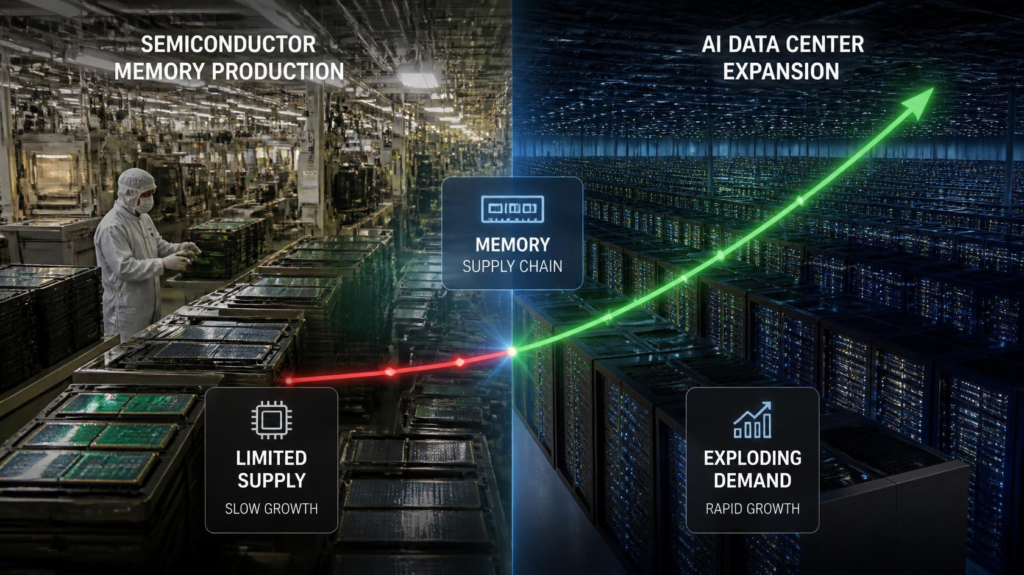
One reason the memory market is under pressure is that semiconductor manufacturing capacity cannot instantly respond to changes in demand.
Building new fabrication capacity takes years.
Manufacturers also have to decide how to allocate existing production capacity among different types of memory.
HBM is particularly important because it requires advanced manufacturing and packaging processes.
At the same time, AI data centers need other forms of memory and storage, including server DRAM and high-performance NAND-based storage.
That means the AI boom can place pressure on multiple parts of the memory supply chain at once.
This is part of the broader hardware and infrastructure challenge behind the rapid development of artificial intelligence.
Recent industry reporting has continued to point toward tight supply conditions, with major manufacturers expanding capacity while customers secure supply further in advance. Samsung and SK hynix, for example, have been expanding longer-term memory supply arrangements as the shortage persists.
Micron has also warned that strong AI demand is keeping memory supply conditions tight.
The company has described AI demand as a major driver of its memory business and has been investing in additional capacity.
Why Micron Is Getting So Much Attention
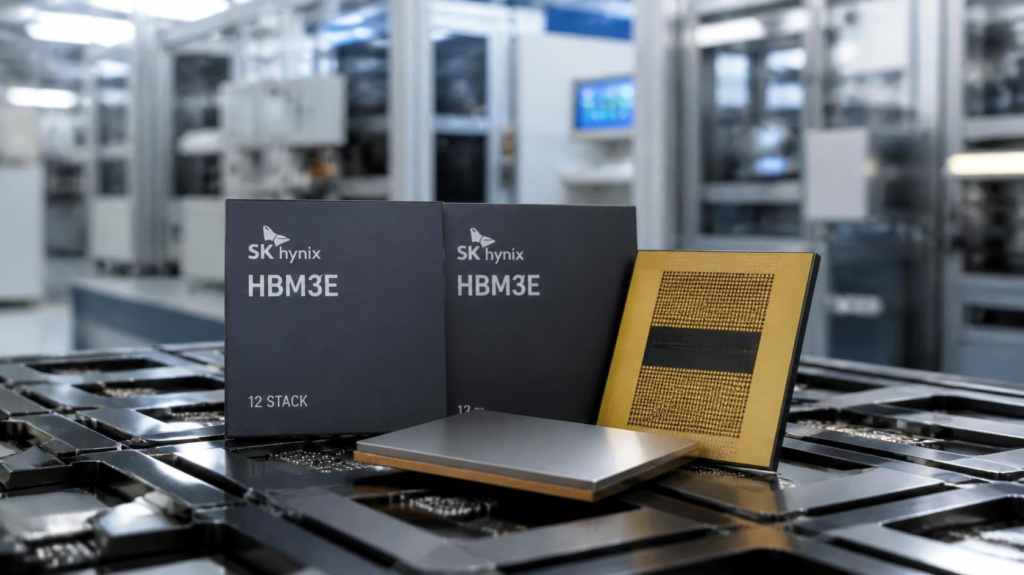
Micron Technology is one of the world’s major memory-chip manufacturers and is particularly relevant to the AI memory story because of its HBM business.
That has made the company a frequent focus of investors following the AI infrastructure boom.
Recent market coverage has highlighted the company’s exposure to HBM and the broader increase in AI-related memory demand.
But Micron is not alone.
The global memory market is dominated by several major manufacturers, including Samsung and SK hynix.
That is important because the AI memory shortage is not simply a story about one company.
It is a supply-chain issue involving some of the world’s largest semiconductor manufacturers.
Micron’s position is nevertheless significant because it is one of the major suppliers competing for a growing share of the advanced-memory market.
Samsung and SK hynix Matter Too
Samsung Electronics and SK hynix are major players in the global DRAM and HBM markets.
According to Counterpoint Research, Samsung led the global DRAM market in Q2 2026 with a 39% revenue share, followed by SK hynix at 26% and Micron at 25%. Micron’s result put it just one percentage point behind SK hynix.
SK hynix is also deeply involved in supplying memory for AI infrastructure.
The three companies are therefore competing in a market where demand is being shaped increasingly by AI data centers rather than only traditional consumer electronics.
That is a major change for the memory industry.
For years, memory companies were heavily exposed to demand from smartphones, PCs and other consumer devices.
AI is creating another enormous source of demand.
Could the Memory Shortage Slow AI Growth?
This is one of the most important questions raised by Musk’s comments.
A shortage of memory does not necessarily mean AI development will stop.
Technology companies can respond in several ways.
They can:
- Build more memory manufacturing capacity.
- Develop more efficient AI models.
- Optimize software to use memory more efficiently.
- Design processors around different memory configurations.
- Secure longer-term supply agreements.
- Develop new generations of HBM.
- Improve data-center architecture.
However, all of those responses take time.
New semiconductor facilities can take years to construct and bring into production.
That creates a potential mismatch between how quickly AI companies want to expand and how quickly the semiconductor supply chain can respond.
The result could be a situation where computing capacity grows faster than the memory infrastructure needed to support it.
Why Memory Could Become More Important as AI Models Grow
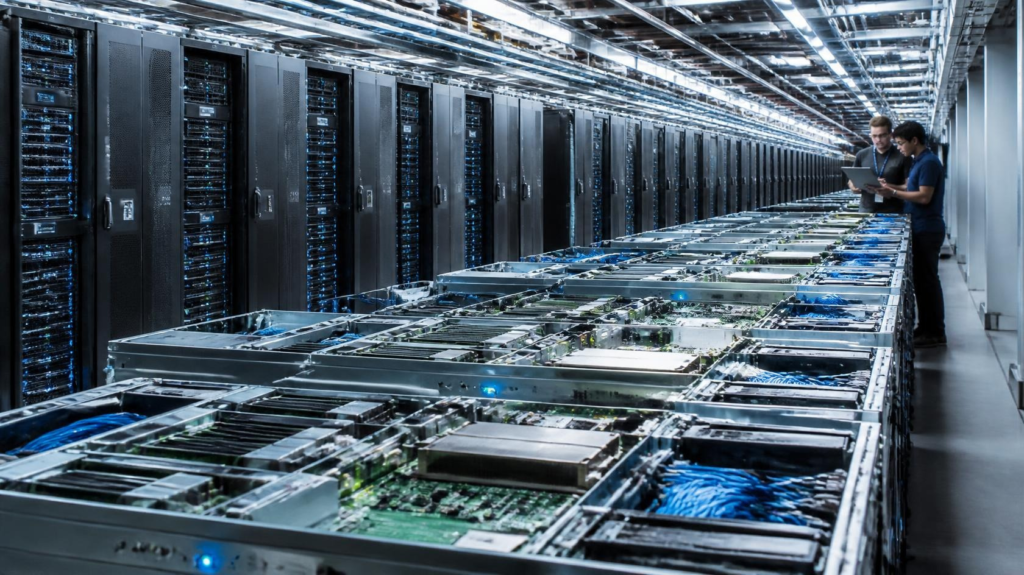
The AI industry is moving toward larger and more capable systems, particularly as AI agents become more sophisticated.
It is also increasingly interested in AI agents that can perform longer sequences of tasks and interact with multiple tools.
These workloads can create different memory requirements from traditional AI applications.
As systems become more sophisticated, companies may need more memory capacity, more memory bandwidth and faster movement of information between processors and memory.
This does not mean every new AI model will automatically require dramatically more physical memory.
Engineers can improve efficiency.
Model compression, quantization, caching and other techniques can reduce the amount of memory required for certain workloads.
But efficiency improvements do not eliminate the overall growth in demand if the number of AI applications and users is expanding rapidly.
That is why memory remains such an important infrastructure issue.
What Does the Memory Shortage Mean for Consumers?
The effects of the AI memory boom are not necessarily limited to giant data centers.
Memory manufacturers have to allocate production across different markets.
If more advanced production capacity is directed toward AI infrastructure, other segments can face tighter supply.
That can eventually affect manufacturers of PCs, smartphones, servers and other electronics.
Recent reporting has already highlighted concerns about memory availability and pricing across the wider technology supply chain.
However, consumers should not assume that every computer or smartphone will suddenly become dramatically more expensive.
Companies can change product specifications, negotiate different supply arrangements, increase production or absorb some costs.
The impact will depend on how long supply remains constrained and how quickly manufacturers add capacity.
Is This a Temporary Shortage or a Longer-Term Problem?
Memory markets have historically been cyclical.
Periods of high demand can lead manufacturers to increase production.
Eventually, additional supply can push prices lower.
That history is important because it means today’s shortage should not automatically be treated as a permanent condition.
However, the AI boom has created a different kind of demand.
AI companies are building enormous data centers and planning infrastructure years in advance.
HBM also requires specialized production and advanced packaging.
That makes it harder to rapidly increase supply than simply turning on additional production lines.
Current industry reporting suggests tight memory conditions could persist beyond the immediate shortage period.
The eventual balance between supply and demand will depend on how quickly manufacturers expand capacity and whether AI demand continues growing at its current pace.
Why Memory Is Different From a GPU Shortage
The AI hardware conversation has often centered on GPUs.
That makes sense because GPUs are among the most important components in modern AI data centers.
But a GPU cannot operate in isolation.
It needs memory.
A useful way to think about the relationship is this:
GPU = computation
Memory = information supply
Networking = movement between systems
All three matter.
If any one of those components becomes a major bottleneck, adding more of the others may not produce the expected increase in performance.
That is why Musk’s comments have attracted attention.
They highlight a part of the AI infrastructure chain that is less visible to ordinary consumers but increasingly important to the industry’s expansion.
Why AI Companies Are Locking in Memory Supply
When a critical component becomes difficult to obtain, companies have an incentive to secure supply before they actually need it.
That is increasingly happening in the memory industry.
Samsung and SK hynix have been discussing longer-term supply agreements as customers seek greater certainty around future memory availability.
This changes the economics of the market.
Instead of simply buying memory on short-term market conditions, large AI customers may want predictable supplies for future data-center deployments.
That can give manufacturers greater visibility into future demand.
It can also make it harder for smaller buyers to compete for limited advanced-memory capacity.
Could AI Memory Demand Keep Rising?
That depends on several factors.
The first is whether AI data-center construction continues expanding at the current pace.
The second is whether AI models continue becoming larger and more computationally demanding.
The third is whether new AI applications generate additional inference workloads.
Training large models is only one part of the market.
Once AI systems are deployed at scale, they need memory every time users interact with them.
That means widespread AI adoption could create sustained memory demand even after individual model-training projects are completed.
The growth of AI agents could also increase demand if systems are expected to maintain more context and perform more complex tasks.
What Happens If Memory Supply Finally Catches Up?
If manufacturers successfully expand production faster than demand grows, the situation could change quickly.
More supply could reduce pricing pressure.
It could also give AI companies greater flexibility when designing systems.
But there is another possibility.
If AI demand continues growing faster than manufacturing capacity, memory could remain one of the industry’s most important constraints.
The semiconductor industry therefore faces a difficult balancing act.
Manufacturers need to invest heavily enough to meet future demand without creating so much excess capacity that the market eventually becomes oversupplied.
Memory has historically been a cyclical business, so that risk remains important.
What Musk’s Comments Really Tell Us About AI’s Next Bottleneck
The biggest takeaway from Musk’s comments is not that GPUs no longer matter.
They do.
It is that AI infrastructure is becoming a much more complicated system.
As the industry scales, bottlenecks can move.
At one stage, computing power may be the limiting factor.
At another, electricity or data-center construction may become the constraint.
At another, networking or memory may become more important.
Memory is currently receiving unusual attention because AI systems require enormous amounts of high-performance memory and because advanced memory production cannot be expanded instantly.

That makes HBM and other forms of memory increasingly strategic parts of the AI supply chain.
Does This Mean Micron, Samsung and SK hynix Will Automatically Win?
Not necessarily.
Strong demand does not eliminate business risks.
Memory manufacturers still face:
- Cyclical pricing
- Capital expenditure risks
- Manufacturing challenges
- Competition
- Technology transitions
- Geopolitical restrictions
- Changes in AI demand
- Potential oversupply in the future
A company can benefit from a strong industry trend and still face significant risks.
That is especially important for investors.
Musk’s comments may increase attention toward memory companies, but attention alone does not determine the long-term performance of an individual stock.
This article explains the technology and industry dynamics rather than providing an investment recommendation.
Why This Matters for the Future of AI
AI development has often been described as a race for more computing power.
That description is becoming incomplete.
The next stage of AI infrastructure will depend on the entire hardware ecosystem.
Companies need processors.
They need high-bandwidth memory.
They need networking equipment.
They need data-center capacity.
They need electricity and cooling.
They need storage.
And they need software capable of using all of those resources efficiently.
Memory sits directly between computation and information.
That makes its availability a fundamental part of how quickly AI systems can scale.
If memory remains constrained, it could become one of the factors determining how quickly new AI infrastructure can be deployed.
What Should Consumers Watch?
Consumers do not need to follow every memory-chip earnings report to understand the trend.
A few indicators are worth watching.
Memory prices
Rising DRAM and NAND prices can signal continued supply pressure.
HBM production
As manufacturers increase HBM output, supply constraints could gradually ease.
AI data-center construction
Continued expansion would likely support demand for advanced memory.
New semiconductor capacity
New fabrication and packaging facilities could eventually increase supply.
AI model efficiency
More efficient models could reduce memory requirements for some workloads.
Together, these indicators can provide a better picture of whether the current memory shortage is getting better or worse.
Frequently Asked Questions
What did Elon Musk say about AI memory?
Musk identified memory as a major bottleneck for expanding AI computing during SpaceX’s Q2 2026 earnings call. His comments have since drawn renewed attention as the AI industry faces tight memory supply.
Why does AI need so much memory?
AI systems need memory to store model parameters and other information that processors must access during training and inference. Larger and more complex workloads can require greater memory capacity and bandwidth.
What is HBM?
HBM stands for high-bandwidth memory. It is a specialized memory technology designed to provide very high data bandwidth for applications such as AI and high-performance computing.
Why is HBM important for AI?
AI accelerators need to move large amounts of data quickly. HBM is designed to provide the bandwidth required by many modern AI workloads, making it an important component of advanced AI hardware.
Which companies make AI memory?
Major memory manufacturers include Micron Technology, Samsung Electronics and SK hynix. These companies compete across DRAM, HBM and other memory technologies. In Q2 2026, Samsung led the global DRAM market with a 39% revenue share, while SK hynix held 26% and Micron reached 25%, according to Counterpoint Research.
Is there a memory shortage in 2026?
The memory market is experiencing tight supply conditions driven in significant part by strong AI-related demand. Industry reports indicate that supply constraints could continue beyond the immediate term.
Could a memory shortage slow AI development?
It could become a constraint if memory supply cannot expand quickly enough to support planned AI infrastructure. However, companies can respond through additional manufacturing capacity, more efficient models and changes to system architecture.
Will the memory shortage make computers more expensive?
It could contribute to higher component costs, but the effect on final consumer prices will depend on manufacturers, product specifications, supply contracts and broader market conditions.
Is Micron a good investment because of AI memory demand?
AI memory demand is an important factor in Micron’s business outlook, but this article does not recommend buying or selling the company’s stock. Investors should consider valuation, competition, memory cycles, capital spending and other risks before making an investment decision.
Is memory more important than GPUs for AI?
Not necessarily. GPUs and other AI accelerators provide the computing power required by AI workloads, while memory supplies the data those processors need. AI systems require both, along with networking, storage, power and data-center infrastructure.
The Bottom Line
Elon Musk’s comments about memory highlight a major shift in the AI infrastructure story.
For years, the conversation focused heavily on GPUs and computing power.
Now another part of the system is demanding attention.
Memory.
AI systems need enormous amounts of data and increasingly fast access to that data. High-bandwidth memory has therefore become an increasingly important component of AI infrastructure, while manufacturers face pressure to expand supply quickly enough to keep up with demand.
Micron, Samsung and SK hynix are among the companies at the center of that market.
The shortage may eventually ease as manufacturers add capacity and technology improves. Memory markets are also historically cyclical, meaning today’s tight supply should not automatically be assumed to last forever.
But for now, Musk’s comments underline an important reality about the AI boom:
The future of AI is not only about building faster chips. It is also about making sure those chips have enough memory to keep working at full speed.
As AI models grow, data centers expand and AI agents become more common, memory could remain one of the most important pieces of the infrastructure puzzle.
And that makes the memory market a story worth watching far beyond the current headlines.
Editorial note: This article provides general technology and business information and is not individualized financial or investment advice. Market conditions, company performance and technology developments can change rapidly. Information in this article reflects publicly reported information available at publication time.




Leave a Reply