
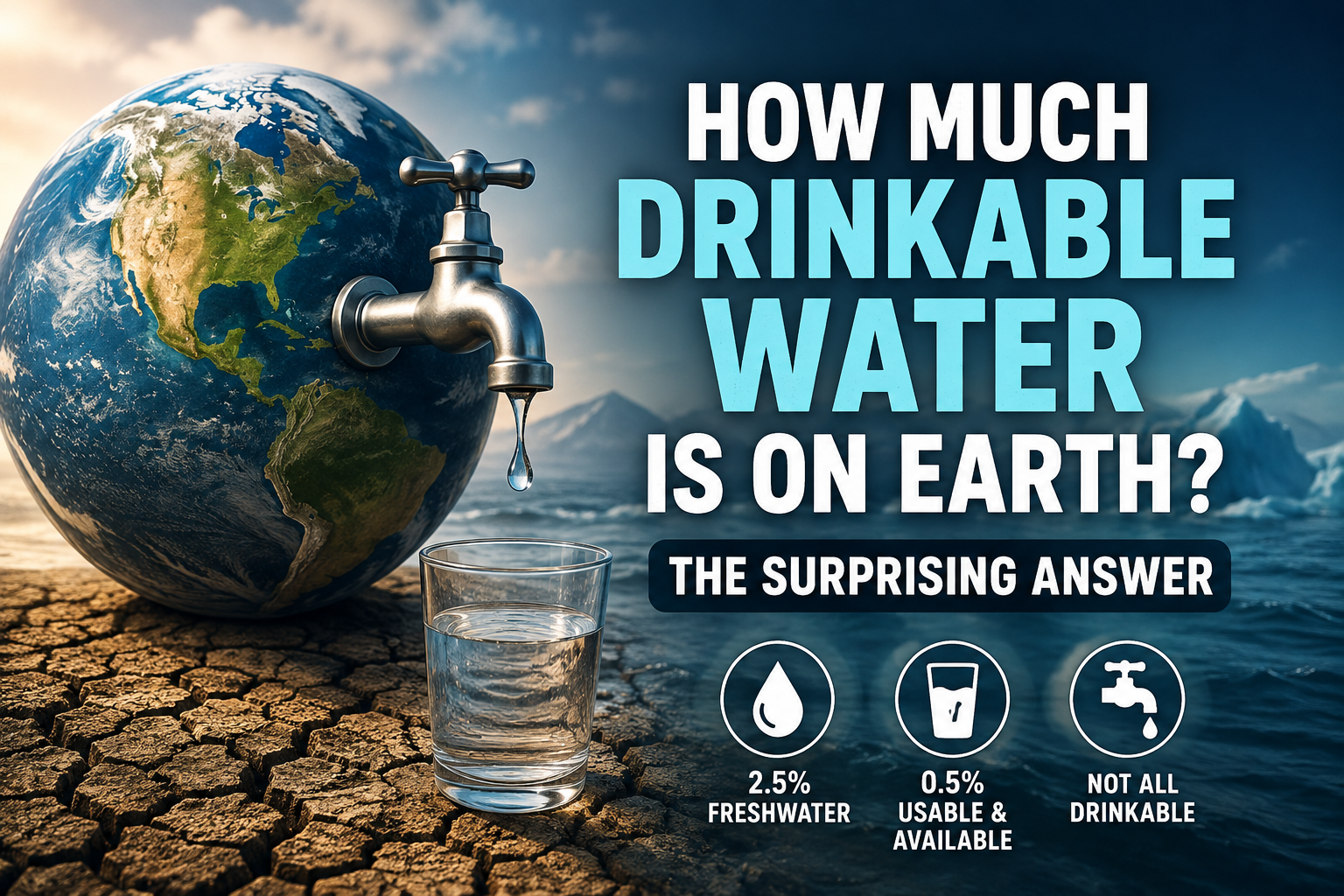
How much drinkable water is on Earth? It is a deceptively difficult question because Earth’s enormous water supply is mostly saltwater, while much of its freshwater is frozen, stored underground, or otherwise unavailable for immediate human use.
About 97.5% of Earth’s water is saltwater, while only about 2.5% is freshwater. Much of that freshwater is stored in glaciers, ice sheets, permanent snow, or underground. UN-Water estimates that only about 0.5% of Earth’s total water is usable and available freshwater.
But there is an important distinction: usable and available freshwater is not the same thing as water that is immediately safe to drink. Drinking water must meet appropriate safety requirements and be accessible when people need it.
So, how much drinkable water is actually on Earth? There is no single scientifically accepted percentage that can accurately describe all of Earth’s water as “drinkable.” The answer depends on whether we are talking about freshwater, accessible freshwater, or water that has been treated and meets drinking-water safety standards.
What Percentage of Earth’s Water Is Drinkable?
The amount of Earth’s water that is actually suitable for drinking is much smaller than the total amount of water on the planet.
Freshwater can be:
- Frozen inside glaciers and ice sheets
- Stored deep underground
- Contaminated by chemicals or microorganisms
- Too difficult or expensive to access
- Located far from the people who need it
- In need of treatment before it can safely be consumed
A useful way to understand the difference is to separate Earth’s water into three broad categories:
| Type of water | Approximate share of Earth’s total water |
|---|---|
| Saltwater | 97.5% |
| Freshwater | 2.5% |
| Usable and available freshwater | About 0.5% |
The 2.5% freshwater figure describes the proportion of Earth’s water that is fresh, while the approximately 0.5% usable and available freshwater figure describes a much smaller portion of the planet’s total water supply. The two figures should not be treated as measures of drinking water.
Even usable and available freshwater is not automatically safe to drink. Water quality, contamination, treatment, accessibility, and local conditions determine whether a particular water source can be considered safe drinking water.
This distinction is crucial when answering the question, “How much drinkable water is on Earth?”
What Percentage of Earth’s Water Is Freshwater?
Only about 2.5% of Earth’s total water is freshwater. The remaining 97.5% is saltwater, found primarily in the oceans and seas.
According to the U.S. Geological Survey (USGS), freshwater includes water stored in glaciers and ice sheets, groundwater, lakes, rivers, soil moisture, and other freshwater reservoirs.


However, the 2.5% figure can be misleading if we assume that all of this freshwater is readily available for human use. A large proportion is frozen in glaciers and ice sheets, while another substantial portion is stored underground as groundwater.
That leaves only a very small fraction in surface-water sources such as lakes and rivers, even though these sources are particularly important for human communities.
This is why the question is not simply how much freshwater exists. The more useful question is how much freshwater is accessible, available, and safe enough to use.
In other words:
2.5% = freshwater
Not 2.5% = immediately drinkable water
Understanding that difference helps explain why Earth can have enormous quantities of water while many regions still face freshwater scarcity.
Why Isn’t All Freshwater Drinkable?
Freshwater is not automatically safe to drink. Freshwater describes the amount of dissolved salt in water, while drinking water must also meet appropriate safety and quality requirements.
Freshwater can contain substances that make it unsafe for human consumption, including:
- Bacteria and viruses
- Parasites
- Heavy metals
- Agricultural chemicals
- Industrial pollutants
- Naturally occurring contaminants
Water can also require treatment even when it looks completely clear. Contaminants are not always visible, and water quality can vary significantly between different sources and locations.
The World Health Organization (WHO) takes a broader approach when describing safely managed drinking water. Safety depends not only on the source itself, but also on whether water is available when needed, accessible, and free from important contamination.
This is why it would be inaccurate to say that 2.5% of Earth’s water is drinkable.
The 2.5% figure refers to freshwater, not water that is guaranteed to be safe for human consumption.
The distinction can be summarized simply:
Freshwater = relatively low in dissolved salts
Drinking water = water that meets appropriate safety requirements for human consumption
That difference is essential when interpreting statistics about Earth’s water supply.
Where Is Most of Earth’s Freshwater Stored?
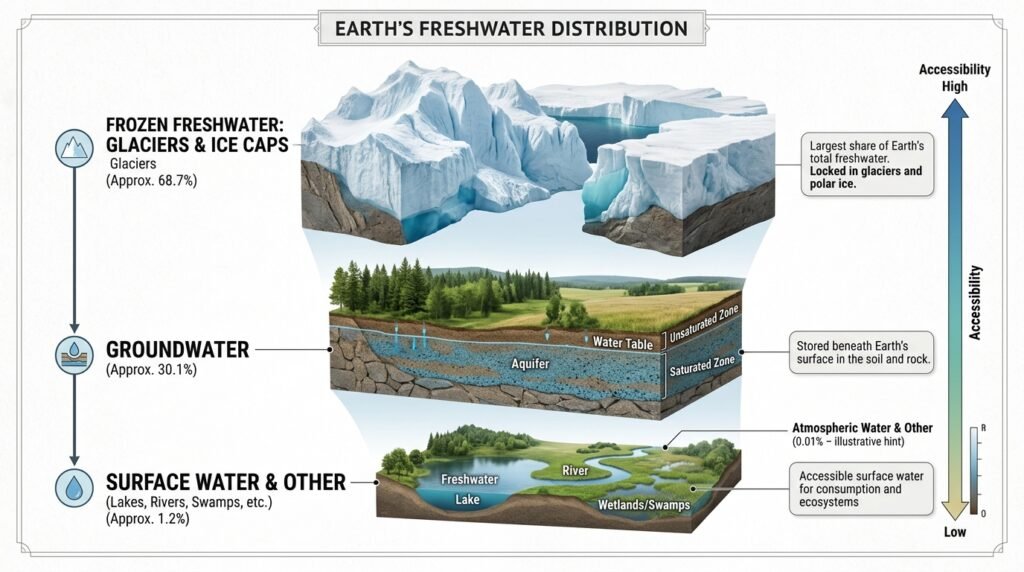
Most of Earth’s freshwater is stored in glaciers, ice sheets, and groundwater, rather than in the lakes and rivers that people see on the surface.
According to the National Oceanic and Atmospheric Administration (NOAA), about 68% of Earth’s freshwater is stored in glaciers, ice sheets, and permanent snow, while roughly 30% is stored as groundwater. Only a small fraction is found in surface-water sources such as lakes, rivers, and wetlands.
This distribution helps explain why the 2.5% freshwater figure does not mean that 2.5% of Earth’s water is easily available for human use.
Glaciers and Ice Sheets
Glaciers and ice sheets contain a huge proportion of Earth’s freshwater, but this water is frozen and generally not readily accessible for drinking or everyday use.
Antarctica and Greenland contain enormous quantities of freshwater locked in ice. Although this represents an important part of Earth’s freshwater reserves, it does not function as an easily accessible drinking-water supply for most communities.
Groundwater
Groundwater is another major freshwater reservoir. It is stored beneath Earth’s surface in soil, rock formations, and aquifers.
Communities around the world rely on groundwater from wells and aquifers for drinking water, agriculture, and other uses.
However, groundwater is not automatically safe to drink. Its quality can be affected by the surrounding geology, land use, industrial activity, agricultural chemicals, naturally occurring substances, and other sources of contamination. Some groundwater therefore requires treatment before it can be used as drinking water.
Lakes and Rivers
Lakes and rivers contain a much smaller share of Earth’s freshwater than glaciers, ice sheets, and groundwater.
Despite their relatively small share, they are extremely important because surface water is often more accessible than water stored in ice or deep underground.
Many communities depend on rivers, lakes, reservoirs, and other surface-water sources for drinking-water supplies. This also means that pollution affecting these sources can have a significant impact on human populations.
The key takeaway is simple: most freshwater exists in places that are difficult to access, while only a small fraction is readily available at Earth’s surface.
How Much of Earth’s Water Is Usable and Available?
Only a small fraction of Earth’s total water is both freshwater and realistically available for human use.
UN-Water estimates that approximately 0.5% of Earth’s total water is usable and available freshwater. This figure helps illustrate the enormous difference between the total amount of water on the planet and the amount that people can realistically access.
However, 0.5% does not mean that 0.5% of Earth’s water is ready to drink. Water may still require treatment, testing, infrastructure, or other measures before it can safely be used as drinking water.
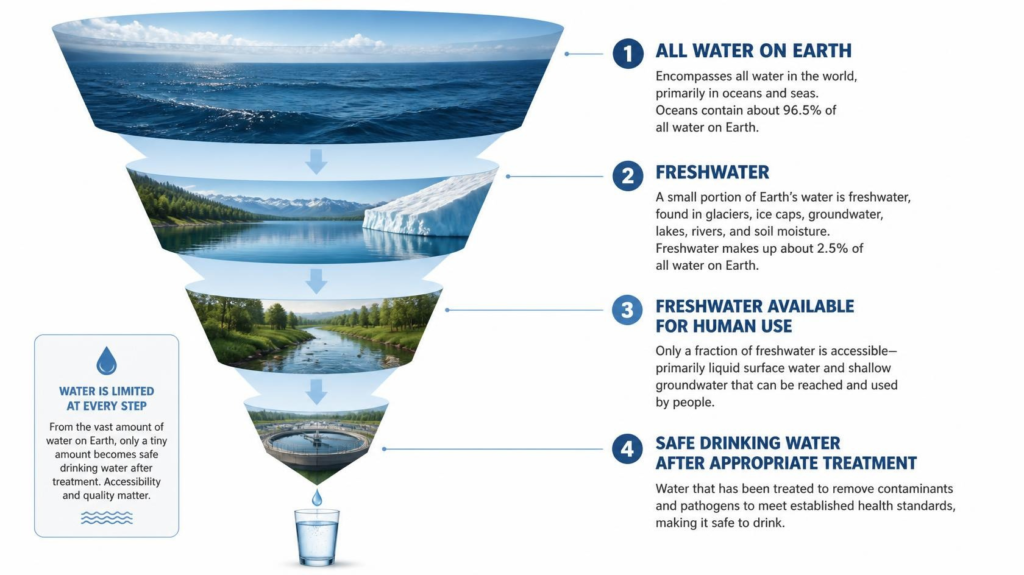
The progression looks like this:
All water on Earth
↓
About 97.5% is saltwater
↓
About 2.5% is freshwater
↓
Much of that freshwater is frozen or stored underground
↓
A much smaller portion is usable and available
↓
Water intended for drinking must also meet appropriate safety and quality requirements
This distinction is important because statistics about freshwater availability describe the physical availability of water, while drinking-water statistics also involve water quality, accessibility, treatment, and reliability.
So when you see the figure 0.5%, think of it as an estimate of usable and available freshwater, not a measurement of water that can be consumed directly from natural sources.
Freshwater vs. Drinkable Water: What’s the Difference?
The simplest way to understand the difference is:
Freshwater describes salinity. Drinking water describes safety and suitability for human consumption.
Freshwater generally contains relatively low concentrations of dissolved salts. It can be found in glaciers, groundwater, lakes, rivers, wetlands, and other freshwater systems.
But freshwater is not automatically safe to drink.
A freshwater source may contain:
- Bacteria and viruses
- Parasites
- Heavy metals
- Agricultural chemicals
- Industrial pollutants
- Naturally occurring contaminants
For example, a freshwater lake or river may require treatment before it can be used as a safe drinking-water source. Groundwater can also contain naturally occurring substances or pollutants that require treatment.
This distinction matters because terms such as freshwater, drinkable water, potable water, and usable water are sometimes used interchangeably online even though they can describe different things.
So, when asking how much drinkable water is on Earth, the 2.5% freshwater figure should not be treated as the answer. It tells us how much of Earth’s total water is freshwater, not how much is immediately safe for human consumption.
Freshwater = low salinity
Drinkable water = water that meets appropriate safety requirements for human consumption
How Much of Earth’s Water Is Potable?
Potable water generally means water that is suitable for human consumption and meets applicable drinking-water safety requirements.
There is no scientifically reliable single percentage that represents all of Earth’s water as potable. The reason is that potability depends on water quality, contamination, treatment, accessibility, and local drinking-water standards.
A natural freshwater source may not be potable because it contains microorganisms, chemicals, heavy metals, or other contaminants. Conversely, water from a source that is not naturally suitable for drinking can potentially become potable after appropriate treatment.
This is why the commonly repeated claim that “only 1% of Earth’s water is drinkable” should be treated cautiously. It combines different measurements of freshwater availability and drinking-water safety into a single number.
The more useful figures are:
- 97.5% of Earth’s water is saltwater.
- 2.5% is freshwater.
- Approximately 0.5% of Earth’s total water is usable and available freshwater, according to UN-Water.
None of these figures, by themselves, represents the percentage of Earth’s water that is immediately safe to drink.
The amount of potable water available to people depends not only on how much freshwater exists, but also on whether it is accessible, adequately treated, available when needed, and free from important contamination.
How Much Drinkable Water Is Left on Earth?
Earth is not running out of water. The planet’s total amount of water remains enormous and continually moves through the water cycle.
The more important issue is whether people have access to enough clean, accessible, and reliably available freshwater in the places where they live.
Water continually circulates through evaporation, condensation, precipitation, surface runoff, groundwater recharge, and other parts of the water cycle. This means that water is constantly moving between the atmosphere, land, oceans, ice, groundwater, lakes, and rivers.
However, water that exists somewhere on Earth is not necessarily available for people to use.
A community can face serious water scarcity when freshwater is:
- Too far away from where people live
- Contaminated or polluted
- Locked in ice
- Stored in groundwater that is difficult to access
- Being withdrawn faster than it can naturally recharge
- Reduced by prolonged drought
- Limited by inadequate infrastructure
This means water scarcity is primarily an issue of availability, accessibility, quality, and demand, rather than the planet simply running out of water.
Several factors influence how much freshwater people can actually access, including:
- Population growth
- Agricultural demand
- Industrial use
- Groundwater extraction
- Drought
- Pollution
- Climate patterns
- Water infrastructure
- Unequal distribution of freshwater resources
So, asking how much drinkable water is “left” is different from asking how much water exists on Earth.
The planet has an enormous supply of water, but only a much smaller amount of clean, accessible freshwater is available for human use in any particular place and at any particular time.freshwater where and when people need it.
Why Is Usable Freshwater Becoming Scarcer?
Freshwater scarcity is often less about the total amount of water on Earth and more about where freshwater is located, how clean it is, how quickly it is replenished, and how much people need.
Population and Demand
Population growth and economic activity increase demand for drinking water, sanitation, agriculture, energy, and industry. Agriculture is especially important because it requires large volumes of freshwater.
Groundwater Depletion
Groundwater is renewable in many systems, but recharge rates vary. When withdrawals remain higher than natural recharge, groundwater levels can decline, making wells less reliable and increasing pressure on other water sources.
Pollution
Pollution can make freshwater sources unsafe or more expensive to treat. Agricultural runoff, industrial pollutants, wastewater, and other contaminants can reduce the amount of water that is realistically usable.
Drought
Drought can reduce precipitation, river flows, reservoir levels, soil moisture, and groundwater recharge. A region may therefore experience severe water shortages even when its long-term freshwater resources are substantial.
Unequal Distribution
Freshwater is unevenly distributed around the world. Some regions have abundant rainfall and rivers, while others are naturally dry. Infrastructure also matters: water may exist within a country or region without being reliably accessible to every community.
Taken together, these factors explain why usable freshwater can become scarcer even though Earth itself still contains an enormous amount of water.
Is All Groundwater Drinkable?
No. Groundwater is not automatically safe to drink.
Groundwater can be an important source of drinking water, but its quality depends on the geology, land use, and conditions surrounding the aquifer.
Groundwater can contain naturally occurring substances such as minerals and metals. It can also become contaminated by human activities, including:
- Agricultural fertilizers and pesticides
- Industrial chemicals
- Leaking fuel or waste
- Septic systems and wastewater
- Naturally occurring contaminants in rocks and soil
Some groundwater sources are suitable for drinking with little or no treatment, while others require treatment before they can safely be consumed.
This is why simply describing water as groundwater does not mean that it is potable water.
Before groundwater is used as a drinking-water source, its quality may need to be tested and, where necessary, treated to remove harmful contaminants.
The key distinction is:
Groundwater = where the water is stored
Potable water = water that meets appropriate safety requirements for human consumption
So although groundwater represents a major portion of Earth’s freshwater reserves, only some groundwater is readily accessible and suitable for drinking.
Is River Water Safe to Drink?
Not necessarily. River water is freshwater, but that does not mean it is automatically safe to drink.
Rivers can collect contaminants as water flows through cities, agricultural areas, industrial zones, and natural environments. These contaminants can include:
- Bacteria and viruses
- Parasites
- Agricultural chemicals
- Industrial pollutants
- Heavy metals
- Sewage and other wastewater contaminants
Even a river that looks clean can contain microorganisms or chemicals that cannot be seen, smelled, or tasted.
For this reason, untreated river water should not be assumed to be safe for drinking. Water intended for human consumption may need appropriate testing and treatment to reduce or remove harmful contaminants.
River water can still be an important source of drinking water. Many communities obtain their water from rivers or reservoirs, but the water typically passes through treatment and quality-control processes before it reaches consumers.
The important distinction is:
River water = a natural freshwater source
Safe drinking water = water that meets appropriate health and safety requirements
So, when considering how much drinkable water exists on Earth, rivers represent only a small part of the planet’s freshwater resources, and even that water is not necessarily potable in its natural state.
Is Rainwater Drinkable?
Rainwater is naturally low in dissolved salts, but that does not automatically make it safe to drink.
As rain falls through the atmosphere and after it reaches a collection surface, it can pick up contaminants from the surrounding environment. These may include microorganisms, dust, pollutants, chemicals, or substances from roofs, gutters, storage containers, and other collection equipment.
The safety of collected rainwater therefore depends on factors such as:
- Local air quality
- The surface used to collect the water
- Storage conditions
- Possible contamination
- Treatment and filtration
- How the water is tested and maintained
In some places, properly collected and treated rainwater can be used as a drinking-water source. However, untreated rainwater should not automatically be considered safe simply because it comes from precipitation.
This is another example of the difference between freshwater and drinking water.
Rainwater = a natural freshwater source
Drinkable water = water that meets appropriate safety and quality requirements for human consumption
So, rainwater can contribute to freshwater supplies, but whether it is potable depends on its quality, collection, treatment, and local conditions.
Frequently Asked Questions
How Much Drinkable Water Is on Earth?
There is no single scientifically accepted percentage for all of Earth’s water that can be classified as drinkable. About 2.5% is freshwater, while approximately 0.5% of Earth’s total water is estimated to be usable and available freshwater. Water must also meet appropriate safety and quality requirements before it can be considered safe for human consumption.
What Percentage of Earth’s Water Is Freshwater?
About 2.5% of Earth’s total water is freshwater, while approximately 97.5% is saltwater. However, much of that freshwater is frozen in glaciers and ice sheets or stored underground, so it is not all readily available for human use.
What Percentage of Earth’s Water Is Drinkable?
There is no reliable universal percentage that represents all of Earth’s water as drinkable. The amount of water that is actually safe for consumption depends on its quality, contamination level, treatment, accessibility, and local drinking-water standards.
Is Groundwater Safe to Drink?
Groundwater is not automatically safe to drink. Some groundwater sources are suitable for consumption, while others may contain microorganisms, chemicals, heavy metals, or naturally occurring contaminants and may require treatment.
Is River Water Safe to Drink?
Untreated river water should not automatically be considered safe to drink. Rivers can contain microorganisms, agricultural chemicals, industrial pollutants, sewage, and other contaminants, so water intended for drinking may require testing and appropriate treatment.
The Bottom Line
So, how much drinkable water is on Earth?
There is no single scientifically reliable percentage that can describe all of Earth’s water as “drinkable.” The commonly cited figures tell us different things:
- 97.5% of Earth’s water is saltwater.
- 2.5% is freshwater.
- About 0.5% of Earth’s total water is estimated to be usable and available freshwater.
But usable freshwater is not the same as drinking water. Water must also be accessible, sufficiently clean, and meet appropriate safety and quality requirements before it can be considered suitable for human consumption.
That distinction explains an important fact about our planet: Earth has an enormous amount of water, but only a small portion is realistically available as clean freshwater for people to use.
The challenge is therefore not simply running out of water. It is protecting freshwater resources, maintaining water quality, managing demand, and ensuring that communities can reliably access safe water.
Understanding the difference between saltwater, freshwater, usable freshwater, and potable water gives you a much more accurate picture of Earth’s water supply.

Leave a Reply