


EDITOR’S UPDATE: August 2026
Knowing how much money to keep in savings can be surprisingly difficult. You may have heard that you should save three to six months of expenses, but that still leaves a bigger question:
Three to six months of what?
There is no single savings number that is right for every household.
If you’re wondering how much money should I have in savings, the answer starts with your essential monthly expenses, income stability, and financial responsibilities.
The Federal Deposit Insurance Corporation (FDIC) says a general recommendation is to keep three to six months’ worth of expenses in an emergency savings fund, while noting that the appropriate amount depends on factors such as income, expenses and household circumstances.
The Consumer Financial Protection Bureau (CFPB) takes a similarly practical approach. It explains that the amount needed in an emergency fund depends on your situation and that even putting aside a small amount can provide some financial security.
So instead of asking, “What is the magic amount I should have in savings?” a better question is:
How much money would I actually need if an unexpected expense occurred or my income suddenly stopped?
This guide explains how to calculate that number based on your essential expenses, financial stability, household responsibilities and savings goals.
Quick Answer: How Much Money Should I Have in Savings?
There is no universal savings amount that everyone should have.
A useful starting framework is:
Essential monthly expenses × number of months = emergency savings target
For example, if your essential expenses are $3,500 per month:
- 1 month = $3,500
- 3 months = $10,500
- 6 months = $21,000
For many households, three to six months of essential expenses can be a reasonable emergency-fund range. People with stable income and lower financial risk may be comfortable working toward the lower end, while people with variable income, dependents, high fixed expenses or less predictable employment may want a larger reserve.
The important point is that your savings target should be based on your actual financial needs rather than an arbitrary dollar amount.
The Federal Reserve’s 2025 household survey found that 55% of U.S. adults said they had set aside money to cover three months of expenses in an emergency savings or “rainy day” fund. That does not mean three months is right for everyone, but it shows how commonly this benchmark is used.
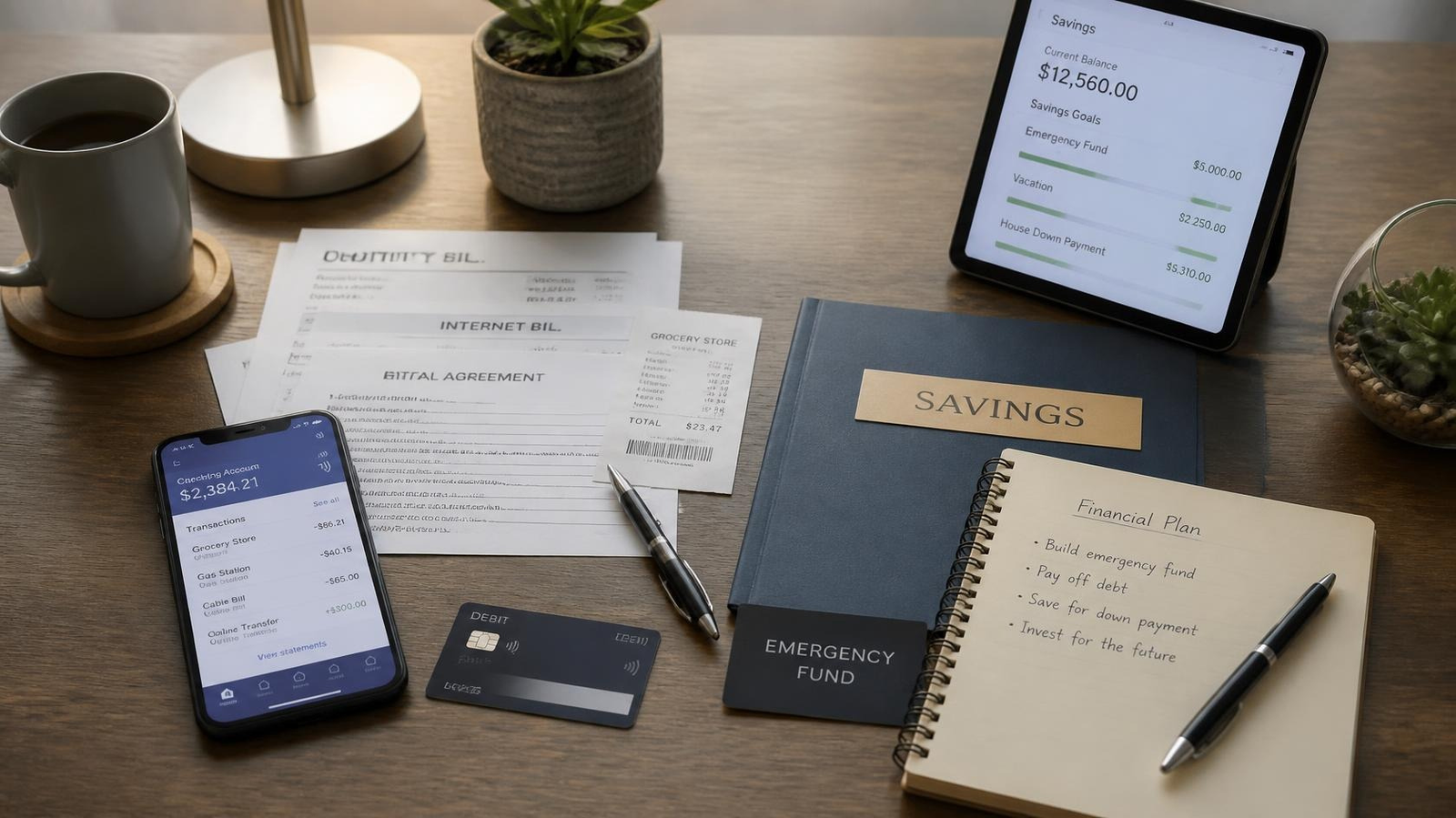
It’s also important to distinguish total savings from emergency savings. Your total savings may include an emergency fund, money for planned purchases, short-term goals and other cash reserves. Your emergency fund is only the portion specifically set aside for unexpected expenses or income loss.
How Much Should You Have in Savings?
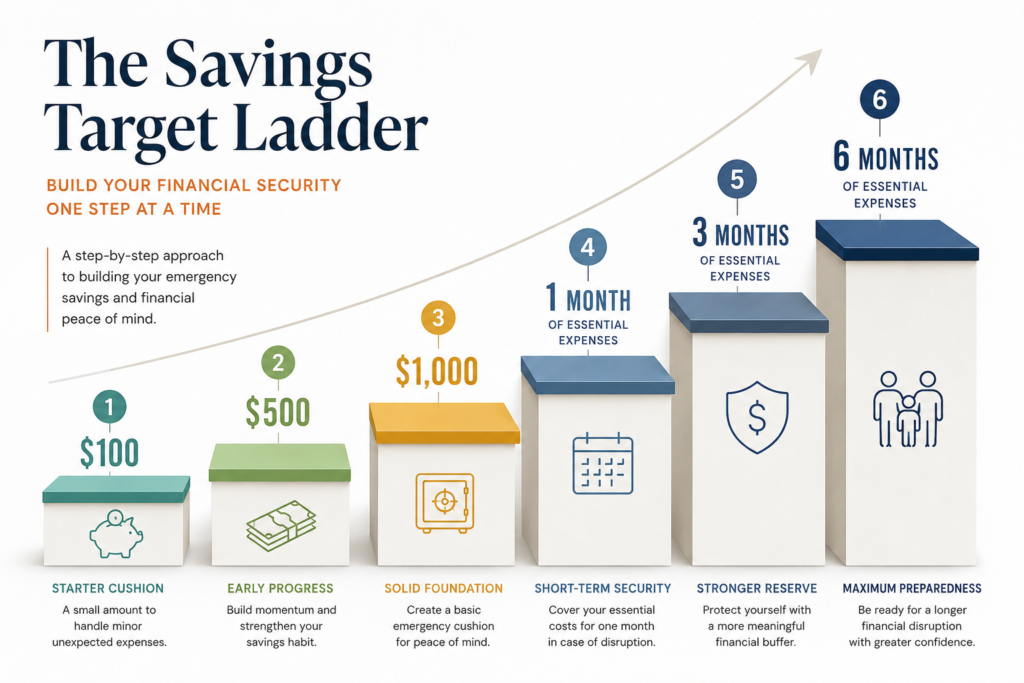
Think of your savings target as a series of milestones rather than one enormous number you have to reach immediately.
The Savings Target Ladder
| Savings level | General target | Main purpose |
|---|---|---|
| Starter cushion | $100–$500 | Handle smaller unexpected expenses |
| Initial milestone | $1,000 | Create a basic emergency cushion |
| First major target | 1 month of essential expenses | Cover a short disruption |
| Stronger reserve | 3 months of essential expenses | Provide more meaningful protection |
| Larger reserve | 6 months of essential expenses | Prepare for a longer financial disruption |
| Higher reserve | 6+ months | May suit households with greater financial uncertainty |
These aren’t universal rules or requirements. They are milestones that can help you decide what to work toward next.
The CFPB specifically notes that even a small amount of emergency savings can provide some financial security. That matters because someone starting with $0 should not feel that saving $10,000 or $20,000 is the only definition of success.
What Is the Difference Between Savings and an Emergency Fund?
Savings is the broader category.
Your savings may include money set aside for:
- Emergencies
- Planned purchases
- Home repairs
- Car expenses
- Vacations
- Annual bills
- Short-term financial goals
- Other upcoming expenses
An emergency fund is more specific. It is money reserved for unexpected financial problems, such as a major repair, medical expense or sudden loss of income.
For example, suppose you have $10,000 in a savings account.
If:
- $5,000 is your emergency fund
- $2,000 is for a car
- $1,500 is for a vacation
- $1,500 is for annual bills
then you do not really have $10,000 available for an emergency.
Your emergency reserve is $5,000.
Keeping these purposes separate can make it much easier to understand how financially prepared you actually are.
Start With a Small Financial Cushion
If you currently have little or no savings, your first goal doesn’t have to be three months of expenses.
Your first goal might be:
- $100
- $250
- $500
- $1,000
The amount matters less than establishing a dedicated reserve and building the habit of contributing to it.
A small emergency fund can help with an unexpected bill without forcing you to immediately rely on a credit card or loan.
The important thing is to start.
Aim for One Month of Essential Expenses
Once you have a starter cushion, a useful next milestone is one month of essential expenses.
If your essential expenses are $3,000 per month, for example, reaching $3,000 in emergency savings gives you a much stronger starting position than having $500.
You still may not be fully protected against a prolonged income interruption, but you have created a meaningful financial buffer.
Build Toward Three Months
Three months of essential expenses is a common emergency-savings benchmark.
The Federal Reserve also uses the ability to cover three months of expenses as a measure of household financial preparedness.
For someone with $3,000 in essential monthly expenses:
$3,000 × 3 = $9,000
That doesn’t mean every person needs exactly $9,000. It means three months gives you a concrete milestone based on your own expenses.
Consider Six Months or More
Six months can provide a larger cushion if replacing your income could take time.
For example, a six-month target may be worth considering if you:
- Have variable income
- Are self-employed
- Work primarily on commission
- Support dependents
- Have high fixed expenses
- Are the only income earner in your household
- Work in a field where finding a new job may take longer
- Have limited access to other financial resources
For someone with $4,000 of essential monthly expenses:
$4,000 × 6 = $24,000
Again, six months is a benchmark, not a rule that everyone must follow.
How to Calculate How Much You Need in Savings
The most useful part of determining your savings target is the calculation.
The Basic Formula
Essential monthly expenses × target number of months = emergency savings target
The formula is simple, but choosing the right expenses and number of months requires some thought.
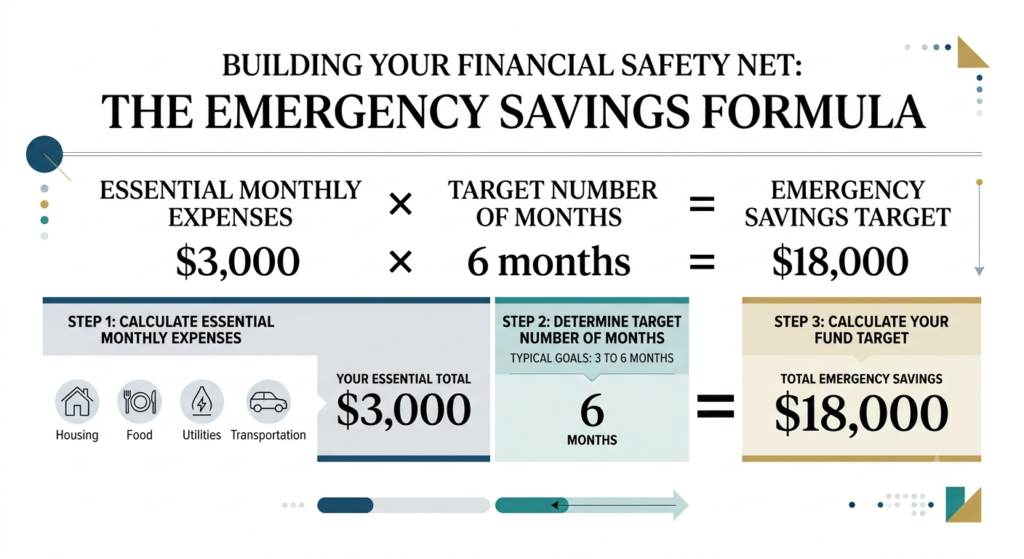
The Consumer Financial Protection Bureau (CFPB) recommends considering your personal circumstances and the unexpected expenses you have faced when deciding how much to keep in an emergency fund. That makes your savings target more useful than simply choosing an arbitrary dollar amount.
Step 1: Calculate Your Essential Monthly Expenses
Start by identifying the expenses you would still need to pay if your income suddenly dropped.
Include things such as:
- Housing
- Utilities
- Groceries
- Transportation
- Insurance
- Minimum debt payments
- Essential healthcare
- Childcare
- Necessary household expenses
You don’t necessarily need to include every expense in your current lifestyle.
The goal is to estimate the amount required to keep your household functioning during a financial disruption.
Step 2: Choose Your Target Number of Months
Next, decide whether you want to work toward:
- 1 month
- 3 months
- 6 months
- More than 6 months
If you’re starting from $0, your first target might simply be one month.
If your income is stable, three months may be a useful medium-term goal.
If your income is less predictable or your household has greater financial responsibilities, six months or more may make sense.
Step 3: Multiply the Numbers
Suppose your essential monthly expenses are $2,500.
Your potential targets would look like this:
| Essential monthly expenses | 3-month target | 6-month target |
|---|---|---|
| $2,500 | $7,500 | $15,000 |
| $4,000 | $12,000 | $24,000 |
| $6,000 | $18,000 | $36,000 |
This is why simply telling everyone to “save $20,000” isn’t particularly useful.
A $20,000 emergency fund could represent more than six months of essential expenses for one household and less than three months for another.
Your expenses provide the context.
How Much Should I Save Each Month?
Once you know your savings target, you can calculate how much you need to save each month.
A simple formula is:
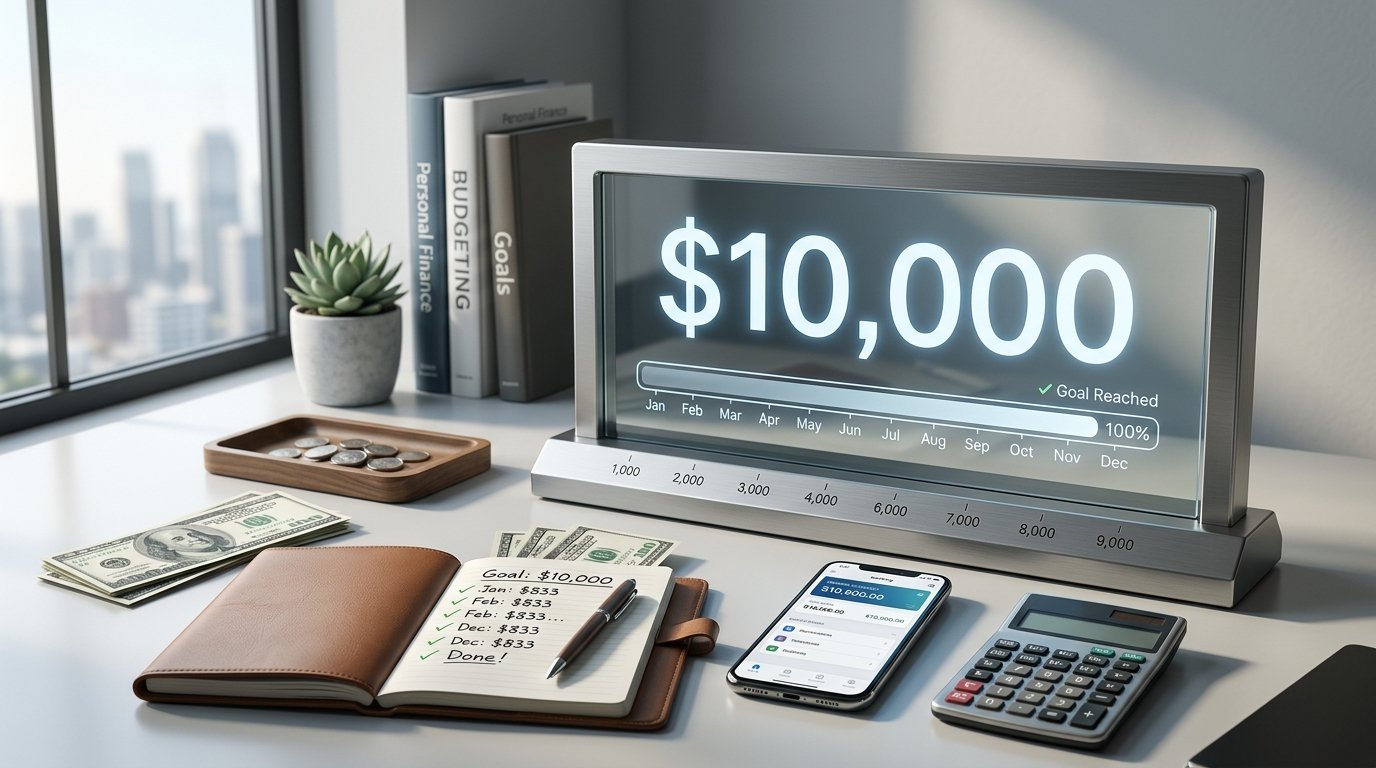
(Savings target − current savings) ÷ number of months = monthly savings needed
For example, suppose your target is $12,000 and you currently have $3,000 saved.
You need another $9,000.
If you want to reach the goal in 12 months:
$9,000 ÷ 12 = $750 per month
That gives you a specific monthly target instead of simply saying, “I need to save more.”
If $750 per month is unrealistic, extend the timeline.
For example:
- $9,000 over 12 months = $750 per month
- $9,000 over 18 months = $500 per month
- $9,000 over 24 months = $375 per month
The best savings plan is one you can maintain consistently.
Why Your Savings Target Should Usually Be Based on Expenses, Not Gross Income
One common mistake is interpreting “six months of savings” as six months of income.
That’s not necessarily the best way to think about an emergency fund.
Imagine you earn $8,000 per month but your essential expenses are $4,500.
Six months of gross income would equal:
$8,000 × 6 = $48,000
Six months of essential expenses would equal:
$4,500 × 6 = $27,000
That’s a difference of $21,000.
If you lost your income, you would likely try to reduce discretionary spending as much as possible. Your emergency fund therefore needs to focus on what you would actually need to keep paying, not necessarily everything you currently spend.
This is why calculating essential expenses is so important.
What Counts as an Essential Monthly Expense?
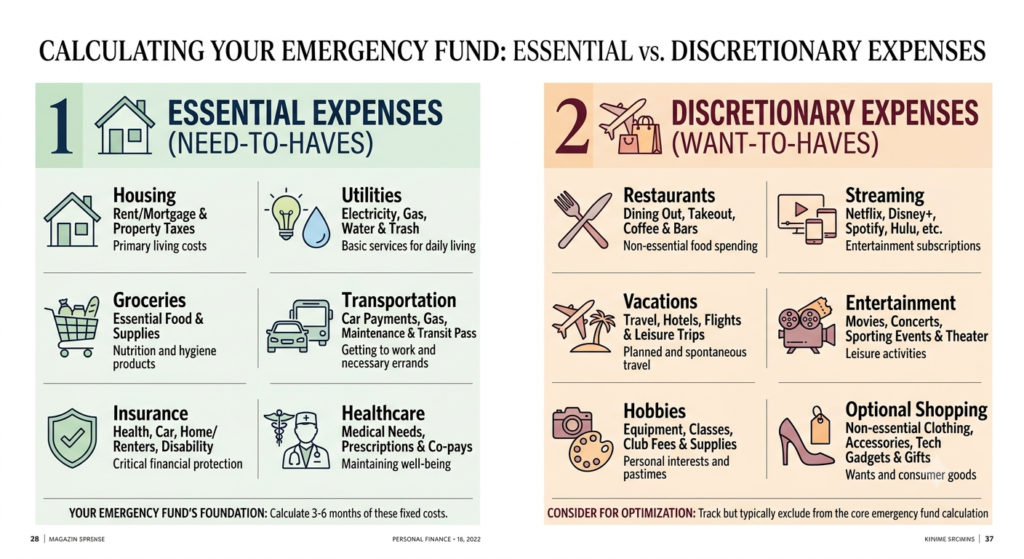
Your emergency-fund calculation should focus on expenses that are difficult or impossible to eliminate during a financial emergency.
Usually Essential
Housing
Rent or mortgage payments.
Utilities
Electricity, water, heating, basic internet or other necessary services.
Groceries
Food required to keep your household functioning.
Transportation
Fuel, public transportation, vehicle payments or other necessary transportation costs.
Insurance
Health, auto, home, renters and other necessary insurance premiums.
Minimum debt payments
The minimum required payments on credit cards, student loans, personal loans or other debts.
Essential healthcare
Necessary medical expenses, prescriptions and healthcare-related costs.
Childcare
Childcare required so you can continue working.
Necessary household expenses
Other unavoidable costs that are important for maintaining basic household operations.
Usually Discretionary
These expenses may be important to your lifestyle, but they generally aren’t essential to keeping your household functioning during a financial emergency.
Examples include:
- Dining at restaurants
- Streaming services
- Vacations
- Entertainment
- Luxury purchases
- Optional subscriptions
- Nonessential shopping
- Hobbies and recreational spending
The purpose isn’t to create the most extreme bare-bones budget possible.
Instead, ask:
“If my income stopped tomorrow, what would I absolutely need to keep paying?”
That number is a much better starting point for calculating your emergency savings target.
Is $1,000 Enough for an Emergency Fund?
$1,000 can be a useful starting milestone, but it isn’t a universal emergency-fund target.
Consider two households.
Household A
Essential monthly expenses: $1,500
Savings: $1,000
That savings balance is less than one month of essential expenses.
Household B
Essential monthly expenses: $5,000
Savings: $1,000
That amount covers an even smaller portion of their essential costs.
This illustrates why a flat $1,000 target doesn’t work equally well for everyone.
Still, $1,000 can be an important milestone for someone starting from nothing.
The CFPB emphasizes that even a small amount set aside for unexpected expenses can provide some financial security.
So don’t think of $1,000 as either “enough” or “not enough.”
Think of it as:
A starting cushion, not necessarily the final destination.
How Much Savings Is Enough?
The answer depends on what your savings are intended to accomplish.
If you’re asking about emergency savings, three to six months of essential expenses is a useful starting benchmark.
If you’re asking about total savings, there isn’t a single target because total savings can include multiple financial goals.
For example, someone could have:
- $8,000 emergency fund
- $3,000 car fund
- $2,000 home-repair fund
- $2,000 vacation fund
That person has $15,000 in total savings but only $8,000 designated for emergencies.
The better question is not simply:
“How much money do I have saved?”
Ask:
“How much of my savings is actually available for an emergency?”
Knowing how much money should I have in savings is more useful than comparing your balance with someone else’s.
How Much Should I Have Saved by Age?
Age-based savings questions are popular because people naturally want to know whether they are “behind.”
You may have seen recommendations such as:
- Save a certain amount by 25
- Have a certain multiple of your income by 30
- Reach another specific number by 40
These benchmarks can sometimes be useful for thinking about long-term retirement savings, but they aren’t the best way to calculate an emergency fund.
Your emergency savings target should be based more heavily on your actual financial circumstances.
How Much Should I Have Saved by 25?
There isn’t one emergency-fund amount that every 25-year-old should have.
A 25-year-old living alone in a high-cost city may have very different essential expenses from a 25-year-old living with family.
Income, housing costs, debt, dependents, employment stability and access to other resources can all change the appropriate target.
Instead of asking:
“How much should a 25-year-old have?”
Ask:
“How much would I need to cover my essential expenses if something went wrong?”
How Much Should I Have Saved by 30?
The same principle applies at 30.
Someone may earn significantly more at 30 than they did at 25, but they may also have:
- A mortgage
- Children
- Higher childcare costs
- Larger insurance bills
- Higher transportation costs
- More debt
- More household responsibilities
Higher income doesn’t automatically mean a larger emergency fund is required, but higher essential expenses can increase the amount needed.
How Much Should I Have Saved by 40?
At 40, financial responsibilities may be different again.
Some households may have higher housing expenses, children, education costs or other obligations.
Others may have paid off debt and have lower fixed expenses.
The appropriate emergency reserve still depends on your actual financial situation rather than your age alone.
Why Age Alone Isn’t the Best Measure
Age alone does not tell you how much emergency savings you need.
It doesn’t tell you:
- How much you spend
- How stable your income is
- Whether you’re supporting dependents
- How secure your job is
- How much debt you have
- How quickly you could replace your income
- How much you have in other accessible assets
For emergency savings, those factors are much more relevant.
How Much Should I Have Saved for Retirement?
Emergency savings and retirement savings serve different purposes. Your emergency fund is designed to protect you from unexpected expenses or a temporary loss of income, while retirement savings are intended to support you over many years after you stop working.
There is no single retirement savings number that everyone should have at a particular age. Your income, retirement age, spending goals, Social Security benefits, investment returns, and how much you have already saved can all change the amount you ultimately need.
Still, age-based benchmarks can give you a useful starting point.
A Simple Retirement Savings Benchmark by Age
One widely used guideline from Fidelity suggests aiming for approximately:
| Age | Retirement savings benchmark |
|---|---|
| 30 | 1× your annual income |
| 40 | 3× your annual income |
| 50 | 6× your annual income |
| 60 | 8× your annual income |
| 67 | 10× your annual income |
For example, if you earn $60,000 a year, a 3× income benchmark at age 40 would equal approximately $180,000 in retirement savings.
These numbers are best viewed as goalposts rather than requirements. Fidelity’s framework assumes that a person begins saving around age 25, saves about 15% of income annually including employer contributions, invests for long-term growth, and retires around age 67. Your own target may be higher or lower depending on when you started saving, when you plan to retire, and the lifestyle you want to maintain. Fidelity’s retirement savings guidelines
How Much Should You Save Each Year?
A useful starting point is to work toward saving around 15% of your pretax income for retirement, including employer contributions when applicable.
You don’t have to reach that percentage immediately. If you’re currently saving less, increasing your contribution gradually can still make a meaningful difference over time.
For example, you might:
- Start by contributing enough to receive your full employer match if one is available.
- Increase your contribution when you receive a raise.
- Direct part of a bonus or tax refund toward retirement.
- Increase your savings rate gradually as your income grows.
- Use tax-advantaged accounts such as a 401(k) or IRA when appropriate.
The IRS sets annual contribution limits for retirement accounts, and those limits can change. For 2026, the employee contribution limit for most 401(k) plans is $24,500, before applicable catch-up contributions. Check the current IRS retirement contribution limits when planning your contributions.
What If You Are Behind on Retirement Savings?
Being below an age-based benchmark doesn’t mean you have failed or that retirement is out of reach.
The most useful response is to look at what you can change now.
You might increase your contribution rate, take full advantage of an employer match, reduce unnecessary spending, pay down expensive debt, or extend your working timeline if that is realistic for your situation.
Starting later can mean you need to save more aggressively, but even small increases can compound over many years.
It’s also important not to compare your retirement balance too closely with someone else’s. Two people who are the same age can have very different incomes, housing costs, family responsibilities, pensions, Social Security expectations, and retirement goals.
Keep Retirement Savings Separate From Your Emergency Fund
Your retirement account should not automatically be treated as part of your emergency fund.
If you need money for an unexpected expense, using accessible cash savings can help you avoid selling long-term investments during an unfavorable market period or disrupting your retirement strategy.
A better approach is to give each type of savings a specific job:
- Emergency savings: unexpected expenses and income disruptions
- Short-term savings: planned expenses in the next few years
- Retirement savings: long-term financial security
- Investments outside retirement accounts: additional long-term goals and wealth building
The goal is not to keep all your money in cash. It’s to build enough accessible savings for emergencies while continuing to invest for long-term goals.
The Bottom Line on Retirement Savings
Age-based benchmarks can help answer the question, “Am I roughly on track?” But they should not become a source of unnecessary stress.
If you’re starting with little or no retirement savings, focus first on building a sustainable habit. If you’re already saving consistently, look for opportunities to increase your contribution over time.
Your retirement target should ultimately reflect your income, expected spending, retirement age, and other sources of retirement income rather than a single number printed on a chart.
Should You Save 3, 6 or More Months of Expenses?
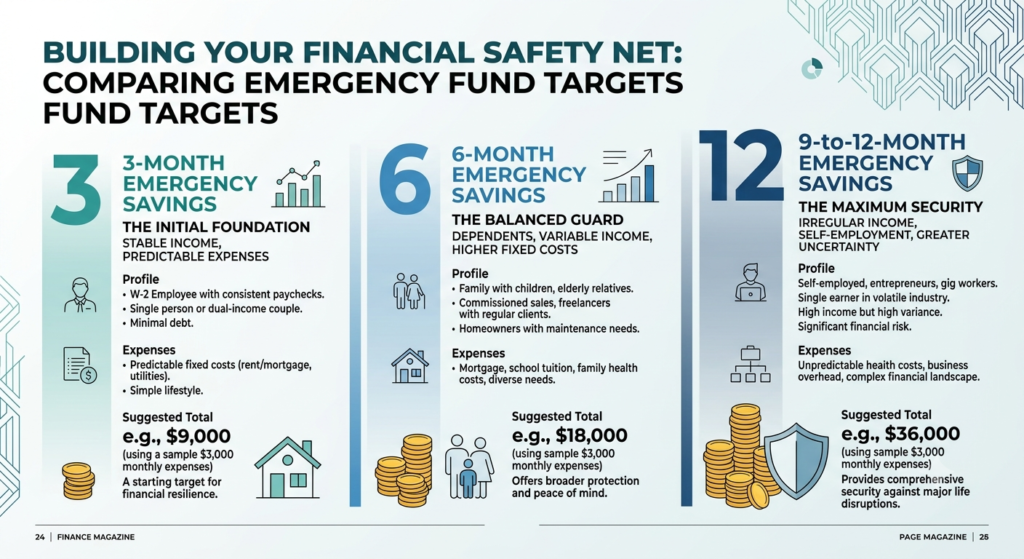
The FDIC says a general recommendation is to keep three to six months of expenses in an emergency savings fund, while noting that the appropriate amount depends on factors such as income, expenses and household circumstances.
That gives us a useful framework, but your circumstances determine where you might fall within it.
Three Months May Be a Useful Target If You Have:
- Stable employment
- Predictable income
- Relatively manageable essential expenses
- Strong job prospects
- Fewer financial dependents
- Other resources available if necessary
Six Months May Make More Sense If You Have:
- Variable income
- Self-employment income
- Commission-based earnings
- A single-income household
- Several dependents
- High fixed expenses
- Less predictable employment
- A potentially long job search
- Limited access to other financial resources
More Than Six Months May Make Sense in Some Situations
Some households may feel more comfortable maintaining a reserve beyond six months.
For example, a self-employed person with irregular income and significant household expenses may have a stronger reason for holding a larger cash reserve than someone with a highly stable paycheck and low fixed costs.
Six months should be treated as a planning benchmark rather than a requirement.
The objective is to have enough accessible money to make a financial shock manageable.
Who May Need a Larger Emergency Fund?
A larger emergency reserve can be particularly useful when your financial situation has more uncertainty.
People With Variable Income
If your income changes significantly from month to month, replacing lost income may be less predictable.
Self-Employed Workers
Business owners and freelancers may not have the same income protections as traditional employees.
A larger reserve can provide additional breathing room during slower periods.
Single-Income Households
If one person’s income supports the entire household, losing that income can create a larger financial shock.
Households With Dependents
Children and other dependents can create expenses that are difficult to reduce quickly.
People With High Fixed Expenses
Large rent or mortgage payments, vehicle payments, insurance costs and other fixed obligations can make a job loss more difficult to absorb.
People With Less Predictable Employment
If your industry has frequent layoffs or long hiring cycles, it may take longer to replace lost income.
People With Limited Backup Resources
Someone who cannot easily access other liquid assets or quickly reduce expenses may benefit from a larger emergency reserve.
These aren’t rules. They are factors that can help you decide how much financial breathing room you want.
Where Should You Keep Your Emergency Savings?
An emergency fund has a different job from long-term investment money.
You generally want emergency savings to be:
- Safe
- Accessible
- Liquid
- Separate enough that you’re not tempted to spend it
- Able to earn a reasonable amount of interest
The CFPB recommends keeping emergency savings somewhere safe and accessible and identifies bank or credit-union accounts as one option.
For many people, a savings account can make sense because the money is designed to be available when an unexpected expense occurs.
What About a High-Yield Savings Account?
For most people, emergency savings should be kept somewhere safe, accessible, and separate enough from everyday spending that you are less likely to use it casually. A traditional FDIC-insured savings account can provide easy access while keeping the money separate from your everyday spending. The FDIC also notes that automatic transfers from checking into savings can help build an emergency fund over time.
However, don’t choose an account based only on the advertised APY.
Also consider:
- Account fees
- Minimum balance requirements
- Withdrawal or transfer rules
- Access speed
- Whether the institution is federally insured
- Any conditions attached to the advertised rate
The purpose of this article is to determine how much you should save. The account-selection question is a separate decision.
Should You Keep Emergency Savings Separate From Other Savings?
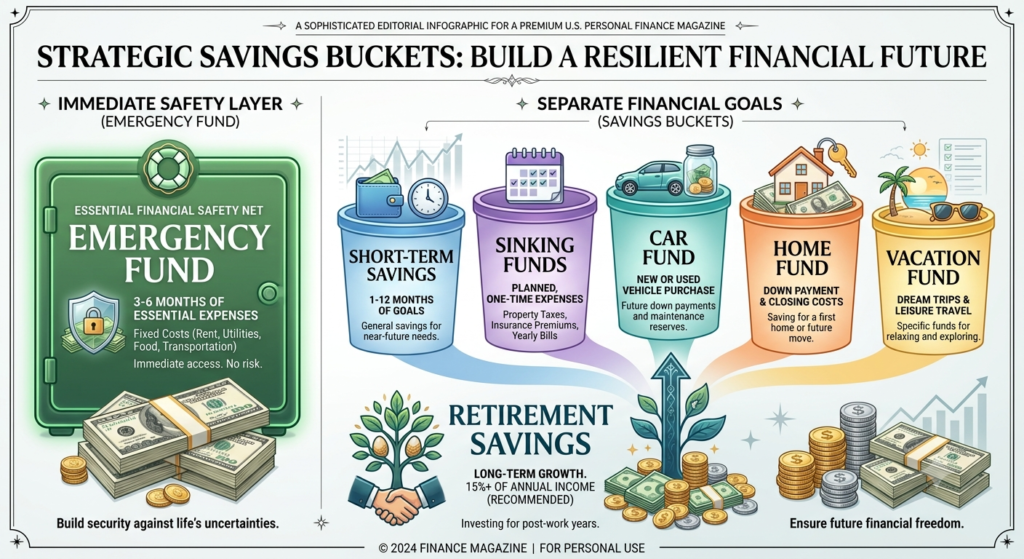
You don’t necessarily need one giant savings balance for every financial goal.
Separating different goals can make your money easier to manage.
| Savings bucket | Purpose |
|---|---|
| Emergency fund | Unexpected financial shocks |
| Car fund | Planned vehicle expenses |
| Home fund | Repairs and maintenance |
| Vacation fund | Planned travel |
| Annual bills fund | Predictable yearly expenses |
| Short-term goal fund | Other planned purchases |
This distinction is important because planned spending isn’t the same as an emergency.
If you have $10,000 saved and $4,000 of that is earmarked for a vacation, you shouldn’t necessarily think of the full $10,000 as emergency savings.
Your true emergency reserve may be closer to $6,000.
Separating savings goals can make that difference obvious.
Savings vs. Investing: How Much Cash Is Enough?
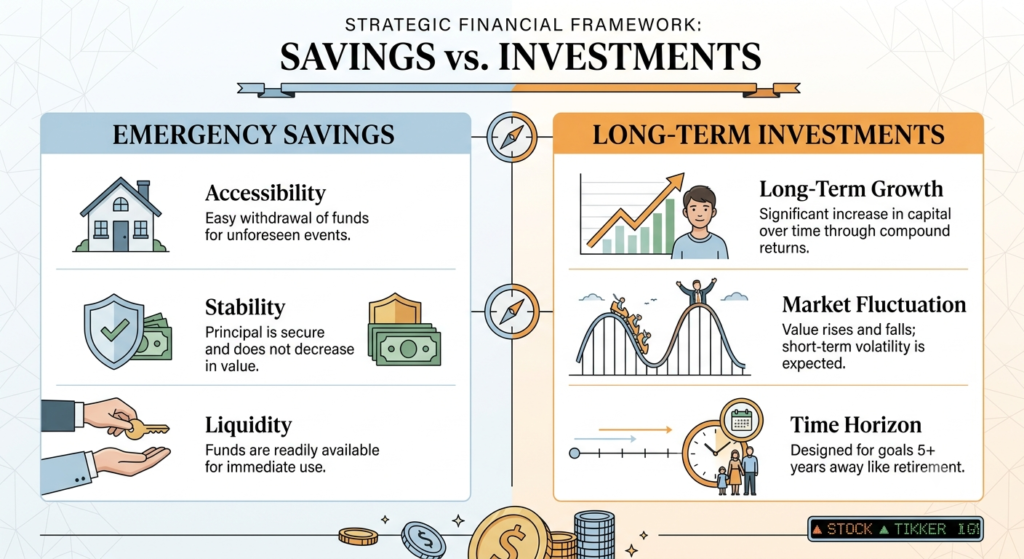
Emergency savings and investments serve different purposes.
Investor.gov similarly explains that savings are generally intended for accessible, lower-risk needs such as emergencies, while investing is designed to pursue longer-term growth and comes with market risk.
If you’re also deciding where your everyday spending money belongs, see our guide to Savings vs. Checking Accounts for a closer look at how the two account types differ and when you may want each one.
Emergency Savings
The priority is generally:
Access + stability + liquidity
You may need the money tomorrow because your car breaks down, you receive an unexpected medical bill or your income suddenly stops.
Long-Term Investments
Long-term investments are designed for a different purpose.
They may have greater potential for growth, but their values can fluctuate, and selling investments during a market decline can create a very different outcome from using cash that was already set aside for emergencies.
That’s why you shouldn’t automatically count your retirement portfolio as equivalent to an emergency savings account.
The Federal Reserve also distinguishes between emergency preparedness and longer-term savings and investing when reporting household financial well-being.
The goal isn’t to keep all of your money in cash.
It’s to give each dollar a job.
How to Build Your Savings When You’re Starting From $0
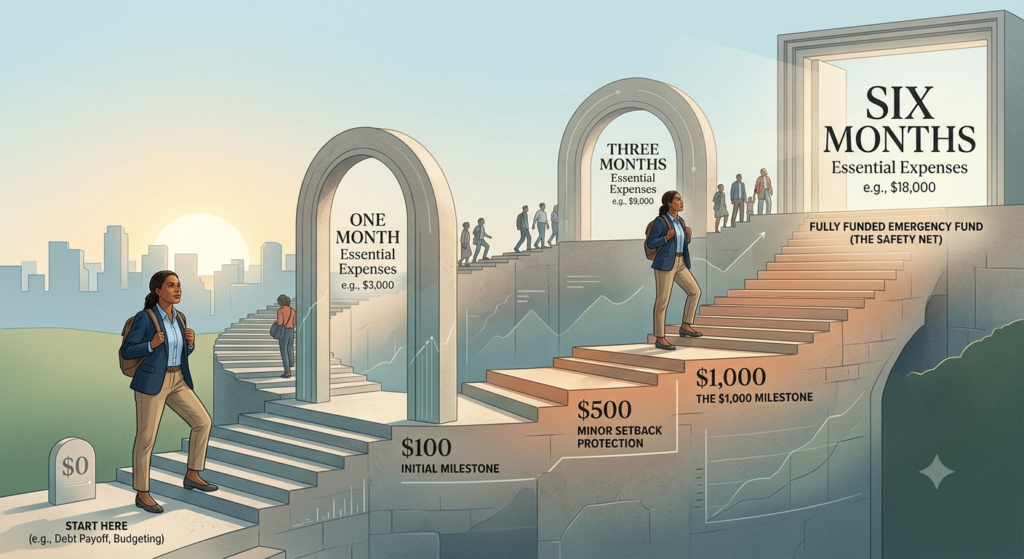
If your current savings balance is $0, don’t make the mistake of thinking your only acceptable target is six months of expenses.
Build progressively.
Stage 1: $0 → $100
Your first objective is simply to create a small cushion.
Even $100 can be useful when an unexpected expense appears.
Stage 2: $100 → $500
Continue building your emergency reserve.
At this stage, consistency matters more than speed.
Stage 3: $500 → $1,000
Now you have a more meaningful starter emergency fund.
It still may not cover several months of expenses, but it gives you a stronger first layer of protection.
Stage 4: $1,000 → One Month of Expenses
If your essential monthly expenses are $3,000, your next target is $3,000.
This gives you a clear number instead of an abstract goal.
Stage 5: One Month → Three Months
Once you’ve reached one month, work toward three months of essential expenses.
At this stage, the account can begin functioning as a stronger financial buffer.
Stage 6: Three Months → Six Months
Finally, decide whether six months is appropriate for your situation.
If your income is stable and your financial risk is relatively low, three months may already provide meaningful protection.
If your income is unpredictable or your household has greater financial obligations, continuing toward six months or more may be worthwhile.
The important thing is to keep progressing.
How to Reach Your Savings Goal Faster
You don’t necessarily need one dramatic change to build savings.
Several small strategies can work together.
Automate Your Savings
Set up an automatic transfer from checking to savings on a schedule that matches your income.
The FDIC notes that automatic transfers can help people build emergency savings and gives the example of saving $20 every two weeks, which would add up to $520 over a year before interest.
One practical way to make this easier is to automate the transfer. The FDIC notes that scheduled transfers from checking into savings can help people build an emergency fund before the money is spent elsewhere.
Split Your Direct Deposit
If your employer allows it, you may be able to send part of your paycheck directly into savings.
This can reduce the temptation to spend money before saving it.
Save Windfalls
Consider directing part of unexpected money toward your savings goal.
Examples include:
- Tax refunds
- Bonuses
- Cash gifts
- Side-income payments
- Certain one-time payments
You don’t have to save every dollar.
Even directing a portion toward your emergency fund can accelerate progress.
Redirect Paid-Off Debt Payments
If you finish paying a loan or other recurring obligation, consider redirecting some or all of that monthly payment into savings.
For example, if you were paying $300 per month toward a debt, continuing to save that amount after the debt is gone can help increase your emergency fund without creating a new budget burden.
Reduce Recurring Expenses
Look for expenses that repeat every month.
Examples might include:
- Unused subscriptions
- Insurance costs that can be reduced
- Unnecessary memberships
- Excessive service plans
- Recurring fees
The goal isn’t to eliminate every enjoyable expense.
It’s to identify expenses that provide little value relative to their cost.
Increase Income Where Possible
Reducing expenses has limits.
Increasing income can create additional room for savings through:
- Overtime
- Freelance work
- Part-time work
- Selling unused items
- Additional services
- Career advancement
Even temporary increases in income can help you reach a savings milestone faster.
How Much Savings Should I Have If I Have Debt?
Having debt doesn’t automatically mean you should have no savings.
A small emergency cushion can help prevent an unexpected expense from immediately going onto a credit card or becoming additional debt.
A practical approach may be to establish an initial emergency cushion first, then balance additional savings with paying down high-interest debt.
For example, someone with $1,000 in emergency savings and expensive credit-card debt may have different priorities from someone with $20,000 in savings and a low-interest mortgage.
The right balance depends on:
- Interest rates
- Minimum payments
- Income stability
- Essential expenses
- Existing emergency savings
- Household responsibilities
- Access to other resources
Avoid treating either “save everything” or “pay off all debt first” as a universal rule.
Common Savings Mistakes to Avoid
1. Using Income Instead of Essential Expenses
Six months of gross income may produce a much larger number than you actually need to maintain your household.
Start with essential expenses.
2. Treating $1,000 as Enough for Everyone
$1,000 can be a useful starting milestone, but its value depends heavily on your monthly expenses.
3. Waiting Until You Can Save a Large Amount
You don’t need thousands of dollars before you start.
The CFPB specifically recognizes that even small amounts can provide some financial security.
4. Counting Investments as Emergency Cash
Long-term investments and emergency savings serve different purposes.
5. Mixing Emergency Savings With Planned Spending
Money set aside for a vacation or vehicle purchase shouldn’t automatically be counted as emergency savings.
6. Chasing the Highest APY Without Checking the Details
A high interest rate is useful, but accessibility, fees, withdrawal rules and account safety matter too.
7. Giving Up Because Six Months Looks Impossible
A six-month target can seem enormous when you’re starting from $0.
Break it into smaller milestones.
Your next target might simply be $100.
Then $500.
Then $1,000.
Then one month of expenses.
Progress matters.
Where Should You Keep a Larger Savings Balance?
Once you’ve built a substantial emergency reserve, it can be worth reviewing whether your savings account is still appropriate for your needs.
A high-yield savings account may be worth considering if you want to keep your emergency money accessible while potentially earning more interest than a basic savings account.
But remember that the goal of an emergency fund is not to maximize investment returns.
Its primary job is to be available when life doesn’t go according to plan.
For a deeper comparison of savings-account options, read our guide to Best High-Yield Savings Accounts.
What Does the Current U.S. Data Say About Emergency Savings?

The need for accessible savings becomes clearer when you look at recent household data.
The Federal Reserve’s 2025 Report on the Economic Well-Being of U.S. Households, released in May 2026, provides several useful measures of Americans’ financial preparedness.
55% Had Three Months of Emergency Savings
In 2025, 55% of adults said they had set aside money to cover three months of expenses in an emergency savings or “rainy day” fund.
That figure is particularly relevant when thinking about the commonly cited three-month emergency-fund benchmark.
It also means that a substantial share of Americans did not report having enough money set aside to cover three months of expenses.
63% Could Handle a $400 Emergency
The Federal Reserve also found that 63% of adults said they could cover a hypothetical $400 emergency using cash, savings or a credit card that they would pay off by the next statement.
That percentage was unchanged from the previous three years.
Lower-Income Households Face Greater Challenges
The same report found a significant difference among lower-income households.
Among adults with annual income below $50,000, about four in ten said they could not cover even a $100 emergency using only their savings.
These numbers don’t tell you how much you personally should have in savings.
They do show why having accessible cash can matter.
An emergency fund isn’t simply a number sitting in an account.
It is a financial buffer between an unexpected event and a potentially expensive form of debt.
Frequently Asked Questions About How Much Money You Should Have in Savings
How much money should I have in savings?
There is no universal amount. A useful starting framework is to calculate your essential monthly expenses and multiply them by the number of months you want your emergency fund to cover. Three to six months of expenses is a common benchmark, but your income stability, household size, fixed expenses and financial situation can change the appropriate target.
Is $1,000 enough for an emergency fund?
$1,000 can be a useful starting emergency-fund milestone, but it may not be enough to cover a significant financial shock. If your essential expenses are $2,000 per month, for example, $1,000 represents only half of one month’s essential costs.
How many months of expenses should I save?
Three to six months of expenses is a commonly cited emergency-savings range. The FDIC notes that the appropriate amount depends on factors including income, expenses and household circumstances.
Should emergency savings be based on income or expenses?
Emergency savings are generally more useful when calculated from essential expenses rather than gross income. Your emergency fund is designed to help cover the costs you still need to pay if your income is interrupted.
How much should I have saved by age 25?
There is no universal emergency-savings target based solely on age. Your essential expenses, income stability, debt, household responsibilities and access to other resources are more useful factors for determining your emergency-fund goal.
How much should I have saved by age 30?
The same principle applies at age 30. Instead of comparing your savings with an arbitrary age-based number, calculate your essential monthly expenses and determine how many months of protection you want.
How much should I have saved by age 40?
There is no universal savings number for everyone at age 40. Your emergency-fund target should reflect your essential expenses, income stability, debt, dependents and other financial responsibilities.
What is the difference between savings and an emergency fund?
Savings can include money for emergencies, planned purchases, vacations, annual bills and other goals. An emergency fund is specifically money reserved for unexpected expenses or a sudden loss of income.
How much savings should I have if I have debt?
You may still benefit from maintaining an emergency cushion while paying down debt. The appropriate balance depends on factors such as your interest rates, income stability, essential expenses and existing savings. High-interest debt may deserve significant attention, but having no emergency savings can leave you vulnerable to taking on additional debt when an unexpected expense occurs.
Where should I keep my emergency fund?
Emergency savings should generally be kept somewhere safe, accessible and liquid. A dedicated bank or credit-union savings account can be one option. The CFPB recommends considering safety and accessibility when choosing where to keep emergency savings.
Is a high-yield savings account good for emergency savings?
A high-yield savings account can be a suitable option for emergency savings if it provides the accessibility, safety and account terms you need. Compare more than the advertised interest rate, including fees, minimums, access and withdrawal rules.
Should I keep emergency savings separate?
Keeping emergency savings separate from money intended for vacations, annual bills or planned purchases can make it easier to know how much you actually have available for a financial emergency.
Should I invest money instead of keeping it in savings?
Emergency savings and investments serve different purposes. Emergency money generally needs accessibility and stability, while long-term investments are intended for longer time horizons and can fluctuate in value. Don’t assume your investment portfolio is equivalent to cash savings.
Bottom Line: How Much Money Should You Have in Savings?
Understanding how much money should I have in savings starts with knowing what you would actually need during a financial emergency.
The right savings number isn’t a magic dollar amount.
For many people, three to six months of essential expenses is a useful emergency-fund target. But your ideal number depends on your own financial situation.
Start by calculating your essential monthly expenses.
Then choose a realistic milestone:
1 month → 3 months → 6 months
If you have variable income, dependents, high fixed expenses or less predictable employment, you may want to build a larger reserve.
If you’re starting from $0, don’t let a six-month target discourage you.
Start with $100.
Then $500.
Then $1,000.
Then one month of essential expenses.
Your savings target should protect your real life, not satisfy an arbitrary number.
The goal isn’t to have the biggest savings balance possible.
The goal is to have enough accessible money that an unexpected expense or temporary loss of income doesn’t immediately turn into a financial crisis.
This article is intended for general educational purposes and is not individualized financial advice.
Sources
- Federal Reserve: 2025 Report on the Economic Well-Being of U.S. Households
- Consumer Financial Protection Bureau: Building an Emergency Fund
- Federal Deposit Insurance Corporation: Consumer guidance on emergency savings





Leave a Reply