

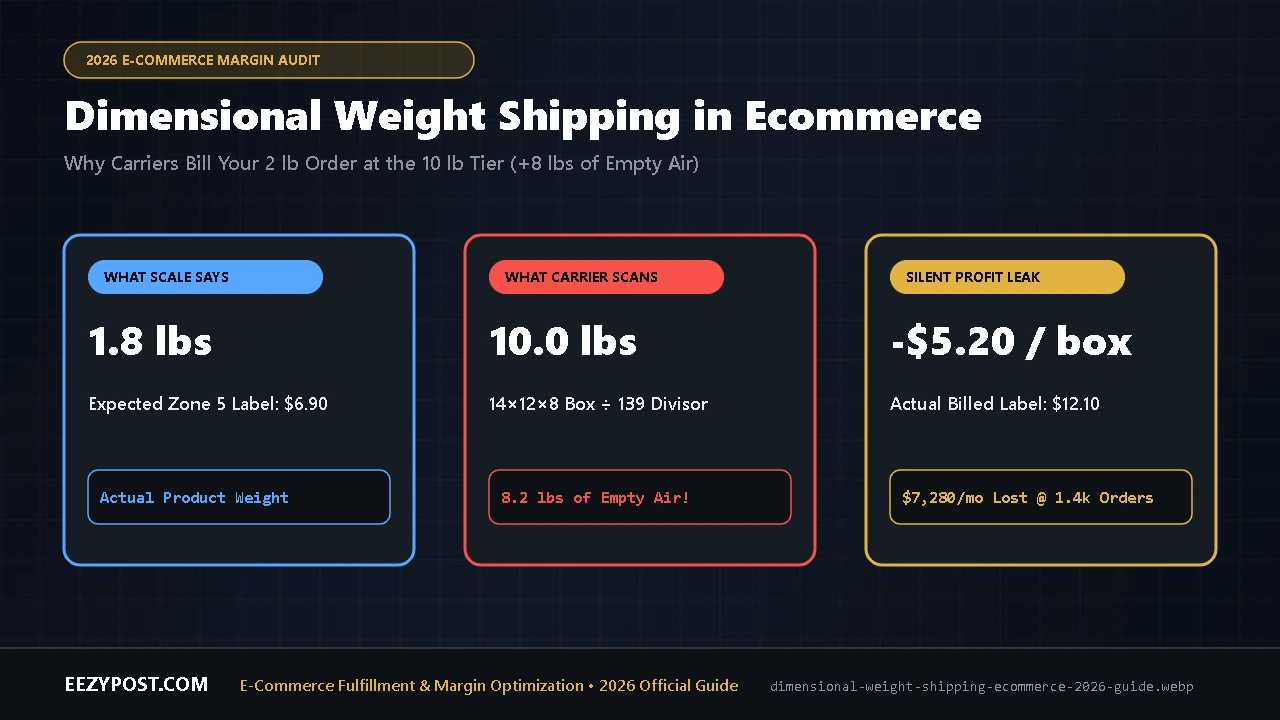
Dimensional weight shipping ecommerce surcharges silently drain 8% to 18% of net profit from growing online stores every single month—charging you for the empty air inside your corrugated boxes rather than what your product actually weighs on a scale. If you have ever celebrated a 3.5x ROAS inside Meta Ads Manager only to stare at a nearly flat bank balance after paying your monthly warehouse bill, dimensional weight shipping ecommerce pricing is almost always the culprit.
Last quarter, while auditing fulfillment invoices for a mid-sized home-goods store shipping 1,400 orders a month, I spotted a brutal billing discrepancy. Their hero product weighed just 1.8 pounds on a postal scale. The founder priced his free-shipping threshold assuming a $6.90 Zone 5 parcel rate. Instead, his third-party logistics (3PL) provider was billing him $12.10 per order—wiping out $7,280 every month because a generic 8-inch-tall stock carton pushed every package into the 10-pound billing tier.
Understanding dimensional weight shipping ecommerce math, renegotiating carrier divisors, and auditing sneaky warehouse surcharges is the fastest way to add pure net profit back to your bottom line without spending an extra dollar on ads.
How Dimensional Weight Shipping Ecommerce Rules Actually Work in 2026
Carriers like UPS, FedEx, DHL, and USPS run out of truck and cargo-plane cube space long before they hit their legal weight limits. To stop merchants from filling trailers with giant boxes of lightweight pillows, supplements, or apparel, carriers bill you on whichever number is higher: Actual Scale Weight or Dimensional (DIM) Weight.
In 2026, dimensional weight shipping ecommerce enforcement has become strictly automated. Laser tunnel scanners at carrier sortation hubs measure every parcel down to a fraction of an inch—including crushed corners, bulging tape seams, or loose poly-bag flaps. Even a 0.2-inch bulge on the side of a carton rounds up to the next full inch under modern carrier tariffs, triggering an automatic post-shipment billing adjustment on your invoice two weeks later.
The DIM Weight Divisor 139 Formula (And How 1 Inch Costs You $4.20)

Every major private parcel carrier uses a standard commercial calculation anchored by the dim weight divisor 139 (while retail counter rates can punish shippers with a divisor as low as 139 to 166 depending on service class, as documented in official carrier tariffs and the USPS Postal Explorer Domestic Mail Manual).
The exact formula is:
$$\text{DIM Weight (lbs)} = \left\lceil \frac{\text{Length (in)} \times \text{Width (in)} \times \text{Height (in)}}{139} \right\rceil$$
Look at what happens under the dim weight divisor 139 rule when an operator ships a 1.8 lb hoodie or kitchen gadget inside a standard 14" × 12" × 8" warehouse stock box:
- Multiply Cubic Volume: $14 \times 12 \times 8 = 1,344\text{ cubic inches}$.
- Apply the Divisor: $1,344 \div 139 = 9.67\text{ lbs}$.
- Carrier Rounding Rule: Every fraction rounds up to the next whole pound, turning a 1.8 lb item into a 10 lb billable shipment.
Now watch what happens if you trim just 4 inches of empty vertical air by switching to a 14" × 12" × 4" multi-depth scored box:
- $14 \times 12 \times 4 = 672\text{ cubic inches} \div 139 = 4.83 \rightarrow$ 5 lbs billable weight.
- Cutting four inches of cardboard air saves $3.40 to $5.20 on every single label—before you even renegotiate a single carrier contract.
5 Brutal 3PL Hidden Fees Small Business Owners Miss on Monthly Invoices
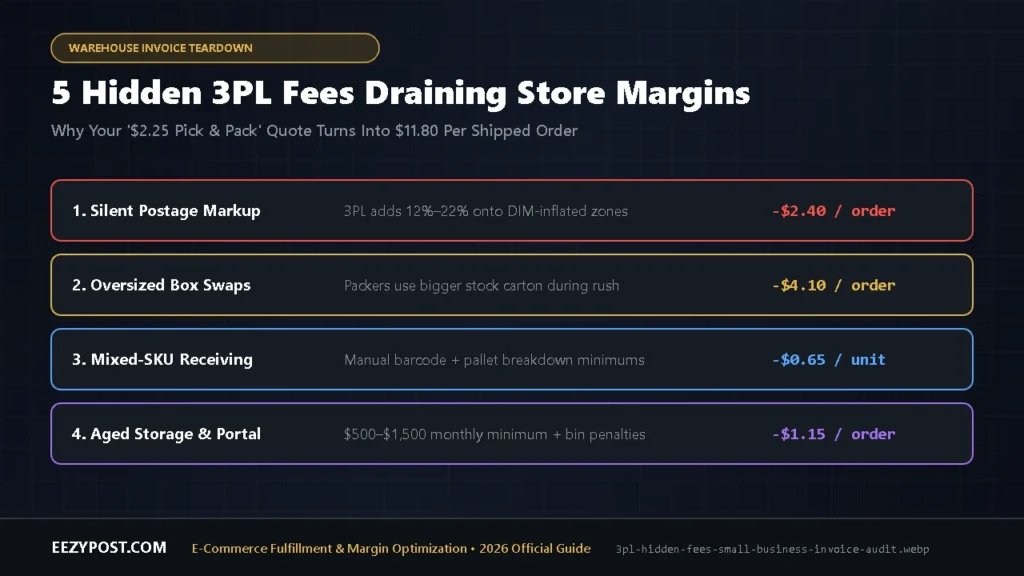
When founders outsource fulfillment, they usually obsess over the advertised $2.25 pick-and-pack fee. Yet that headline number rarely represents more than 25% of your total warehouse bill. Uncovering 3pl hidden fees small business brands overlook is critical before Q4 peak surcharges compound your losses.
| Fee Category | Advertised Quote | Real Invoice Reality (The Hidden Markup) | Profit Impact per Order |
| 1. Carrier Postage Markup | “Discounted Commercial Rates” | 3PLs buy wholesale postage and silently add a 12% to 22% margin on top of DIM-inflated zones. | -$1.40 to -$3.10 |
| 2. Stock Box Selection Mismatch | “$0.65 – $1.40 Packaging Fee” | Pickers grab the nearest oversized carton during rush hours, spiking dimensional weight shipping ecommerce tiers. | -$2.80 to -$5.50 |
| 3. Inbound Receiving & Pallet Breakdown | “$35/hr Dock Labor” | Mixed-SKU cartons trigger manual barcode-labeling penalties ($0.35/unit) + slow dock turnaround minimums. | -$0.40 to -$0.85 |
| 4. Long-Term & Bin Minimum Storage | “$25/pallet/month” | Charging full pallet rates for 10 remaining slow-moving units + 90-day aged inventory double-rates. | -$0.30 to -$1.10 |
| 5. Account Management & Minimum Spend | “No Setup Fee” | $500–$1,500 monthly order minimums + $150/mo portal fees + $3.50 return restocking fees. | -$0.50 to -$2.00 |
The nastiest trap among 3pl hidden fees small business operators face is incentive misalignment on box selection. If a warehouse runs out of 10" × 8" × 4" cartons on a Tuesday afternoon, the floor packer puts your item into a 14" × 12" × 8" carton so they hit their hourly pick quota. If your 3PL marks up postage by 15%, the warehouse actually makes more profit when they ship your product in an oversized box. Always insert a “Box Dimension Cap Clause” in your 3PL service-level agreement (SLA) requiring the 3PL to reimburse DIM overages caused by out-of-stock standard cartons.
The Split Shipment Cost Ecommerce Brands Ignore When Scaling Inventory
Many 3PLs pitch multi-warehouse distribution (“Put inventory in New Jersey, Texas, and California to hit 2-day ground shipping and lower shipping zones!”). On a pitch deck, going from Zone 7 down to Zone 3 sounds like an instant win.
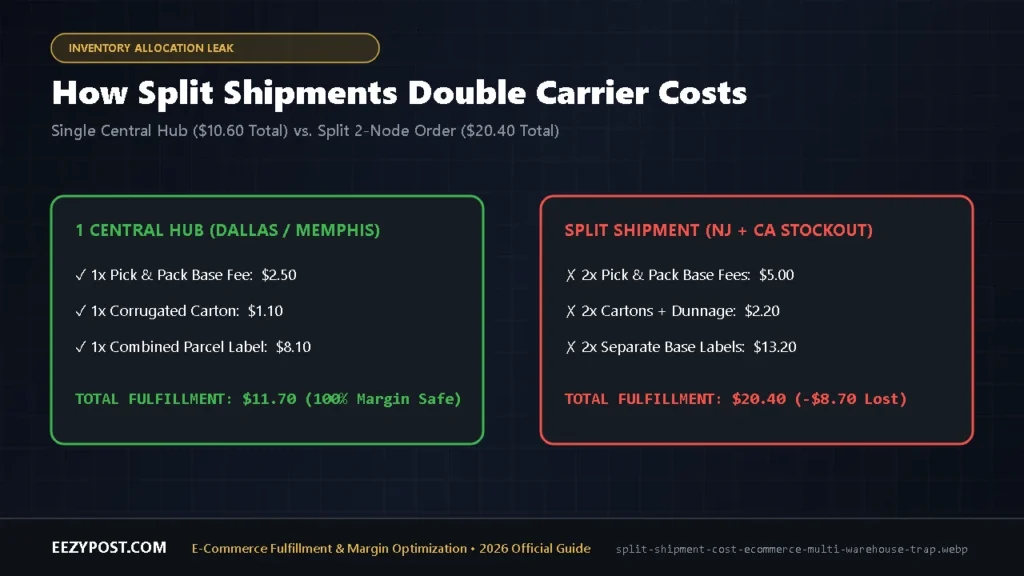
In practice, multi-node inventory creates the split shipment cost ecommerce founders rarely model until their margins evaporate.
Suppose your store has an Average Order Value (AOV) of $78 with 2.4 items per cart. When a customer buys Bundle SKU A and Accessory SKU B—and your East Coast warehouse runs out of SKU B—your order management system splits the single checkout into two separate shipments from two different states:
- You pay two pick-and-pack base fees ($2.50 $\times$ 2 = $5.00).
- You pay two corrugated box fees ($1.10 $\times$ 2 = $2.20).
- You pay two base parcel minimums ($6.80 + $6.40 = $13.20 instead of one $8.10 combined box).
A 15% split-shipment rate across 2,000 monthly orders adds 300 duplicate shipments, torching over $2,400/month in pure friction. Unless you are shipping more than 3,500 orders per month with disciplined SKU forecasting, consolidating inventory in a single central hub (such as Dallas, Memphis, or Columbus) almost always beats multi-node splitting on net margin.
4 Operational Fixes to Reduce Ecommerce Fulfillment Costs Immediately
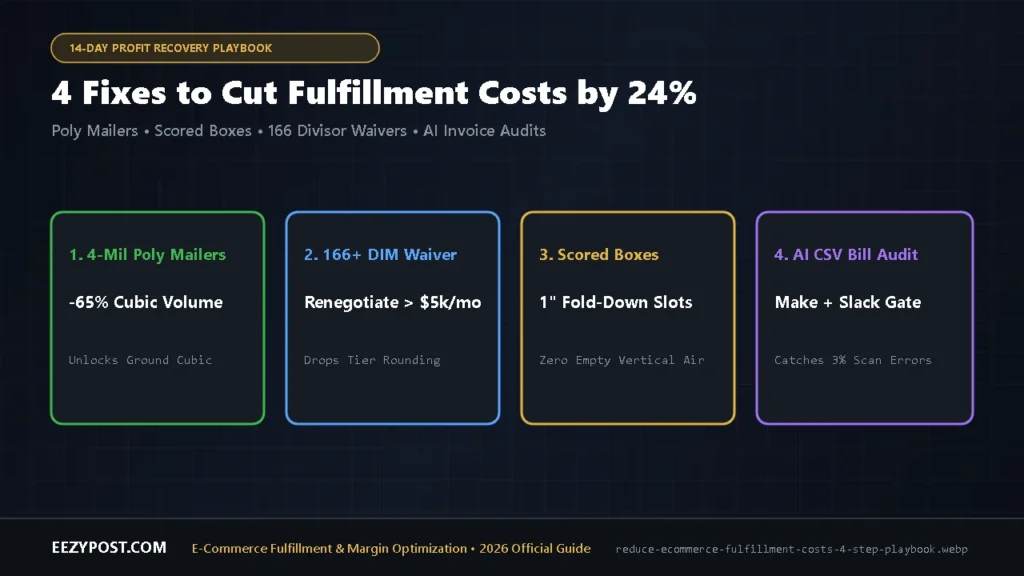
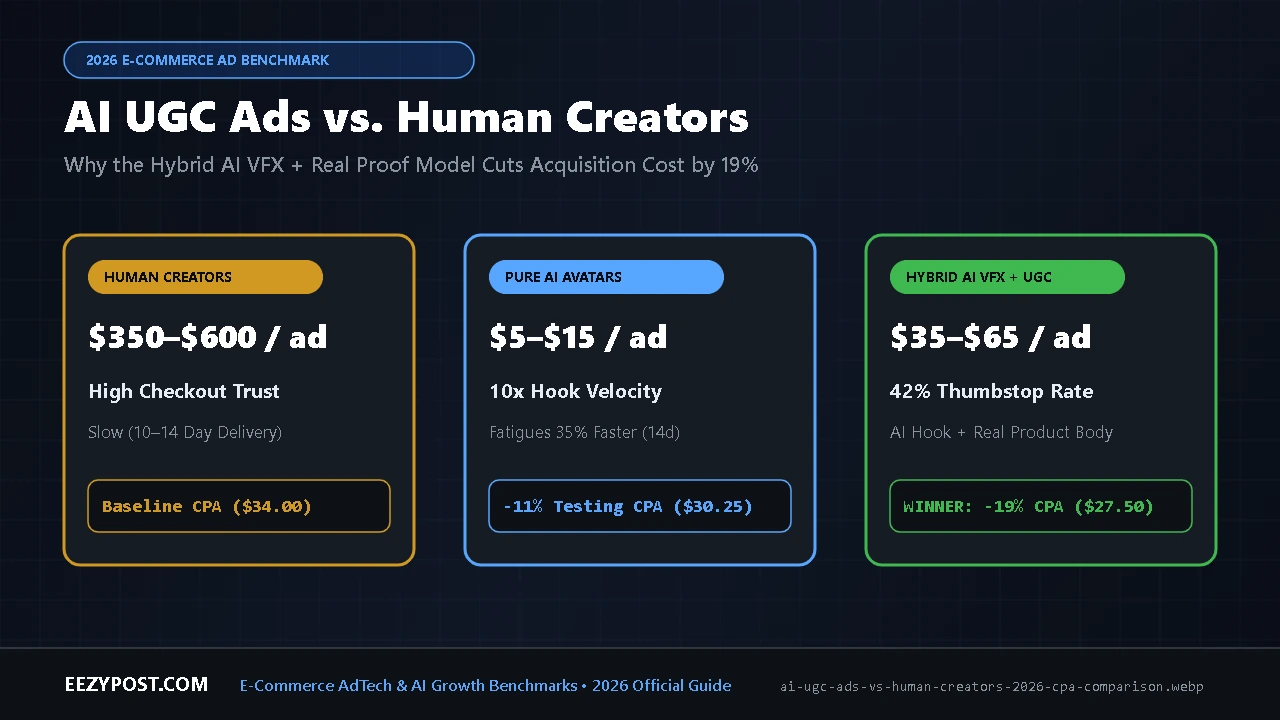
Spend 30% less energy obsessing over minor ad bid tweaks—because even cutting your Meta and TikTok CPA by 19% with hybrid AI UGC ads won’t save a store that leaks $5.00 per box on the loading dock. Here are four high-leverage moves to reduce ecommerce fulfillment costs within 14 days:
1. Audit Your Top 5 SKUs Against Cubic & Poly-Mailer Thresholds
Take your five highest-volume single-item orders and test whether they survive a 4-foot drop test inside a padded bubble mailer or heavy-duty 4-mil poly bag. Poly mailers collapse tightly around soft goods, supplements, and boxed cosmetics, slashing cubic volume by up to 65% and unlocking USPS Ground Advantage Cubic or sub-pound tiers that bypass punitive dimensional weight shipping ecommerce surcharges completely.
2. Negotiate a Custom DIM Divisor Waiver (166 or 194)
Never accept the default dim weight divisor 139 once your brand exceeds $5,000 a month in parcel spend. Ask your carrier rep or 3PL account manager for a 166 or 194 DIM divisor modification (or a cubic-inch threshold exemption on packages under 1,728 cubic inches). Moving from a 139 divisor to a 166 divisor on a 14" × 12" × 8" carton immediately drops billable weight from 10 lbs down to 9 lbs across every order.
Dimensional Weight & 3PL Margin Leak Calculator
Enter your current box dimensions, scale weight, and monthly order volume to uncover how much profit you are losing to “billed air” DIM penalties and split shipments.
Immediate Fix Required: Your 1,344 cu. in. carton forces carriers to bill a 2 lb item at the 10 lb rate. Trimming box height by 3 inches (or switching to a padded mailer) + eliminating split shipments recovers $2,910/month in pure net margin.
3. Deploy Multi-Depth Scored Cartons & Right-Sized Dunnage
Replace fixed-height cartons with multi-depth boxes pre-scored at 1-inch intervals (8", 6", and 4"). Warehouse packers make four quick corner slits and fold the flaps down flush with the product, eliminating both kraft-paper dunnage waste and empty vertical air.
4. Automate Weekly 3PL & Carrier Invoice Auditing with AI
Roughly 2% to 4% of carrier and 3PL line items contain billing errors: duplicate tracking charges, false residential reclassifications, or incorrect laser-scanner dimension spikes caused by a loose piece of tape. Instead of hiring a traditional audit firm that takes 50% of your refunds, use AI tools for small business to audit your weekly CSV billing exports automatically.
You can wire up a simple CSV parser using Gumloop vs. Make AI workflows that compares every billed parcel’s Billed_Dimensions against your master SKU Expected_Box_Dimensions. Whenever a 3PL bills a 2 lb SKU at 9 lbs, trigger one of our human in the loop AI workflows to send a pre-drafted dispute claim to your Slack channel for 1-click sign-off before emailing your 3PL account rep.
Frequently Asked Questions (AEO Quick Answers)
How do I calculate dimensional weight shipping ecommerce charges?
To calculate dimensional weight shipping ecommerce charges, multiply your package’s Length × Width × Height (in inches, rounding any fraction up to the nearest whole inch) and divide the total cubic inches by your carrier’s DIM divisor—typically 139 for commercial UPS and FedEx shipments. Always round the final result up to the next full pound and compare it against your actual scale weight; carriers bill whichever number is higher.
What are the most common 3PL hidden fees small business brands pay?
The biggest 3pl hidden fees small business stores pay include 12% to 22% silent markups on carrier postage, oversized box substitution errors that inflate dimensional weight, inbound mixed-SKU receiving penalties, monthly minimum billing thresholds ($500 to $1,500), and multi-warehouse inventory transfers that trigger duplicate split-shipment labels.
What is the fastest way to reduce ecommerce fulfillment costs without slowing delivery?
The fastest way to reduce ecommerce fulfillment costs without downgrading delivery speed is migrating non-fragile products under 20 lbs from rigid corrugated boxes into tear-proof poly or padded mailers, switching remaining cartons to multi-depth scored boxes, consolidating split inventory into one central US hub until you pass 3,500 monthly orders, and negotiating a 166+ DIM divisor once monthly shipping spend tops $5,000.




Leave a Reply