

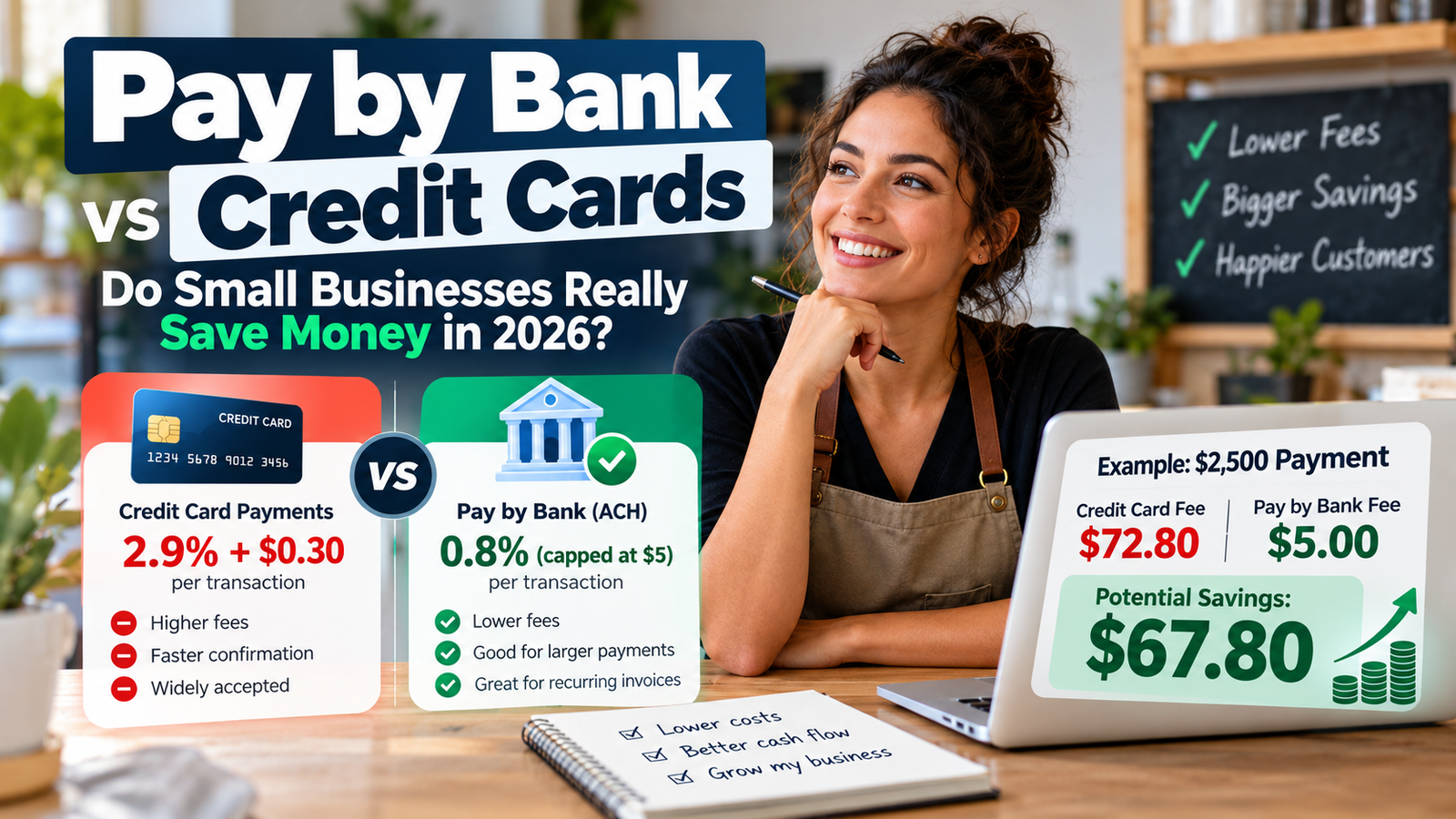
A $2,500 customer payment sounds like good news for a small business. Then the processing fee arrives.
If that customer pays with a credit card, the business might lose more than $70 before the money reaches its account.
What if the same transaction could cost just $5 to process?
That’s the appeal of pay by bank, a payment option that lets customers pay directly from their bank accounts instead of using traditional card networks.
For American small businesses already dealing with rising operating costs, lower payment fees sound attractive. But the cheapest way to collect money isn’t always the best way to keep it.
Bank payments can take longer to clear. Customers may hesitate to connect their accounts. And a payment that initially appears successful can sometimes be returned.
So before changing your checkout, it’s worth understanding what the numbers actually mean.
What Is Pay by Bank, and How Does It Work?
Pay by bank is a payment method that allows customers to transfer money directly from their bank accounts to a business, without routing the transaction through a traditional credit card network.
Depending on the provider, payments may use the Automated Clearing House (ACH) network or an instant payment system.
A typical online transaction works like this:
- The customer selects a bank payment option during checkout.
- They choose or connect their financial institution through an approved payment service.
- The customer reviews the payment amount and authorizes the transfer.
- The provider processes the transaction and reports its status to the merchant.
- The business receives the funds according to the provider’s settlement schedule.
The experience varies by provider. Some services offer rapid confirmation, while ordinary ACH debits can take several business days to confirm and settle.
For a customer, the attraction may be convenience. For a merchant, the larger selling point is potentially lower payment processing costs.
The Federal Reserve Bank of Kansas City’s July 2026 research identifies account-to-account payments as an emerging alternative to cards.
It also makes an important distinction: bank-based payments are gaining traction online in the United States, but dedicated pay-by-bank transactions at physical retail checkouts were not yet established in the U.S. market when the research was published.
In other words, this isn’t a payment revolution that has already replaced your local coffee shop’s card terminal.
It’s a developing option that makes more sense for some business models than others.
Pay by Bank vs Credit Cards: How Much Can a Small Business Save?
Processing fees are where the comparison becomes interesting.
As of October 2026, Stripe’s published standard U.S. pricing includes:
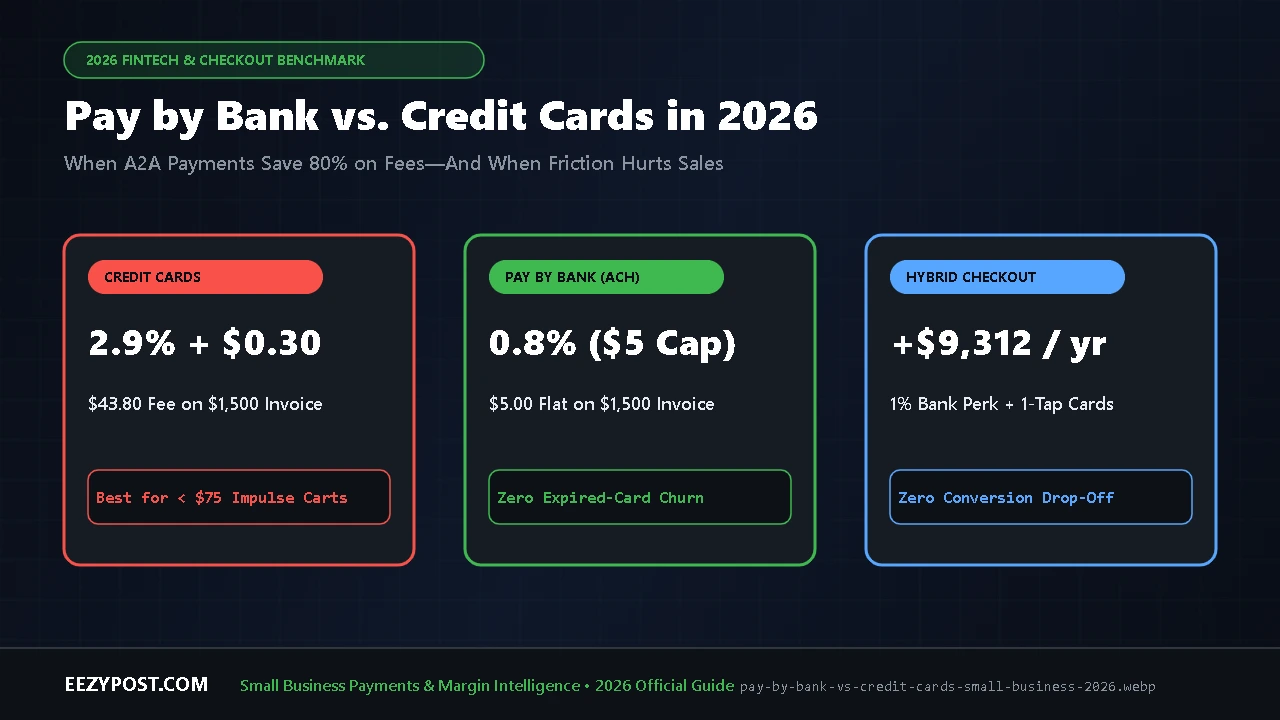
- Domestic online card payments: 2.9% plus $0.30 per successful transaction.
- Standard ACH Direct Debit: 0.8% per successful payment, capped at $5.
These are different payment products with different settlement and risk characteristics. They are being used here to illustrate the fee difference, not to suggest every provider offers the same pricing.
Source: Stripe’s official pricing information.
The Real Cost of a $2,500 Customer Payment
Consider a small marketing agency that invoices a customer $2,500.
With standard domestic card pricing:
$2,500 × 2.9% + $0.30 = $72.80
With Stripe’s standard ACH Direct Debit pricing:
0.8% would equal $20, but the published $5 cap applies.
That creates an illustrative fee difference of $67.80 on one payment.
The larger the payment, the more valuable a capped bank-processing fee can become.
EEZYPOST Payment Fee Comparison
| Customer payment | Card fee | Standard ACH fee | Potential savings |
|---|---|---|---|
| $100 | $3.20 | $0.80 | $2.40 |
| $500 | $14.80 | $4.00 | $10.80 |
| $1,000 | $29.30 | $5.00 | $24.30 |
| $2,500 | $72.80 | $5.00 | $67.80 |
| $5,000 | $145.30 | $5.00 | $140.30 |
EEZYPOST calculation using Stripe’s published standard U.S. domestic online card rate and standard ACH Direct Debit rate, checked October 17, 2026. The estimates exclude additional verification charges, disputes, returns, optional services and other fees. They are not quotes for every bank payment product.

These savings are meaningful, but they aren’t automatic.
If customers abandon checkout because they don’t want to connect a bank account, the lost sales could outweigh the processing savings.
A business collecting occasional $20 payments faces a different decision from one collecting regular $2,500 invoices.
The Hidden Catch: Not Every Bank Payment Has the Same Fee
A common mistake is treating ACH transfers, instant bank payments and newer account-to-account checkout services as interchangeable.
They aren’t.
For example, Stripe lists a separate Instant Bank Payments product at 2.6% plus $0.30 per transaction, compared with its lower-cost standard ACH Direct Debit product.
On a $1,000 payment, the published base processing fee for that instant option would be $26.30, before any other applicable charges.
That is only $3 less than the $29.30 standard domestic card fee in our example.
The service may offer faster payment confirmation, which can be valuable. But merchants shouldn’t assume that every button labeled as a bank payment delivers the same fee reduction.
According to Stripe’s U.S. bank payment documentation, standard ACH and instant bank payments differ in confirmation time, settlement timing and pricing.
Before accepting a provider’s advertised savings, ask what you’re actually buying.
Are you paying for standard ACH processing, faster confirmation, faster settlement or a product with additional payment guarantees?
The answer changes the economics.
Why Small Businesses Are Looking Beyond Credit Cards in 2026
Payment processing isn’t a minor administrative detail when profit margins are thin.
A contractor purchasing materials, a consultant managing software expenses or a retailer paying employees all depend on the money left after business costs.
Recent Federal Reserve research provides useful context.
In September 2026, the Federal Reserve Bank of Cleveland reported that U.S. business-to-business ACH payment volumes more than doubled between 2015 and 2024, rising from approximately 3.6 billion to 8.7 billion transactions.
That doesn’t mean small businesses suddenly stopped using cards. It shows how electronic bank-based payments have become increasingly important in business transactions.
Source: Federal Reserve Bank of Cleveland, B2B Payments Research Brief, September 2026.
There are several practical reasons businesses may prefer bank-based payments.
Larger Invoices Make Card Fees More Noticeable
Consider a freelance software developer billing a client $4,000 for a completed project.
The customer may not care whether the payment travels through a credit card network or an ACH system.
The developer certainly notices the difference between a large percentage-based processing fee and a capped alternative.
Provided the client is comfortable with the process, bank payment acceptance may be worth offering.
Recurring Payments Create Repeated Processing Costs
Subscription businesses, consultants on monthly retainers and service providers with recurring invoices all face the same problem.
A small fee paid repeatedly becomes a substantial annual expense.
Bank payments may also avoid some issues associated with expired or replaced credit cards.
They introduce different risks, including insufficient funds, revoked authorizations and returned transfers.
The decision is about managing the entire payment lifecycle, not just selecting the lowest advertised rate.
Business Customers May Already Be Comfortable With ACH
Many U.S. companies already use bank transfers for payroll, supplier payments and recurring obligations.
That familiarity can make ACH a natural option for business-to-business invoicing.
Retail consumers may behave differently.
Someone purchasing a $35 item from an unfamiliar online store may prefer a saved credit card rather than connecting a checking account for the first time.
Businesses should account for that difference instead of assuming every customer will embrace the same payment method.
ACH vs Credit Card Payments: Which Is Better for Your Business?
Neither payment method wins in every situation.
| Business situation | More practical starting option | Why |
|---|---|---|
| Large client invoices | ACH or bank payment | Potentially lower fees |
| First-time online customers | Credit cards | Familiar, convenient checkout |
| Monthly service retainers | ACH worth testing | Repeated payments can increase potential savings |
| Time-sensitive orders | Card or instant-confirmation method | Faster confirmation |
| International shoppers | Cards or supported international methods | Domestic U.S. ACH has limited applicability |
| Customers reluctant to link banks | Cards | Lower checkout friction |
| High-value B2B transactions | Compare ACH, wire and card | Costs and settlement needs vary |
The practical answer: Offer bank payments where the economics justify them, but don’t remove cards simply because their published fees are higher.
A payment method that saves $20 but causes a $1,000 order to disappear isn’t saving your business anything.
Can Pay by Bank Payments Be Reversed?
Yes, some can.
This is one of the most important details merchants should understand.
ACH transactions have return and dispute processes. The applicable rules depend on the payment type, account type, reason for the return and provider.
For example, a debit might be returned because the customer’s account lacks sufficient funds, the account information is incorrect or the customer disputes authorization.
The mechanics are different from traditional credit card chargebacks, but the financial risk doesn’t disappear.
Adyen’s U.S. pay-by-bank documentation specifically addresses ACH returns and explains that account validation and risk checks can reduce, but not eliminate, return risk.
For merchants, this means three things:
- A successful authorization isn’t always the same as final settlement.
- A payment processor’s protection or guarantee should be evaluated separately from its standard processing fee.
- Refunds, returned debits and customer disputes need clear handling procedures.
A contractor ordering expensive materials should understand whether a customer’s bank payment is still pending before treating it as fully collected.
The same applies to businesses shipping high-value products.
Does Pay by Bank Offer the Same Protection as Credit Cards?
Not necessarily.
Consumers may have protections under federal electronic fund transfer rules when an unauthorized transfer occurs.
However, those protections shouldn’t be confused with the purchase-dispute processes associated with credit cards.
An unauthorized bank transfer and a customer unhappy with a product are not automatically the same legal issue.
The Consumer Financial Protection Bureau explains consumer rights and financial institution responsibilities involving unauthorized electronic transfers.
Businesses must also consider how customers will perceive the difference.
For example, a buyer purchasing an expensive item from an unfamiliar merchant may value the dispute process offered by their credit card.
That preference may matter more to the buyer than the merchant’s processing costs.
A responsible payment strategy recognizes both sides.
The EEZYPOST Bank Payment Break-Even Test
Before changing payment methods, a small business can perform a simple calculation.
The goal isn’t to estimate the maximum possible savings. It’s to determine how much money the business could reasonably keep.

Step 1: Identify Your Average Payment
Review recent transactions and separate them into practical groups:
- Small retail purchases
- Large invoices
- Recurring subscriptions
- Business-to-business payments
Don’t calculate one average across transactions that behave very differently.
Step 2: Compare Your Actual Processing Rates
Use your merchant statements, not just a provider’s headline price.
Calculate:
Card processing cost minus bank processing cost = gross savings per converted payment
Then account for additional costs.
Step 3: Estimate How Many Customers Would Actually Switch
Suppose a small agency receives ten domestic $1,000 invoices each month.
Using the earlier illustrative Stripe rates:
- Total monthly card processing fees: $293
- Total monthly standard ACH processing fees: $50
- Potential monthly difference: $243
Across twelve months, that creates a hypothetical $2,916 annual fee difference.
But only if all ten transactions successfully move to the lower-cost payment method, and before additional costs.
If just five customers switch, the starting gross savings would be half as much.
The real result also depends on verification charges, returns, settlement timing and any lost sales.
Step 4: Include the Cost of Payment Problems
A useful decision formula is:
Net payment benefit = processing fee savings − additional payment costs − estimated costs from failed payments or lost sales
Consider how often a transfer might fail, how much staff time it takes to resolve, and whether slower access to funds affects operations.
These costs matter even when they don’t appear in the processor’s headline percentage.
Step 5: Test Without Removing Existing Payment Options
Start with a small group of appropriate transactions.
For example, offer ACH to established customers with larger recurring invoices.
Measure the results before rolling it out more widely.
This approach gives the business actual evidence rather than relying on promotional claims.
What Types of Small Businesses Should Consider Pay by Bank?
Some companies are better candidates than others.
Professional service providers: Accountants, marketing agencies, designers and consultants often collect relatively large invoices. Lower-cost bank debits may improve retained revenue.
Contractors and home service businesses: Larger project payments can make card fees expensive. However, payment confirmation and return exposure need particular attention before materials are purchased or work is finalized.
Subscription-based companies: Regular billing can create cumulative processing savings, although failed debits still need an effective recovery process.
Online retailers: Bank payments may be useful for repeat customers, but checkout abandonment should be monitored closely.
New businesses: Before selecting a payment processor, consider the broader financial responsibilities involved in starting and running a business. Low transaction fees matter, but so do customer experience, cash flow and reliable bookkeeping.
The best candidate isn’t necessarily the company processing the most transactions.
It’s the company whose customers can use bank payments comfortably, whose invoices justify the fee difference, and whose operations can manage the settlement risks.
Five Questions to Ask Before Choosing a Pay by Bank Provider
A provider comparison should go beyond the advertised percentage.
1. What is the full processing cost?
Ask about transaction fees, minimums, caps, monthly platform costs, bank verification and failed-payment charges.
2. When is the money actually available?
Payment confirmation and settlement are different events. A customer approving a debit doesn’t automatically mean the merchant has immediate access to the funds.
3. Who is responsible for returned or disputed payments?
Find out whether the provider offers protection and what exclusions apply.
4. How difficult is the checkout experience?
Test the process on a phone, not just a desktop computer. Check the steps required for a first-time customer and for a returning buyer.
5. Does the payment system connect to your accounting and invoicing software?
Lower fees won’t help as much if every payment requires manual reconciliation.
For many small businesses, the simplest integration will be more valuable than a tiny difference in the processing rate.
How to Introduce Bank Payments Without Losing Customers
Don’t force every buyer into an unfamiliar payment method.
A better starting approach is to explain the option clearly and keep a familiar alternative available.
For example, an invoice might offer:
“Pay securely by bank account or credit card.”

That’s enough to introduce the choice without overwhelming the customer with technical terms.
Businesses can also test bank payments with existing clients first, because those customers already have a relationship with the company.
During the trial, track:
- How many customers select bank payments
- How many complete the process
- How many payments are returned
- Average settlement times
- Total payment processing costs
- Customer questions or complaints
A processing fee report alone doesn’t tell the whole story.
The business should measure whether it collected the same revenue at a lower overall cost.
Frequently Asked Questions
Is Pay by Bank Cheaper Than Credit Cards?
It can be, especially for large transactions processed through low-cost ACH products. However, some instant bank payment services charge fees much closer to standard card rates. Compare the specific products and additional charges before deciding.
How Does Pay by Bank Work for Small Businesses?
Customers authorize a payment from their bank accounts through a participating provider. The provider processes the transfer, verifies its status and settles funds according to the applicable payment network and service terms.
What Does Pay by Bank Purchase Mean on a Bank Statement?
It generally indicates a purchase funded directly from a bank account through a bank-based payment service, rather than a conventional card transaction. Statement descriptions vary by bank and provider. If the payment is unfamiliar, review the transaction details and contact your financial institution.
Is ACH Better Than Credit Cards for Business Payments?
ACH can be attractive for recurring payments and larger domestic invoices because processing fees may be lower. Credit cards often provide more familiar checkout experiences and faster authorization. The best method depends on customer preferences, costs, risk and settlement requirements.
Can a Small Business Accept Both ACH and Credit Cards?
Yes. Many payment providers support more than one payment method. Offering both can give customers flexibility while allowing merchants to evaluate where lower-cost bank payments make financial sense.
Is Pay by Bank Instant?
Not always. Standard ACH debits can take several business days to confirm and settle. Some newer bank payment products offer instant confirmation, but that does not necessarily mean funds become immediately available to the merchant.
Should Every Online Store Offer Pay by Bank in 2026?
No. It is worth evaluating, particularly for high-value and recurring transactions. Businesses with mostly low-value, one-time purchases should examine customer demand and checkout conversion before adding another payment option.
Final Verdict: Lower Fees Matter, but Successful Payments Matter More
Pay by bank deserves attention from American small business owners in 2026.
The potential savings are real in the right circumstances. A business collecting thousands of dollars through recurring invoices could retain substantially more revenue by moving suitable transactions to a lower-cost bank payment option.
But payment acceptance isn’t simply about finding the cheapest transaction.
Customers need to trust the process. Business owners need to know when funds are available. And both sides need to understand what happens if something goes wrong.
For most small businesses, the practical next step isn’t abandoning credit cards.
It’s checking whether bank payments can handle a meaningful portion of existing transactions at a lower total cost.
Start with the numbers. Test with real customers. Keep the payment methods that work.
Because the best payment system isn’t the one with the lowest advertised fee. It’s the one that helps your business collect more of what it earns.
EEZYPOST Research Note: This guide was prepared using payment research published by the Federal Reserve Banks of Kansas City and Cleveland, publicly available payment-provider documentation, and illustrative calculations based on Stripe’s published U.S. pricing checked October 17, 2026. EEZYPOST has not independently tested the payment services discussed. Actual fees, eligibility, settlement times and consumer protections can vary.
Disclaimer: This article provides general business and payment information, not individualized financial or legal advice.





Leave a Reply