

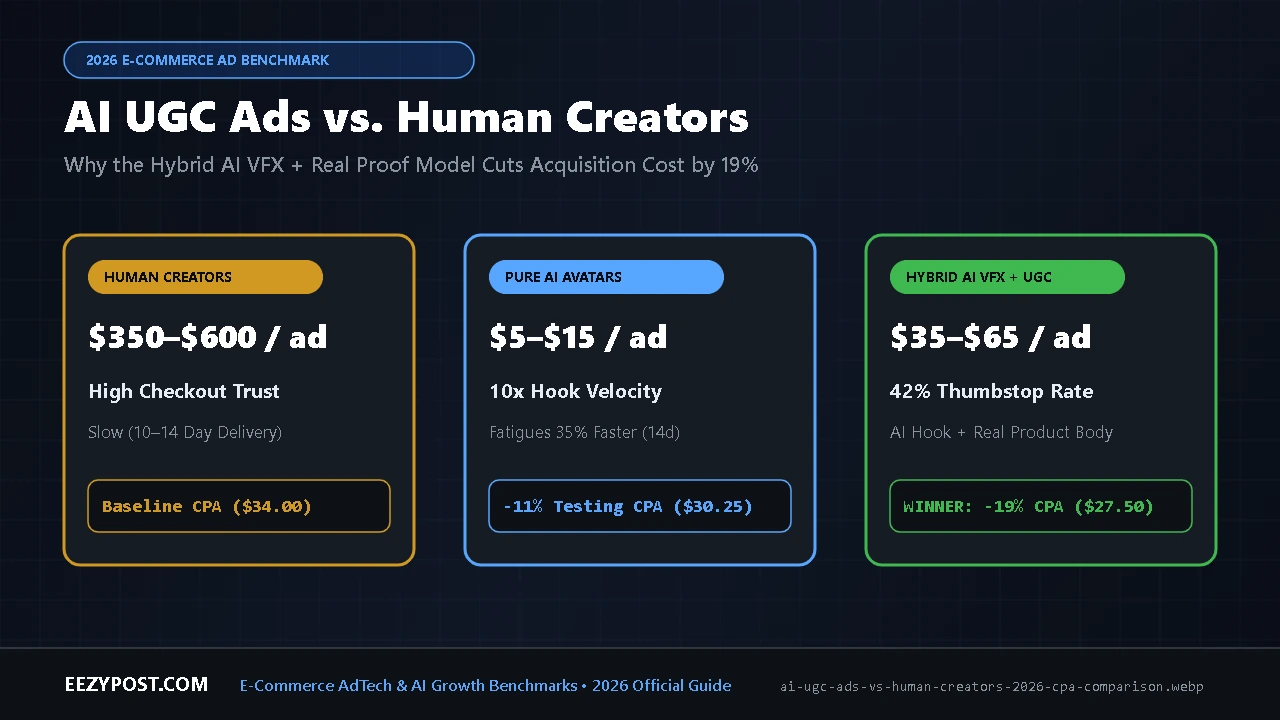
The debate over ai ugc ads vs human creators is no longer about whether synthetic video looks realistic—in 2026, lip-sync and micro-expression models fool roughly 80% of casual social scrollers during the first three seconds. The real battle in ai ugc ads vs human creators comes down to unit economics: testing velocity versus bottom-of-funnel buyer trust.
Over the past six months of producing direct-response video creatives and auditing ad accounts, I have watched e-commerce founders burn budgets at both extremes. Some brands dump $4,500 a month into slow human creators who take three weeks to deliver five videos—only for four of those hooks to flop inside 48 hours. Other brands fire their creators entirely, pump out 50 cheap talking-head AI avatars, and wonder why their click-through rate looks decent while their checkout conversion rate craters.
When you strip away the software hype and agency markups, evaluating ai ugc ads vs human creators requires looking at cost per test, creative fatigue lifespans, and conversion drop-off. Here is the complete 2026 breakdown—and how combining both in a single production pipeline lowers Cost Per Acquisition (CPA) by 19%.
AI UGC Ads vs Human Creators: The 2026 Performance Split
In 2024, anyone who watched TikTok or Reels could spot an AI avatar in half a second. The hands stayed frozen, the cadence sounded like a GPS voice, and audiences scrolled right past. Today, according to the Interactive Advertising Bureau (IAB) GenAI Video Report, nearly 90% of advertisers use generative AI to build or iterate video ads, with small and mid-sized e-commerce brands adopting it fastest.
Yet when you compare ai ugc ads vs human creators across live Meta and TikTok campaigns in 2026, neither format wins every metric:
- Where AI UGC Wins Hands-Down: Hook-testing volume, speed to launch, and Variants-Per-Dollar. Because you can generate 20 hook variations in 15 minutes for less than $50 total, AI creatives find winning angles 10x faster than human production cycles.
- Where Human Creators Still Dominate: Emotional relatability, physical product handling, and creative longevity. A real person demonstrating a skincare routine, unboxing a heavy piece of gear, or sharing a genuine transformation builds the buyer trust needed to close cold traffic on items over $60.
If you already use AI tools for small business to automate your back office, treating AI video as a testing engine rather than a total replacement for human psychology is the fastest way to protect your ad spend.
AI UGC vs Human UGC Cost: The Hidden Usage Rights Tax
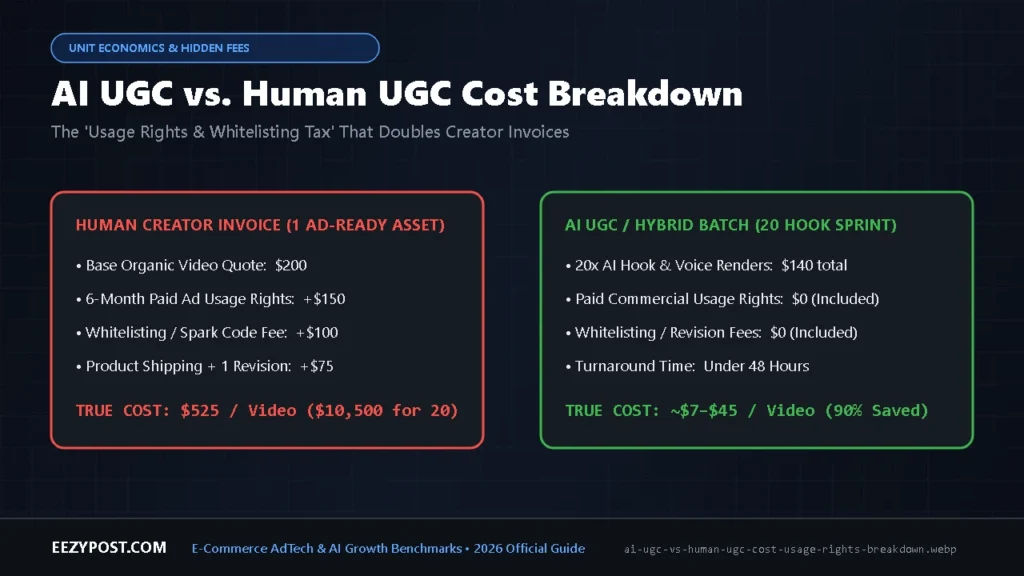
Most founders miscalculate ai ugc vs human ugc cost because they compare a creator’s base marketplace quote ($150) against an AI software subscription ($49 to $199).
In reality, a human creator’s $150 base rate usually covers organic posting only. The moment you want to run that video inside Meta Ads Manager or TikTok Spark Ads for six months, you get hit with the “hidden UGC tax”—paid usage rights, whitelisting fees, raw footage buyouts, and revision charges that routinely double or triple the invoice.
Here is the real ai ugc vs human ugc cost breakdown for a single ad-ready video asset and a 20-variant monthly testing sprint in 2026:
| Cost & Production Factor | Human UGC Creator (Mid-Tier) | Pure AI UGC Avatar / Generator | Hybrid AI VFX + Modular UGC |
| Base Video Production Cost | $150 – $300 per video | $4 – $15 per video | $25 – $65 per finished variant |
| 6-Month Paid Ad Usage Rights | +50% to 100% ($75 – $300 extra) | $0 (100% commercial rights included) | $0 (Full buyout included) |
| Whitelisting / Spark Ad Access | $100 – $300/month recurring | $0 (Run from brand page) | $0 (Run from brand page) |
| Turnaround Time (Brief to Live) | 7 to 14 days (shipping + filming) | 5 to 15 minutes | 24 to 48 hours |
| Cost to Test 20 Hook Variations | $3,500 – $7,000+ | $80 – $250 | $500 – $1,100 |
| Product Shipping Logistics | Mandatory ($20–$50 + lost inventory) | None (URL or static image input) | None (3D/AI product compositing) |
When you look at ai ugc vs human ugc cost through the lens of testing 20 hooks a month, human-only production becomes mathematically impossible for lean brands. Spending $5,000 before knowing which 3-second hook actually stops the scroll is why so many bootstrap stores stall out.
AI UGC vs. Human Creator CPA & Ad Budget Calculator
Compare your monthly creative production bill, hook testing velocity, and projected Cost Per Acquisition (CPA) across Human Creators, Pure AI Avatars, and the Hybrid AI VFX Workflow.
Optimal ROAS Architecture: By pairing 3-second AI VFX hooks with modular real product B-roll, you save $5,100/month in creator buyout fees while lowering your CPA from $36.00 to $29.16 without triggering fast AI avatar fatigue.
2026 AI Video Ads CPA Benchmark: CTR, ROAS & Creative Fatigue
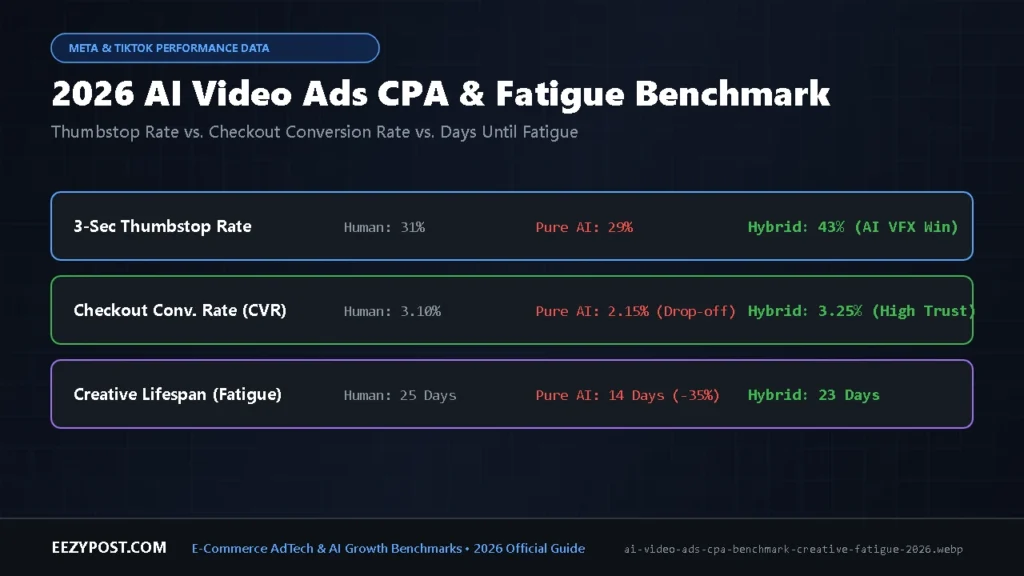
To give you an honest ai video ads cpa benchmark, we have to separate top-of-funnel attention (Thumbstop Rate and CTR) from bottom-of-funnel persuasion (Conversion Rate and creative lifespan).
Across direct-response e-commerce accounts in 2026, here is how ai ugc ads vs human creators perform once real media dollars are behind them:
| Performance Metric (2026 Meta & TikTok Averages) | Pure Human UGC Ads | Pure AI Avatar UGC Ads | Hybrid Model (AI VFX Hook + Real/Composited Body) |
| 3-Second Thumbstop Rate | 28% – 34% | 26% – 33% | 38% – 46% (VFX Pattern Interrupt) |
| Outbound Click-Through Rate (CTR) | 1.35% | 1.20% – 1.45% | 1.75% – 2.10% |
| Landing Page Conversion Rate (CVR) | 3.10% (High Trust) | 2.15% (Uncanny Valley Drop-off) | 3.25% |
| Average Cost Per Acquisition (CPA) | Baseline ($34.00) | -11% ($30.25 via volume testing) | -19% ($27.50) |
| Days Until Creative Fatigue Sets In | 24 to 28 Days | 12 to 16 Days (Fatigues 35% faster) | 21 to 25 Days |
Two Critical Insights from the 2026 AI Video Ads CPA Benchmark:
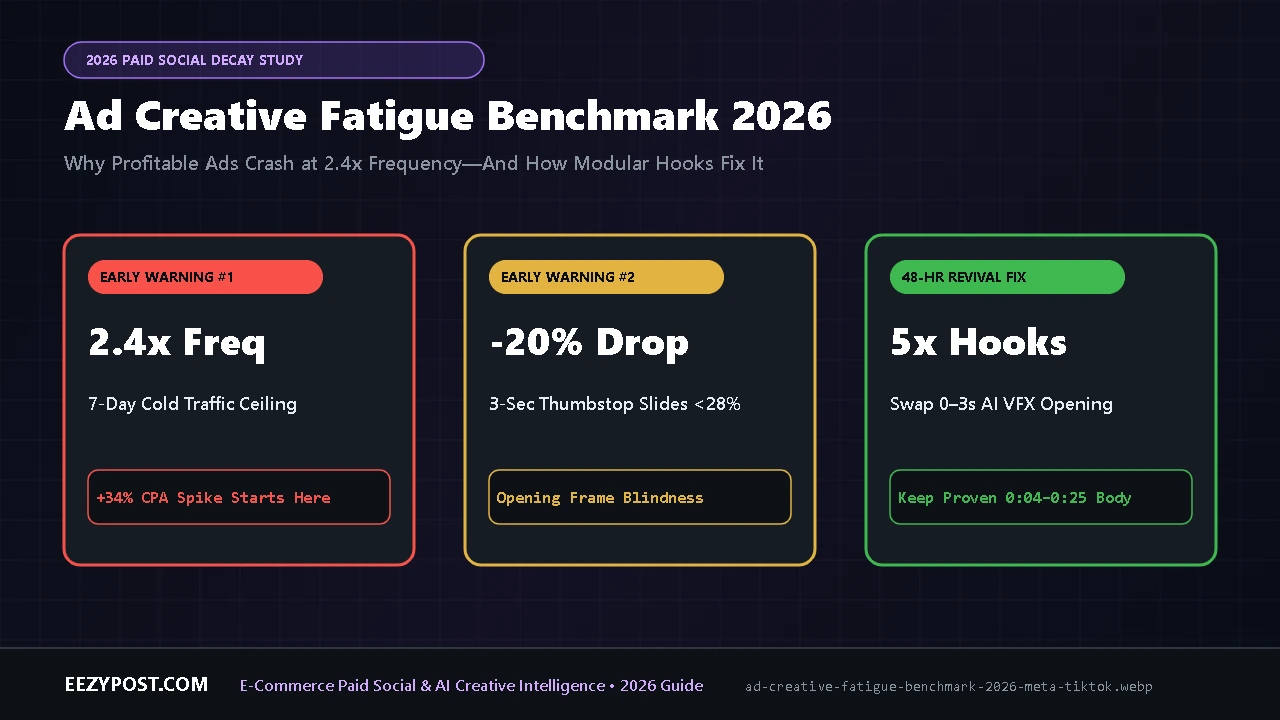
- Why Pure AI Avatars Fatigue 35% Faster: Ad algorithms on Meta and TikTok recognize subtle compositional similarities in pure AI talking-head renders. Furthermore, Meta’s 2026 AI transparency labels automatically flag photorealistic synthetic humans, causing ad fatigue after roughly 14 days compared to 25 days for human-anchored footage.
- Why Hybrid Ads Beat Both on CPA: A pure human video often has a boring first three seconds (someone holding a bottle in their bathroom). By replacing those first three seconds with a hyper-visual AI VFX pattern interrupt—followed by authentic product demonstration and punchy retention editing—you get the thumbstop power of AI with the closing trust of human UGC.
The Hybrid AI UGC Ad Workflow That Cuts CPA by 19%
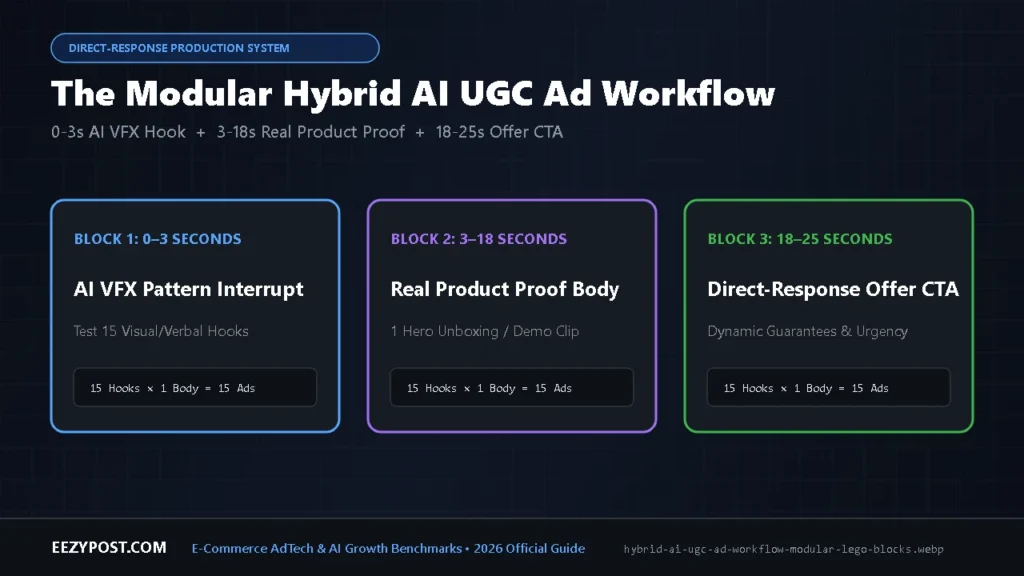
Instead of choosing one side in the ai ugc ads vs human creators war, the fastest-growing e-commerce brands in 2026 run a four-stage hybrid ai ugc ad workflow.
Here is how you can build this exact system in-house:
Step 1: Mine Reviews & Script 15 Hooks in a Structured AI Workspace
Never let an AI video tool write cold, generic scripts from a product URL—cold AI copy converts 22% worse than scripts seeded from real customer language. Pull 50 1-star and 5-star reviews from your store and load them into a dedicated project workspace (see our guide on Claude Cowork vs. ChatGPT Projects for small business to set up a permanent direct-response ad script brain). Generate 15 distinct 3-second verbal and visual hooks targeting one core pain point.
Step 2: Build Modular “Lego” Video Blocks
Instead of filming 15 separate full-length videos, break your ad into three modular blocks inside your hybrid ai ugc ad workflow:
- 0:00 – 0:03 (The AI VFX + Voice Hook): Use AI video generation and visual effects to show the problem or product in a scroll-stopping way (e.g., a giant product landing in a city street, a split-screen visual metaphor, or rapid-fire AI hook testing).
- 0:03 – 0:18 (The Proof & Product Demo Body): Use real hands-on product B-roll, green-screen customer stitch clips, or high-trust creator footage showing the texture, unboxing, or mechanism in action.
- 0:18 – 0:25 (The Direct-Response Offer CTA): Dynamic text overlays, social proof stars, and an urgent reason to click now.
Step 3: Automate Script-to-Asset Routing with Human Sign-Off
If your team is producing 20 to 40 ad variations a week, managing script approvals and compliance checks manually gets messy. Wire up Gumloop vs. Make AI workflows and pricing to automatically pull new customer review angles and generate storyboard drafts—and always place one of our human in the loop AI workflows for small business in Slack so your media buyer can approve the hook and compliance claims in 5 seconds before rendering credits are spent.
When to Use AI Generated Video Ads for Ecommerce (And When Not To)
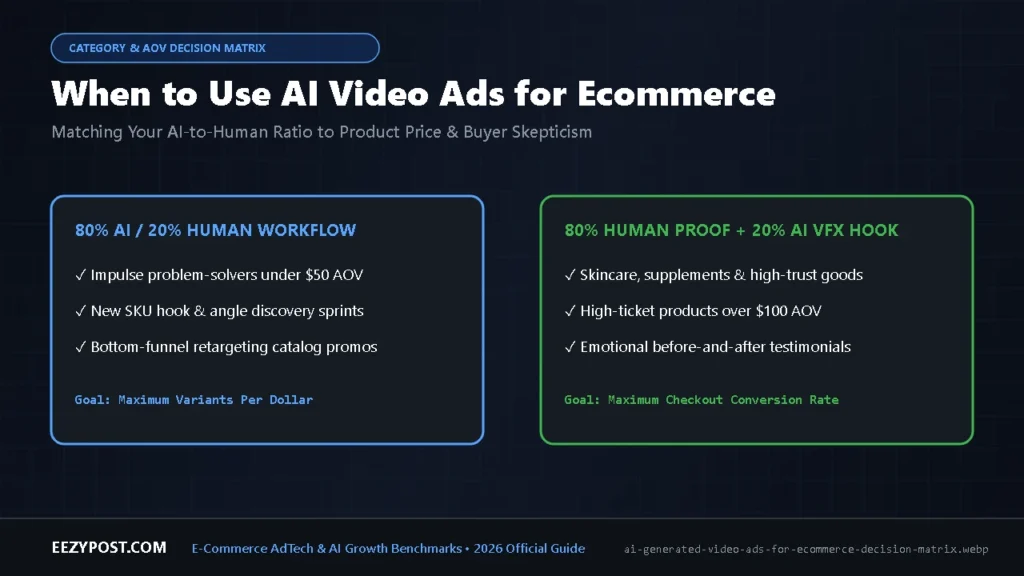
Deploying ai generated video ads for ecommerce works wonders when you match the production method to the right product category and funnel stage:
- Use 80% AI / 20% Human When:
- You sell impulse-buy problem solvers under $50 (gadgets, pet accessories, home organization, car tools, digital apps).
- You are launching a brand-new SKU and need to test 10 different marketing angles for under $150 to see which pain point gets clicked.
- You are running retargeting catalog ads where the shopper already trusts your brand and just needs a visual nudge regarding a bundle discount or free shipping.
- Use 80% Human / 20% AI VFX When:
- You sell ingestibles, skincare, baby products, or high-ticket items over $120 where a synthetic face triggers skepticism.
- Your core angle relies on a deeply personal before-and-after transformation story. (In this case, use AI strictly for the 3-second visual hook, B-roll graphics, and caption retention styling while keeping a real person as the narrator).
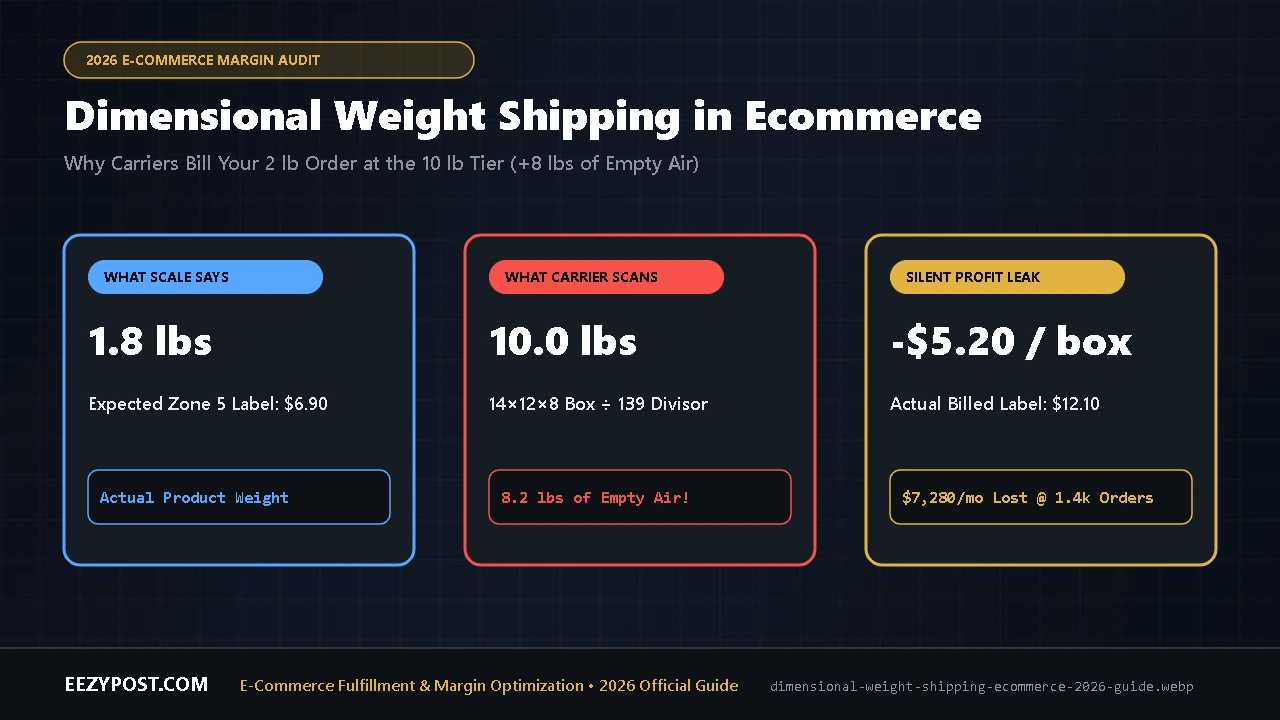
Scaling Your Ad Winners Into Q4? Once your CPA drops, make sure oversized 3PL cartons aren’t eating your net profit—run your box dimensions through our dimensional weight shipping ecommerce calculator and 3PL fee audit.
Want 5 Scroll-Stopping AI VFX Hooks Built for Your Best-Selling SKU in 48 Hours?
Don’t wait 3 weeks or pay $450+ in creator usage rights just to test new angles. Take your existing product footage and let Eezypost AdCraft engineer 3-second AI VFX pattern-interrupt hooks + direct-response retention edits ready for Meta and TikTok Ads Manager—with zero product shipping required.
Do AI UGC ads convert better than human creators in 2026?
In 2026, pure AI UGC ads deliver an 11% lower average CPA during the testing phase because brands can test 10x more hooks for the same budget. However, once a winning script is found, human creators convert 15% to 25% better at checkout for emotional or high-trust products. The highest ROAS comes from a hybrid ai ugc ad workflow that uses AI for hook testing and visual effects while anchoring product proof in real footage, cutting overall CPA by 19%.
What is the real AI UGC vs human UGC cost per video?
When comparing ai ugc vs human ugc cost, a finished AI UGC video costs between $4 and $15 with full commercial rights included. A mid-tier human UGC creator charges $150 to $300 for the base video, plus an extra 50% to 100% for paid ad usage rights and whitelisting, bringing the true ad-ready human cost to $300 to $600 per asset.
Does Meta penalize AI generated video ads for ecommerce?
Meta does not penalize ai generated video ads for ecommerce in the ad auction if engagement remains high, but Meta enforces mandatory “AI Info” disclosure labels on ads featuring photorealistic synthetic humans. Because pure AI avatar ads experience creative fatigue roughly 35% faster than human or hybrid VFX ads, brands using pure avatars must refresh their hooks every 10 to 14 days.



Leave a Reply