

Imagine sitting in a coffee shop with a friend, discussing a family problem you would rather keep private.
Halfway through the conversation, you notice a small device attached to their shirt.
It looks like a fitness tracker. Perhaps you assume it is counting steps or monitoring activity.
But it is something different.
The device is an AI wearable, and it may be turning parts of your conversation into notes, reminders, and searchable memories.
You never downloaded an app. You never accepted a privacy policy. You might not even realize that the device is processing what you say.
That is the uncomfortable question surrounding a new generation of personal technology.
Can AI wearables record you without consent, and what control do you have when the device belongs to someone else?
Amazon’s newly announced Bee Frontier and Bee Eclipse bring that question into sharper focus.
Quick Answer: Can AI Wearables Record You Without Consent?
Yes, an AI wearable can technically capture and process speech from people who have not personally agreed to use the device. Whether that activity is lawful depends on the circumstances, the applicable recording and privacy laws, and how the technology operates.
Not every AI wearable works the same way.
Some save audio recordings. Others convert speech into written transcripts or summaries and discard the original audio.
Amazon says its Bee devices process audio in real time without storing the raw recordings. However, the system can retain encrypted transcripts, summaries, and memories.
That distinction matters.
Deleting the sound of a conversation does not necessarily mean deleting the information learned from it.
It also does not settle whether everybody involved gave meaningful permission.
Meet Amazon Bee Frontier and Bee Eclipse
On October 15, 2026, Amazon announced two additions to its Bee personal AI lineup.
The Bee Frontier and Bee Eclipse are designed to help people remember information from everyday conversations.
Instead of opening a note-taking app after every meeting, users can activate a device that processes speech and organizes useful details into summaries, reminders, and tasks.
The devices take two different forms.
| Feature | Bee Frontier | Bee Eclipse |
|---|---|---|
| Design | Wristband or clothing clip | Magnetic phone attachment |
| Starting price | $74.99 | $99.99 |
| Battery life claimed by Amazon | Up to 7 days | More than 21 days |
| Main purpose | Everyday conversation memory | Conversation and phone-related memory |
| Audio control | Physical button | Physical button |
| Privacy indicator | Visible LED | Visible LED |
| Availability at announcement | Available | Coming soon |
Amazon also introduced Bee Pro at $11.99 per month, with additional memory, integrations, and assistant features.
These are manufacturer specifications and announced prices, not independently tested EEZYPOST results.
The bigger development is that AI is moving away from screens.
You no longer need to sit in front of a chatbot and type a question.
Personal AI can now accompany everyday life, listen when activated, and organize information afterward.
That convenience introduces a problem older digital assistants did not solve: what happens to the privacy of everyone else in the conversation?
Does Amazon Bee Record Everything You Say?
Amazon’s description of Bee is more specific than the phrase “always listening” might suggest.
The company says Bee Frontier and Bee Eclipse have physical controls that allow users to start and stop audio processing. An indicator light signals when the device is active.
Bee Frontier can also be configured to stop automatically after a period without detected sound.
For Bee Eclipse, Amazon also says users are prompted to obtain permission from call participants whenever recording is started. That is an important safeguard, although a prompt shown to the device owner does not independently establish that every participant has consented.
When activated, the devices can process spoken conversations and extract information that may be useful later.
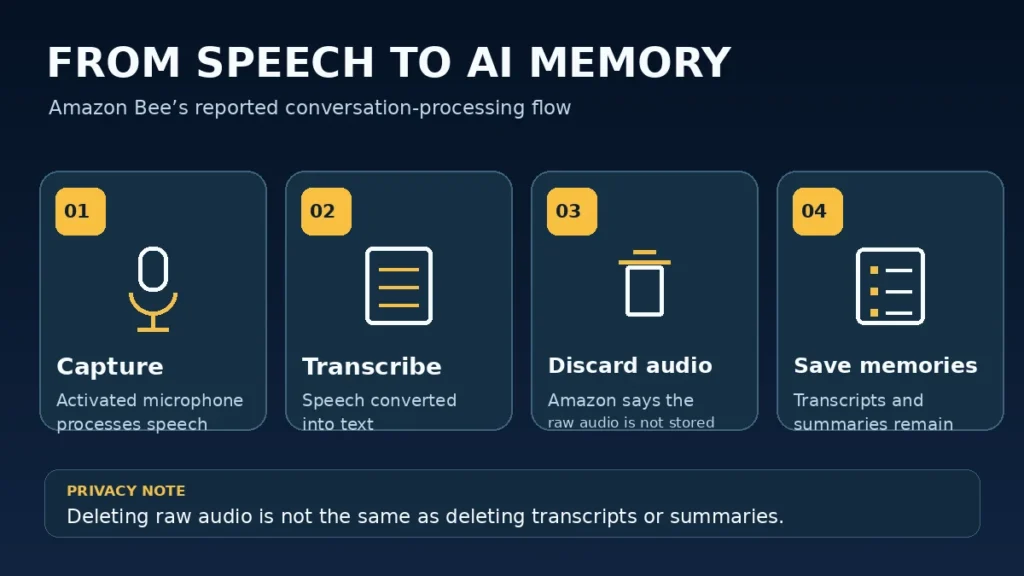
According to Amazon, the process works broadly like this:
- The microphone captures speech while the device is activated.
- The system processes and transcribes audio in real time.
- The original audio is discarded rather than stored.
- Transcripts and extracted information are encrypted.
- The user can access memories, summaries, and reminders through Bee.
Amazon calls its privacy architecture Bee Private Compute.
The company says the system protects transcripts and other personal information with encryption keys controlled by the user’s device.
Its technical explanation is available in Amazon’s Bee Private Compute documentation.
Still, there is a difference between explaining how a system is designed and independently establishing every aspect of its behavior.
A device can have meaningful security protections while leaving difficult social questions unanswered.
The Privacy Problem: Your Conversation Can Become Someone Else’s Memory
Consider an ordinary workplace conversation.
You tell a colleague that you are considering changing jobs.
You are not making an announcement. You are trusting someone with an early thought.
Later, you discover that your colleague was using an AI wearable to help remember conversations throughout the day.
The device may not have saved your voice as an audio file.
But what if it created a summary containing your plans?
The information could remain accessible as part of another person’s digital memory.
This is a different privacy concern from a conventional voice recorder.
With an ordinary recording, people generally understand that a sound file may exist.
An AI system can go further by extracting facts, identifying commitments, and making information easier to retrieve.
A passing remark can become a stored note.
A personal detail can become part of a searchable conversation history.
A forgotten comment may be remembered by software long after the people involved have moved on.
None of this automatically means the device is being used unlawfully or maliciously.
The concern is that one person’s desire for convenient digital memory may conflict with another person’s expectation of privacy.
What Happens to Your Voice After an AI Wearable Processes It?
It helps to separate three kinds of information.
AI wearables rely on technologies such as speech recognition and natural language processing to turn spoken words into useful information. If you want to understand the technology behind these systems, our guide to what is artificial intelligence explains how AI processes language and supports everyday applications.
Raw audio
This is the actual sound captured by the microphone.
Amazon says Bee processes this audio without retaining the original recording.
Conversation transcripts
A transcript preserves words in written form.
Even without the original audio, a transcript may contain private names, personal information, financial details, or confidential business discussions.
AI-generated memories and summaries
A summary may preserve selected facts rather than every sentence.
For example, imagine telling a friend:
“I might sell my house next spring, but please do not tell anybody yet.”
An AI assistant could potentially transform that into:
“Friend is considering selling their home next spring.”
That is a hypothetical example, not a documented Bee output.
The meaning remains sensitive even when the sound recording is gone.
There is another complication: AI summaries can be inaccurate.
A system might confuse who said something, misunderstand a joke, or treat a possibility as a confirmed decision.
For that reason, automated memories should not automatically be treated as reliable records of what somebody agreed to.
Can Someone Legally Use an AI Wearable Around You in the United States?
There is no single answer that applies to every conversation in every state.
U.S. recording laws include different consent requirements depending on location and circumstances.
Under federal law, recording a conversation generally requires at least one participating party’s consent, subject to applicable exceptions and restrictions.
Some states impose stricter requirements.
States commonly described as all-party consent jurisdictions can require everyone involved in certain private conversations to agree before recording occurs.
The specific rules may also depend on whether the discussion happens in person or over a telephone call.
California, Florida, Illinois, and Pennsylvania are among the states with significant all-party consent requirements.
The Reporters Committee for Freedom of the Press maintains a detailed state-by-state recording law guide.
But AI wearables introduce a legal question that should not be oversimplified.
If a device processes speech momentarily, discards the original audio, and retains a transcript or summary, how do the relevant interception, recording, and privacy laws apply?
The answer may depend on statutory language, technical operation, and legal interpretation.
A manufacturer’s decision not to store audio should not be treated as automatic proof that consent laws do not apply.
The safest practical approach is to tell participants when conversation processing is active and obtain their agreement before using an AI wearable in a private discussion.
This section provides general information, not individualized legal advice.
What If Someone Is Wearing an AI Recorder at Work?

Offices may become one of the most difficult environments for personal AI wearables.
Meetings often contain information that is not intended for people outside the room.
An ordinary discussion might involve:
- Customer contact details
- Salary or employment information
- Confidential business plans
- Financial figures
- Product development discussions
- Personal employee concerns
An AI wearable could make it easier for employees to remember decisions and prepare meeting notes.
It could also introduce questions about whether information is being processed or retained outside approved company systems.
Imagine a manager discussing a confidential client proposal while an employee’s personal AI recorder is active.
Even if the employee has good intentions, the organization may need to consider data handling, workplace policies, confidentiality obligations, and applicable law.
For businesses, an appropriate starting point is a clear policy explaining when personal recording assistants may be used, whether participants must agree, and how work-related information can be retained or shared.
The EEZYPOST Bystander Privacy Check
Before an AI wearable processes a conversation, there are five practical questions worth asking.
This is an editorial privacy checklist, not a legal compliance test.
| Question | Why it matters |
|---|---|
| Does everyone know the device is active? | An indicator light alone may not make the purpose obvious. |
| Has the wearer explained what information is processed? | Participants may assume ordinary note-taking rather than AI transcription. |
| Has everyone agreed to the conversation being processed? | The device owner’s permission is not the same as agreement from other participants. |
| Can the information be deleted afterward? | Removing raw audio does not necessarily remove transcripts or memories. |
| Will information be shared with connected services? | Additional integrations may introduce new data-sharing decisions. |
EEZYPOST’s practical rule: For sensitive conversations, ask first, activate second, and explain what will be kept.
That is a reasonable habit even when the law does not clearly require every step.
Can You Stop Someone Else’s AI Wearable From Listening?
There is no universal setting on your phone that reliably turns off every nearby AI recorder.
If somebody else owns the wearable, the controls generally belong to that person.
You can still take practical steps.
First, ask whether the device is currently processing conversations.
If it is, request that the wearer pause it before discussing anything private.
You might say:
“Would you mind turning your AI recorder off while we talk? I’d rather keep this conversation between us.”
There is nothing unreasonable about making that request.
For workplace discussions, follow the organization’s recording and confidentiality policies.
If information has already been processed, ask whether the wearer can delete the relevant transcript or summary. Deletion capabilities and any information already shared with other services need to be considered separately.
For particularly sensitive matters, choose a setting where you understand which devices are active.
These steps do not guarantee privacy against a person determined to record secretly. They are practical ways to establish expectations in ordinary situations.
Are Amazon Bee Conversations Private?
Amazon says Bee Private Compute uses a protected processing environment and encryption designed to prevent unauthorized access to users’ conversation data.
The company also states that users can delete transcripts and summaries and control certain sharing permissions.
Amazon’s privacy claims have also received independent technical scrutiny. In September 2026, security research firm Trail of Bits reviewed Bee Private Compute and reported 21 findings, including seven rated high severity.
The findings covered areas such as security verification, access controls, and how some conversation-related information was handled. These observations apply to the systems examined during the audit and should not be interpreted as proof that the same issues remain unresolved in released devices.
The review is valuable because it provides evidence beyond the manufacturer’s own description. It also illustrates why an independent security assessment should not be confused with a guarantee that every privacy risk has been eliminated.
Three different issues need to be considered:
Technical security: How well does the system protect stored and processed information?
User control: Can the device owner review, delete, and limit access to personal data?
Bystander consent: Do other people have a meaningful opportunity to decide whether their conversations should be processed?
A product can address the first two without completely resolving the third.
That distinction deserves attention as wearable AI becomes more common.
Amazon Bee Can Also Connect Conversations to Shopping
There is another development worth watching.
Amazon says Bee can connect with Alexa+ and Amazon.com to offer personalized assistance and shopping recommendations.
Imagine telling a friend that you have been looking for a particular book.
An AI assistant might remember the title and later help you find it.
Or suppose you mention needing a replacement coffee maker.
With an appropriate connection enabled, the assistant could use that context to suggest relevant products.
These integrations are optional and may require Bee Pro.
Personalized recommendations are not inherently a privacy problem. Many consumers appreciate services that help them remember useful information.
But they raise an important question.
When does information shared in conversation become information used to influence a purchase?
There is also an important difference between recommending a product and having authority to buy it.
Our related EEZYPOST analysis, AI Shopping Recommendations: Can You Trust Them in 2026?, explains why AI shopping suggestions deserve careful evaluation.
Readers interested in spending permissions can also explore What Happens When AI Agents Start Spending Your Money?.
As personal assistants become more connected, users should understand both what their AI remembers and what actions they have authorized it to take.
Should You Buy an AI Wearable That Remembers Conversations?
The answer depends on what you expect the device to accomplish.
Someone who regularly forgets appointments or meeting details may find conversation summaries useful.
A professional who handles sensitive information may need stricter rules.
A household that values private conversations might prefer activating the device only for specific tasks.
Before purchasing one, consider how frequently you would actually use it.
Do you need a wearable microphone for an entire day, or would a conventional notes application be enough?
Would you feel comfortable explaining the device to the people you regularly speak with?
Are the privacy controls understandable?
Will connected services receive additional information?
What happens when you no longer want certain memories stored?
Also consider the ongoing cost.
Bee Frontier starts at $74.99, while Bee Eclipse is expected to start at $99.99. Amazon says both devices include conversation summaries and 14-day memory at no additional cost. Bee Pro costs $11.99 per month and adds expanded memory features, third-party integrations, and other tools. Amazon also offers new customers a 30-day Bee Pro trial.
For some users, that may be worthwhile.
Others may decide that a smartphone, traditional calendar, and occasional meeting transcription are sufficient.
The best personal technology is not necessarily the technology that collects the most information.
It is the technology that solves a genuine problem without creating a larger one.
Frequently Asked Questions
Can AI wearables listen to other people’s conversations?
Yes. A microphone-equipped AI wearable can capture nearby speech while its audio features are active. Whether it may legally process a particular conversation depends on applicable laws and circumstances.
Does Amazon Bee save audio recordings?
Amazon says Bee processes audio in real time and discards the original sound without storing it. The service can retain encrypted transcripts, summaries, and other conversation-derived information.
Is Amazon Bee always listening?
Bee is designed for extended use, but Amazon says Frontier and Eclipse have physical activation controls and visible indicator lights. Frontier also supports an automatic stop setting after a period without detected sound. Extended-use capability should not be confused with a claim that the microphone is continuously active under every condition.
Do AI wearables need consent in California?
California generally has strict requirements concerning the recording or interception of certain confidential communications. Whether a particular wearable’s operation falls within those rules depends on the facts and the applicable law. Users should not assume that discarding raw audio automatically removes consent obligations.
Can someone delete my conversation from their AI wearable?
Some devices allow their owners to delete transcripts and summaries. Amazon says Bee users can delete their conversation information. However, deletion from one service does not necessarily reverse information previously shared elsewhere.
Can AI wearables remember conversations without recording audio files?
Yes. A system can process speech and preserve written transcripts or summaries without keeping the original sound file. Amazon describes this as part of Bee’s privacy architecture.
Can Amazon Bee use conversations to recommend products?
Amazon says optional Amazon.com integrations can use relevant information to provide personalized shopping recommendations. Availability and subscription requirements depend on the connected features.
The Bottom Line
AI wearables offer something genuinely useful: the ability to remember details that people might otherwise forget.
That can make work easier, reduce everyday frustration, and help users organize complicated schedules.
But a conversation rarely belongs to just one person.
Amazon’s Bee Frontier and Bee Eclipse show how rapidly personal AI is moving into ordinary physical spaces.
The technology now has to address questions that cannot be answered by better microphones, longer battery life, or stronger encryption alone.
Who knew the device was active?
Who agreed to the conversation being processed?
Who controls the information afterward?
Those questions matter whether the wearable costs $75 or $750.
The next challenge for personal AI is not simply remembering more.
It is learning when it should not remember at all.
EEZYPOST reporting note: This article is based on Amazon’s October 2026 announcements, published Bee privacy documentation, public security-audit information, and U.S. recording-law guidance. EEZYPOST has not independently tested Bee Frontier or Bee Eclipse. Technical features and prices reflect information available as of October 16, 2026. Laws and product features may change.






Leave a Reply