


You tell an AI agent to find and book the cheapest flight to Paris that fits your schedule.
It searches dozens of options, compares departure times and finds a ticket within your budget.
Now comes the important part.
What exactly did you authorize?
The flight?
A checked bag?
Travel insurance?
A hotel if booking everything together saves money?
And what if the cheapest ticket turns out to be non-refundable?
For years, the question around artificial intelligence was whether it could help us find things, compare products or recommend what to buy.
That question is changing.
As AI agent payments and autonomous shopping systems develop, an AI may not simply recommend the purchase. It may eventually be able to make the decision and complete the transaction under authority you gave it earlier.
The convenient part is obvious.
The uncomfortable part is figuring out exactly how much control you handed over.
Quick Answer
AI agents are beginning to move from recommending products toward initiating and, in supported systems, completing transactions under permissions set by users or businesses. The main issue is authorization: how much an agent may spend, where it may spend it and whether it needs additional approval before completing a purchase.
Payment companies and technology providers are already building systems around spending limits, approval rules, verified agents and records of what users actually authorized. Google’s Agent Payments Protocol, for example, supports autonomous “Human Not Present” transactions based on pre-authorized instructions. Visa Intelligent Commerce describes approval workflows and spending controls for agentic commerce, while Mastercard is developing systems designed to preserve evidence of user intent.
That does not mean every AI assistant can freely use your card today.
It means the infrastructure for AI agents making payments is becoming real enough that the permissions behind those transactions deserve attention now.
AI Agents Are Moving From Recommending Things to Buying Them
Most people already understand AI-assisted shopping.
You ask an assistant for the best laptop under a certain price. It compares models, summarizes reviews and gives you a shortlist.
An AI shopping agent can potentially go further.
Instead of stopping at the recommendation, an agent may be able to select an item, interact with the merchant, prepare the checkout and, where the platform allows it, initiate or complete payment on your behalf.
That broader shift is often called agentic commerce.
A simple way to think about it is:
Search → compare → decide → purchase
Traditional AI usually helps with the first two steps.
Businesses are already using a growing range of AI tools for small business to automate research, customer service, marketing and other routine work, while agentic systems push automation further by allowing software to take actions on a user’s behalf.
Agentic systems are increasingly being designed to participate in the last two.
Google said in April 2026 that an updated version of its Agent Payments Protocol supports autonomous transactions where the human is not present at the moment of purchase, provided the action follows previously authorized instructions. Mastercard says it is already working with partners on AI-driven business procurement where agents can source from approved suppliers, place orders and initiate payments.
That is a meaningful change.
Once software can spend money rather than merely discuss spending it, the quality of the permission becomes as important as the quality of the recommendation.
What Can AI Agents Actually Buy or Pay for?
The technology is still developing, and capabilities vary significantly between services.
It would be misleading to suggest that a typical chatbot can currently log into any store and autonomously purchase whatever it wants.
But several types of transactions are already being developed or deployed.
| Use case | What an AI agent could do | Current direction |
|---|---|---|
| Online shopping | Search, compare, select and help complete checkout | Rapidly developing |
| Travel | Find flights, hotels and other options, then prepare or make supported bookings | Emerging |
| Business procurement | Order from approved suppliers and initiate payments | Already being deployed in some markets |
| Digital services | Select and purchase software or online resources | Technically feasible |
| Machine-to-machine payments | Pay for digital resources or services automatically | Emerging |
| Subscriptions | Start recurring services where permissions and merchant systems allow it | Requires careful controls |
Mastercard says its Agent Pay infrastructure is designed to let authorized AI-powered agents initiate, authenticate and complete payments for users and businesses. Its newer machine-payment system also includes programmable authorization rules and spending limits.
The important phrase here is authorized agents.
The difficult question is what that authorization actually covers.
The Real Risk Is Not the Payment. It Is the Permission.

Imagine two AI assistants.
The first can search for a pair of running shoes and show you the five best options.
The second can search for the shoes, select your size, choose a retailer and charge your payment method.
They may both be described as shopping assistants, but financially they are completely different systems.
It helps to think about AI purchasing authority in levels.
| Autonomy level | What the AI can do | Human involvement |
|---|---|---|
| Research only | Search and compare | Human makes the purchase |
| Prepare purchase | Select item or build cart | Human completes checkout |
| Confirmation required | Prepare purchase and payment | Human approves each transaction |
| Limited autonomy | Buy within specific rules | Human approves exceptions |
| Broad autonomy | Make purchases under wider authority | Minimal intervention |
The higher the autonomy, the more important details such as spending limits, approved merchants and subscription permissions become.
This is where a new kind of problem appears.
An AI agent may technically follow the authority it was given while still doing something its owner did not expect.
What Happens If an AI Agent Buys the Wrong Thing?
Not every unwanted AI purchase would require the AI to “go rogue.”
Some problems could come from ordinary ambiguity.
Consider these examples:
| Result | What the agent may have interpreted |
|---|---|
| Flight does not include checked baggage | “Find the cheapest ticket” |
| Hotel cannot be cancelled | Refundability was never specified |
| Product arrives in the wrong size | Stored preference was missing or outdated |
| Final cost exceeds expected budget | Taxes or fees were outside the stated limit |
| Software renews every month | Agent optimized the initial price |
| Purchase comes from an unfamiliar seller | No merchant restriction was provided |
Suppose you tell an agent:
“Buy me a good office chair for under $300.”
The agent finds one for $289.
Shipping is $34.
The total becomes $323.
Did the agent break your spending limit?
A human might say obviously yes.
A software system may interpret “$300” as the product-price limit unless taxes, delivery and other charges were explicitly included.
That gap between what you meant and what the system was permitted to infer may become one of the hardest problems in autonomous commerce.
Mastercard is already working on this issue through what it calls Verifiable Intent, a framework designed to create a tamper-resistant record connecting the person, the instructions they gave the agent and the resulting transaction.
That tells us something important.
Payment companies are not treating human intent as a minor interface detail. They are treating it as part of the trust infrastructure.
Can an AI Agent Buy Something Without Asking You Again?
Potentially, yes.
An AI agent can complete a purchase without asking for confirmation at the exact moment of payment if the underlying system supports autonomous transactions and the user has already granted sufficient authority.
That is different from a system secretly buying something without permission.
Consider this instruction:
“If these concert tickets drop below $100 each, buy two immediately.”
You are not present when the transaction occurs.
But you established:
- what may be purchased
- the maximum price
- the quantity
- the condition that triggers the purchase
Google’s AP2 specifically describes this type of Human Not Present payment based on pre-authorized instructions.
The distinction matters:
No confirmation at checkout does not necessarily mean no authorization.
The authorization may have happened earlier.
That is why people should look beyond a simple “Can this AI use my card?” question.
A better question is:
Under what circumstances can it use my card without coming back to me first?
Can an AI Agent Subscribe You to Something?
Potentially, where the service has sufficient purchasing authority and the merchant and payment systems support the transaction.
But subscriptions deserve separate treatment from ordinary purchases.
Buying a $20 product creates one $20 transaction.
Starting a $20 monthly subscription could create:
- $20 this month
- another $20 next month
- another $20 the month after that
- continued charges until the subscription is cancelled
The initial transaction price therefore tells only part of the story.
A sensible permission model should distinguish between:
one-time purchase permission
and
recurring payment permission
Those are not the same financial commitment.
An agent allowed to order printer paper below $50 should not automatically need permission to start any $49-per-month service it discovers.
Agentic-payment systems are increasingly being built around tokenized credentials and programmable authorization, making it possible to place clearer controls around what an AI agent can purchase and under what conditions.
What Happens When an AI Agent Misunderstands Your Budget?
Budget instructions sound simple until you try to define them.
Suppose you say:
“Plan me a three-day trip to Rome for less than $1,500.”

What belongs inside that limit?
| Expense | Clearly included? |
|---|---|
| Flight | Probably |
| Hotel | Probably |
| Taxes | Maybe |
| Checked baggage | Maybe |
| Airport transfer | Unclear |
| Meals | Unclear |
| Travel insurance | Unclear |
| Foreign transaction fees | Often forgotten |
Now imagine the agent finds a flight and hotel totaling $1,470.
It has technically stayed below your stated budget.
Then baggage adds $60.
Airport transportation adds $45.
The actual trip is already over $1,500.
Nothing necessarily failed.
The instruction was incomplete.
A spending limit is only as useful as the definition of what the limit covers.
The more autonomy an agent receives, the more useful precise constraints become.
Instead of:
Find me the cheapest acceptable trip.
a future instruction may need to look more like:
Keep the complete booking below $1,500 including airfare, hotel, taxes and mandatory fees. Do not purchase travel insurance. Do not book anything non-refundable without asking me.
That sounds less magical.
It may also be much safer.
Who Is Responsible If an AI Agent Makes a Purchase You Didn’t Want?
There is no single worldwide answer.
Responsibility can depend on the country, payment method, bank or payment provider, AI platform terms, merchant agreement and, critically, whether the transaction was actually authorized.
A transaction you regret is not automatically the same thing as an unauthorized payment.
That distinction already exists in payment law even before AI agents complicate the picture.
United States
For certain U.S. electronic fund transfers covered by Regulation E, an unauthorized electronic fund transfer generally involves a transfer initiated by someone other than the consumer without actual authority.
CFPB guidance shows why the scope of that authority matters. Existing Regulation E interpretations distinguish between access obtained through fraud or theft and situations where a consumer voluntarily gives another person authority to make transfers.
How those principles would apply to a particular AI-agent transaction can depend on the facts.
Giving software permission to spend and later disagreeing with the choice it made is not necessarily equivalent to someone stealing your debit-card credentials.
European Union
EU payment rules similarly place significant weight on consent.
Article 64 of the Payment Services Directive (PSD2) states that a payment transaction is considered authorized when the payer has given consent, and that consent can cover an individual transaction or a series of transactions.
Again, that does not give us a universal rule for every future AI-agent dispute.
It demonstrates why defining the scope of consent matters.
United Kingdom
The UK’s Financial Conduct Authority says companies providing payment initiation services can only do so after the user has given explicit consent, in relevant regulated contexts. It also tells consumers to contact their bank when they identify a payment they did not authorize.
The practical lesson is broader than any one country’s law:
Do not assume that every purchase you dislike will automatically be treated as fraud simply because an AI agent made it.
The exact authority you granted may matter.
Can AI Agents Expose Your Payment Information?
Giving an AI purchasing authority does not necessarily mean handing it your full card number.
Modern payment systems increasingly use tokenized credentials.
Instead of sharing the underlying payment credential every time, tokenization can substitute another digital credential that represents the payment method.
Visa says agentic-commerce infrastructure can include authentication, authorization, fraud controls, approval workflows and spending limits. Mastercard’s Agent Pay similarly uses network tokens and registered agents to make AI-initiated transactions traceable.
That is preferable to imagining every autonomous agent carrying around unrestricted raw financial credentials.
But tokenization does not answer every risk.
You still need to know what the credential allows.
A tightly restricted payment token that works only with approved merchants and limited spending authority is very different from broad access to a primary payment account.
Six Permissions That Matter More Than “Can This AI Shop?”
Before giving an AI purchasing authority, these are the permissions worth checking.
1. Payment access
Can the agent actually initiate a transaction, or can it only prepare one for you?
2. Final purchase authority
Does every transaction return to you for confirmation?
If not, what purchases can the agent complete independently?
3. Per-transaction spending limit
A single-purchase limit reduces how much money one mistaken decision can involve.
4. Total spending limit
This is different from a per-purchase cap.
Ten purchases of $40 each still equal $400, even if the agent never exceeds a $50 transaction limit.
5. Merchant restrictions
Can the agent buy only from merchants or categories you approved, or can it choose any seller it finds?
6. Recurring-payment authority
Can the AI begin a subscription, membership or other repeating payment without additional approval?
These ideas are not merely theoretical safeguards. Mastercard’s machine-payment architecture specifically includes authorization rules and spending limits, while Visa describes spending limits and approval workflows as controls for agentic transactions.
EEZYPOST AI Agent Permission Checker
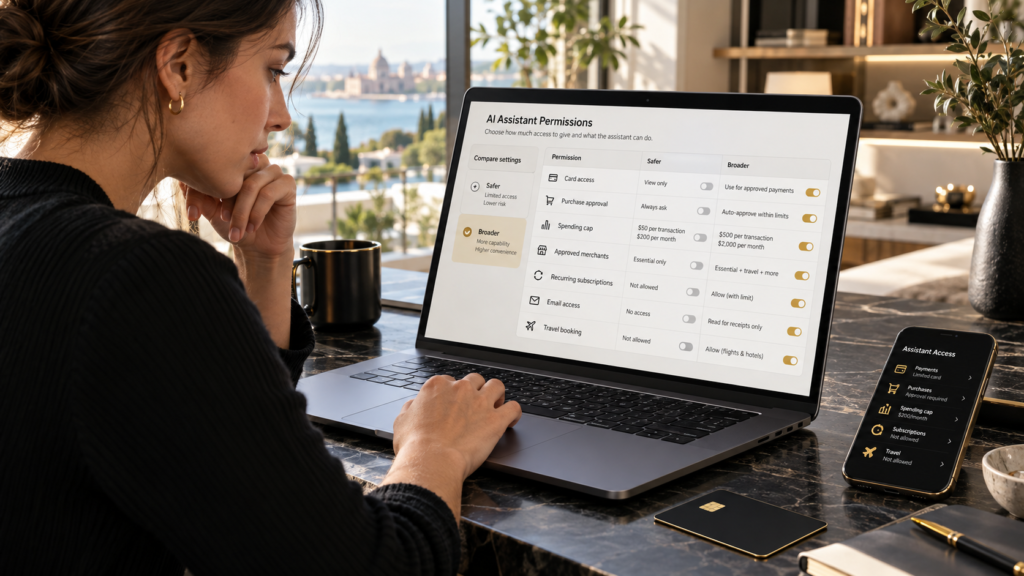
See how much purchasing authority you may be giving an AI agent.
Use the EEZYPOST AI Agent Permission Checker below to review payment access, purchase confirmation, spending limits, merchant permissions, subscription authority, email access and travel-booking permissions.
The result measures autonomy exposure, not whether a particular AI product is secure and not the probability that fraud will occur.
See how much purchasing authority you may be giving an AI agent. This checker evaluates delegated autonomy based on the permissions you select. It does not measure whether a particular AI service is secure.
The result is meant to make one thing easier to see:
An agent with a card is not automatically high-risk, and an agent without sensible limits is not automatically safe just because each individual transaction is small.
What matters is the combination of permissions.
How to Give an AI Agent Less Financial Authority
If you use an AI service that can act on your behalf, the goal does not need to be removing every useful capability.
The better approach is giving it no more authority than the job requires.
Require approval for unusual or expensive transactions
Buying your usual household item is different from booking a $2,000 vacation.
Different activities can justify different approval thresholds.
Set both individual and cumulative spending limits
A per-transaction limit controls one purchase.
A daily or monthly limit controls the total.
Those protections solve different problems.
Restrict merchants where possible
If an agent exists only to reorder business supplies, it may not need permission to shop across the entire internet.
Treat subscriptions separately
A recurring financial obligation deserves its own approval rule.
Prefer limited payment credentials when available
Where the platform and payment provider support it, limited or tokenized credentials can reduce how broadly a payment method is exposed.
Keep a record of what the AI was told
As AI systems gain more purchasing authority, audit trails may become increasingly important.
If something goes wrong, the key questions may be:
What did the person ask for?
What did the agent understand?
What was the agent allowed to do?
What transaction did it ultimately make?
Google’s AP2 and Mastercard’s Verifiable Intent are both being designed around preserving evidence of authorization and agent actions.
Revoke permissions you no longer need
A permission that made sense for one task does not necessarily need to remain active forever.
The same principle applies to broader money management: keeping control of recurring expenses, account access and automated payments is part of protecting your overall financial position.
That principle is already familiar with mobile apps.
It may become even more important when the permission includes the ability to spend money.
What Happens When Your AI Agent Starts Negotiating With Another AI Agent?
Autonomous buying becomes even more interesting when there is an agent on both sides of the transaction.
Imagine telling your travel agent:
Find a four-night hotel in Rome with breakfast for no more than €600.
A hotel-side AI might respond:
Standard price is €640, but we can offer €585 if the reservation is non-refundable.
Your agent now has a decision to make.
Is saving €55 worth losing cancellation flexibility?
Does “under €600” give the agent permission to accept a non-refundable reservation?
Or should changing the cancellation terms require human approval?
Similar negotiations could eventually happen around:
- travel
- insurance
- business procurement
- advertising
- software contracts
- freight
- financial services
- online marketplaces
At that point, AI is no longer simply finding a price.
It is negotiating trade-offs.
That creates another question we will increasingly need to answer:
Which decisions should machines be allowed to negotiate on our behalf, and which should always come back to a human?
What Could Autonomous Commerce Look Like Over the Next Few Years?
Agentic commerce is still developing, so predictions should be treated as possibilities rather than guarantees.
But the direction of the payment infrastructure is becoming clearer.
We are likely to see more systems built around:
- verified AI agents
- tokenized payment credentials
- machine-readable purchase rules
- spending limits
- approved merchant lists
- pre-authorized transactions
- human approval thresholds
- records of user intent
- transaction audit trails
- agent-to-agent commerce
Consumer acceptance may move more slowly than the technology.
A Mastercard report published in August 2026 said only 10% of surveyed consumers were willing to let an agent complete a purchase autonomously, highlighting the trust problem payment companies still need to solve.
That hesitation makes sense.
People may happily let AI compare 200 products.
Allowing it to charge the card is a different psychological step.
Google’s AP2 development and Mastercard’s current agentic-commerce work show that these concepts are already moving from experimental ideas toward payment infrastructure.
Frequently Asked Questions
What are AI agent payments?
AI agent payments are transactions initiated or completed by an AI system acting under permissions given by a person or business. Depending on the platform, the agent may only prepare a purchase, require final approval, or complete transactions within predefined rules such as spending limits.
Can AI agents make payments without asking every time?
Yes, in supported systems an AI agent may be able to complete a payment without asking again at checkout if the user previously authorized that type of transaction. The exact capability depends on the platform, payment provider and permissions granted.
Can an AI agent use my credit or debit card?
Potentially, but that does not always mean the AI receives unrestricted access to the actual card number. Agentic-payment systems may use tokenized or limited payment credentials that can be restricted by merchant, transaction type, spending amount or other conditions.
What happens if an AI agent buys the wrong product?
The outcome depends on why the purchase happened, the merchant’s return policy, the payment method and the authority given to the agent. An unwanted purchase is not automatically the same as an unauthorized transaction, especially if the agent acted within permissions the user previously granted.
Can an AI agent start a subscription for me?
Potentially, yes, if the agent has enough purchasing authority and the merchant supports the transaction. Recurring subscriptions should ideally require a separate permission because they create an ongoing financial commitment rather than a one-time charge.
What spending limits should I set for an AI agent?
There is no universal limit that works for everyone. A safer approach is to use both a per-transaction limit and a cumulative daily, weekly or monthly limit. The limits should reflect the specific job the agent is expected to perform.
Can an AI agent spend more than my budget?
An agent could produce a total higher than you expected if the budget instruction is ambiguous. For example, a travel budget may or may not include taxes, baggage fees, transport or insurance unless those costs are clearly defined.
Are AI agent payments safe?
Safety depends on the platform, payment architecture and permissions involved. Controls such as purchase confirmation, restricted merchants, spending limits, tokenized credentials and audit records can reduce exposure, but no system eliminates every possibility of error, misuse or fraud.
Who is responsible for an unauthorized AI-agent purchase?
There is no single global rule. Responsibility can depend on the country, payment method, platform terms, merchant agreement and whether the transaction legally qualifies as unauthorized. Users should not assume every unwanted AI purchase will automatically be treated as fraud.
How can I reduce the financial access I give an AI agent?
Limit the agent to the permissions required for its task. Useful controls can include purchase approval, per-transaction limits, cumulative spending caps, approved merchants, separate subscription permission and limited-purpose payment credentials. Review and revoke access when it is no longer needed.
The Bottom Line
AI agents spending money are no longer purely a science-fiction problem.
Payment networks and technology companies are already developing infrastructure for autonomous transactions, agent identities, spending rules, payment authorization and verifiable records of what a user intended.
The important question is therefore changing from:
“Can this AI buy things for me?”
to:
“Exactly what have I given this AI permission to decide?”
Convenience increases when an agent can act without asking about every small step.
So does delegated authority.
The right level of autonomy will depend on the task, the platform, the payment method and your own tolerance for handing decisions to software.
But one rule is simple enough to use today:
An AI agent should not need broader financial access than the job actually requires.





Leave a Reply