
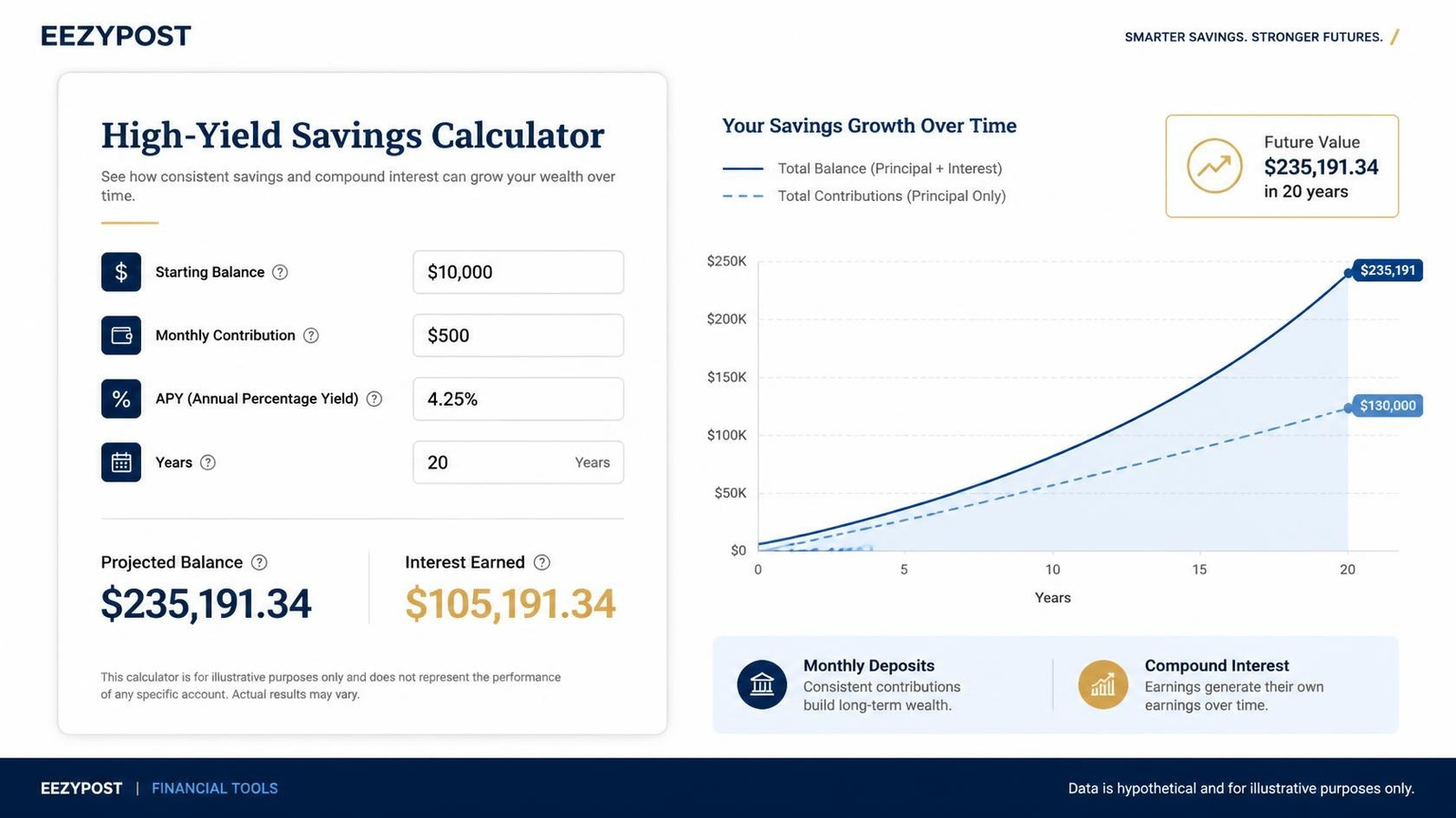
High Yield Savings Account Calculator
High Yield Savings Account Calculator
Estimate how your savings could grow with compound interest and regular monthly contributions.
Your Estimated Savings
Estimate only:This calculator assumes the APY remains constant and interest compounds monthly. Actual earnings can vary because savings account rates may change and banks may use different interest-crediting methods.
High Yield vs. Regular Savings Calculator
Compare how your savings could grow at a high-yield savings APY versus a regular savings account APY.
Estimates assume the entered APYs remain unchanged throughout the selected period. Actual savings growth can differ because rates, fees, deposits, withdrawals, and account terms may change.
High Yield Savings vs. Regular Savings: What’s the Difference?
A high yield savings account typically offers a higher annual percentage yield (APY) than a traditional savings account. That difference can affect how quickly your savings grow, especially when you maintain a balance for several years or make regular monthly contributions.
The calculator above lets you compare two savings scenarios using the same starting balance, monthly contribution, and savings period. You enter a separate APY for the high-yield and regular savings accounts, and the calculator estimates the ending balance and interest earned for each.
Why APY Matters When Comparing Savings Accounts
APY represents the annual rate of return on a deposit account while taking the effect of compounding into account. When comparing savings accounts, looking at APY can make it easier to compare the potential growth of accounts with different interest rates and compounding practices.
How Monthly Contributions Affect the Comparison
Regular contributions can significantly increase your ending savings balance because each deposit adds to the amount that can potentially earn interest. The longer your savings period, the more opportunity there is for both your contributions and estimated interest to accumulate.
What the Additional Interest Result Means
The “estimated additional interest” figure shows the difference between the interest projected for the high-yield savings scenario and the interest projected for the regular savings scenario. It is an estimate, not a guaranteed return.
Actual savings growth can differ because savings account APYs may change over time, and accounts can have different fees, deposit requirements, withdrawal rules, and interest-crediting practices.
High Yield vs. Regular Savings Calculator Example
Suppose you start with $10,000, contribute $500 per month, and save for 5 years. If the high yield savings account earns 4% APY while the regular savings account earns 0.5% APY, the projected results can be substantially different.
- High yield savings: approximately $45,256.04
- Regular savings: approximately $40,623.39
- Estimated additional interest from the high-yield account: approximately $4,632.65
In this example, the difference comes from the higher APY applied to the same starting balance and monthly contributions. The figures are projections based on the assumptions entered into the calculator and should not be interpreted as guaranteed returns.
High Yield vs. Regular Savings Calculator FAQs
Is a high yield savings account better than a regular savings account?
A high yield savings account may offer a higher APY than a regular savings account, which can result in more interest when the other factors are similar. However, account rates, fees, requirements, access rules, and other terms can vary by financial institution.
How much more interest can I earn with a high yield savings account?
The difference depends on your starting balance, monthly contributions, APYs, and savings period. Use the comparison calculator above to estimate the difference between two APYs using your own numbers.
Does a higher APY always mean I will earn more money?
Not necessarily. APY is an important factor, but fees, account requirements, withdrawal rules, balance requirements, and changes to the APY can affect your actual savings growth.
Can I compare two savings accounts with different APYs?
Yes. Enter the APY for each account in the calculator above while keeping the starting balance, monthly contribution, and savings period the same. The calculator will estimate the projected balance and interest for each scenario.
Are the calculator results guaranteed?
No. The results are estimates based on the APYs and other assumptions you enter. Savings account APYs can change, and actual interest may differ based on the financial institution's terms and interest-crediting practices.
How This Savings Comparison Calculator Estimates Results
The EEZYPOST high yield savings comparison calculator uses the APYs entered by the user to estimate how the same savings plan could grow under two different interest-rate scenarios.
The calculator applies the same starting balance, monthly contribution, and savings period to both scenarios. It converts each annual APY into an equivalent monthly growth rate and applies that rate during each monthly projection.
For each scenario, the calculator estimates:
- Projected balance: the estimated account value at the end of the selected period.
- Interest earned: the estimated growth above the starting balance and monthly contributions.
- Additional interest: the difference between the estimated interest from the high-yield and regular savings scenarios.
This approach provides a consistent comparison using the assumptions entered into the calculator. It does not attempt to reproduce every financial institution's specific interest-accrual, compounding, or crediting procedure.
Important Assumptions
The calculator assumes that both APYs remain unchanged throughout the selected savings period. It also assumes that the monthly contribution remains constant and that there are no withdrawals, account fees, taxes, promotional-rate changes, or other account-specific adjustments unless they are reflected in the inputs.
Actual savings results can therefore differ from the calculator's estimates. For current rates, fees, compounding terms, and account requirements, review the financial institution's current account disclosures and agreement.
How to Use the Savings Comparison Results
Use the comparison results to understand how different APYs could affect your savings over time. A higher APY can produce more estimated interest when the other assumptions remain the same, but the rate is only one factor to consider when evaluating a savings account.
Before opening an account, compare the current APY, fees, minimum balance requirements, withdrawal or transfer rules, deposit requirements, and other account terms. Rates can change, so a calculator projection based on today's APY should be treated as an estimate rather than a promise of future earnings.
For a broader view of your savings strategy, you can also review our guide on how much money you should have in savings and explore our Best High-Yield Savings Accounts guide.
Key Takeaway
A savings comparison calculator can help show how the difference between two APYs may affect your projected interest and ending balance. Enter your own starting balance, monthly contribution, APYs, and savings period to compare the two scenarios using consistent assumptions.
Quick Answer: A high-yield savings account calculator estimates how your money could grow using your starting balance, monthly contributions, APY, and savings period. It separates projected interest from your contributions so you can see how much of your future balance comes from deposits versus estimated interest.
How the High Yield Savings Account Calculator Works
This high-yield savings account calculator estimates how your savings could grow over time based on four inputs: your starting balance, monthly contribution, annual percentage yield (APY), and the number of years you plan to save.
Enter your numbers above to see three results:
- Projected Balance: the estimated amount in the account at the end of the selected period.
- Total Contributions: the money you contribute, including your starting balance and monthly deposits.
- Interest Earned: the estimated growth generated by interest.
If you're still deciding how much money to keep in savings, see our guide to how much money you should have in savings.
The calculator is designed for estimates and planning. Actual savings-account earnings can differ because interest rates, account terms, fees, deposits, withdrawals, and compounding practices vary by financial institution.
What Is a High Yield Savings Account?
A high-yield savings account is a savings account that generally offers a higher interest rate than many traditional savings accounts. The rate offered by a bank or credit union can change, so the APY you see when opening an account may not remain the same over time.
When comparing savings accounts, look beyond the advertised rate. Check the account's APY, minimum-balance requirements, fees, withdrawal or transfer policies, and whether the institution is insured.
For U.S. consumers, deposits at FDIC-insured banks are generally protected up to $250,000 per depositor, per insured bank, for each ownership category, subject to FDIC rules.
If you're comparing actual accounts, see our Best High-Yield Savings Accounts guide for factors to consider, including APY, fees, minimum balances and deposit insurance.
What Is APY?
APY stands for annual percentage yield. It expresses the annualized yield on a deposit account and reflects the effect of interest being earned over the applicable period.
Federal consumer-disclosure rules require financial institutions to disclose APY for covered deposit accounts, along with information such as interest rates, minimum-balance requirements, and fees.
For this calculator, APY is the primary rate input used to estimate future savings growth.
APY vs. Interest Rate
An interest rate describes the rate paid on an account, while APY incorporates the effect of compounding. Because of this difference, APY is generally the more useful figure when comparing the advertised annual yield of savings accounts.
Always review the financial institution's account disclosures for the exact terms that apply to your account.
How Does Compound Interest Help Savings Grow?
Compound interest means you earn interest on your savings and on interest that has already accumulated. As your balance grows, future interest can be calculated on a larger amount.
For example, if $1,000 earns interest and the interest remains in the account, the following period begins with more than the original $1,000. Over longer periods, this compounding effect can contribute significantly to savings growth.
Your monthly contributions can also increase the amount available to earn interest.
How Monthly Contributions Affect Savings Growth
Regular deposits can make a substantial difference in your projected savings balance.
For example, someone who starts with $10,000 and contributes $500 every month is putting substantially more money into the account than someone who starts with $10,000 and makes no additional deposits.
The calculator separates your contributions from estimated interest earned, making it easier to see how much of the projected balance comes from money you deposited versus estimated account growth.
Regular saving works best when it becomes part of a consistent system. Our Savings vs. Checking Account guide explains how to separate everyday spending from emergency savings and short-term goals.
High Yield Savings Calculator Example
Suppose you start with:
- Starting balance: $10,000
- Monthly contribution: $500
- APY: 4%
- Time: 5 years
Under the calculator's assumptions, the projected balance is approximately $45,256, including $40,000 in total contributions and approximately $5,256 in estimated interest.
This is an illustration, not a guarantee of future earnings. Actual results can change if the APY changes, deposits occur at different times, money is withdrawn, or the financial institution uses different compounding or crediting practices.
How to Use a Savings Account Calculator
Using a savings account calculator is straightforward:
- Enter the amount you already have saved.
- Enter how much you expect to contribute each month.
- Enter the account's APY.
- Choose how many years you plan to save.
- Review the projected balance, total contributions, and estimated interest.
Try different contribution amounts and time periods to understand how changing your savings habits could affect the projected outcome.
What Can Affect Your Actual Savings Growth?
A calculator provides an estimate based on its assumptions. Your actual account balance can differ because of several factors.
APY Changes
Many savings accounts have variable rates. If the bank changes the APY, your future interest earnings may be higher or lower than the calculator's estimate.
Deposits and Withdrawals
The timing and amount of deposits and withdrawals can affect the balance on which interest is calculated.
Fees and Account Requirements
Account fees, minimum-balance requirements, and other terms can reduce the amount you ultimately keep. The CFPB recommends reviewing account terms and fees when comparing deposit accounts.
Compounding and Crediting Practices
Financial institutions may have different account terms governing how interest is calculated and credited. Check the account agreement and disclosures for the exact methodology.
High Yield Savings Account Calculator FAQs
What is a high yield savings account calculator?
A high-yield savings account calculator estimates how savings may grow based on an initial balance, APY, recurring contributions, and a selected time period.
How is savings interest calculated?
Savings interest depends on the account's interest rate, balance, compounding method, and the timing of deposits and withdrawals. Compound interest allows previously earned interest to contribute to future growth.
Does this calculator use APY?
Yes. The calculator uses the APY you enter to estimate monthly savings growth over the selected period.
Can I include monthly deposits?
Yes. Enter your expected monthly contribution to estimate how recurring deposits could affect your future balance.
Is the calculator's result guaranteed?
No. The result is an estimate based on the information entered and the calculator's assumptions. Actual savings growth can differ if the APY changes or if your deposits, withdrawals, fees, or account terms differ from the assumptions.
How accurate is a savings calculator?
A savings calculator can provide a useful planning estimate when its assumptions closely match the account's actual terms. It should not be treated as a guarantee of future earnings.
Are high yield savings accounts FDIC insured?
Savings accounts at FDIC-insured banks are generally covered by FDIC deposit insurance within applicable limits. The standard coverage limit is $250,000 per depositor, per insured bank, for each ownership category. You can review the FDIC's official deposit insurance guidance for current coverage rules and account categories.
Should I compare APY or interest rate?
When comparing deposit accounts, APY is useful because it reflects the annualized yield and the effect of compounding under the applicable disclosure rules. You should also compare fees, minimum-balance requirements, withdrawal policies, and other account terms.
More EEZYPOST Finance Tools & Guides
Planning your savings is easier when you can compare different scenarios and understand where your money fits into your overall financial plan.
- How Much Money Should I Have in Savings?
- Best High-Yield Savings Accounts
- Savings vs. Checking Account
Calculator Assumptions and Limitations
This calculator is intended for educational and planning purposes.
Its projection assumes:
- The APY entered by the user remains unchanged throughout the selected period.
- Monthly contributions are made consistently.
- Contributions remain in the account.
- Interest is calculated using the calculator's monthly projection methodology.
- No taxes, account fees, withdrawals, bonuses, or promotional-rate changes are included unless specifically represented by an input.
- The result is an estimate rather than a prediction or guarantee.
For the exact calculation method and account terms, consult the financial institution offering the savings account.
How This Savings Calculator Estimates Growth
EEZYPOST's high-yield savings account calculator uses the APY you enter to estimate how a savings balance could grow over the selected period.
The calculator converts the annual APY into an equivalent monthly growth rate and applies that rate during each monthly projection. When a monthly contribution is entered, the contribution is added to the projected account balance during each monthly cycle.
The calculation then separates the ending balance into:
- Starting balance and monthly contributions: the money you put into the account.
- Estimated interest: the projected growth above your total contributions.
- Projected balance: the estimated total after the selected number of months.
This methodology is intended to provide a consistent planning estimate. It does not attempt to reproduce every bank's specific interest-accrual and crediting procedure.
Because savings-account APYs can change, the calculator assumes the APY entered by the user remains constant for the entire projection period. Actual results may therefore differ from the estimate.
Important Calculation Note
The calculator does not account for taxes, account fees, withdrawals, promotional rates, changing APYs, or other account-specific conditions unless they are represented by an input.
For an actual savings account, use the financial institution's current disclosures and account agreement to determine the applicable rate, fees, compounding terms, and other conditions.
Key Takeaway
A high-yield savings account calculator can help you understand how an initial balance, APY, regular contributions, and time may work together to grow your savings.
The most useful way to use the calculator is to test multiple scenarios. Try increasing your monthly contribution, changing the savings period, or comparing different APYs to see how those assumptions affect the projected balance.
Before opening an account, compare the financial institution's current APY, fees, minimum-balance requirements, withdrawal policies, and deposit-insurance status.
For U.S. deposit accounts, you can also verify FDIC insurance and coverage using the FDIC's official resources.
This calculator and accompanying information are provided for educational purposes and are not financial advice. Actual account earnings and terms vary by financial institution.