

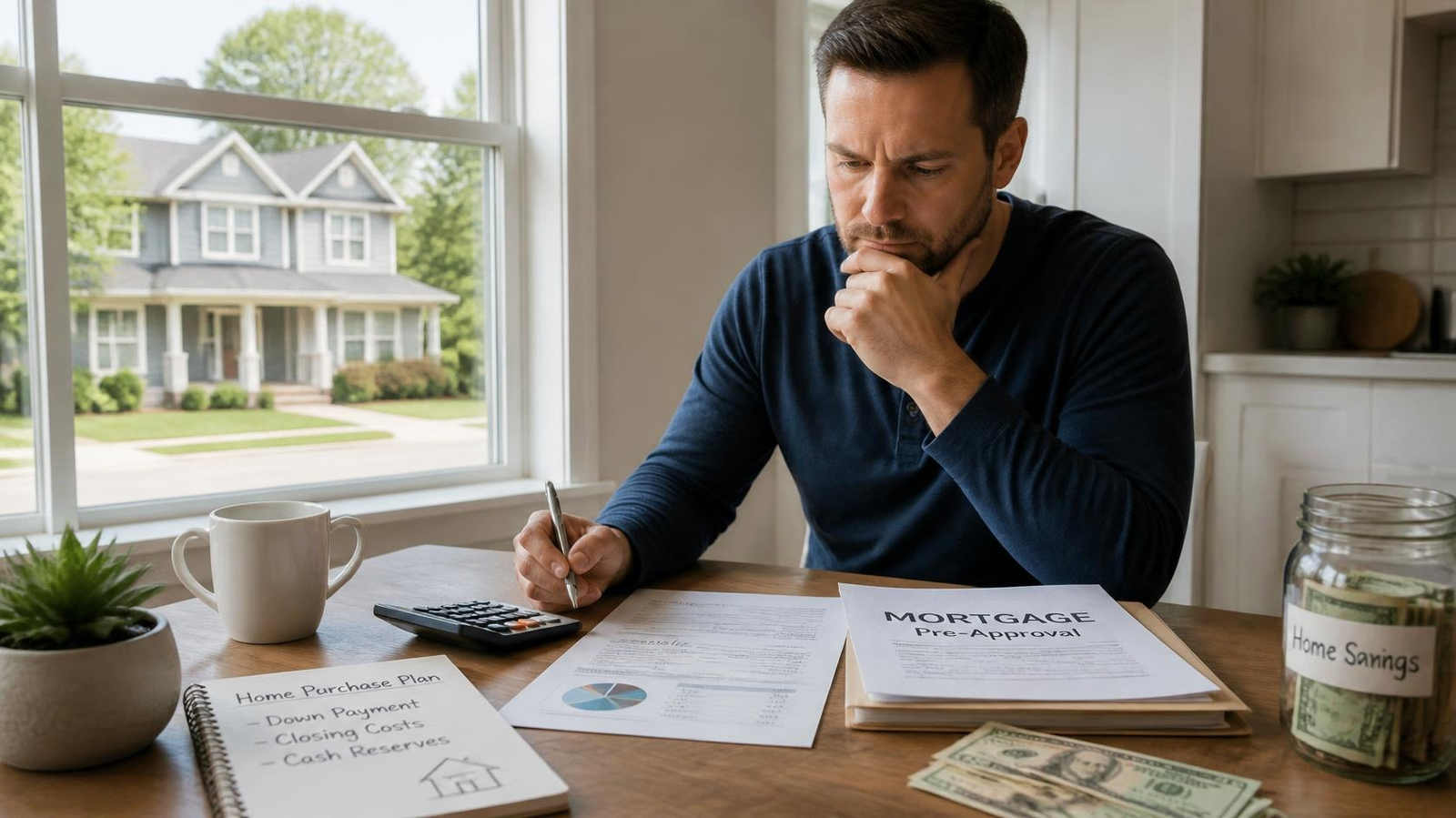
Buying a house requires more cash than just the down payment.
If you’re buying your first home, understanding your upfront costs is just as important as knowing how much house you can afford. Our first-time home buyer guide walks through the broader home-buying process, while this guide focuses specifically on closing costs.
You may need money for the down payment, closing costs, inspections, appraisal, prepaid taxes and insurance, moving expenses, and an emergency fund after you close. That is why someone who has $20,000 saved may technically qualify for a mortgage but still not have enough cash to comfortably complete the purchase.
So, how much cash do you actually need to buy a house?
For many buyers, a realistic starting point is the down payment plus roughly 2% to 5% of the purchase price for closing costs, although the exact amount varies by loan type, lender, location and transaction. Some mortgage programs allow down payments well below 20%, while eligible buyers may qualify for programs requiring little or no down payment.
The key is to calculate your total cash needed, not just the amount required for the down payment.
Quick Answer
If you are buying a $300,000 home with a 5% down payment, you would need $15,000 for the down payment. If closing costs are 2% to 5%, that could add another $6,000 to $15,000. That puts the basic cash requirement around $21,000 to $30,000, before considering moving expenses, repairs and emergency savings.
Editorial note: Homebuying costs vary by location, lender, loan program and individual circumstances. The examples in this guide are estimates intended to help readers understand the types of cash they may need before and after closing. Always review your official Loan Estimate and Closing Disclosure before making a purchase decision.
What Does “Cash Needed to Buy a House” Actually Mean?
When people talk about having enough cash to buy a house, they often mean the amount sitting in their bank account before closing.
But your total cash requirement can include several different expenses.
Generally, you should consider:
- Down payment
- Closing costs
- Earnest money
- Home inspection
- Appraisal
- Prepaid interest
- Homeowners insurance
- Property tax payments
- Initial escrow funding
- Moving expenses
- Immediate repairs or improvements
- Emergency savings
Your cash to close is not necessarily the same thing as your down payment.
The Consumer Financial Protection Bureau recommends reviewing your Loan Estimate and Closing Disclosure carefully so you understand how much you are actually expected to bring to closing.
That distinction is important because a buyer who saves $30,000 and plans to use all of it for a down payment could discover that thousands more are needed for closing and other upfront expenses.
How Much Cash Do You Need to Buy a House?
There is no single amount that works for every buyer.
The amount you need depends primarily on:
- The price of the home
- Your down payment percentage
- Your mortgage program
- Closing costs
- Your location
- Lender fees
- Prepaid taxes and insurance
- How much money you want to keep after closing
Current housing market conditions can also affect how much home you can realistically afford. Our Housing Market Today guide covers current home prices, mortgage rates, inventory, and affordability trends that buyers should consider before purchasing.
For example, consider a $300,000 home.
| Down payment | Down payment amount | 2% closing costs | 5% closing costs | Basic cash range |
|---|---|---|---|---|
| 3% | $9,000 | $6,000 | $15,000 | $15,000-$24,000 |
| 3.5% | $10,500 | $6,000 | $15,000 | $16,500-$25,500 |
| 5% | $15,000 | $6,000 | $15,000 | $21,000-$30,000 |
| 10% | $30,000 | $6,000 | $15,000 | $36,000-$45,000 |
| 20% | $60,000 | $6,000 | $15,000 | $66,000-$75,000 |
These are illustrative calculations, not quotes from a lender.
They also do not include every possible upfront expense or the emergency savings you may want to keep after buying the property.
That last point is important.
The amount a lender allows you to spend is not necessarily the amount you should spend.
Do You Need 20% Down to Buy a House?
No.
A 20% down payment is not a universal requirement for buying a home.
Depending on the mortgage program and your qualifications, you may be able to buy with a significantly smaller down payment.
For example, some conventional mortgage programs allow eligible borrowers to put down as little as 3%. FHA loans can require as little as 3.5% for eligible borrowers.
Eligible veterans and certain other borrowers may also qualify for programs with little or no down payment.
However, putting less money down can have tradeoffs.
A smaller down payment may mean:
- A larger mortgage balance
- Higher monthly payments
- Private mortgage insurance on some conventional loans
- More interest paid over the life of the loan
- Less equity when you initially purchase the home
That does not automatically make a smaller down payment a bad decision.
For some buyers, keeping additional cash available for emergencies is more valuable than putting every available dollar into the house.
How Much Are Closing Costs When Buying a House?
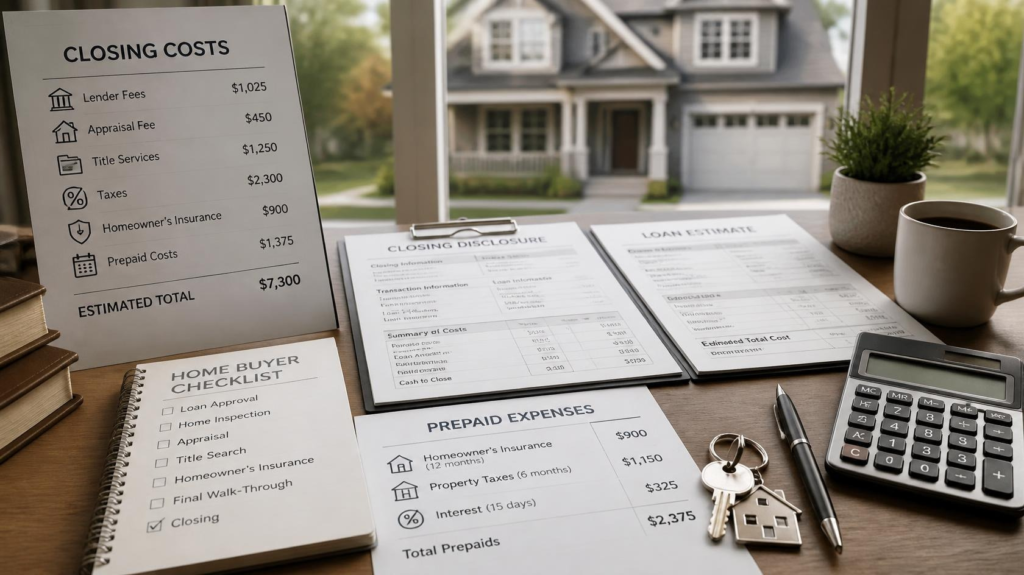
Closing costs are one of the biggest expenses buyers overlook.
The CFPB says closing costs can often be around 2% to 5% of the purchase price, although the actual amount varies.
For a $300,000 home, that would represent approximately:
- 2% = $6,000
- 3% = $9,000
- 4% = $12,000
- 5% = $15,000
Closing costs can include expenses related to the mortgage, property and closing process.
Depending on the transaction, you may encounter:
- Loan origination charges
- Appraisal fees
- Credit report fees
- Title services
- Title insurance
- Government recording fees
- Prepaid interest
- Property taxes
- Homeowners insurance
- Initial escrow deposits
Not every buyer will pay exactly the same fees.
Your lender, location, loan program and purchase contract can all affect the final amount.
What Are Closing Costs When Buying a House?
In simple terms, Closing costs are only one part of the total cost of buying a home, which can also include the down payment, mortgage costs, taxes, insurance and other expenses.
They are separate from your down payment.
For example, suppose you buy a $300,000 home with 5% down.
Your down payment would be:
$300,000 × 5% = $15,000
If your closing costs were 3%:
$300,000 × 3% = $9,000
Your basic cash requirement would therefore be approximately:
$15,000 + $9,000 = $24,000
And you may still want additional money available for moving, repairs and emergencies.
How Much Cash Do I Need for a $200,000 House?
A $200,000 house produces much lower upfront costs than a $500,000 house, but the same principles apply.
| Down payment | Amount |
|---|---|
| 3% | $6,000 |
| 3.5% | $7,000 |
| 5% | $10,000 |
| 10% | $20,000 |
| 20% | $40,000 |
Estimated closing costs at 2% to 5% would be approximately $4,000 to $10,000.
So, with a 5% down payment, the basic combination of down payment and estimated closing costs could be approximately $14,000 to $20,000.
That does not mean you should have exactly that amount and nothing else.
A buyer should also consider cash reserves and other expenses.
How Much Cash Do I Need for a $300,000 House?
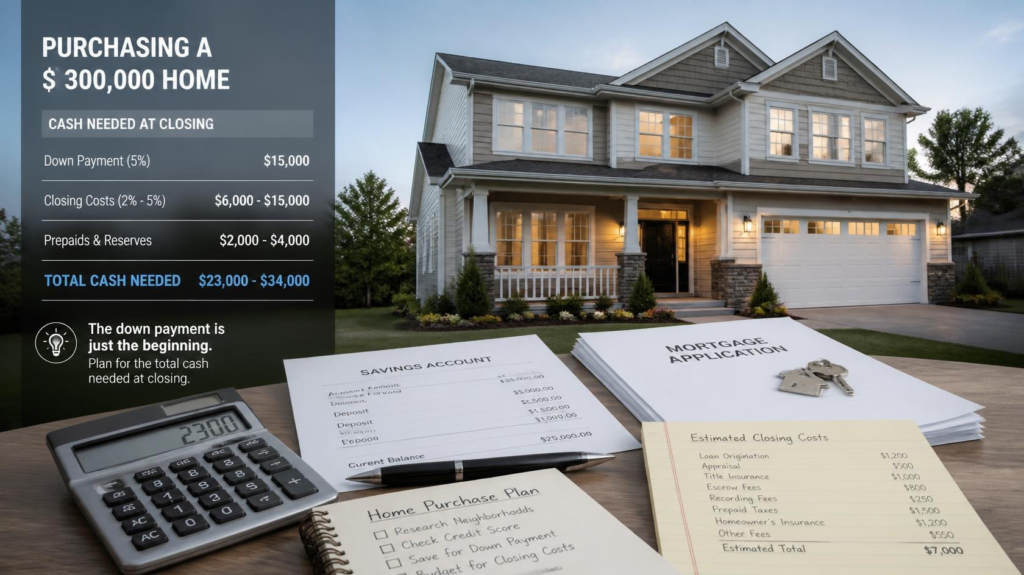
A $300,000 home is a useful example because it shows how quickly closing costs can add to the amount you need.
With a 5% down payment:
Down payment: $15,000
Estimated closing costs:
$6,000 to $15,000
Basic cash requirement:
$21,000 to $30,000
With a 10% down payment:
Down payment: $30,000
Estimated closing costs:
$6,000 to $15,000
Basic cash requirement:
$36,000 to $45,000
With 20% down:
Down payment: $60,000
Estimated closing costs:
$6,000 to $15,000
Basic cash requirement:
$66,000 to $75,000
Again, these numbers do not represent the amount you should necessarily spend from your entire savings account.
How Much Cash Do I Need for a $400,000 House?
For a $400,000 house:
| Down payment | Amount |
|---|---|
| 3% | $12,000 |
| 3.5% | $14,000 |
| 5% | $20,000 |
| 10% | $40,000 |
| 20% | $80,000 |
At 2% to 5%, estimated closing costs would be approximately $8,000 to $20,000.
With a 5% down payment, you could therefore be looking at approximately $28,000 to $40,000 for the down payment and estimated closing costs alone.
How Much Cash Do I Need for a $500,000 House?
For a $500,000 house:
| Down payment | Amount |
|---|---|
| 3% | $15,000 |
| 3.5% | $17,500 |
| 5% | $25,000 |
| 10% | $50,000 |
| 20% | $100,000 |
Estimated closing costs at 2% to 5% would be approximately $10,000 to $25,000.
With 5% down, that produces a basic cash requirement of approximately $35,000 to $50,000, before additional reserves and other expenses.
Is $10,000 Enough to Buy a House?
It can be possible in some situations, but $10,000 is not enough for every home purchase.
Suppose you are buying a $200,000 home with a 3% down payment.
The down payment would be:
$6,000
That leaves $4,000 of your $10,000 savings.
If closing costs were 2%, that would be another:
$4,000
That would use the entire $10,000 before considering moving expenses, inspections, repairs or emergency savings.
So while $10,000 might technically get some buyers into a low-cost purchase with a low-down-payment program and assistance, it can leave very little financial cushion.
Being able to make the purchase and being financially prepared for homeownership are two different things.
Is $20,000 Enough to Buy a House?
$20,000 can potentially be enough for certain lower-priced homes, particularly when a buyer qualifies for a low-down-payment mortgage or assistance program.
For example, on a $200,000 home with 5% down:
Down payment = $10,000
If closing costs were 2%:
Closing costs = $4,000
That leaves approximately $6,000 before other expenses.
But on a $300,000 home with 5% down, the same $20,000 would not necessarily be enough to cover both the down payment and closing costs.
This is why the purchase price matters just as much as your savings balance.
How Much Money Should I Have Left After Buying a House?
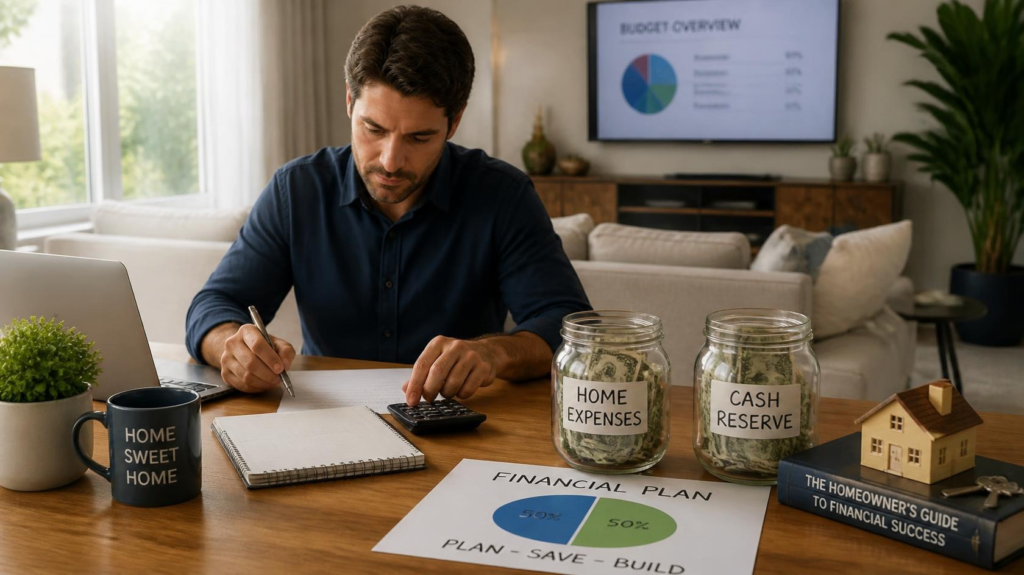
One of the biggest mistakes a buyer can make is putting every available dollar into the purchase.
You may want to maintain an emergency fund after closing.
A common emergency-fund guideline is to keep roughly three to six months of essential expenses in reserve, although the appropriate amount depends on your income, job stability, household situation and expenses.
For example, if your essential monthly expenses are $4,000, three months of expenses would be:
$4,000 × 3 = $12,000
Six months would be:
$4,000 × 6 = $24,000
So someone with $50,000 saved should not automatically assume that the entire $50,000 is available for the down payment.
They may need part of that money to remain available after closing.
What Other Cash Expenses Should Buyers Expect?
The down payment and closing costs are not necessarily the end of the spending.
You may also need money for:
Home inspection
A professional inspection can identify potential problems before you complete the purchase.
Appraisal
Your lender may require an appraisal to evaluate the property’s value.
Moving
Moving costs can range from relatively small DIY expenses to several thousand dollars for professional movers and long-distance relocation.
Immediate repairs
Even a home that looks move-in ready can require unexpected repairs.
Furniture and household items
New homeowners often underestimate how much they may spend after moving in.
Homeowners insurance
Your lender may require homeowners insurance, and the cost can vary substantially by location and property.
Property taxes
Depending on the transaction, you may need to prepay or place money into escrow for property taxes.
This is another reason why having additional cash after closing can be valuable.
How to Calculate How Much Cash You Need to Buy a House
A simple way to estimate your target is to add four major categories:
Down payment + closing costs + upfront expenses + emergency savings
For example:
Imagine you want to purchase a $300,000 house.
You plan to put down 5%.
Down payment: $15,000
You estimate closing costs at 3%.
Closing costs: $9,000
You expect another $3,000 for moving and immediate expenses.
Other upfront expenses: $3,000
You want to keep $15,000 as an emergency fund.
Your target savings would therefore be:
$15,000 + $9,000 + $3,000 + $15,000 = $42,000
The important point is that the mortgage down payment alone does not tell you whether you are financially ready to buy.
Can a Seller Pay the Buyer’s Closing Costs?
Sometimes.
Seller concessions or seller-paid closing costs may be permitted depending on the loan type, transaction and applicable rules.
However, buyers should not assume that a seller will automatically agree to cover their costs.
There can also be limits on how much a seller can contribute under particular mortgage programs.
If you are negotiating seller-paid costs, ask your lender and real estate professional how the concession would affect your transaction.
Can You Reduce the Amount of Cash Needed to Buy a House?
In some cases, yes.
Potential strategies include:
Compare multiple lenders
Different lenders may offer different rates, fees and loan structures.
Look into down-payment assistance
Some state and local programs provide assistance to eligible buyers.
Consider lower-down-payment programs
Depending on your circumstances, you may qualify for a mortgage requiring less than 20% down.
Negotiate seller concessions
In some transactions, the seller may agree to contribute toward allowable closing costs.
Ask about lender credits
Some lenders offer credits toward certain closing costs in exchange for a higher interest rate or other terms.
Consider a less expensive home
A lower purchase price reduces both the down payment and many costs tied to the purchase price.
Should You Put 20% Down?
There is no universal answer.
Putting 20% down can reduce the amount you borrow and may help you avoid private mortgage insurance on certain conventional loans.
But it also requires substantially more cash upfront.
For example, on a $300,000 home:
5% down = $15,000
10% down = $30,000
20% down = $60,000
The difference between 10% and 20% is $30,000.
If putting that additional $30,000 into the house would leave you with almost no emergency savings, a smaller down payment may deserve consideration.
The best choice depends on your finances, mortgage terms, risk tolerance and long-term plans.
What Is the Biggest Mistake Buyers Make With Their Savings?
The biggest mistake is often thinking:
If I have enough money for the down payment, does that mean I can afford the house?
That’s not necessarily true.
Homeownership comes with costs that renters do not directly face, including repairs, maintenance, property taxes, homeowners insurance and potentially higher utility expenses.
A buyer who spends every dollar on the purchase may find themselves financially stretched immediately after moving in.
A better approach is to determine:
How much do I need to close?
Then ask:
How much do I need to comfortably own the home after closing?
Those are two different questions.
Cash Needed to Buy a House: Quick Examples
Here’s a simplified comparison:
| Home price | 5% down | 2%-5% estimated closing costs | Basic cash range |
|---|---|---|---|
| $200,000 | $10,000 | $4,000-$10,000 | $14,000-$20,000 |
| $300,000 | $15,000 | $6,000-$15,000 | $21,000-$30,000 |
| $400,000 | $20,000 | $8,000-$20,000 | $28,000-$40,000 |
| $500,000 | $25,000 | $10,000-$25,000 | $35,000-$50,000 |
These figures are estimates designed to illustrate the relationship between home price, down payment and closing costs.
Your actual cash requirement can be higher or lower.
First-Time Buyers: Don’t Forget Your Cash Reserve
If you’re buying your first home, it’s tempting to focus entirely on getting enough money together for the down payment.
But your first few months of homeownership can bring unexpected expenses.
You may need to pay for:
- Moving
- Basic tools
- Furniture
- Repairs
- Appliances
- Maintenance
- Insurance
- Property taxes
- Utility deposits
- Unexpected emergencies
That’s why preserving a cash reserve can be just as important as increasing your down payment.
If you’re buying your first home, our First-Time Home Buyer Guide can help you understand the broader homebuying process.
A Simple Rule for Deciding Whether You’re Ready
Before making an offer, ask yourself five questions:
1. Do I have enough for the down payment?
2. Have I budgeted for closing costs?
3. Will I have money left after closing?
4. Can I comfortably afford the monthly housing payment?
5. Can I handle an unexpected repair without using high-interest debt?
If the answer to the first question is yes but the other four are no, you may need to save more before buying.
Frequently Asked Questions
How much cash do I actually need to buy a house?
You generally need money for a down payment, closing costs and other upfront expenses. A realistic target should also include an emergency reserve that remains available after closing. The exact amount depends on the home price, loan program, lender and location.
How much cash do I need to buy a $300,000 house?
With a 5% down payment, the down payment would be $15,000. If closing costs were 2% to 5%, they could add approximately $6,000 to $15,000. That produces a basic cash requirement of roughly $21,000 to $30,000 before other expenses and emergency savings.
How much are closing costs when buying a house?
Closing costs often fall around 2% to 5% of the purchase price, although actual costs vary. They can include lender fees, appraisal and title-related costs, government fees, prepaid interest, taxes and insurance.
Do I need 20% down to buy a house?
No. Some mortgage programs allow eligible buyers to purchase with much smaller down payments. The right amount depends on the mortgage program and your financial circumstances.
Is $10,000 enough to buy a house?
It can be possible in certain situations, especially with a lower-priced property, low-down-payment financing or assistance. However, $10,000 may leave little money for closing costs and emergencies, so being technically able to buy does not necessarily mean you are financially prepared.
Is $20,000 enough to buy a house?
It can be enough for some lower-priced homes, depending on the down payment and closing costs. It may not be enough for a higher-priced home once all upfront expenses are included.
How much should I have left after buying a house?
Many financial experts use three to six months of essential expenses as a general emergency-fund guideline. Your personal target can vary depending on income stability, household expenses and other financial obligations.
Who pays closing costs when buying a house?
The buyer typically pays many of the costs associated with their mortgage and purchase, while the seller may pay certain transaction costs. Seller concessions may sometimes be negotiated, subject to the applicable loan and transaction rules.
The Bottom Line
How much cash do you actually need to buy a house?
There isn’t one magic number.
A buyer may be able to qualify for a mortgage with a relatively small down payment, but the real cash requirement is usually larger because you also need to account for closing costs and other upfront expenses.
For a $300,000 home, for example, a buyer putting 5% down could need roughly $21,000 to $30,000 for the down payment and estimated closing costs, before considering moving expenses, repairs and emergency savings.
The better question isn’t simply:
“How much do I need to get the keys?”
It’s:
“How much do I need to buy the house without putting my finances under unnecessary pressure?”
That distinction can make the difference between becoming a homeowner and becoming a homeowner who is immediately stretched too thin.
Before making a final decision, compare your Loan Estimates, review your expected Closing Disclosure, understand your total monthly housing costs and make sure you still have an appropriate emergency reserve after closing.


Leave a Reply