


Editorial Note:
This guide was researched using current information from U.S. government agencies including the Consumer Financial Protection Bureau, HUD, the U.S. Department of Veterans Affairs and USDA Rural Development. Mortgage requirements and assistance programs can change, so readers should verify current terms with their lender or the appropriate government agency.
Buying your first home is exciting, but it can also feel overwhelming. There are mortgages to compare, down payments to save, closing costs to understand, inspections to schedule, and plenty of paperwork to review before you finally get the keys.
The good news is that you do not have to figure everything out at once.
The home-buying process becomes much easier when you break it into clear steps. Before you start touring houses, you need to understand how much you can realistically afford, how much cash you may need upfront, which mortgage options could fit your situation, and what ongoing costs come with owning a home.
This first-time home buyer guide walks you through the process from preparing your finances to closing on your first house. It also explains down payments, closing costs, mortgage affordability, PMI, home inspections, first-time buyer assistance, and the important question of whether buying is actually better than renting for you.
First Time Home Buyer Guide: What You Need to Know

A first time home buyer is generally someone purchasing a home for the first time. However, the exact definition can vary depending on the mortgage or assistance program.
The Consumer Financial Protection Bureau also provides home-buying resources that can help buyers understand the financial steps involved in purchasing a home, including preparing for a mortgage and evaluating the costs of homeownership.
That distinction matters because some programs use their own eligibility rules when determining whether someone qualifies as a first-time buyer.
If you previously owned a home, do not automatically assume that you are excluded from every first time buyer program. Check the specific requirements of the loan or assistance program you are considering.
For someone purchasing a home for the first time, the most important thing is not simply finding a house. It is making sure the purchase fits your finances before you make an offer.
How to Buy a House for the First Time
The first-time home buying process can be broken into 10 major steps:
- Review your finances and credit
- Determine how much house you can afford
- Save for your down payment
- Budget for closing costs and other upfront expenses
- Research mortgage and first-time buyer programs
- Get preapproved for a mortgage
- Find a home and make an offer
- Get a home inspection
- Complete the appraisal and mortgage process
- Review the documents and close on the home
Let’s walk through each step.
1. Check Your Credit and Finances

Before looking at homes, take an honest look at your financial situation.
Mortgage lenders generally review factors such as your income, debts, credit history, assets, and ability to repay the loan. Your credit profile can also affect the mortgage options and interest rate you may receive.
Start by reviewing:
- Your credit reports
- Your credit score
- Monthly income
- Monthly debt payments
- Savings
- Existing loans
- Credit card balances
- Employment history
- Emergency savings
A strong income does not automatically mean you can comfortably afford an expensive house. Your existing debts and other monthly expenses matter too.
The Consumer Financial Protection Bureau recommends considering whether you have reliable income, manageable long-term debt, savings for a down payment, and enough money for other ownership expenses such as taxes, insurance, repairs, closing costs, and moving expenses.
Do not focus only on the mortgage payment.
The real question is:
Can I comfortably afford the entire cost of owning this home?
2. Determine How Much House You Can Afford
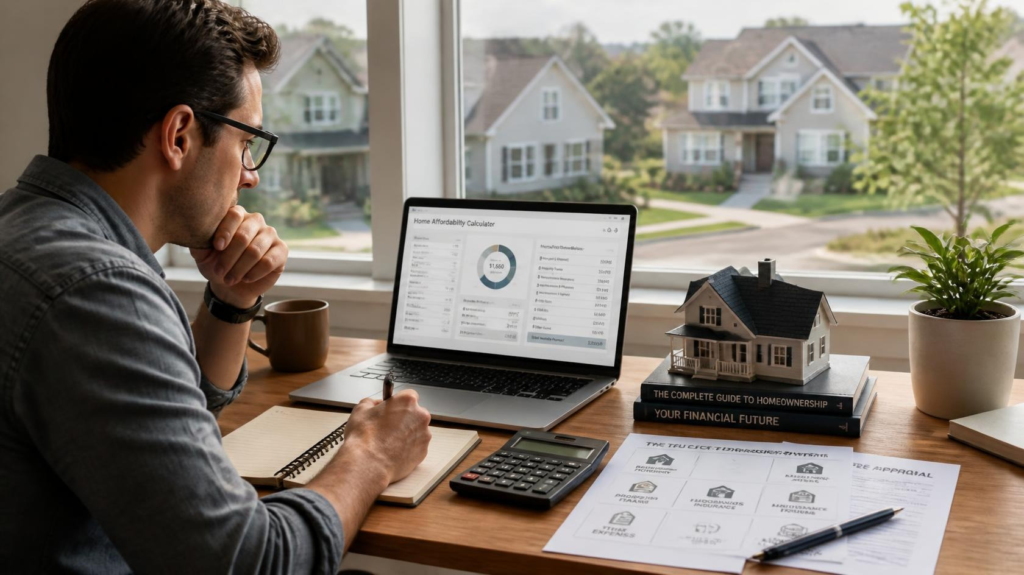
One of the biggest first time home buyer mistakes is confusing the amount a lender is willing to approve with the amount you should actually spend.
They are not necessarily the same thing.
A lender evaluates your finances to determine how much it may be willing to lend. You should also create your own budget based on your lifestyle and financial goals.
Your housing budget may include:
- Mortgage principal
- Mortgage interest
- Property taxes
- Homeowners insurance
- Private mortgage insurance, if applicable
- HOA fees
- Utilities
- Maintenance
- Repairs
This is why the answer to “how much mortgage can I afford?” is different for every buyer.
For example, two people earning the same income may have completely different affordable housing budgets if one has significant student loans, auto payments, credit card debt, or childcare expenses.
Think Beyond the Mortgage Payment
Suppose a mortgage payment appears affordable when you look only at principal and interest.
Then add property taxes, homeowners insurance, HOA dues, maintenance, and other costs.
The monthly housing expense could be substantially higher.
Before making an offer, estimate the complete monthly cost rather than focusing on the mortgage alone.
3. Save for Your Down Payment

Your down payment is the portion of the home’s purchase price you pay upfront rather than financing through the mortgage.
Many buyers assume they need 20% down.
That is not universally true.
The required down payment depends on the mortgage program, lender, borrower qualifications, property, and other factors.
For example, HUD says eligible borrowers may qualify for FHA financing with a down payment as low as 3.5% of the purchase price.
Some buyers may also qualify for other low-down-payment programs.
The important point is that a smaller down payment can make buying a home possible sooner, but it may also increase the amount you borrow and can result in additional mortgage insurance costs depending on the loan.
How Much Down Payment Do You Need for a House?
There is no single down payment amount that applies to every first-time home buyer.
Your options may include:
- A low-down-payment conventional mortgage
- FHA financing
- VA financing for eligible borrowers
- USDA financing for eligible properties and borrowers
- State or local down-payment assistance
- Other specialized programs
The right option depends on your financial situation and eligibility.
Don’t Put Every Dollar Into the Down Payment
This is one of the most important rules for first-time buyers.
If you use all of your savings for the down payment, you could have very little money left after closing.
If you’re unsure how much cash you should keep available, our guide on how much money you should I have in savings can help you think through an appropriate savings cushion.
Homes eventually need repairs.
Appliances break. Plumbing problems happen. Heating and cooling systems need maintenance. Moving also costs money.
Try to keep an emergency fund separate from the money you need to purchase the home.
If you’re still building your savings, see our guide to the best high yield savings accounts for ways to potentially earn more interest while keeping your home-buying funds accessible.
4. Budget for Closing Costs

Your down payment is not the only money you may need when buying a house.
You also need to prepare for closing costs.
Closing costs can include expenses related to the mortgage and the purchase transaction. Depending on the transaction, these can include lender charges, appraisal fees, title-related costs, government taxes, prepaid property taxes, homeowners insurance, and other expenses.
The CFPB explains that buyers generally pay costs associated with the transaction, although the contract and state law can determine whether the seller pays some costs. Seller credits may sometimes help cover certain expenses.
How Much Are Closing Costs on a House?
There is no single dollar amount because closing costs vary based on factors such as:
- Purchase price
- Mortgage type
- Location
- Lender
- Property
- Taxes
- Insurance
- Title services
- Prepaid expenses
This is why you should request and carefully review the lender’s Loan Estimate and later the Closing Disclosure.
The CFPB explains how the Loan Estimate and Closing Disclosure work and what borrowers should review before completing a mortgage transaction.
Do not assume that the money you need at closing equals only your down payment.
Common Closing Costs
Depending on the transaction, you may encounter:
- Loan origination charges
- Appraisal fees
- Title-related fees
- Title insurance
- Recording or government fees
- Prepaid property taxes
- Homeowners insurance
- Prepaid interest
- Escrow deposits
- Other settlement services
Some costs may be negotiable or paid by another party depending on the transaction and applicable rules.
The important thing is to understand exactly what you are being charged for.
5. Explore Mortgage Options and First Time Buyer Assistance

Before choosing a mortgage, compare your options.
Different loan programs have different requirements, costs, insurance rules, and eligibility standards.
Common mortgage options may include:
Conventional Loans
Conventional mortgages are not insured by the federal government and are offered by private lenders.
Some conventional programs allow qualified buyers to purchase a home with a relatively small down payment.
FHA Loans
FHA loans are insured by the Federal Housing Administration.
HUD states that eligible FHA borrowers may have a down payment as low as 3.5%. FHA loans can be particularly useful for some buyers who have limited savings or credit challenges, although borrowers should understand the mortgage insurance and other costs involved.
VA Loans
Eligible veterans, active-duty service members, and certain surviving spouses may qualify for VA-backed home loans.
VA says that nearly 90% of VA-backed loans are made without a down payment, although eligibility and lender requirements still apply.
VA-backed purchase loans can also have an important advantage because they generally do not require private mortgage insurance.
USDA Loans
Some buyers in eligible rural areas may qualify for USDA-backed financing that can provide a path to homeownership with little or no down payment, subject to program and borrower requirements.
Down-Payment Assistance
Some state and local housing agencies offer programs that can help eligible buyers with down payments or closing costs.
Eligibility can depend on factors such as:
- Income
- Location
- Purchase price
- Occupancy
- Credit
- First-time buyer status
- Program availability
Never assume that a program is available simply because you saw it advertised online. Verify the current requirements through the appropriate government or housing agency.
6. Get Preapproved for a Mortgage

Once you understand your finances and potential loan options, consider getting preapproved.
A mortgage preapproval can give you a clearer idea of how much you may be able to borrow and can make your offer more credible to a seller.
During the process, the lender may request documents such as:
- Pay stubs
- Bank statements
- Tax documents
- Employment information
- Identification
- Information about existing debts
Preapproval does not mean you should spend the maximum amount the lender offers.
Instead, use it as one piece of information when setting your personal home-buying budget.
Compare More Than One Mortgage Offer
Do not automatically accept the first mortgage offer you receive.
Compare factors such as:
- Interest rate
- Annual percentage rate
- Loan term
- Monthly payment
- Mortgage insurance
- Origination charges
- Other lender fees
- Cash required at closing
A mortgage with a lower advertised interest rate is not automatically the cheapest option if it comes with substantially higher upfront costs.
7. Find a Home and Make an Offer
Once you have your financing strategy and budget, you can begin shopping.
Think about what you actually need rather than only what looks attractive in a listing.
Consider:
- Location
- Commute
- Property taxes
- Insurance costs
- School considerations
- Neighborhood
- Home size
- Number of bedrooms
- Condition of the property
- Expected maintenance
- HOA fees
- Future resale considerations
Don’t Forget the Neighborhood Costs
A house that looks affordable on paper may become less attractive when you add property taxes, insurance, HOA fees, commuting costs, and expected maintenance.
Your home should fit your life, not just your mortgage approval.
When you find a suitable property, your agent can help you understand the offer process, including price, contingencies, closing timeline, and other terms.
8. Get a Home Inspection
A home inspection is one of the most important steps for a first-time buyer.
An inspection can identify potential problems that may not be obvious during a normal showing.
A buyer’s inspection may examine areas such as:
- Roof
- Foundation
- Electrical systems
- Plumbing
- Heating and cooling
- Windows
- Doors
- Attic
- Basement or crawl space
- Structural components
- Major appliances, depending on the inspection
Home Inspection Checklist for Buyers
Before or during the inspection, pay particular attention to:
Structure
Look for signs of foundation movement, water intrusion, structural damage, or major deterioration.
Roof
Ask about the age and condition of the roof and whether repairs or replacement may be approaching.
Plumbing
Check for leaks, water pressure problems, drainage issues, and signs of water damage.
Electrical
Look for outdated or potentially unsafe electrical components.
Heating and Cooling
Ask about the age and condition of major HVAC equipment.
Water Damage
Look carefully for stains, mold-like growth, musty odors, or evidence of previous leaks.
Exterior
Check siding, drainage, grading, windows, doors, decks, and other exterior components.
An inspection is not a guarantee that a home has no problems. It is a tool that helps you understand the property’s condition before you complete the purchase.
9. Complete the Appraisal and Mortgage Process
After your offer is accepted, there is still work to do.
The lender will continue processing your mortgage.
You may need to provide additional financial documents, answer underwriting questions, and complete other requirements.
The property may also need an appraisal.
An appraisal is different from an inspection.
Inspection vs. Appraisal
Inspection: Primarily evaluates the condition of the property.
Appraisal: Provides an opinion of the property’s value for lending purposes.
Both can matter during the purchase process, but they serve different purposes.
During this period, avoid making major financial changes without discussing them with your lender.
For example, taking on a large new loan, opening multiple credit accounts, or making unusual financial moves could complicate the mortgage process.
10. Review Everything and Close on Your Home
Closing is the final stage of the home-buying process.
This is when you sign the documents that finalize the mortgage and transfer ownership according to the transaction.
The CFPB recommends reviewing your closing documents carefully and completing a final walk-through before signing.
Before closing, make sure you understand:
- Purchase price
- Loan amount
- Interest rate
- Monthly payment
- Closing costs
- Prepaid expenses
- Escrow amounts
- Cash required to close
- Other fees
Review Your Closing Disclosure
The Closing Disclosure contains important details about your mortgage and closing costs.
Compare it with the earlier Loan Estimate and ask questions if something does not match what you expected.
Do not rush through the paperwork simply because you are excited to get the keys.
A home purchase is one of the largest financial transactions most people will ever make.
How Much Money Do You Need to Buy a House?
The amount of money you need depends on the home’s price, mortgage program, down payment, closing costs, and your personal financial situation.
You may need money for:
- Down payment
- Closing costs
- Home inspection
- Appraisal
- Earnest money, depending on the transaction
- Moving
- Homeowners insurance
- Initial repairs
- Furniture
- Emergency savings
For example, someone buying a $300,000 home with a 5% down payment would need $15,000 for the down payment alone.
That does not mean $15,000 is the total amount they should have available.
Closing costs and other expenses can add to the amount of cash needed.
This is why planning only around the down payment can leave first-time buyers financially stretched.
What Is PMI and When Do You Pay It?
Private mortgage insurance, commonly called PMI, can apply to certain conventional mortgages when the borrower makes a smaller down payment.
PMI protects the lender rather than the borrower.
The amount and rules depend on the mortgage and lender.
The important takeaway is that a smaller down payment can affect more than the amount you bring to closing. It can also affect your monthly payment and total borrowing costs.
Some loan programs have different mortgage insurance structures.
For example, VA-backed purchase loans generally do not require private mortgage insurance.
If you are comparing mortgages, ask the lender to show you the total monthly payment and total costs rather than focusing only on the interest rate.
Can You Buy a House With No Down Payment?
Yes, some buyers may be able to purchase a home without a traditional down payment, but eligibility is limited to specific programs and circumstances.
VA-backed loans are one major example for eligible borrowers. VA states that its purchase loans can allow eligible borrowers to buy a home without a down payment when the applicable requirements are met.
Some USDA-backed programs can also provide zero-down financing for eligible borrowers and properties.
However, “no down payment” does not necessarily mean “no money required.”
You may still have costs such as:
- Closing costs
- Inspection
- Appraisal
- Prepaid taxes
- Insurance
- Moving expenses
- Reserves
- Other transaction expenses
Always look at the total cash needed to complete the purchase.
What Does It Really Cost to Own a Home?
The mortgage payment is only one part of homeownership.
Your total monthly and annual costs may include:
Mortgage
This generally includes principal and interest.
Property Taxes
Property taxes vary significantly by location and property.
Homeowners Insurance
Insurance protects against covered risks and is commonly required by mortgage lenders.
PMI or Other Mortgage Insurance
Depending on your loan, mortgage insurance may increase your monthly cost.
HOA Fees
Some communities charge homeowners association dues.
Maintenance
Every home needs ongoing maintenance.
Repairs
Major repairs can be expensive, particularly when systems such as the roof, HVAC, plumbing, or electrical equipment need attention.
Utilities
Electricity, gas, water, trash, internet, and other services can add significantly to the monthly cost.
This is why a buyer should calculate the total cost of owning a home, not just the advertised mortgage payment.
What Are the Hidden Costs of Home Ownership?
Some homeownership costs are easy to overlook.
Examples include:
- Lawn care
- Pest control
- Appliance replacement
- Roof maintenance
- HVAC maintenance
- Plumbing repairs
- Landscaping
- Higher utility bills
- Home insurance increases
- Property tax increases
- HOA special assessments
- Moving expenses
- Furniture and household equipment
You will not necessarily pay all of these costs every month.
That is precisely why an emergency fund matters.
A home can have a low monthly maintenance cost for a period and then suddenly require a large repair.
First Time Home Buyer Assistance and Programs
If you are struggling to save for a down payment, do not assume that homeownership is automatically out of reach.
Research assistance programs available through:
- State housing agencies
- Local housing authorities
- HUD-approved housing counseling organizations
- Government-backed mortgage programs
- Local first-time buyer programs
HUD notes that state and local governments may offer programs that help eligible buyers with down payments.
However, program rules change.
Before relying on a particular program, verify:
- Current income limits
- Property requirements
- Minimum credit requirements
- Occupancy requirements
- First-time buyer definition
- Funding availability
- Required buyer contribution
- Repayment rules
Is It Better to Rent or Buy?
Buying a home is not automatically better than renting.
The right choice depends on your finances, goals, location, and how long you expect to stay.
Buying May Make Sense If:
- You have stable income
- You have enough savings
- You can comfortably afford the total housing cost
- You expect to stay in the home for several years
- You want to build home equity
- You are comfortable handling maintenance
- You value long-term housing stability
Renting May Make More Sense If:
- Your job or location may change soon
- You have limited savings
- Buying would leave you with little emergency cash
- Home prices in your area are far beyond your budget
- You are not ready for maintenance responsibilities
- You expect to move within a short period
A rent-vs-buy decision should consider more than the monthly rent compared with the mortgage payment.
Compare:
- Upfront costs
- Monthly housing costs
- Maintenance
- Insurance
- Property taxes
- HOA fees
- Expected length of stay
- Opportunity cost of your down payment
- Potential home appreciation
- Selling costs
Rent vs. Buy Comparison
| Factor | Renting | Buying |
|---|---|---|
| Upfront costs | Usually lower | Down payment and closing costs |
| Monthly housing costs | Rent and utilities | Mortgage, taxes, insurance and other costs |
| Maintenance | Usually handled by landlord | Homeowner responsibility |
| Flexibility | Generally higher | Generally lower |
| Equity | Does not build home equity | Can build equity over time |
| Selling costs | None | Selling can involve significant costs |
| Long-term commitment | Generally lower | Generally higher |
| Property value risk | Generally none directly | Home value can rise or fall |
Neither option is automatically better. The better choice depends on your financial situation, how long you expect to stay, and whether you can comfortably handle the full cost of homeownership.
Is Buying a House Worth It for a First Time Buyer?
Buying can be worthwhile, but it is not automatically the best financial decision for everyone.
Homeownership can provide stability and the opportunity to build equity over time. The CFPB also notes that homeowners can benefit from protection against rising housing costs and eventually own the property after paying off the mortgage.
But ownership also comes with responsibility.
You are responsible for repairs, maintenance, taxes, insurance, and potentially HOA dues.
The strongest first-time home purchase is one that you can comfortably afford rather than one that pushes your budget to the limit.
First Time Home Buyer Checklist
Use this checklist before buying your first house:
- Review your credit
- Check your income and debt
- Determine your personal housing budget
- Build an emergency fund
- Save for the down payment
- Estimate closing costs
- Research mortgage options
- Compare lenders
- Explore first-time buyer assistance
- Get mortgage preapproval
- Decide where you want to live
- Research property taxes and insurance
- Start viewing homes
- Make an offer
- Schedule a home inspection
- Review inspection results
- Complete the appraisal
- Respond to lender requests
- Review the Loan Estimate
- Review the Closing Disclosure
- Complete a final walk-through
- Sign the closing documents
- Receive the keys
Common First Time Home Buyer Mistakes
1. Spending the Maximum a Lender Approves
A lender’s maximum approval is not necessarily your ideal budget.
Leave room for savings, emergencies, travel, family expenses, and unexpected repairs.
2. Saving Only for the Down Payment
Closing costs and other expenses can require additional cash.
3. Using All Your Savings
You should not enter homeownership with no financial cushion if you can avoid it.
4. Skipping the Home Inspection
An inspection can reveal problems that are difficult to see during a showing.
5. Ignoring Property Taxes
Property taxes can have a major effect on your monthly housing costs.
6. Forgetting Maintenance
Homeowners are responsible for maintaining the property.
7. Comparing Only Interest Rates
A mortgage’s interest rate is important, but so are fees, mortgage insurance, closing costs, and other loan terms.
8. Making Major Financial Changes Before Closing
Avoid unnecessary new debt or major financial changes while your mortgage is being finalized unless you have discussed them with your lender.
9. Making an Emotional Offer
It is easy to fall in love with a house and stretch your budget.
Remember your long-term financial plan.
10. Rushing the Closing
Read your documents carefully and ask questions before signing.
Frequently Asked Questions About First Time Home Buying
How much money should a first time home buyer have saved?
There is no universal savings target. You should plan for the down payment, closing costs, inspection, appraisal and moving expenses while maintaining an emergency fund for unexpected costs.
What is the minimum down payment for a house?
The minimum depends on the mortgage program and borrower qualifications. FHA financing can allow eligible borrowers to put down as little as 3.5%, while some other programs may require less or no down payment for eligible borrowers.
Can you buy a house with no down payment?
Yes, some eligible buyers can use programs that allow no down payment. VA-backed loans are one example. USDA financing may also offer zero-down options for eligible buyers and properties. Requirements apply.
How much are closing costs on a house?
Closing costs vary by transaction. They can include lender charges, appraisal, title services, taxes, insurance, prepaid expenses, and other fees. Review your Loan Estimate and Closing Disclosure to understand your specific costs.
How much mortgage can I afford based on my income?
Your affordable mortgage depends on income, debts, credit, interest rate, down payment, property taxes, insurance, and other expenses. The amount a lender approves is not necessarily the amount you should spend.
What credit score do you need to buy a house?
There is no single credit score that applies to every mortgage. Different loan programs and lenders have different requirements. Your credit profile can also affect the loan terms available to you.
What is PMI?
PMI stands for private mortgage insurance. It can apply to certain conventional mortgages with smaller down payments and protects the lender against losses if the borrower defaults.
What should I check during a home inspection?
Pay attention to the property’s structure, roof, plumbing, electrical systems, HVAC, drainage, water damage, windows, doors, and other major components. A qualified inspector can provide a more detailed assessment.
Is buying a house worth it?
Buying can be worthwhile if you have stable finances, sufficient savings, and expect to stay in the property long enough for the benefits of ownership to make sense. Renting may be better if buying would stretch your budget or you need flexibility.
Is it better to rent or buy?
Neither option is automatically better. Compare the total cost of buying with the total cost of renting while considering your finances, expected length of stay, maintenance responsibilities, and long-term goals.
Final Thoughts
Buying your first home is a major financial decision, but it does not have to be confusing.
Start with your finances rather than the listings.
Understand how much you can comfortably afford. Save for more than just the down payment. Compare mortgage options. Research first-time home buyer assistance. Understand closing costs. Get a thorough inspection. And review your loan and closing documents carefully before signing.
Most importantly, remember that the goal is not simply to qualify for a mortgage.
The goal is to buy a home you can afford to keep.
A successful first-time home purchase should leave you with a place to live and a financial plan you can continue to manage after the excitement of closing is over.
Sources and Further Reading
For current mortgage and home-buying guidance, buyers should verify program requirements and costs with authoritative sources before making a financial decision.
- Consumer Financial Protection Bureau: home-buying and mortgage resources
- U.S. Department of Housing and Urban Development: FHA loan information
- U.S. Department of Veterans Affairs: VA home loan information
- USDA Rural Development: home loan programs
Disclaimer: This article is for general educational and informational purposes only and is not financial, mortgage, legal, tax, or real estate advice. Mortgage requirements, interest rates, program eligibility, fees, taxes, and assistance programs can change. Always verify current requirements and costs with the appropriate lender, government agency, housing counselor, or qualified professional before making a home-buying decision.


Leave a Reply